
 By Adrian Pascual•Hiring insight•Published
Common Mistakes Interviewing Candidates: 2026 HR Guide
Interviewing mistakes are defined as systematic errors in how hiring managers design, conduct, or evaluate candidate conversations, and they directly reduce the quality of hiring decisions. The most common mistakes interviewing candidates involve unstructured formats, biased snap judgments, and poor candidate engagement. Unstructured interviews predict job performance with only 14% accuracy, and 69.5% of interviewers form their opinion within the first five minutes. That means most hiring decisions are made before a candidate has finished their opening answer. This guide identifies the specific pitfalls that cost organizations top talent, and shows you how to fix them.
1. What are the most common mistakes in interview structure and question design?
Poor interview structure is the single biggest driver of bad hiring decisions. When interviewers skip pre-defined questions or rely on casual conversation, they collect inconsistent data that cannot be fairly compared across candidates.
The most common structural errors include:
- Unstructured formats. Without a fixed question set, interviewers drift toward topics they find comfortable rather than topics that predict performance.
- Too few questions. Fewer than six questions in a 45-minute interview fails to gather sufficient behavioral evidence. Six questions in 45 minutes leaves roughly seven minutes per answer, which is barely enough to surface one real example per competency.
- Yes/no questions. Closed questions shut down candidate responses before any meaningful information is shared.
- Stacking multiple questions at once. Asking "Tell me about a time you led a project, and what was the outcome, and how did your team respond?" forces candidates to choose which part to answer, and they usually pick the easiest one.
The fix is a pre-defined question bank paired with an evaluation rubric. Every interviewer asks the same questions in the same order, and scores responses against the same criteria. This approach removes the guesswork from comparison and gives you a defensible record of why one candidate advanced over another.
Pro Tip: Build your question bank around the STAR method (Situation, Task, Action, Result) so every behavioral question has a natural structure that candidates can follow and interviewers can score consistently.

2. How does interviewer behavior affect candidate evaluation?
Interviewer behavior shapes both the quality of information collected and the candidate's perception of your organization. These two outcomes are connected. A candidate who feels dismissed or confused will give shorter, less revealing answers.
The most damaging behavioral errors are:
- Dominating the conversation. Interviewers who talk more than 30% of the time reduce candidate participation and lose critical signal. The interview becomes a monologue, not an evaluation.
- Arriving unprepared. Skipping resume review before the interview signals disrespect and wastes the first ten minutes on information already on the page.
- Ignoring nonverbal cues. Candidates communicate hesitation, confidence, and discomfort through body language. Interviewers focused on their notes miss these signals entirely.
- Gut-feel decisions. Affinity bias causes interviewers to favor candidates who share their communication style or background, prioritizing likability over competence.
"Affinity bias is particularly dangerous because it feels like good judgment. The interviewer walks away thinking 'we just clicked,' when what actually happened is that they hired a mirror image of themselves instead of the best person for the role."
Replacing informal small talk with structured rapport-building questions reduces unconscious bias tied to initial personal similarities. A simple question like "What drew you to this type of work?" gives you useful data while still warming up the conversation.
3. What are common interview panel mistakes and how do they affect outcomes?
Panel interviews introduce a specific set of errors that solo interviews do not. The format creates group dynamics that can distort both candidate performance and interviewer judgment.
The most frequent common interview panel mistakes include:
- Ignoring quiet observers. Silent panel members often hold the most influence on the final hiring decision. Candidates who fail to engage them lose critical buy-in from the person who may cast the deciding vote.
- Directing all answers to one panelist. Candidates naturally gravitate toward the most senior or most talkative person in the room. This leaves other panelists feeling excluded and reduces their investment in the outcome.
- Poor eye contact management. Failing to distribute eye contact across all panelists signals low awareness and weak communication skills, regardless of how strong the verbal answer is.
- Conflicting questions from panelists. When panelists have not coordinated beforehand, they ask overlapping or contradictory questions. Candidates end up confused, and the interview produces redundant data.
| Panel mistake | Impact on hiring | Fix |
|---|---|---|
| Ignoring quiet observers | Loss of decision-maker buy-in | Engage all panelists by name |
| Answering to one person only | Uneven evaluation data | Distribute eye contact deliberately |
| Uncoordinated questions | Redundant or conflicting data | Pre-assign question topics per panelist |
| No personalized follow-up | Weak candidate impression | Send tailored thank-you notes to each panelist |
Pro Tip: Before a panel interview, assign each panelist a specific competency to probe. This prevents overlap, fills coverage gaps, and gives you a richer, more complete candidate profile.
4. How does candidate experience affect your employer brand?
Candidate experience is not a soft metric. 68% of candidates share their poor interview experience with others, which means a single disorganized process can damage your employer brand at scale. That reputation loss affects future applicant quality, not just the current hire.
The logistics errors that cause the most damage are:
- Disorganized scheduling. Double-bookings, last-minute reschedules, and missing calendar invites signal that your organization does not respect candidates' time.
- Slow or absent feedback. Delays of even three days in post-interview feedback cause strong candidates to withdraw or accept competing offers.
- Ghosting. Failing to notify rejected candidates is the fastest way to generate negative reviews on public employer rating platforms.
- One-sided evaluation. Treating the interview as purely a screening exercise misses the fact that top candidates are evaluating you simultaneously. The interview is also a sales conversation.
Hiring under pressure compounds every one of these errors. Rushed evaluations prioritize speed over fit, which produces hires that look good on a timeline but fail within the first year. Building a realistic feedback SLA into your process, such as 48 hours for a post-interview status update, protects both your pipeline and your reputation.
5. What best practices help hiring managers avoid these errors?
The most effective way to eliminate interviewing pitfalls is moving to structured interviews with standardized questions and evaluation rubrics. Structured interviewing raises predictive accuracy from 14% to approximately 26%, which is nearly double the performance of unstructured formats. That gap represents real hiring outcomes: fewer bad hires, lower turnover, and stronger team performance.
The core practices that produce this improvement are:
Standardized behavioral and situational questions. Behavioral questions ask candidates to describe past actions ("Tell me about a time you managed a conflict"). Situational questions ask how they would handle a hypothetical scenario. Both formats generate evidence that can be scored. You can review structured interview formats to find the right approach for your team's specific roles.
Interviewer training focused on listening. Interviewers who talk less collect more. Training should include active listening techniques, probing follow-up questions, and explicit instruction to resist forming opinions before the interview ends.
Scorecards completed immediately after each interview. Memory degrades fast. Interviewers who wait until the end of the day to score candidates conflate responses and introduce recency bias. Completing a scorecard within 15 minutes of the interview preserves accuracy.
AI-assisted data capture. Tools that analyze interview data to improve decisions help hiring teams spot patterns across large candidate pools that individual interviewers would miss. They also create an audit trail that supports fair hiring practices.
Pro Tip: Use an interview preparation checklist before every session. Reviewing the job requirements, the candidate's resume, and the question bank takes 15 minutes and eliminates the most common preparation failures.
Key Takeaways
Structured, evidence-based interviewing is the single most effective way to reduce hiring errors, improve predictive accuracy, and protect your employer brand from the damage caused by poor candidate experiences.
| Point | Details |
|---|---|
| Structure predicts performance | Structured interviews nearly double predictive accuracy compared to unstructured formats. |
| Fewer questions, worse data | Asking fewer than six questions in 45 minutes leaves critical competencies unevaluated. |
| Candidate experience is public | 68% of candidates share poor interview experiences, directly harming employer brand. |
| Panel dynamics need management | Quiet panelists often decide outcomes; failing to engage them costs you their buy-in. |
| Speed kills quality | Rushed hiring under pressure prioritizes timelines over fit, increasing early turnover. |
What I've learned from watching good interviewers make avoidable mistakes
The most frustrating thing about interviewing errors is that they are almost never caused by bad intentions. The hiring managers I have seen make the biggest mistakes are often the most experienced ones. They trust their instincts because their instincts have worked before. The problem is that instinct is just pattern recognition, and pattern recognition in hiring is another name for bias.
I have watched senior leaders spend 40 minutes talking about the company and then give a candidate a thumbs-up based on "good energy." I have seen panel interviews where three people asked the same competency question because nobody coordinated beforehand. I have seen strong candidates ghost employers after a week of silence, not because they lost interest, but because the employer never followed up.
The shift that actually changes outcomes is not a new tool or a new framework. It is leadership deciding that interviewing is a skill that requires practice, feedback, and accountability, not just good intentions. When organizations treat reducing interviewer subjectivity as a measurable goal, the process improves. When they treat it as common sense that everyone already has, the same mistakes repeat every quarter.
AI-assisted interviewing is changing what is possible here. Real-time analytics, attention pattern analysis, and transcript review give hiring teams data they never had before. But the technology only works if the underlying process is sound. Fix the structure first. Then let the data make it better.
— Hudson
How Evy helps hiring teams run better interviews
Interviewing errors cost organizations time, money, and top candidates. Evy is built to address the root causes directly.
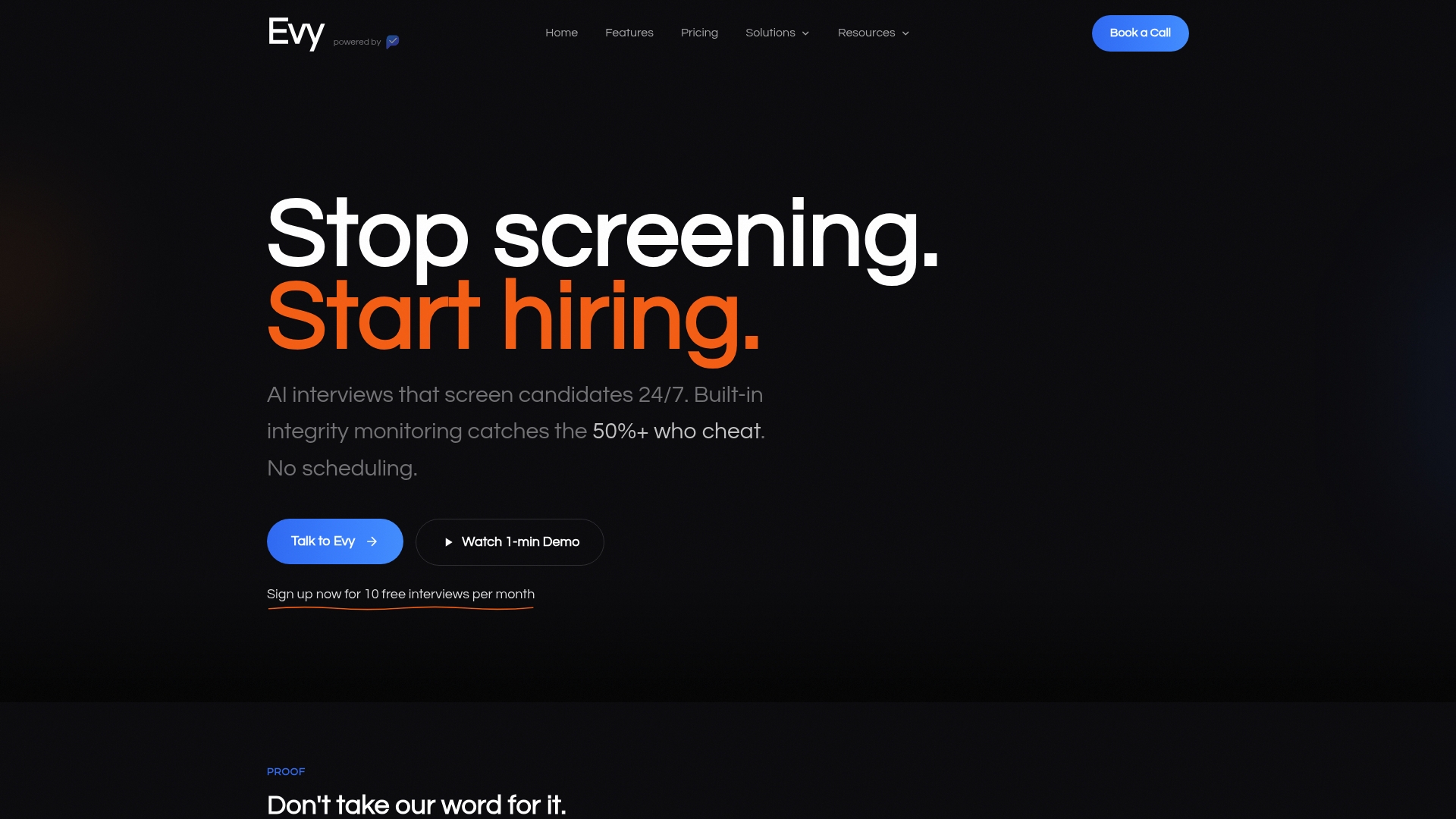
Evy is the only AI interview platform with real-time eye tracking to detect when candidates use AI assistance during screening. Beyond integrity, Evy standardizes the interview process at scale, running structured candidate assessments 24/7 without interviewer scheduling constraints. Every session generates consistent, comparable data that hiring managers can use to make evidence-based decisions. For teams that want to screen more candidates without sacrificing quality or fairness, Evy's AI interview features replace the guesswork with a process that holds up under scrutiny. The result is a hiring pipeline built on honest, qualified talent rather than first impressions.
FAQ
What makes an interview unstructured?
An unstructured interview lacks pre-defined questions, a fixed order, and a scoring rubric. Without these elements, interviewers collect inconsistent data that cannot be fairly compared across candidates.
How many questions should a 45-minute interview include?
A 45-minute interview should include at least six behavioral or situational questions. Fewer than six fails to gather enough evidence to evaluate key competencies reliably.
What is affinity bias in interviewing?
Affinity bias occurs when an interviewer favors a candidate who shares their communication style, background, or personality. It causes hiring decisions based on likability rather than demonstrated competence.
How do panel interview mistakes differ from solo interview mistakes?
Panel interviews add group dynamics that solo formats do not have. The most common panel error is ignoring quiet observers, who often hold the most influence over the final hiring decision.
How quickly should hiring managers give post-interview feedback?
Feedback delays of even three days increase the risk of losing strong candidates to competing offers. A 48-hour status update SLA protects your pipeline and signals respect for candidates' time.