
 By Adrian Pascual•Hiring insight•Published
Examples of Bad Interview Questions HR Must Avoid
Bad interview questions are defined as those that are unstructured, legally non-compliant, or poor predictors of job performance, and they directly undermine the quality of every hiring decision your organization makes. The industry term for this problem is "interview question validity," and it sits at the intersection of employment law, cognitive bias research, and structured interviewing methodology. Poor interview questions expose organizations to EEOC complaints, introduce unconscious bias, and produce candidate assessments that correlate weakly with actual job performance. Understanding which questions fall into this category, and why, is the first step toward building a hiring process that is both legally defensible and genuinely predictive.
1. Examples of bad interview questions that create legal exposure
Legally problematic questions are the most urgent category of poor interview questions because they carry direct liability under federal law. The Civil Rights Act, the Americans with Disabilities Act, and the Age Discrimination in Employment Act collectively prohibit employers from making hiring decisions based on protected characteristics. Questions that reveal those characteristics, even indirectly, create legal exposure regardless of intent.
Common examples of inappropriate questions in this category include:
- "Are you married, or do you have children?" (marital status and family status)
- "What country are you originally from?" or "Where did you grow up?" (national origin)
- "Do you have any disabilities or health conditions?" (disability status under the ADA)
- "What religion do you practice?" or "Do you observe any religious holidays?" (religion)
- "Have you ever been arrested?" (arrest record, which correlates with race under disparate impact doctrine)
- "How old are you?" or "When did you graduate high school?" (age)
The risk is not limited to direct questions. Casual rapport-building questions often cross legal boundaries and can undermine employer brand when non-compliant questions occur routinely. A question like "So, do you have a long commute?" sounds harmless but can reveal a candidate's neighborhood, which correlates with protected characteristics. Compliance guidelines explicitly caution against asking about marital status, children, arrest records, and native language in any interview context.
Pro Tip: Train every interviewer to redirect candidate-initiated disclosures of protected information. If a candidate volunteers that they are pregnant or have a disability, the interviewer should acknowledge it briefly and return to job-relevant questions. Documenting this redirection protects the organization.

2. Unstructured open-ended questions that reduce predictive accuracy
Unstructured questions are the most widespread category of bad questions to ask in interviews, and they persist largely because they feel natural and conversational. Questions like "Tell me about yourself," "What's your biggest weakness?" and "Where do you see yourself in five years?" dominate interview rooms despite producing data that is nearly useless for predicting job performance.
The research is direct: structured interviews predict job performance with a validity coefficient of r=0.51, compared to r=0.38 for unstructured interviews. That gap represents a 34% drop in predictive accuracy. For a hiring team making dozens of decisions per quarter, that loss compounds into measurably worse workforce quality over time.
"Unstructured open-ended questions not only predict poorly but invite bias and legal risk, challenging common HR assumptions that such questions are harmless icebreakers." — The Human Capital Hub
The deeper problem is what researchers call the dilution effect. When candidates respond to "Tell me about yourself," they typically share personal history, hobbies, and life context. That information is irrelevant to job competence, yet it shapes the interviewer's overall impression. Unstructured questions increase bias and fail to predict job performance while giving interviewers a false sense of confidence in their assessments. The interviewer walks away feeling they "know" the candidate, when in fact they have gathered mostly noise.
3. Why brainteaser questions are among the worst interview questions
Brainteaser questions represent a specific and well-documented category of interview question mistakes. Questions like "How many tennis balls fit in a Boeing 747?" or "How would you move Mount Fuji?" were popularized by technology companies in the early 2000s as proxies for analytical thinking. The premise was that watching someone reason through an impossible problem reveals cognitive ability. The data says otherwise.
Brainteasers do not measure relevant skills and reduce interview reliability by generating noise rather than signal. The score a candidate receives depends heavily on whether they have encountered that specific puzzle before, not on their actual reasoning ability. This makes brainteasers a measure of cultural exposure, not job-relevant competence.
Google abandoned brainteaser questions after internal data showed they had no predictive value and actively annoyed candidates. Google's People Operations team found that performance on brainteasers correlated with nothing measurable in subsequent job performance. This finding from one of the world's most data-driven hiring organizations is the clearest available evidence that these questions belong in the discard pile.
Confirmation bias compounds the problem. Interviewers who use brainteasers tend to rate candidates who answer in ways that mirror their own thinking style more favorably, regardless of the answer's actual quality. This is similarity bias operating under the cover of a "logic test."
Pro Tip: Replace brainteasers with structured behavioral questions tied to specific competencies. "Describe a time you had to solve a problem with incomplete information" tests the same cognitive flexibility without the noise, legal ambiguity, or candidate frustration.
4. Comparison of bad interview question types, risks, and alternatives
Understanding the categories of unprofessional interview queries side by side makes it easier to audit your current question bank systematically.
| Question type | Example | Primary risk | Better alternative |
|---|---|---|---|
| Legally prohibited | "Do you have children?" | EEOC complaint, ADA/Civil Rights Act violation | "Are you able to meet the travel requirements of this role?" |
| Unstructured open-ended | "Tell me about yourself." | Low predictive validity (r=0.38), dilution bias | "Walk me through a project where you had to manage competing deadlines." |
| Brainteaser | "How many gas stations are in the U.S.?" | Near-zero predictive validity, candidate alienation | "Describe a time you had to estimate an outcome with limited data." |
| Hypothetical without context | "What would you do if a coworker disagreed with you?" | Measures social desirability, not actual behavior | "Tell me about a specific conflict with a coworker and how you resolved it." |
| Similarity-seeking | "What do you do for fun on weekends?" | Similarity bias, potential protected characteristic disclosure | "What professional development have you pursued in the past year?" |
Behavioral and situational questions consistently outperform every category in this table on both predictive validity and legal defensibility. Job knowledge questions, which test specific technical competencies, add further accuracy when combined with structured scoring rubrics. The types of interview questions for technical roles that perform best are those anchored to observable, job-relevant behaviors rather than personality impressions.
5. How bias amplifies the damage from red flags in interview questions
The harm from bad interview questions is not just about individual questions in isolation. It is about how those questions interact with cognitive bias to systematically distort hiring outcomes. Unstructured interviews produce more than double the bias effect sizes compared to structured interviews, with bias effect sizes of d=0.59 versus d=0.23. That difference reflects discrimination based on physical appearance, social similarity, and demographic characteristics that have no bearing on job performance.
Similarity bias is particularly insidious in unstructured formats. When an interviewer asks "What do you like to do outside of work?" and discovers a shared interest in a sport or hobby, that shared interest inflates the candidate's perceived competence. The interviewer is not consciously biased. The question structure itself creates the conditions for bias to operate. Traditional interview formats make candidate comparison hard precisely because inconsistent questions produce incomparable data.
Affinity bias, halo effect, and recency bias all operate more powerfully when questions are unstructured. A candidate who answers an early question brilliantly benefits from the halo effect across all subsequent answers. A candidate interviewed late in the day suffers from interviewer fatigue. Structured questions with standardized scoring rubrics reduce these effects by anchoring evaluations to specific, observable behaviors rather than general impressions.
6. Practical steps to eliminate poor interview questions from your process
Fixing a broken interview process requires more than swapping out individual questions. It requires structural changes to how interviews are designed, conducted, and scored.
The most direct fix is adopting a standardized question set of 8 to 12 well-designed items. Research shows effectiveness plateaus around 8 to 12 standardized questions for best predictive validity. More questions do not produce better data. They produce fatigue, inconsistency, and more opportunities for bias to enter the process.
Key structural changes that eliminate the worst interview question mistakes:
- Build a question bank reviewed by HR compliance and legal before any interview cycle begins.
- Assign each question a specific competency it measures, and score responses on a defined rubric before the interview starts.
- Train interviewers to recognize and redirect candidate-initiated disclosures of protected information.
- Conduct regular audits of interview notes and scoring sheets to identify patterns that suggest bias.
- Use AI candidate screening tools to support consistent question delivery and scoring, particularly in high-volume hiring.
Interview integrity for HR teams depends on treating the question bank as a controlled instrument, not a casual conversation guide. Every question should have a documented purpose, a scoring standard, and a compliance review on record.
Pro Tip: Pilot your question bank with a small group of current employees before deploying it in live interviews. Ask them to answer the questions and rate their relevance to the actual job. This surfaces questions that feel valid but measure nothing job-related.
Key takeaways
Bad interview questions reduce hiring quality, increase legal exposure, and introduce bias that structured question design directly prevents.
| Point | Details |
|---|---|
| Legal risk is immediate | Questions touching age, disability, religion, or national origin violate federal law regardless of intent. |
| Unstructured questions predict poorly | Validity drops from r=0.51 to r=0.38 when interviews lack structure, a 34% accuracy loss. |
| Brainteasers add noise, not signal | Google's internal data confirmed zero predictive value; behavioral questions are the evidence-based replacement. |
| Bias doubles in unstructured formats | Bias effect sizes are d=0.59 for unstructured vs d=0.23 for structured interviews. |
| 8 to 12 questions is the optimal range | More questions do not improve accuracy; they increase fatigue and inconsistency. |
What I've learned from watching bad questions persist despite the evidence
I have spent years reviewing hiring processes across organizations that genuinely want to hire well. The most consistent finding is not that hiring managers are careless. It is that bad interview questions survive because they feel productive. "Tell me about yourself" feels like a warm opening. "How many piano tuners are in Chicago?" feels like a test of sharp thinking. The feeling is wrong in both cases, but it is convincing enough to override the research.
The legal risk argument tends to land harder than the validity argument in most organizations. When I explain that a casual question about weekend plans could surface a protected characteristic and form the basis of an EEOC complaint, that gets attention. When I explain that the same question has a near-zero correlation with job performance, that gets a nod and then gets forgotten by the next interview cycle.
The harder truth is that most interview training focuses on how to ask questions, not which questions to ask. Interviewers learn active listening, rapport building, and follow-up techniques. They rarely learn that the question they just asked has a validity coefficient of 0.12 and doubles their exposure to similarity bias. That gap between training content and research findings is where bad questions live.
My honest recommendation: treat your question bank the way you treat a compliance document. Review it on a defined schedule, assign ownership, and require sign-off from both HR and legal before any question enters a live interview. That single process change eliminates more bad questions than any amount of interviewer coaching.
— Hudson
How Evy helps you build interviews that actually work
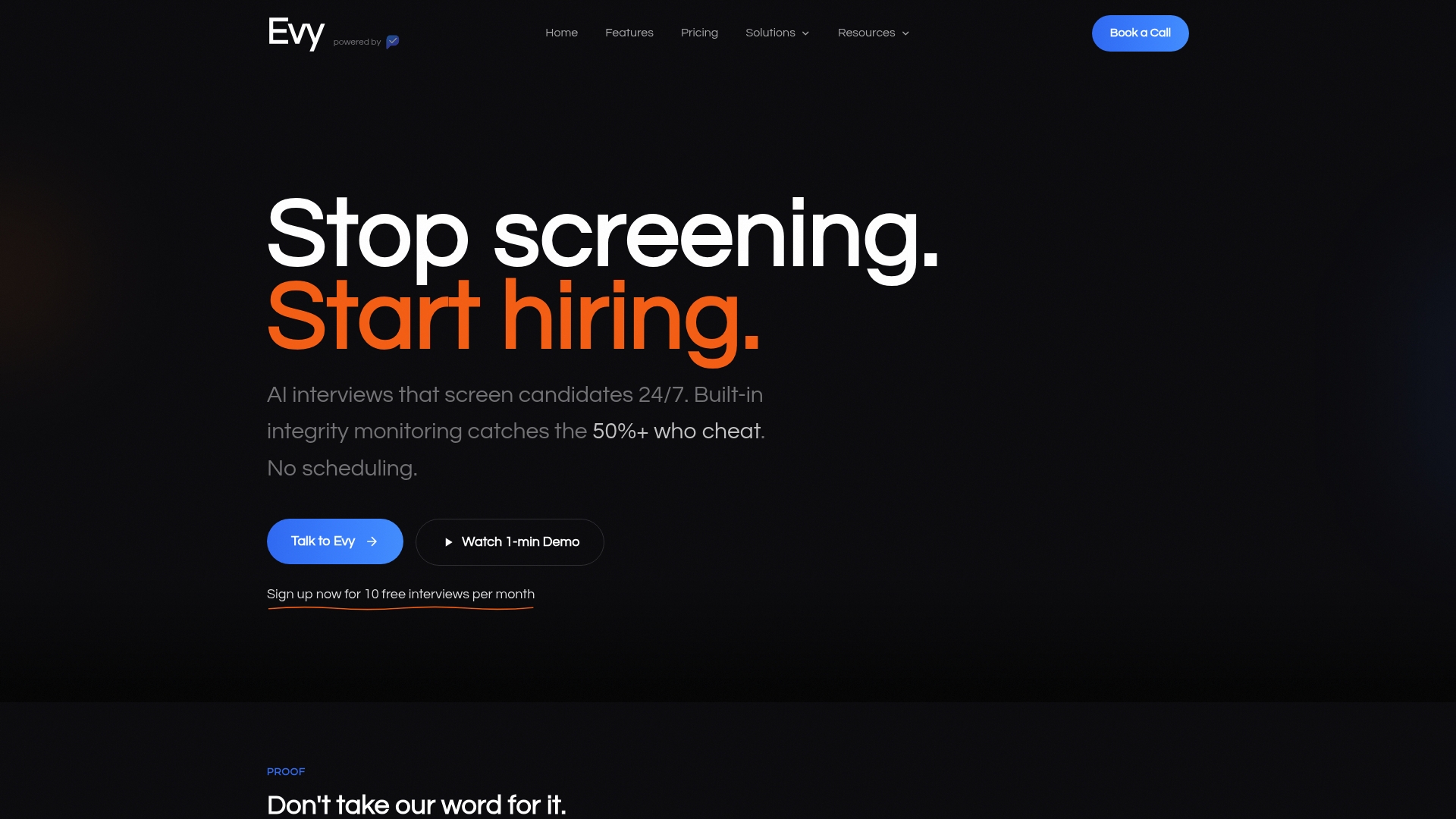
Evy is the only AI interview platform with real-time eye tracking designed to catch candidates using AI assistance during interviews. Beyond anti-cheat detection, Evy supports structured, legally defensible interviews by delivering consistent questions to every candidate and scoring responses against standardized rubrics. This removes the inconsistency that makes unstructured interviews so damaging. HR teams using Evy can screen at scale, 24/7, without the bias and legal exposure that come with ad hoc question formats. Explore Evy's interview platform features to see how structured question delivery and integrity monitoring work together to surface honest, qualified talent.
FAQ
What makes an interview question legally problematic?
A question is legally problematic when it reveals or invites disclosure of a protected characteristic under the Civil Rights Act, ADA, or Age Discrimination in Employment Act. Protected characteristics include age, religion, disability, national origin, marital status, and pregnancy.
Why are brainteaser questions considered bad interview questions?
Brainteasers have near-zero predictive validity for job performance and primarily measure whether a candidate has encountered that specific puzzle before. Google discontinued them after internal data confirmed they predicted nothing about on-the-job success.
How many questions should a structured interview include?
Research shows predictive validity plateaus at 8 to 12 well-designed, standardized questions. Adding more questions beyond that range increases interviewer fatigue and inconsistency without improving hiring accuracy.
What is the difference between structured and unstructured interview questions?
Structured interviews use the same predetermined questions for every candidate and score responses against defined rubrics, achieving a validity coefficient of r=0.51. Unstructured interviews vary by candidate and produce a validity coefficient of r=0.38, a 34% drop in predictive accuracy.
Can casual rapport-building questions create legal risk?
Yes. Questions that seem conversational, such as asking about a candidate's hometown or weekend activities, can inadvertently reveal protected characteristics and create legal exposure. Compliance guidelines recommend keeping all questions directly tied to job-relevant competencies.