
 By Adrian Pascual•Hiring insight•Published
How Interview Data Improves Hiring Decisions in 2026
Most HR teams believe that collecting more interview data automatically leads to better hiring decisions. It doesn't. Understanding how interview data improves hiring decisions requires more than volume. It requires structure, analysis, and a clear link between what you observe during interviews and what you measure after someone is hired. This article walks through why unstructured interview data fails, how structured evaluation methods like scorecards and rubrics change the equation, and what it takes to build a data-driven hiring process that actually predicts candidate success.
Table of Contents
- Key takeaways
- How interview data improves hiring decisions, and where it falls short
- Scorecards, rubrics, and the case for structured data
- Predictive analytics and what your data can forecast
- Practical strategies for collecting and using interview data
- Common challenges and how to address them
- My take on why most organizations get this wrong
- How Evy supports structured, data-driven interview scoring
- FAQ
Key takeaways
| Point | Details |
|---|---|
| Structure drives accuracy | Unstructured interview notes are unreliable; scorecards and rubrics make data comparable and predictive. |
| Evidence backing is non-negotiable | Every numeric score needs behavioral evidence, or the scorecard becomes just another subjective form. |
| Predictive models require history | At least two years of linked interview and outcome data are needed before predictive analytics become reliable. |
| Bias risk is real and specific | AI hiring tools can produce correlated rejections by race, especially when organizations rely on a single algorithmic vendor. |
| Post-hire validation closes the loop | Linking scorecard ratings to job performance data over time is what turns interview data into a genuine hiring asset. |
How interview data improves hiring decisions, and where it falls short
The concept at the center of this article is structured hiring analytics. That is the recognized industry term for the practice of capturing, coding, and analyzing interview data within defined frameworks to support objective candidate evaluation. The related phrase "data-driven hiring decisions" is widely used, but it means nothing without that structure underneath it.
Understanding the impact of interview data starts with an honest look at what happens when that data lacks structure. Most interviewers walk into a room, ask questions that feel right in the moment, and leave with impressions rather than evidence. Those impressions get discussed in a debrief where the loudest voice or the strongest advocate typically wins. The result is a decision that feels data-informed but is actually driven by social dynamics and cognitive shortcuts.
Research on unstructured interview validity tells a clear story: structured interviews correlate with job performance at r=0.42, while unstructured interviews sit near r=0.20. That gap is not minor. It represents the difference between a method that predicts success and one that approximates a coin flip.
The problems with unstructured data are specific and compounding:
- Subjective impressions vary significantly between interviewers, even when they interview the same candidate for the same role.
- Without standardized criteria, scores are not comparable across panels or time periods.
- Post-hoc rationalization in debriefs leads interviewers to construct coherent narratives around gut-feel decisions rather than evidence.
- Hiring managers struggle to defend decisions legally or operationally when scores are not anchored to observable behaviors.
"Disagreement in debriefs can actually be valuable, but only if it reflects genuine differences in the evidence each interviewer observed, not differences in how they felt about a candidate." — Scorecards vs Rubrics
The issue is not that interviewers are careless. It is that the process gives them no reliable instrument to work with. That is what structure solves.
Scorecards, rubrics, and the case for structured data
A scorecard is a standardized form that assigns numerical ratings to defined competencies evaluated during an interview. A rubric describes what each rating level looks like in observable behavioral terms. Together, they transform a subjective conversation into evidence-backed ratings that can be compared, aggregated, and analyzed.

The mechanics work because behavioral anchors reduce interpretation variance. When a rubric says that a "3 out of 5" on conflict resolution means "the candidate described a specific instance where they de-escalated a peer disagreement and documented the resolution," every interviewer is measuring the same thing. Without that anchor, a 3 from one interviewer might mean something completely different from a 3 scored by another.
Scoring variance between interviewers drops by up to 40% when rubric-supported structured interviews replace conversational assessments. That matters not just for fairness, but for your ability to use the data downstream in reporting, analytics, or legal reviews.
Pro Tip: Run calibration exercises before rolling out new scorecards. Have two or three interviewers independently score the same recorded mock interview, then compare results. Where scores diverge significantly, your rubric anchor language needs to be more specific.
The research on outcomes is direct. Structured hiring methods improve quality of hire by 26% compared to unstructured approaches. That improvement comes primarily from reducing post-hoc rationalization and forcing interviewers to commit to evidence before the debrief conversation begins.
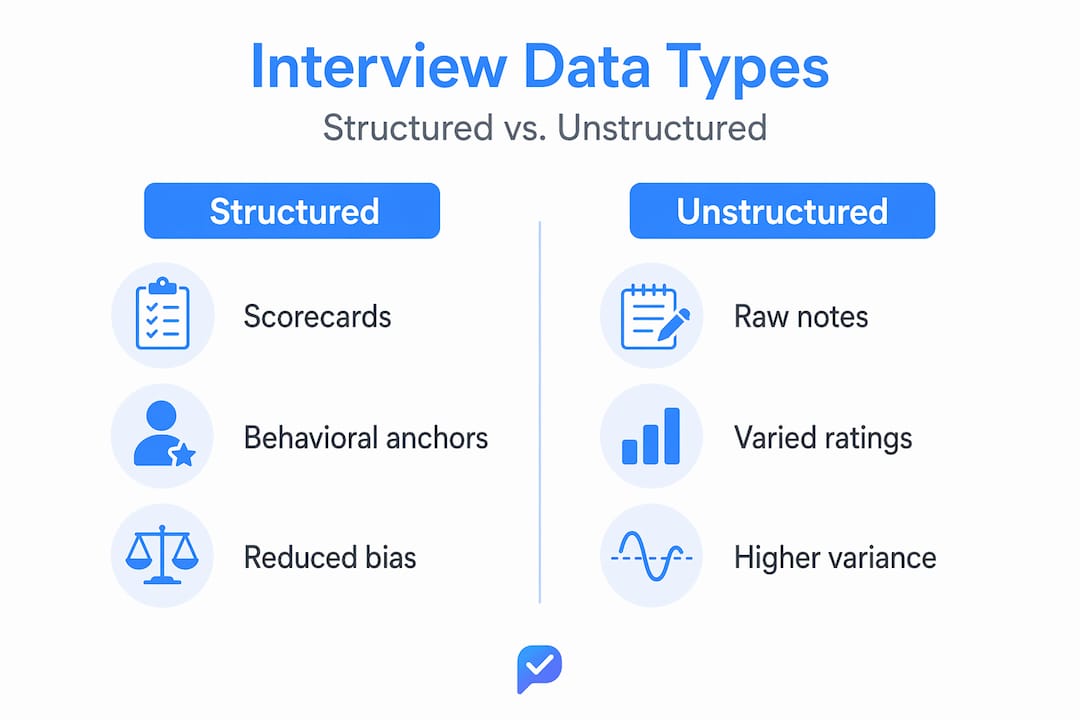
Here is how structured and unstructured interview data compare across the dimensions that matter most to hiring teams:
| Dimension | Structured interview data | Unstructured interview data |
|---|---|---|
| Comparability across candidates | High — scores use defined criteria | Low — impressions are not standardized |
| Inter-rater reliability | Significantly improved with rubrics | Varies widely between interviewers |
| Legal defensibility | Strong — decisions are evidence-based | Weak — hard to justify specific outcomes |
| Predictive validity | r=0.42 with job performance | r=0.20, close to chance |
| Usefulness for analytics | High — structured data feeds models | Low — qualitative notes resist analysis |
Every numeric score must be backed by behavioral evidence. Without that evidence note, the scorecard becomes a subjective form with a number attached to it, which is only marginally better than the problem it was meant to solve.
Predictive analytics and what your data can forecast
Once you have structured interview data linked to hiring outcomes, you move from describing what happened to predicting what will happen. That is the transition from descriptive to predictive analytics in hiring, and it is where the real return on data infrastructure begins.
The three analytical stages work like this:
- Descriptive analytics answers "what happened?" by summarizing past interview scores, offer acceptance rates, and panel agreement levels.
- Diagnostic analytics answers "why did it happen?" by identifying which interviewers score outliers, which competencies correlated with early attrition, and where process gaps exist.
- Predictive analytics answers "what will happen?" by applying models trained on historical patterns to forecast candidate quality, retention likelihood, and offer acceptance probability.
To use data to make hiring decisions at the predictive level, you need at least two years of structured interview scores linked to post-hire performance data. Most organizations are not there yet, and that is fine. The point is to start building that linkage now.
Retention analytics built on sufficient linked data can reach 95% flight risk accuracy, as demonstrated by IBM's Watson-based retention model, which saved the company an estimated $300 million annually.
That kind of accuracy is not achievable with raw notes or gut-feel assessments. It requires clean, consistent scorecard data tied to outcomes like 90-day performance ratings, time-to-productivity, and 12-month retention. Without that linkage between systems, most organizations cannot even begin to build reliable predictive models, because the interview data and the outcome data live in separate tools with no connection.
Bias is a real concern at this layer. Stanford HAI research found that AI hiring tools from certain vendors produce correlated racial rejections, where applicants who apply to multiple roles get rejected across the board when a single algorithmic tool is involved. Using interview analytics for forecasting requires ongoing audits of model outputs for disparate impact, not just at deployment but continuously.
Practical strategies for collecting and using interview data
Building interview data infrastructure is a project, not a setting. Here is how to approach it in a way that produces reliable, usable data over time.
Design scorecards around role competencies, not generic traits. A scorecard for a sales role should assess negotiation, pipeline ownership, and stakeholder communication, not "culture fit" or "enthusiasm." Generic traits introduce subjectivity and undermine comparability. Competency-aligned questions tied to specific behavioral anchors are what make a scorecard actually work.
Enforce evidence notes for every score. Interviewers should not be able to submit a scorecard without typing the specific candidate statement or behavior that informed each rating. This rule is uncomfortable at first and then becomes second nature. It also dramatically improves the quality of debrief conversations because everyone arrives with evidence rather than impressions.
Conduct calibration sessions before high-volume hiring cycles. Calibration is not a one-time event. Interviewer rating patterns drift over time, and new team members develop their own interpretations of anchor language. A quarterly 30-minute calibration session using scored mock responses keeps your data consistent enough to trust.
Use scorecard data to structure panel debriefs. Instead of asking "what did everyone think?", start debriefs by sharing individual scores and the evidence behind any significant disagreements. Score divergence is signal, not noise. Calibrating around disagreements is how you improve your process over time.
Best practices for maintaining data quality across hiring cycles:
- Audit interviewer score distributions quarterly to detect leniency, severity, or central tendency bias in ratings.
- Tag each scorecard with the interviewer ID so that variance analysis is possible at the individual level.
- Connect your ATS scorecard exports to your HRIS performance data, even manually at first, to begin building outcome linkage.
- Review inter-rater reliability statistics like intraclass correlation periodically to confirm your panel scores are stable enough to act on.
Pro Tip: After every quarterly performance review cycle, pull the scorecard ratings for recent hires and compare them to their performance scores. You will quickly see which competency ratings actually predicted success and which ones were noise. Adjust your rubrics accordingly.
Common challenges and how to address them
Using interview insights for recruitment at scale introduces problems that do not appear when you are hiring one person at a time. Being aware of them in advance changes how you set up your process.
The most significant risk is algorithmic monoculture. When an entire organization screens candidates through a single AI vendor's model, correlated errors become systemic errors. One biased model affects every candidate across every role. Mitigation requires using multiple assessment signals and auditing output patterns by demographic group.
Interviewer rating drift is underappreciated. Raters who scored consistently in January may interpret anchor language differently by September, particularly if the team grew and new interviewers modeled their scoring on existing ones. Rating variance in panels signals rubric interpretation drift, and the fix is targeted calibration, not adding more interview rounds.
Data overload without structure is a real trap. Some teams build elaborate scorecards with 15 competencies and wonder why adoption fails. When a form takes 40 minutes to complete, interviewers skip fields or average scores to finish quickly. Limit scorecards to five to seven core competencies per interview stage and cover different competencies at different stages rather than everything at once.
Candidate experience matters in data-driven processes too. Highly structured interviews can feel cold or rigid if interviewers are too focused on the form. The goal is a conversation with structure underneath it, not a questionnaire disguised as a conversation. Interviewers should be trained to maintain natural dialog while capturing the evidence they need.
Finally, transparency with candidates about how their data is used builds trust. As analytics become more sophisticated, candidates increasingly want to know what signals were evaluated and how decisions were made.
My take on why most organizations get this wrong
I have watched organizations spend months building elaborate interview scorecards and then file them in a shared drive where nobody looks at them after the hire. The data exists. The analysis never happens. That is the most common version of "data-driven hiring" in practice, and it is not data-driven at all.
The uncomfortable truth is that collecting interview data without linking it to outcomes is mostly theater. You feel rigorous. You have spreadsheets. But if you cannot tell me whether a "4 out of 5" on problem-solving from your Q3 hiring cohort correlates with six-month performance ratings, you do not actually know if your scorecard is measuring anything real.
What I have seen work is treating calibration as a standing agenda item, not a one-time training event. Teams that run quarterly calibrations and tie scorecard data to performance reviews, even with imperfect ATS integrations, consistently make better hiring decisions over time. The discipline builds on itself.
I am also wary of the push to hand over hiring recommendations entirely to algorithmic tools. The Stanford HAI findings on correlated rejections are a serious warning. AI can surface patterns that humans miss, but it can also amplify historical biases at a scale that takes years to detect. The right posture is to treat AI recommendations as one input in a structured process, not a verdict.
Invest in the infrastructure. It pays back in better hires, lower attrition, and decisions you can actually defend.
— Hudson
How Evy supports structured, data-driven interview scoring
If you are building the kind of structured interview process described in this article, the quality of your data depends heavily on the integrity of your interviews. That is where Evy fits in.
Evy is the only AI interview platform with real-time eye tracking to detect when candidates are using AI assistance during screening. That matters for your data because scorecard scores based on AI-assisted responses are not measuring candidate capability. They are measuring the output of a language model. Evy keeps your structured interview data clean by surfacing honest performance from the start. The platform supports high-volume, 24/7 asynchronous screening with built-in scoring support, so your team collects consistent, trustworthy data at scale without adding interviewer hours. For HR teams committed to improving hire quality through better data, that foundation is where it begins.
FAQ
What is structured hiring analytics?
Structured hiring analytics is the practice of capturing interview scores within defined frameworks, like scorecards and rubrics, and then analyzing those scores alongside post-hire outcomes to evaluate and improve hiring decisions over time.
How does structured interview data improve predictive validity?
Structured interviews correlate with job performance at r=0.42, compared to r=0.20 for unstructured interviews. That difference reflects the reduction in measurement error when behavioral anchors guide scoring.
How much data do you need before predictive hiring models work?
Predictive hiring models require at least two years of structured interview scores linked to outcome data for the forecasts to be reliable. Without that linkage, models are training on incomplete signals.
Can interview analytics introduce bias?
Yes. AI hiring tools have been shown to produce correlated rejections by race when a single algorithmic vendor is used across many applications. Regular audits for disparate impact and reliance on multiple assessment signals are necessary safeguards.
What is the first step to improving how we use interview data?
Start by adding behavioral evidence requirements to your existing scorecards. Requiring interviewers to document the specific candidate behavior behind each rating is the single highest-leverage change most teams can make immediately.