
 By Adrian Pascual•Hiring insight•Published
Why Candidates Cheat Video Interviews: HR Guide
Candidate dishonesty in video interviews, formally called interview fraud, is now a measurable hiring crisis. One in three hiring managers has caught a candidate cheating, using tactics that range from AI-assisted answering to full proxy interviews. The scale reflects a structural shift. Affordable AI tools, social normalization of AI assistance, and outdated interview formats have created conditions where cheating feels accessible, low-risk, and even justified. Understanding why candidates cheat video interviews is the first step toward building a hiring process that surfaces genuinely qualified people.
Why candidates cheat video interviews: the core drivers
The most direct reason candidates cheat is access. AI tools that coach candidates in real time cost as little as $20–$50 per month. That price point puts covert assistance within reach of almost any job seeker, regardless of income level. When the barrier to cheating is lower than a monthly streaming subscription, the behavior spreads fast.

Social normalization compounds the access problem. Cheating tools are marketed on social media not as fraud aids but as career empowerment products. Candidates see peers posting about landing roles with AI help, and the ethical line blurs. AI-assisted cheating is often rationalized as a productivity tool comparable to spell-check or a calculator. That framing makes it easier for candidates to dismiss the ethical weight of what they are doing.
Competitive pressure adds another layer. Hiring cycles have grown longer, application volumes have surged, and candidates face rejection rates that feel arbitrary. Many job seekers genuinely believe the interview process is broken or biased. Cheating, in their view, levels a playing field that was never fair to begin with. That perception does not excuse the behavior, but it does explain why it persists across skill levels and industries.
Pro Tip: Ask candidates directly during the interview whether they used any AI tools to prepare. The question itself signals that your process is aware and watching, which deters casual cheaters before they start.
Common cheating methods candidates use in video interviews
Video interview dishonesty has grown technically sophisticated. Hiring managers who understand the specific mechanics are far better positioned to spot it. The most common cheating tactics fall into four categories.
Invisible AI overlays. These overlays operate below the screen-sharing capture layer, rendering AI-generated answers visible only to the candidate. Screen-sharing software captures the rendered display layer that the interviewer sees, not the overlay sitting beneath it. A candidate can read a full AI-generated answer while their screen appears clean to you.
Secondary devices. Candidates angle a phone or tablet just outside the webcam frame, running an AI model that listens to the interview audio and generates answers. The device stays off-camera but within easy reading distance. This tactic requires no software exploits and is nearly invisible without a wide-angle environment check.
Tab switching and multi-browser sessions. Candidates run AI chat tools in a separate browser tab or window, switching rapidly between the interview and the AI response. Response timing gives this away. The candidate pauses, looks slightly off-center, then delivers a polished answer that does not match their earlier conversational register.
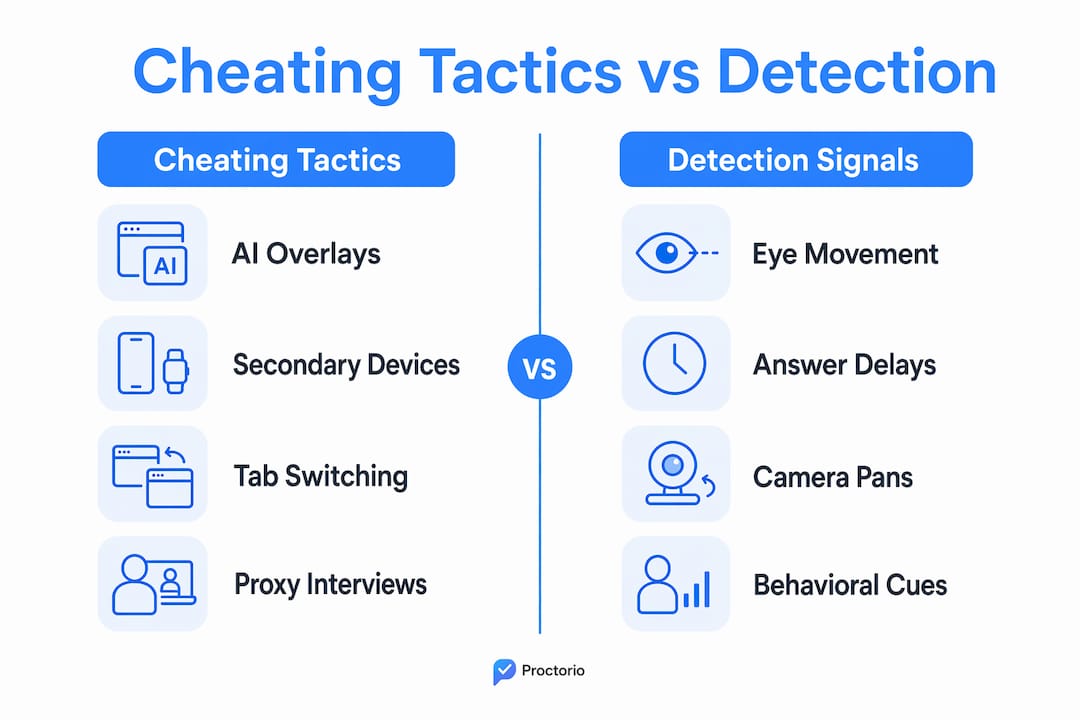
Proxy interviews. A more qualified person answers off-camera while the registered candidate sits in front of the webcam. Coached responses arrive via earpiece or chat. This is the most serious form of interview fraud because it produces a candidate who can pass every screen but cannot perform the job.
| Cheating method | Detection difficulty | Key signal |
|---|---|---|
| Invisible AI overlay | High | Unnatural eye movement, reading pattern |
| Secondary device | Medium | Off-camera glances, slight head turns |
| Tab switching | Medium | Consistent pause before answers |
| Proxy interview | High | Voice inconsistency, identity mismatch |
Pro Tip: Request candidates to do a slow 360-degree camera pan of their environment at the start of the interview. This simple step removes secondary devices from easy reach and signals that your process includes environment verification.
Why outdated interview methods encourage cheating
Static interview questions are the single biggest enabler of cheating at scale. Outdated assessments that rely on publicly solved problems give AI tools a perfect target. A coding question pulled from LeetCode or a knowledge question with a textbook answer can be solved in seconds by any capable AI model. The interview format itself creates the opportunity.
The absence of genuine follow-up questions makes the problem worse. A scripted interview that moves from question to question without probing the candidate's reasoning gives a cheater no moment of exposure. They read the AI answer, deliver it, and move on. No one asks why they chose that approach or what they would do if the constraint changed.
Adaptive questioning closes that gap. When interviewers follow a strong answer with a specific, unscripted follow-up, candidates relying on AI face a harder problem. The AI needs a new prompt, the candidate needs time, and the behavioral signals of cheating become visible. Genuine understanding produces a different conversational pattern than AI-assisted recall.
Here is how the two approaches compare in practice:
- Static question format. The interviewer asks a fixed question from a prepared list. The candidate delivers a polished answer. The interviewer moves to the next question. No deviation from the script occurs. AI tools handle this format with ease.
- Adaptive question format. The interviewer asks an opening question, then follows with a specific probe based on the candidate's answer. The follow-up requires the candidate to explain their reasoning, handle a constraint change, or connect their answer to a real experience. AI tools struggle with this format because each follow-up is unique and context-dependent.
- Human judgment as a final layer. Automated flags catch behavioral patterns, but human review is critical for distinguishing genuine candidates from cheaters. False positives occur in automated systems. A skilled interviewer reading the full transcript and behavioral data makes the final call with context that no algorithm fully captures.
Improving your interview questions is not just about reducing cheating. It also produces better signal on candidates who are genuinely qualified.
How behavioral and technological signals help detect cheating
Detection starts with knowing what to look for. Behavioral signs of AI-assisted cheating are consistent enough to form a recognizable pattern once you know the signatures.
The most reliable signals include:
- Eye movement that tracks left to right in a reading pattern. Natural thinking produces irregular eye movement. Reading AI-generated text produces a mechanical left-to-right scan. Eye tracking tools, like those built into Evy, detect this distinction in real time.
- Consistent 2–4 second delays before answers. Candidates use stall tactics like slowly repeating the question back to mask the latency AI systems need to generate a response. The delay is consistent across questions, which is itself a signal. Genuine thinking produces variable pause lengths.
- Verbatim question repetition. Restating the question word-for-word before answering is a classic stall. It buys the candidate 3–5 seconds while the AI processes the prompt. One instance is unremarkable. A pattern across multiple questions is a flag.
- Audio anomalies. A second voice, an earpiece echo, or audio that cuts in and out can indicate off-camera coaching. Environment monitoring tools capture these anomalies in the recording for later review.
- Performance inconsistency across stages. Top HR teams cross-reference multi-step interview performance to validate candidate skills. A candidate who performs brilliantly in a video screen but struggles in a live technical exercise has a gap that warrants investigation.
Spotting dishonest interview responses requires both technological tools and trained human observation. Neither works as well alone.
Key Takeaways
Candidates cheat in video interviews primarily because affordable AI tools, normalized cheating culture, and static interview formats make it easy, low-risk, and socially acceptable.
| Point | Details |
|---|---|
| Cheating is widespread | One in three hiring managers has caught a candidate cheating, spanning AI tools to proxy interviews. |
| Access drives behavior | AI coaching tools cost $20–$50 per month, putting real-time cheating assistance within reach of most candidates. |
| Outdated formats enable fraud | Static, public-domain questions give AI tools a perfect target; adaptive follow-ups disrupt the cheating pathway. |
| Behavioral signals are detectable | Mechanical eye movement, consistent 2–4 second delays, and verbatim question repetition are reliable cheating indicators. |
| Human review remains essential | Automated flags reduce false positives only when combined with skilled human judgment and cross-stage performance data. |
The process problem hiding behind the cheating problem
Cheating in video interviews bothers me less as a moral issue and more as a diagnostic signal. When one in three hiring managers has caught a candidate cheating, that is not a story about bad candidates. That is a story about a hiring process that has not kept pace with the tools available to the people going through it.
The interviews most vulnerable to fraud are the ones built on questions with known answers. If I can find the answer on the first page of a Google search, an AI can find it in under a second. Hiring managers who rely on those questions are not testing skill. They are testing whether a candidate memorized or retrieved the right answer. That is a low bar, and cheating clears it easily.
What actually works is conversation. Adaptive follow-ups, constraint changes, and questions that require a candidate to connect their answer to a real experience produce a different kind of signal. A candidate using AI to answer those questions will show the latency, the reading pattern, and the inconsistency between their conversational register and their polished answer. The gap becomes visible.
Combining behavioral analysis with human review is the approach I trust. Technology catches the patterns. A skilled interviewer reads the context. Neither replaces the other.
The harder question is whether your current interview format is actually measuring what you need it to measure. If it is not, cheating is the least of your problems.
— Hudson
How Evy helps hiring managers protect interview integrity
Hiring managers who want to move beyond manual detection need a platform built for the current environment.
Evy is the only AI interview platform with real-time eye tracking designed to catch candidates using AI during live interviews. The platform monitors attention patterns, flags behavioral anomalies, and surfaces identity verification signals across every session. Hiring teams can screen at scale, 24/7, without sacrificing the quality of evaluation. Evy combines automated behavioral analysis with tools that support human review, so your team makes final decisions with full context rather than guesswork. Explore Evy's anti-cheat features to see how the platform supports fair, secure hiring at every stage.
FAQ
Why do candidates cheat in video interviews?
Candidates cheat primarily because AI tools are cheap and accessible, interview formats rely on questions with known answers, and social media has normalized AI assistance as career empowerment rather than fraud.
What are the most common interview cheating tactics?
The most common tactics are invisible AI overlays, secondary devices positioned off-camera, tab switching to run AI chat tools, and proxy interviews where a more qualified person answers on behalf of the candidate.
How can hiring managers catch cheating in video interviews?
Behavioral signals like mechanical eye movement, consistent 2–4 second answer delays, and verbatim question repetition are reliable indicators. Combining video proctoring tools with adaptive questioning and human review produces the most accurate results.
Does adaptive questioning actually reduce cheating?
Yes. Adaptive, unscripted follow-up questions require candidates to explain their reasoning in real time, which disrupts the AI-assisted answer pathway and makes behavioral cheating signals more visible.
What role does human judgment play in detecting fraud?
Automated systems flag patterns but produce false positives. Human reviewers cross-reference behavioral data, transcript analysis, and multi-stage performance to make fair, accurate decisions about candidate integrity.