
 By Adrian Pascual•Hiring insight•Published
Asynchronous Video Interviewing: A 2026 HR Guide
Asynchronous video interviewing is defined as a one-way interview format where candidates record video responses to pre-set questions, and hiring teams review those recordings later at their own convenience. Unlike a live call, there is no real-time interaction. Candidates complete the interview on their own schedule, and recruiters evaluate responses when it suits their workflow. Platforms like HireVue, Spark Hire, and VidCruiter have made this format widely accessible, offering question setup, candidate recording, and AI-assisted analysis in one place. For HR professionals managing high-volume hiring, understanding what is asynchronous video interviewing is the first step toward building a faster, fairer screening process.
What is asynchronous video interviewing and how does it work?
Asynchronous video interviewing works by sending candidates a set of pre-recorded or text-based questions through a platform. The candidate logs in, reads or hears each question, and records a video response within a set time limit. Hiring teams then access those recordings and review them on their own schedule, often scoring each response against a rubric.
The format removes the need for calendar coordination between candidates and recruiters. Candidates can answer when convenient, whether that is early morning or late at night, which expands the talent pool to include candidates across different time zones and work schedules. Recruiters gain the ability to pause, rewatch, and compare responses side by side, something a live interview never allows.

Most platforms give candidates a brief preparation window before recording begins. Some allow retakes; others do not. That design choice matters more than it might seem, and we will return to it in the best practices section. The core mechanics are straightforward, but the decisions made around question design, time limits, and scoring criteria determine whether the format delivers on its promise.
What are the different formats of asynchronous video interviews?
Asynchronous video interviews fall into three formats: structured, semi-structured, and unstructured. Each serves a different hiring need, and choosing the wrong one undermines the efficiency gains the format is supposed to deliver.
Structured interviews
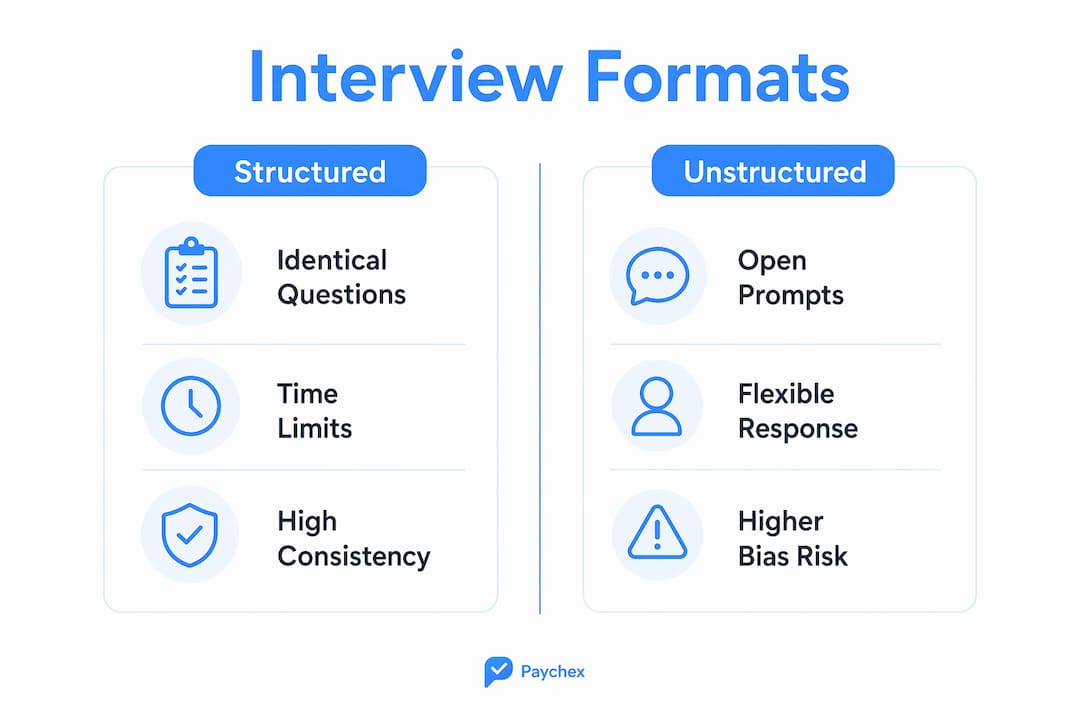
Structured asynchronous video interviews present every candidate with identical questions, identical time limits, and identical preparation windows. Structured AVIs mitigate bias by generating comparable data points across all candidates. This format works best for high-volume roles where consistency and legal defensibility matter most, such as customer service, retail, or entry-level corporate positions.
Semi-structured interviews
Semi-structured formats combine a fixed core of required questions with one or two open-ended prompts that vary by role or seniority. This gives hiring teams flexibility to probe specific competencies while still maintaining a baseline for comparison. Mid-level roles with varied responsibilities benefit most from this approach.
Unstructured interviews
Unstructured formats give candidates a broad prompt and let them respond freely, with minimal constraints on time or content. Assessment consistency drops significantly in this format. Without standardized criteria, evaluators tend to rely on subjective impressions, which reintroduces the bias the format was meant to reduce. Unstructured asynchronous interviews are rarely the right choice for competitive hiring processes.
| Format | Best for | Bias risk | Consistency |
|---|---|---|---|
| Structured | High-volume, entry-level roles | Low | High |
| Semi-structured | Mid-level, specialized roles | Medium | Medium |
| Unstructured | Exploratory or creative roles | High | Low |
The table above shows a clear pattern. As structure decreases, bias risk rises and consistency falls. Most HR teams default to structured or semi-structured formats for exactly this reason.
Asynchronous vs synchronous interviewing: which should you use?
Synchronous video interviewing is a live, real-time video call between a candidate and one or more interviewers, conducted through tools like Zoom, Microsoft Teams, or Google Meet. It mirrors the traditional in-person interview experience but removes geography as a barrier. Asynchronous interviewing removes the time barrier as well.
The advantages of asynchronous interviews are clearest at the screening stage. Employers using AVIs can screen more candidates efficiently and reduce overall hiring costs while maintaining assessment quality. Scheduling overhead drops, and recruiters can review ten responses in the time a single live interview would take. For global hiring, the format is particularly effective because it eliminates time zone friction entirely.
Synchronous interviews hold advantages at later hiring stages. Real-time conversation lets interviewers probe unexpected answers, read conversational dynamics, and build rapport with candidates. For senior roles or positions requiring strong interpersonal skills, a live interview provides signals that a recorded response cannot replicate.
Candidate experience perceptions differ between the two formats. Some candidates find asynchronous interviews impersonal or anxiety-inducing because they are speaking to a camera rather than a person. Others prefer the control it gives them over timing and environment. The balance of question structure and retake options significantly affects how candidates perceive fairness in the process.
Pro Tip: Use asynchronous video interviews for initial screening and synchronous interviews for final-round assessment. This combination captures efficiency at scale while preserving relationship-building at the decision stage.
The right choice depends on the hiring stage and the role. Asynchronous formats win on efficiency and standardization. Synchronous formats win on depth and connection. Most effective hiring workflows use both.
What best practices should HR teams follow for asynchronous video interviews?
The effectiveness of asynchronous video interviewing depends almost entirely on how it is designed and implemented. A poorly designed process can frustrate candidates, produce unreliable data, and expose organizations to bias claims.
- Use structured question sets. Write questions that target specific competencies and apply them identically to every candidate. This is the single most reliable way to generate comparable, defensible assessments.
- Provide clear instructions before the interview begins. Tell candidates exactly what to expect: how many questions, how much time per response, whether retakes are allowed, and what the review timeline looks like. Candidates who understand the process perform better and report higher satisfaction.
- Guide candidates on technical setup. Clear guidance on setting, lighting, and camera use improves video quality and candidate confidence. Recommend a quiet room, a neutral background, and direct eye contact with the camera.
- Set a deliberate retake policy. Allowing one retake per question reduces anxiety without compromising assessment validity. Unlimited retakes allow candidates to over-rehearse, which can mask authentic communication style.
- Train evaluators before they review responses. Hiring teams need calibration sessions where they score the same sample responses independently, then compare results. This surfaces scoring inconsistencies before they affect real candidates.
- Use consistent scoring rubrics. Every evaluator should score against the same criteria. Rubrics tied to job-relevant competencies, rather than general impressions, produce more reliable hiring decisions.
Pro Tip: AI-assisted scoring tools can flag patterns across large candidate pools, but treat their outputs as one data point among several. Asynchronous interviews enhance human decision-making by enabling review of recorded responses rather than replacing the judgment of trained evaluators.
Timely review matters too. Candidates who submit responses and wait weeks without feedback form negative impressions of the employer brand. Build a review window into your process and communicate it clearly upfront.
What are the main challenges of asynchronous video interviewing?
Asynchronous video interviewing solves real problems in recruitment, but it introduces its own set of challenges. Organizations that ignore these risks undermine the format's benefits.
Candidate discomfort with the format is the most common barrier. Speaking to a camera without a human on the other end feels unnatural to many candidates. This discomfort can cause strong candidates to perform below their actual ability, which skews your assessment data. Transparent communication about the format before candidates begin reduces this effect meaningfully.
Technical barriers create access inequities. Connectivity issues and platform accessibility remain documented barriers to uniform candidate experiences. Candidates in areas with unreliable internet, or those using older devices, face disadvantages that have nothing to do with their qualifications. Offering a technical support contact and a fallback option addresses this directly.
AI bias in automated scoring is a growing concern. Platforms that use AI to analyze facial expressions, tone, or word choice can embed the biases present in their training data. HR teams should understand exactly what any AI scoring tool is measuring and audit its outputs for demographic disparities before relying on it at scale.
Data privacy compliance requires attention. Video recordings of candidates are personal data under frameworks like GDPR and CCPA. Organizations must have clear data retention policies, candidate consent processes, and secure storage practices in place before deploying any asynchronous video platform.
Impression management limitations affect both sides. Candidates cannot ask clarifying questions or read the room, which can lead to responses that miss the mark. Hiring teams cannot probe an unexpected answer in real time. Designing questions that are specific and unambiguous reduces this problem, but it does not eliminate it entirely. The platform choice itself affects candidate reactions and outcomes, so selecting a platform with strong candidate experience features is not a secondary concern.
Key takeaways
Asynchronous video interviewing delivers the most value when structured question design, clear candidate guidance, and trained evaluators work together as a system rather than as separate steps.
| Point | Details |
|---|---|
| Format determines fairness | Structured AVIs produce the most consistent, bias-resistant assessments across candidates. |
| Flexibility expands talent pools | Candidates record on their own schedule, removing time zone and scheduling barriers. |
| Retake policy shapes experience | A single retake option reduces candidate anxiety without compromising assessment validity. |
| Human judgment stays central | AI tools support evaluation but do not replace trained recruiters reviewing recorded responses. |
| Platform choice has real consequences | Technical barriers and AI scoring risks require deliberate platform selection and ongoing audits. |
The efficiency trap in asynchronous hiring
The efficiency argument for asynchronous video interviewing is real and well-documented. Scheduling overhead drops, candidate pools expand, and evaluators can review responses at their own pace. These are genuine gains. But efficiency becomes a trap when organizations treat the format as a set-and-forget solution.
The teams I have seen get the most out of asynchronous interviewing are the ones that invest heavily in the design phase. They spend time writing questions that actually test job-relevant competencies. They run calibration sessions with evaluators before the first real candidate is reviewed. They audit their AI scoring tools for demographic bias rather than trusting vendor claims at face value.
The teams that struggle are the ones that deploy a platform quickly, use generic question templates, and hand off scoring to an algorithm without oversight. The format looks efficient on paper, but the hiring decisions that come out of it are no better than a poorly run phone screen.
There is also a fairness dimension that does not get enough attention. Candidates from different backgrounds experience the format very differently. A candidate who has never done a video interview before, who is recording on a phone in a shared apartment, is not competing on equal terms with someone who has a home office and broadband. Acknowledging that gap and designing around it, with clear instructions, technical support, and flexible retake policies, is not just good ethics. It is good hiring practice.
The future of asynchronous video interviewing will be shaped by how well organizations balance the efficiency gains with the responsibility to assess candidates fairly. The technology is ready. The question is whether the processes around it are.
— Hudson
How Evy supports fair and secure asynchronous screening
Asynchronous video interviewing works best when the responses you collect are honest. That is where integrity becomes a real concern for HR teams.
Evy is the only AI interview platform with real-time eye tracking designed to detect when candidates are using AI assistance during a recorded interview. Eye movement patterns look different when someone is reading from a screen versus thinking through an answer naturally. Evy's platform captures that difference and flags it for human review. Combined with structured question standardization and candidate guidance tools, Evy gives hiring teams the confidence that the responses they are evaluating reflect genuine candidate ability. For teams screening at scale, that integrity layer is what separates a reliable process from one that surfaces coached answers rather than real talent.
FAQ
What is asynchronous video interviewing?
Asynchronous video interviewing is a one-way interview format where candidates record video responses to pre-set questions and hiring teams review those recordings later. No live interaction takes place between the candidate and the interviewer.
How does asynchronous video interviewing differ from a live video interview?
A live video interview happens in real time with both parties present simultaneously, while an asynchronous interview allows candidates to record responses on their own schedule for later review. The key difference is timing, not technology.
What are the main benefits of asynchronous interviews for HR teams?
Asynchronous interviews reduce scheduling overhead, expand candidate pools across time zones, and enable standardized evaluation through identical questions and scoring rubrics. They also allow multiple evaluators to review the same response independently.
Can asynchronous video interviews introduce bias?
Poorly designed asynchronous interviews can introduce bias, particularly when AI scoring tools analyze subjective signals like tone or facial expression. Structured question sets and human-reviewed scoring rubrics are the most reliable way to reduce this risk.
What platforms are commonly used for asynchronous video interviewing?
HireVue, Spark Hire, and VidCruiter are among the leading platforms, each offering question setup, candidate recording, and varying levels of AI-assisted analysis. Platform choice affects both candidate experience and the integrity of the assessment data collected.