
 By Adrian Pascual•Hiring insight•Published
How AI Reduces Interviewer Subjectivity in Hiring
Interviewer subjectivity is the tendency for human evaluators to score candidates differently based on mood, personal preference, or unconscious bias rather than job-relevant evidence. AI reduces interviewer subjectivity by standardizing the questions every candidate receives, applying rubric-based scoring tied to defined competencies, and capturing auditable transcripts that replace memory-based recall. Unstructured interviews produce correct hiring decisions only 57% of the time. That figure alone makes the case for structured, AI-driven evaluation. Platforms like Evy go further by adding real-time integrity monitoring to the process, so the data you collect reflects genuine candidate performance.
How AI reduces interviewer subjectivity through structured evaluation
The core mechanism is standardization. AI delivers the same questions, in the same order, to every candidate. That consistency eliminates one of the most common sources of variation: interviewers who go off-script and ask different questions to different people, making fair comparison nearly impossible.
Structured interviews standardize questions, order, and scoring rubrics, enabling consistent evaluation across all candidates and all interviewers. The practical effect is that two candidates applying for the same role face the same evaluation criteria, not two different versions shaped by whoever happens to be interviewing that day.

AI also captures a full transcript of each interview. That transcript becomes an auditable record tied to specific rubric dimensions, which means hiring decisions rest on documented evidence rather than a recruiter's post-interview impression. Auditable, transcript-backed evidence reduces hiring inconsistencies and improves fairness across the board.
Real-time adaptive questioning adds another layer of consistency. When a candidate gives a vague answer, the AI probes with a follow-up question using the same logic it would apply to every other candidate. No interviewer fatigue, no favoritism, no skipping the hard follow-up because the conversation felt awkward.
Pro Tip: Build your rubric around observable, job-relevant behaviors before you deploy any AI interview tool. A rubric that measures "communication clarity" or "problem-solving approach" produces far more defensible scores than one that measures vague traits like "culture fit."
- Standardized question delivery: Every candidate receives identical questions in a fixed sequence.
- Rubric-based scoring: Responses are scored against predefined competency dimensions, not interviewer intuition.
- Automated notetaking: AI captures full transcripts, removing the need for interviewers to rely on memory.
- Adaptive follow-up: The system probes incomplete answers consistently, without the social hesitation a human interviewer might feel.
- Auditability: Every score links back to a specific transcript segment, making decisions reviewable and defensible.
What types of bias does AI reduce, and what can it miss?
AI is most effective at reducing spontaneous bias. These are the biases that emerge in the moment: an interviewer who is tired after five back-to-back calls, one who unconsciously favors candidates who share their alma mater, or one whose scoring shifts based on the order in which candidates are interviewed. AI eliminates these variations by removing the human from the delivery and initial scoring of each interview.
AI interviewers surface existing interviewer bias through data, making it visible and correctable. That is a meaningful distinction. AI does not erase bias. It makes bias legible, so your team can act on it.
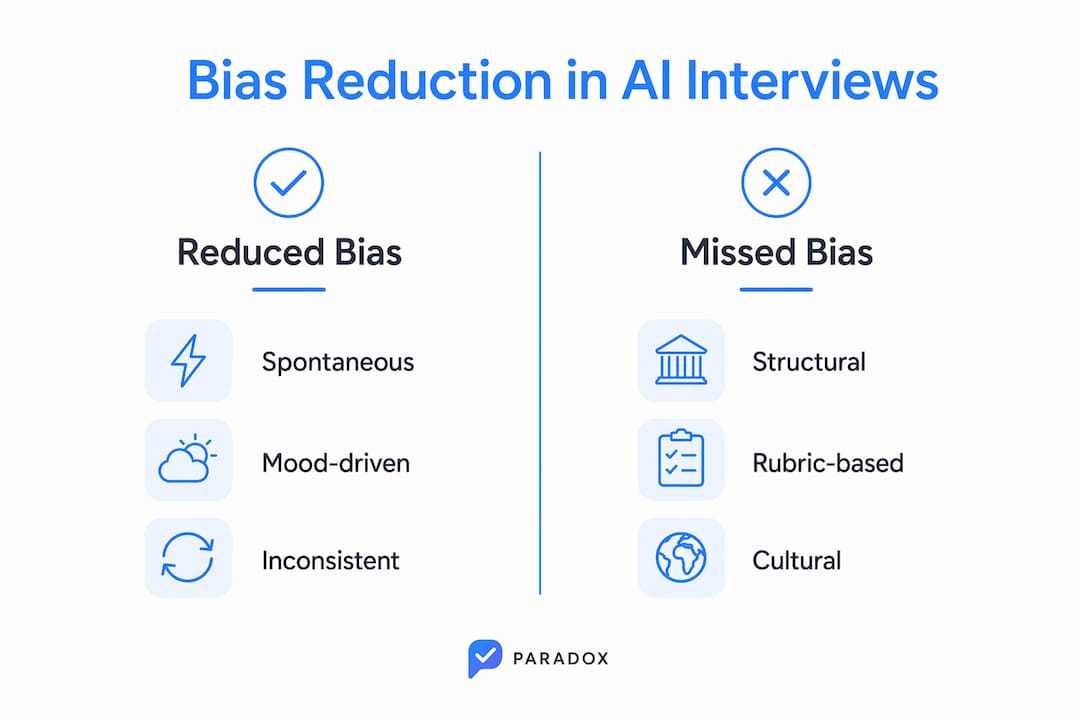
The risk lies in structural bias. If the rubric itself favors candidates with formal corporate communication styles, or if it penalizes responses that reflect non-traditional career paths, the AI will apply that flawed standard consistently to every candidate. Government guidelines stress that AI tools can reduce spontaneous bias but may embed structural bias when assessment criteria are themselves biased. Consistency applied to a flawed rubric produces consistently unfair outcomes.
Rubric auditing is the corrective. HR leaders should review rubric criteria at regular intervals, using the data the AI generates to identify patterns. If candidates from certain backgrounds consistently score lower on a particular dimension, that dimension deserves scrutiny before the next hiring cycle.
Pro Tip: Run a calibration session with your hiring team after the first cohort of AI interviews. Compare how human reviewers would have scored the same transcripts. Disagreements reveal where your rubric needs refinement.
Transparency with candidates also matters. Telling applicants that AI will evaluate their responses, and explaining the criteria used, builds trust and satisfies the transparency requirements that regulatory bodies increasingly expect from organizations using automated hiring tools.
How does AI-driven interviewing improve hiring efficiency?
The operational benefits of AI in recruitment extend well beyond fairness. AI-driven recruitment tools cut manual hiring tasks by up to 80%. That reduction frees recruiters to spend their time on the decisions that genuinely require human judgment, such as final-round conversations and offer negotiations.
Candidate experience also improves. 41.2% of candidates abandon job applications prematurely because of slow communication. AI interviews available 24/7 remove that friction. A candidate in a different time zone can complete a structured interview at midnight without waiting for a recruiter to schedule a call.
The average global time-to-hire sits at 40.1 days, with an average of 5.5 interviews per hire. AI screening compresses the early stages of that process by surfacing qualified candidates faster, so human interviewers spend their time on a smaller, better-qualified pool.
| Benefit | Impact |
|---|---|
| Reduced manual task time | Up to 80% reduction in administrative hiring work |
| Candidate abandonment | 41.2% of applicants drop off without fast engagement |
| Time-to-hire | Global average of 40.1 days, compressed by AI screening |
| Interview volume | Average of 5.5 interviews per hire, reduced by AI pre-screening |
The consistency AI provides also benefits the hiring team's internal workflow. When every candidate has been evaluated against the same rubric and every response is documented, calibration meetings become shorter and more focused. Disagreements between reviewers are resolved by returning to the transcript, not by relitigating impressions.
- Recruiters focus on final-stage evaluation rather than repetitive screening calls.
- Hiring managers receive structured summaries rather than uneven interview notes.
- Compliance teams gain a documented audit trail for every hiring decision.
- Candidates receive faster feedback, which protects your employer brand.
What best practices help HR leaders get the most from AI interviews?
Effective implementation follows a clear sequence. AI interviews work best as a middle-stage screening layer, placed after resume review and before in-depth human technical interviews. That positioning gives AI the role it performs best: consistent, scalable evaluation of a large candidate pool before human time is committed.
- Treat rubrics as living documents. Update evaluation criteria after each hiring cycle using the data the AI generates. Static rubrics calcify the biases present when they were first written.
- Communicate AI's role to candidates. Tell applicants what the AI evaluates, how scores are used, and who makes the final decision. Transparency reduces candidate anxiety and satisfies regulatory expectations.
- Run interviewer calibration sessions. After each cohort, have human reviewers score a sample of transcripts independently. Compare results to the AI scores and use disagreements to refine the rubric.
- Implement integrity monitoring. AI interviews are only as fair as the data they collect. Platforms that detect suspicious behaviors, such as tab switching or off-screen attention patterns, protect the integrity of every score. Evy's real-time eye tracking is designed specifically for this purpose, catching candidates who use AI assistance during the interview itself.
- Review for adverse impact. Analyze scores by demographic group at regular intervals. If a rubric dimension consistently disadvantages a protected group, revise it before the next cycle.
Pro Tip: Do not deploy AI interviews without first piloting them on a small internal cohort. Ask employees to complete the interview as if they were candidates, then review the transcripts and scores for any rubric dimensions that feel arbitrary or unclear.
The goal is not to remove human judgment from hiring. The goal is to give human judgment better evidence to work with. AI handles the consistent, repeatable parts of evaluation. Humans handle the contextual, relational parts that require experience and empathy.
Key takeaways
AI reduces interviewer subjectivity most effectively when standardized rubrics, auditable transcripts, and integrity monitoring work together as a single system rather than isolated tools.
| Point | Details |
|---|---|
| Standardization is the foundation | AI delivers identical questions and rubric-based scoring to every candidate, eliminating variation caused by interviewer mood or preference. |
| Bias becomes visible, not invisible | AI surfaces existing interviewer bias through data patterns, making it correctable rather than hidden. |
| Rubrics require ongoing auditing | Static rubrics embed structural bias; treat evaluation criteria as documents that evolve with each hiring cycle. |
| Middle-stage placement maximizes value | AI interviews perform best after resume review and before human technical rounds, providing a consistent, auditable baseline. |
| Integrity monitoring protects data quality | Detecting suspicious behaviors during AI interviews ensures scores reflect genuine candidate performance. |
Why I think most teams underestimate the rubric problem
The conversation about AI and interviewer bias tends to focus on what AI removes: mood-driven scoring, inconsistent questions, post-interview memory gaps. Those benefits are real. But after working closely with AI-powered recruitment technologies, the part that deserves more attention is what AI preserves and amplifies.
A rubric written by a team that has only ever hired from a narrow talent pool will reflect that pool's norms. AI will apply that rubric with perfect consistency to every candidate. The result is a system that is procedurally fair but substantively biased. The AI did exactly what it was told. The problem was in the instructions.
The organizations that get the most from AI in recruitment treat rubric design as a continuous discipline, not a one-time setup task. They bring in diverse reviewers to stress-test criteria before deployment. They analyze score distributions after each cohort and ask hard questions when patterns emerge. They use the AI's data as a mirror, not just a filter.
There is also the question of candidate integrity. An AI interview that can be gamed with AI assistance produces data that is neither fair nor useful. That is why integrity monitoring is not an optional add-on. It is a prerequisite for the data to mean anything. Evy's approach to real-time eye tracking addresses this directly, because a fair process requires honest inputs from both sides.
The technology is ready. The harder work is organizational: building the culture, the discipline, and the willingness to act on what the data reveals.
— Hudson
Evy's approach to fair, auditable AI interviews
Evy is built for HR teams that need more than consistent questions. They need confidence that the data they collect is honest.
Evy's AI interview features combine structured, rubric-based evaluation with real-time eye tracking, the only system of its kind designed to detect when candidates use AI assistance during the interview itself. Every session produces a full transcript tied to competency scores, giving your hiring team an auditable record for every decision. Interviews run 24/7, so candidates complete assessments on their schedule without slowing your pipeline. If fair hiring practices with AI matter to your organization, Evy gives you the tools to screen at scale while protecting the integrity of every result.
FAQ
What is interviewer subjectivity in hiring?
Interviewer subjectivity is the tendency for evaluators to score candidates based on personal bias, mood, or inconsistent criteria rather than job-relevant evidence. It is one of the primary reasons unstructured interviews produce correct hiring decisions only 57% of the time.
How does AI improve interview consistency?
AI delivers identical questions in a fixed sequence and scores responses against predefined rubrics, removing the variation caused by different interviewers asking different questions or applying different standards.
Can AI introduce its own bias into interviews?
Yes. AI applies rubric criteria consistently, so if those criteria are biased, the AI will replicate that bias at scale. Government guidelines recommend ongoing rubric auditing and transparency to prevent structural bias from being embedded in automated hiring tools.
Where in the hiring process should AI interviews be used?
AI interviews work best as a middle-stage screening layer, placed after resume review and before in-depth human technical interviews. That positioning provides a consistent, auditable baseline without replacing the human judgment needed in final-stage evaluation.
What is integrity monitoring in AI interviews?
Integrity monitoring detects suspicious candidate behaviors during AI interviews, such as tab switching or off-screen attention patterns, that may indicate the use of AI assistance. It protects the fairness of the process by ensuring scores reflect genuine candidate performance.