
 By Adrian Pascual•Hiring insight•Published
Recruiting AI for HR Teams: A 2026 Practical Guide
Recruiting AI, the broad category of artificial intelligence applied to talent acquisition workflows, is no longer an experiment reserved for enterprise tech companies. Over half of organizations already use AI in recruiting, and adoption is accelerating fast. Yet many HR professionals still carry a persistent misconception: that AI is here to replace recruiters. It is not. The more accurate framing is that AI handles the repetitive, high-volume work so your team can focus on the judgment calls that actually require a human. This guide covers how these systems work, what they deliver, where they fail, and how to deploy them responsibly in 2026.
Table of Contents
- Key Takeaways
- How recruiting AI works across the hiring lifecycle
- Efficiency gains that HR teams actually see
- Bias, fairness, and the monoculture problem
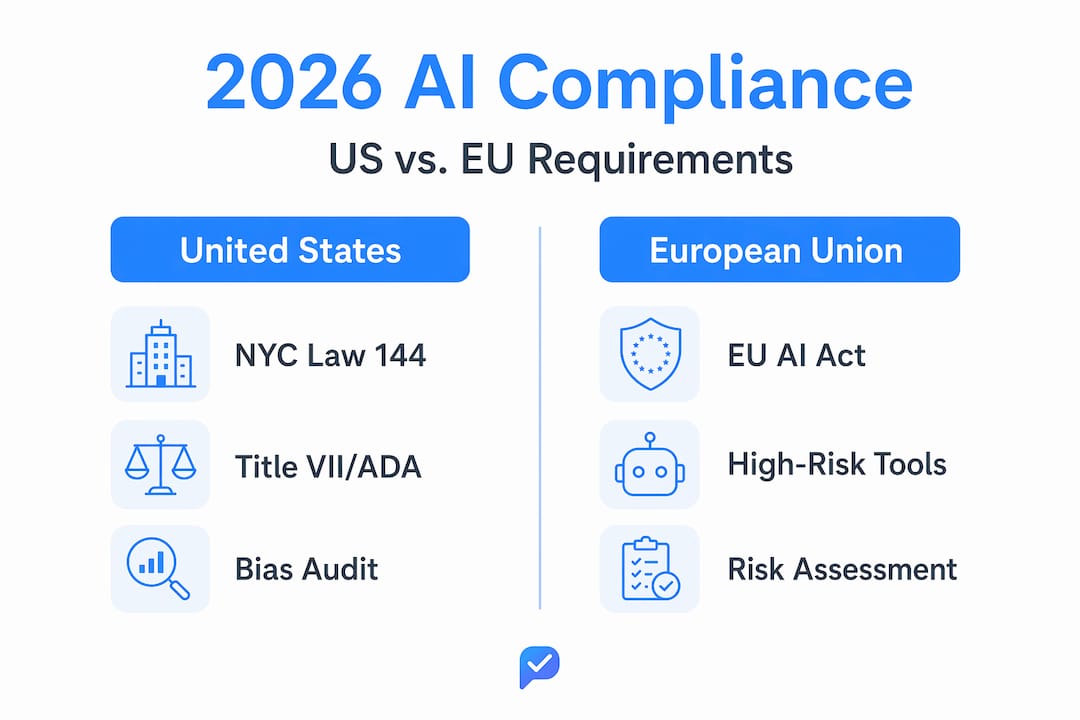
- The compliance landscape in 2026
- Selecting and implementing AI recruiting tools responsibly
- My take on where recruiting AI actually stands
- Screen smarter with Evy's AI interview platform
- FAQ
Key Takeaways
| Point | Details |
|---|---|
| AI supports, not replaces, recruiters | Recruiting AI handles screening and scheduling while humans retain final hiring authority. |
| Bias and monoculture are real risks | Using the same AI vendor as competitors can cause systemic rejections across your candidate pool. |
| Compliance is non-negotiable in 2026 | NYC, ADA, and EU AI Act rules each impose specific audit, notice, and oversight obligations. |
| Human oversight is legally required | Employers remain liable for discriminatory AI outcomes regardless of vendor responsibility claims. |
| Governance requires cross-functional work | Effective AI recruiting deployments involve Legal, Procurement, and HR working together from day one. |
How recruiting AI works across the hiring lifecycle
The industry term for this category is "automated employment decision tools," or AEDTs, though most practitioners simply refer to them as recruiting AI or AI talent acquisition systems. Understanding what these tools actually do, rather than what vendors claim they do, is the starting point for any responsible deployment.
AI automates routine recruiting tasks at nearly every stage of the hiring process. Resume screening is the most common application. Natural language processing models parse thousands of applications, score candidates against job requirements, and surface a prioritized shortlist. Interview scheduling tools connect to calendar systems and eliminate the back-and-forth that can consume hours of recruiter time per week. Automated candidate communication keeps applicants informed at each stage without requiring manual outreach.
Machine learning plays a deeper role in candidate sourcing. Autonomous recruiting agents can now proactively identify passive candidates from public sources, flag them for recruiter review, and only proceed with outreach after human approval. This is a meaningful distinction. The AI does the prospecting; the recruiter makes the call.
The key principle underlying all of this is decision support, not decision replacement. AI prioritizes and flags. Humans evaluate and decide. Any deployment that removes human judgment from the final hiring decision creates both legal exposure and a real risk of poor outcomes.
- Resume parsing and scoring against defined job criteria
- Automated scheduling and calendar coordination
- Candidate status updates and FAQ responses via chatbot
- Passive candidate sourcing from public professional profiles
- Interview question generation and AI-driven candidate screening based on structured criteria
Pro Tip: Before selecting any AI recruiting tool, map your existing workflow and identify the three or four steps that consume the most recruiter time. Target those specific bottlenecks first rather than deploying a broad platform that touches everything at once.
Efficiency gains that HR teams actually see
The business case for hiring AI is straightforward, but the specifics matter more than the headline numbers. Seventy percent of HR leaders report efficiency gains from AI in hiring. What does that look like in practice?
- Faster time-to-fill. Automated resume screening can reduce the time spent on initial candidate review from days to hours. When a role generates 400 applications, the difference between manual review and AI-assisted shortlisting is often measured in weeks, not hours.
- More consistent screening. Human reviewers apply different standards depending on the time of day, the order in which they read resumes, and their own cognitive load. AI applies the same criteria to every application, which reduces one category of inconsistency. Note: this consistency only helps if the criteria themselves are fair and well-defined.
- Better candidate experience. Candidates who receive timely status updates and clear communication are significantly more likely to complete the application process and hold a positive view of your employer brand. AI-powered communication tools make this possible at scale.
- Access to passive talent. Most of the best candidates for any given role are not actively job searching. AI-driven candidate sourcing tools can identify and engage this population in ways that manual recruiting simply cannot match at volume.
The efficiency gains are real. But they come with a condition: the AI must be configured thoughtfully, monitored continuously, and paired with human recruiter judgment at every decision point. AI that generates a flood of low-quality candidates or surfaces a shortlist that looks nothing like your actual requirements is not saving time. It is creating new work.
Bias, fairness, and the monoculture problem

This is where most vendor conversations go quiet. The fairness risks associated with AI talent acquisition are well-documented, and they are not theoretical.
Stanford HAI researchers analyzed 3.4 million applications across 1,700 jobs and found a phenomenon they called algorithmic monoculture. When multiple employers use the same AI screening vendor, a candidate who applies to several companies can be rejected everywhere for the same algorithmic reason, even if each employer would independently have made a different decision. In their study, 10% of applicants submitting four applications were rejected at every single company. That is not a coincidence. It is a systemic failure caused by shared infrastructure.
Racial and demographic bias compounds this problem. AI models trained on historical hiring data inherit the biases embedded in that data. If your organization historically hired fewer candidates from certain demographic groups, an AI trained on your past decisions will tend to replicate that pattern.
"Employers remain liable for discriminatory hiring outcomes even when AI tools are provided by vendors. 'The AI did it' is not a legal defense under Title VII or EEOC guidance." — KJK Employment Law
Practical governance requires more than a one-time audit. It means reviewing AI outputs regularly for demographic patterns, testing the system under shared-vendor conditions to detect monoculture effects, and maintaining human oversight at every decision point. You also need explainability: if a recruiter cannot explain why the AI ranked a candidate the way it did, that is a governance gap, not just a technical limitation.
The risks and fairness considerations in AI screening deserve the same level of scrutiny you would apply to any high-stakes HR process. Because legally, that is exactly what they are.
The compliance landscape in 2026
Regulatory requirements for automated hiring tools have expanded significantly, and the patchwork of laws now covers geography, disability status, and the nature of the AI system itself.
| Regulation | Scope | Key obligation |
|---|---|---|
| NYC Local Law 144 | NYC employers using AEDTs | Independent bias audit, public posting, 10-business-day candidate notice |
| Americans with Disabilities Act | All U.S. employers | AI tools must not screen out qualified candidates due to disability; accommodations required |
| EU AI Act (Article 26) | EU-based deployers of high-risk AI | Human oversight, AI usage logs retained for six months, transparency to affected workers |
NYC Local Law 144 is the most operationally specific. It requires an independent bias audit completed before deployment, a public summary posted on your careers site, and written notice to candidates at least 10 business days before the tool is used to evaluate them. The notice requirement is often managed in a separate workflow from the audit itself, and that separation creates its own compliance failure modes. Many organizations complete the audit but miss the notice timing.
The ADA's requirements are broader and more fundamental. Hiring technologies must measure relevant job skills, not inadvertently screen out candidates because of a disability. This means AI tools that rely on voice analysis, facial expression detection, or other biometric signals carry heightened ADA risk. Accessibility must be built into your AI workflows from the start, not added as an afterthought.
For organizations operating in the EU, the EU AI Act classifies recruitment AI as high-risk, which triggers obligations including human oversight at every consequential decision point, logging of AI usage for a minimum of six months, and transparency requirements for affected workers. Before deploying any tool, you must verify that your vendor's documentation satisfies these obligations, not just assume it does.
Pro Tip: Build a simple AEDT inventory: a spreadsheet listing every AI tool used in your hiring process, the vendor, the audit status, and the candidate notice workflow. This single document will save you significant time when a compliance question arises.
Selecting and implementing AI recruiting tools responsibly
The market for AI recruiting tools is crowded, and vendor claims are not always grounded in evidence. Here is how to evaluate and deploy these systems without creating the risks described above.
- Define the use case first. Identify the specific hiring stage you want to address. A tool designed for high-volume resume screening at the top of the funnel is a different product from one designed for structured interview scoring. Mixing them up leads to poor results and compliance gaps.
- Evaluate vendor fairness documentation. Ask every vendor for their bias audit results, the demographic composition of their training data, and their process for updating models when bias is detected. Vendors who cannot answer these questions clearly should not advance in your evaluation.
- Test for monoculture risk. Ask vendors whether they can tell you what percentage of your industry uses the same underlying model. If many of your competitors use the same tool, your candidates may face the systemic rejection risks identified in the Stanford research.
- Train your team thoroughly. AI tools fail most often not because of the technology but because recruiters and hiring managers do not understand what the tool is doing or why. Training should cover both how to use the tool and how to override it when human judgment differs.
- Maintain human final authority. Every AI-assisted hiring decision should have a documented human review step. This is both a legal requirement in many jurisdictions and a practical safeguard against algorithmic errors.
- Monitor outputs continuously. Set up regular reviews of your AI's outputs by demographic group, role type, and hiring stage. If patterns shift, investigate before they become a compliance issue.
Responsible deployment also means being transparent with candidates. Tell applicants when AI is used in your process and give them a clear path to request accommodations or opt out where required. Transparency is not just a legal obligation. It is a signal that your organization takes fairness seriously.
My take on where recruiting AI actually stands
I have watched AI move from a novelty to a near-standard feature in hiring platforms over the past several years, and my honest assessment is this: the technology is genuinely useful, but the governance conversation is about three years behind where it needs to be.
What I have seen in practice is that teams adopt AI tools quickly and govern them slowly. The efficiency gains are visible and immediate. The bias accumulation is invisible and gradual. By the time a demographic disparity shows up in your hiring data, it has often been building for months.
The monoculture issue is the one I find most underappreciated. Most HR teams evaluate AI vendors in isolation, asking whether the tool performs well for their roles. Almost nobody asks whether using the same vendor as 200 other companies creates a systemic disadvantage for candidates who apply broadly. That is a question worth asking before you sign a contract.
I am genuinely optimistic about where agentic AI is heading. The ability to proactively source passive candidates, coordinate scheduling across time zones, and maintain consistent candidate communication at scale is a real improvement over what recruiters could do manually. But that optimism is conditional. It depends on HR teams treating AI as a decision-support layer, not a decision-making layer, and building the governance infrastructure to back that up.
The teams I have seen get this right share one characteristic: they brought Legal and Procurement into the conversation before they selected a tool, not after. That partnership changes the questions you ask vendors and the contracts you sign.
— Hudson
Screen smarter with Evy's AI interview platform
If you are building out your AI recruiting stack and want to address one of the fastest-growing integrity risks in hiring, Evy is worth a close look.
Evy is the only AI interview platform with real-time eye tracking designed to detect when candidates are using AI assistance during interviews. As AI-generated answers become harder to identify through transcript analysis alone, attention patterns and eye movement data provide a layer of signal that text cannot. For HR teams that need to screen at scale without sacrificing the integrity of their results, Evy runs 24/7, surfaces honest and qualified candidates, and integrates into the workflows you already use. Explore the platform features or see how Evy is built specifically for HR team needs.
FAQ
What is recruiting AI?
Recruiting AI refers to artificial intelligence tools used to automate and support hiring decisions, including resume screening, candidate sourcing, interview scheduling, and communication. These systems are formally called automated employment decision tools, or AEDTs, in most regulatory frameworks.
How does recruiting AI handle bias?
AI recruiting tools can inherit and amplify biases present in historical hiring data. Bias audits, demographic monitoring, and human oversight at every decision point are required to detect and reduce these risks over time.
Are employers legally responsible for AI hiring decisions?
Yes. Employers remain liable for discriminatory outcomes caused by AI tools under Title VII and EEOC guidance, regardless of whether the tool was built by a third-party vendor.
What is NYC Local Law 144?
NYC Local Law 144 requires employers using automated employment decision tools in New York City to complete an independent bias audit, post the results publicly, and give candidates at least 10 business days' notice before the tool is used to evaluate them.
What is algorithmic monoculture in recruiting?
Algorithmic monoculture occurs when many employers use the same AI screening vendor, causing candidates who apply to multiple companies to be rejected everywhere for the same algorithmic reason. Stanford HAI research found this affected 10% of applicants submitting four or more applications in their study.