
 By Adrian Pascual•Hiring insight•Published
Structured Interview Formats: 8 Examples for HR Teams
Structured interview formats are standardized methods of candidate evaluation where all applicants answer the same job-related questions in a consistent order, enabling fair and evidence-based comparisons. Unlike unstructured conversations, these formats replace subjective "gut feel" with defined competencies, scoring rubrics, and predetermined question sequences. HR professionals who adopt structured interview techniques see measurable gains in hiring consistency, legal defensibility, and candidate quality. This article covers eight concrete examples of structured interview formats, along with scoring guidance and implementation best practices for 2026.
1. Examples of structured interview formats: an overview
Structured interview formats involve defining 4–6 core competencies per role, then asking every candidate the exact same behavioral or hypothetical questions in the same order. That standardization replaces personal impression with documented evidence. The result is a hiring record that holds up to scrutiny and supports fair candidate comparison across a full applicant pool.
Common question types include situational, behavioral, skills-based, job knowledge, problem-solving, motivation, and organizational fit questions. Each type targets a different candidate attribute. Choosing the right mix depends on the role level, the competencies you need to assess, and the hiring stage.

2. Behavioral structured interview
The behavioral format asks candidates to describe specific past experiences using the STAR method: Situation, Task, Action, and Result. A typical question is "Tell me about a time you managed a project under a tight deadline." The candidate's answer reveals how they actually performed, not how they think they would perform.
This format works best for roles where past behavior predicts future performance, such as account management, customer success, or team leadership. Structured interviews reduce unconscious bias by using identical questions and scoring for every candidate. That consistency makes behavioral formats one of the most legally defensible options available.
Pro Tip: Require candidates to name their specific contribution in every behavioral answer. Vague answers like "we solved it as a team" signal a rehearsed response, not genuine experience.
3. Situational structured interview
The situational format presents hypothetical, role-relevant scenarios and asks candidates what they would do. A sample question: "A key client threatens to cancel their contract the day before a product launch. How do you respond?" This tests judgment and decision-making before the candidate has any real experience in your organization.
Situational questions work well for entry-level roles where past experience is limited, or for assessing how candidates would handle rare but high-stakes situations. The scoring rubric anchors each response to predefined answer quality levels, from poor to excellent. That structure keeps evaluators consistent even when candidate answers vary widely.
4. Skills-based structured interview
Skills-based formats assess specific, measurable job tasks. A data analyst candidate might be asked to walk through a sample dataset and explain their analysis approach. A copywriter might respond to a brief on the spot. The format blurs the line between interview and work sample test.
This approach is particularly effective for technical and specialist roles where competency is hard to infer from behavioral answers alone. Job-relevant interview tasks give hiring managers direct evidence of capability rather than self-reported skill. Scoring is straightforward because the rubric can reference objective output criteria.
5. Job knowledge structured interview
The job knowledge format tests whether candidates understand the technical or regulatory foundations of the role. Questions might include "What is the difference between GAAP and IFRS?" for a finance role, or "Explain the GDPR requirements for data subject access requests" for a compliance position. Right or wrong answers exist, which makes scoring more objective than most other formats.
This format suits roles where incorrect knowledge creates real risk, such as legal, medical, engineering, or financial positions. It pairs well with behavioral questions to create a two-stage evaluation: first confirm the candidate knows the field, then assess how they apply that knowledge under pressure.
6. Motivation and values structured interview
Motivation questions probe why a candidate wants the role and what drives their work. A structured version asks every candidate the same questions: "What type of work environment brings out your best performance?" or "Describe the kind of manager you work best with." The answers reveal alignment with your team's working style and culture.
Defining role attributes rather than job titles is a practice Google recommends to reduce bias and improve hiring defensibility. Motivation questions built around those attributes surface candidates who will stay and perform, not just candidates who interview well. This format reduces early attrition by catching misalignment before the offer stage.
7. Organizational fit structured interview
Organizational fit questions assess how a candidate's work style aligns with your team's processes and values. Sample questions include "How do you handle disagreement with a manager's decision?" or "Describe how you prioritize competing deadlines." These are not culture-fit questions in the vague sense. They are structured, scored, and tied to specific behavioral competencies.
Fair and structured interviewing reduces the impact of personal characteristics on hiring decisions and lowers staff turnover. Organizational fit formats work best when the rubric defines what "good" looks like for your specific team, not a generic ideal. Without that specificity, these questions drift toward bias.
8. Panel-based structured interview
The panel format assigns specific competencies to individual interviewers rather than having everyone assess everything. One panelist covers problem-solving, another covers communication, and a third covers technical knowledge. Assigning competencies to individual panel members produces focused, high-quality evidence and outperforms shallow assessments spread across all traits.
Each panelist scores only their assigned competencies using the shared rubric. After the interview, the panel compares scores and resolves discrepancies through structured discussion. This division of labor prevents groupthink and keeps the evaluation grounded in evidence rather than overall impression.
How scoring rubrics and competencies define structured interview formats
Scoring rubrics are the mechanism that makes structured interview formats comparable across candidates and interviewers. A standard rubric uses a 1–5 scale, where each score level is anchored to a specific behavioral description. A score of "1" might mean "no relevant example provided," while a "5" means "clear, specific example with measurable outcome."
Calibrating rubric scoring before interviews is the highest-leverage step for eliminating rater bias. This calibration phase, where panelists score sample answers together and align on standards, matters more than writing good questions. Without it, two interviewers using the same rubric can score the same answer three points apart.
The best practice for 2026 is to define 4–6 competencies per role, then assign each competency to one panelist. That panelist writes or selects questions for their competency, calibrates with the panel, and scores independently during the interview. The process produces a structured interview questions template that is both role-specific and legally defensible.
Pro Tip: Run a calibration exercise before your first interview of each hiring cycle. Have all panelists score the same written sample answer independently, then compare. Gaps above two points signal a rubric that needs clearer anchor descriptions.
Comparing structured interview formats by use case
| Format | Question type | Best for | Scoring ease |
|---|---|---|---|
| Behavioral | Past experience (STAR) | Mid-to-senior roles | Moderate |
| Situational | Hypothetical scenarios | Entry-level or rare situations | Moderate |
| Skills-based | Task or work sample | Technical and specialist roles | High |
| Job knowledge | Factual or technical | Risk-sensitive roles | High |
| Motivation and values | Preference and alignment | All levels, retention focus | Low to moderate |
| Organizational fit | Work style and process | Team integration assessment | Moderate |
| Panel-based | Mixed, competency-assigned | Complex or senior roles | High with calibration |
Behavioral and situational formats are the most widely used because they apply across industries and role levels. Skills-based and job knowledge formats produce the most objective scores but require more preparation time. Panel formats deliver the most complete picture when the panel is well-calibrated and competencies are clearly divided.
Tips for implementing structured interview formats effectively
Applying structured interview formats well requires more than writing good questions. The following practices protect the integrity of your process from start to finish.
- Keep introductions brief. Avoid icebreaker questions like "What do you like to do for fun?" These casual questions introduce unconscious bias before the scored portion begins. A short, professional overview of the process is enough.
- Take detailed notes during each answer. Score based on documented evidence, not memory. Notes also protect your organization if a hiring decision is challenged.
- Use pre-approved follow-up questions. Role-specific follow-ups that probe for specifics, candidate actions, and reasoning behind decisions reveal deeper competencies and prevent rehearsed answers from passing unchallenged.
- Train every panelist on the rubric before the first interview. Calibration is not optional. It is the step that makes scores comparable across candidates.
- Divide competencies across panelists. Avoid having every interviewer assess every trait. Focused evaluation produces better evidence than broad, shallow coverage.
Reducing bias at the screening stage starts before the panel interview. An interview preparation checklist helps hiring managers confirm that questions, rubrics, and panelist assignments are ready before the first candidate arrives.
Key takeaways
Structured interview formats produce fairer, more defensible hiring decisions when they combine standardized questions, calibrated rubrics, and clearly assigned competencies across a trained panel.
| Point | Details |
|---|---|
| Standardize every question | Ask all candidates the same questions in the same order to enable direct comparison. |
| Define 4–6 competencies per role | Tie every question to a specific competency rather than a general job title. |
| Calibrate rubrics before interviewing | Align panelists on scoring anchors before the first interview to reduce rater bias. |
| Assign competencies to panelists | Divide evaluation responsibilities so each interviewer provides focused, high-quality evidence. |
| Keep introductions structured | Avoid casual icebreakers that introduce bias before scored questions begin. |
Why structured formats still fail without the right discipline
Structured interview formats are the most reliable hiring tool available. I have seen organizations adopt behavioral question banks, build scoring rubrics, and assemble panels, then watch the process fall apart because no one calibrated the rubric before day one.
The most common failure point is not the format itself. It is the assumption that writing good questions is enough. Calibration is where the real work happens. When two panelists score the same answer a "2" and a "5" respectively, the rubric has not done its job. That gap does not average out. It produces a hiring decision based on two different standards applied to the same candidate.
The second failure point is the introduction. Hiring managers who spend ten minutes on casual conversation before the structured questions begin have already introduced bias. The candidate who mentions a shared hobby or alma mater gets a warmer reception, and that warmth colors every score that follows. Keeping introductions brief and professional is not cold. It is fair.
The formats that work best in practice are the ones that get refined after every hiring cycle. Review your rubric scores after each cohort. If every candidate scores a "4" on communication, your anchor descriptions are too vague. If no one scores above a "2" on problem-solving, your questions may be too abstract. Structured interview design is not a one-time task. It is a process that improves with use.
— Hudson
Evy's AI-powered tools and structured interview integrity
Structured interview formats set the standard for fair evaluation. Maintaining that standard at scale requires more than good questions and trained panels.
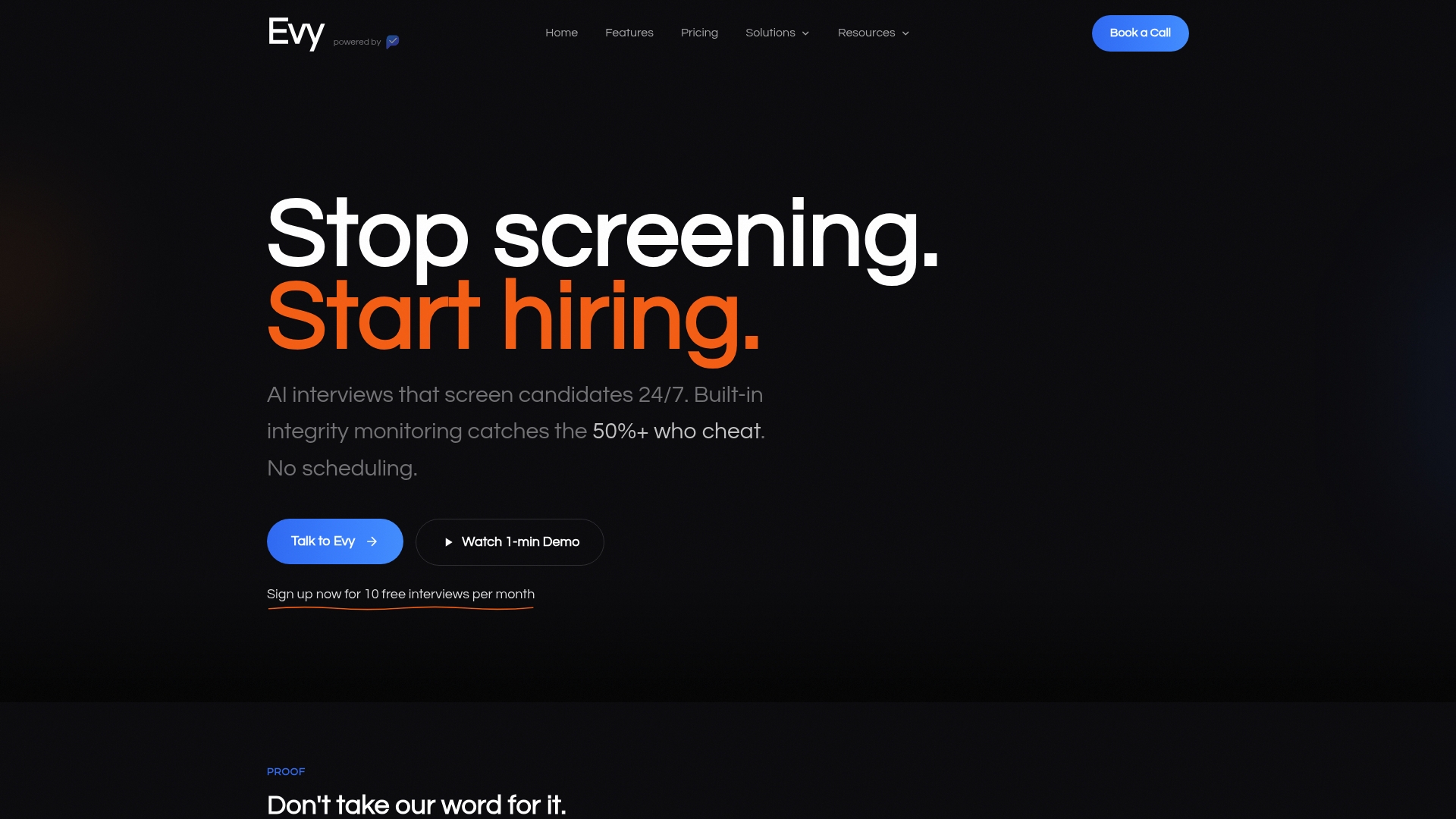
Evy is the only AI interview platform with real-time eye tracking to detect candidates using AI assistance during interviews. That capability protects the integrity of your structured process by confirming that candidate responses reflect genuine competency, not AI-generated answers. When you screen at scale, 24/7, you need confidence that the scores your rubric produces reflect real candidate performance. Explore Evy's anti-cheat interview features to see how AI-assisted scoring and integrity monitoring support structured interview adoption without adding manual overhead to your panel's workload.
FAQ
What are the main types of structured interview formats?
The main types are behavioral, situational, skills-based, job knowledge, motivation, organizational fit, and panel-based formats. Each targets different candidate attributes and suits different role levels and hiring stages.
How do scoring rubrics improve structured interviews?
Scoring rubrics anchor each response to a defined quality level on a 1–5 scale, making candidate scores comparable across interviewers. Calibrating rubrics before interviews is the most effective step for reducing rater bias.
What is the benefit of assigning competencies to individual panelists?
Assigning specific competencies to individual panelists produces focused, high-quality evidence and prevents shallow assessments spread across all traits. This approach outperforms having every interviewer evaluate every competency.
How do structured interviews reduce hiring bias?
Structured interviews use identical questions and scoring for every candidate, which removes the variation introduced by unstructured conversation. This standardization makes hiring decisions more equitable and legally defensible.
When should you use situational vs. behavioral interview questions?
Use behavioral questions for mid-to-senior candidates with relevant experience, and situational questions for entry-level candidates or when assessing responses to rare, high-stakes scenarios.