
 By Adrian Pascual•Hiring insight•Published
Structured Interviewing: A Practical 2026 Guide
What is structured interviewing?
Structured interviewing is a standardized method for assessing candidates by asking every applicant the same job-relevant questions, in the same fixed order, and scoring each response against a predefined rubric. According to the U.S. Office of Personnel Management, it is specifically designed to measure job-related competencies by systematically inquiring about past behavior and proposed responses to hypothetical situations. The result is a process where fairness is built into the design, not left to chance.
Three elements define a true structured interview:
- Standardized questions: Every candidate receives the same questions in the same sequence, eliminating the variability that makes unstructured formats unreliable.
- Job-related content: Questions are grounded in a formal job analysis, focusing on behavioral or situational competencies tied directly to the role.
- Anchored scoring rubrics: Responses are evaluated against consistent, predefined criteria rather than interviewer intuition or gut feel.
The method applies equally in hiring and research contexts. In research settings, the same logic holds: fixed question order and minimal interviewer influence allow for unbiased comparisons across participants.
How structured interviews compare to unstructured and semi-structured formats

The differences between interview types go well beyond style. They affect reliability, legal defensibility, and whether your hiring decisions actually predict job performance.

| Feature | Structured | Semi-structured | Unstructured |
|---|---|---|---|
| Question consistency | Same for all candidates | Core questions fixed; follow-ups vary | Varies by candidate |
| Scoring method | Anchored rating scale | Partially standardized | No standard required |
| Interviewer discretion | Minimal | Moderate | High |
| Reliability | High | Moderate | Low |
| Legal defensibility | Strong | Moderate | Weak |
| Predictive validity | High | Moderate | Low to moderate |
Unstructured interviews feel natural and conversational, which is exactly why they underperform. The OPM notes that their lack of standardization makes them susceptible to legal challenges and produces low reliability across interviewers. Semi-structured formats sit in between: useful for qualitative research where some flexibility is needed, but not ideal when consistent, comparable hiring decisions are the goal.
How to prepare a structured interview step by step
Preparation is where structured interviews succeed or fail. Skipping steps here undermines everything downstream.
- Conduct a job analysis. Identify the tasks, responsibilities, and competencies the role genuinely requires. This is the foundation every question and rating criterion builds on.
- Select 4–6 core competencies. The OPM recommends limiting the interview to four to six competencies to keep the process manageable without sacrificing rigor. Oral communication and interpersonal skills are particularly well-suited to interview-based assessment.
- Develop behavioral and situational questions. Write open-ended questions tied directly to each competency. Behavioral questions ask about past experiences; situational questions present realistic hypothetical scenarios. Both formats are valid and can be combined.
- Create anchored rating scales. Define what a strong, average, and weak response looks like for each question before the first interview takes place. Without this step, scoring becomes subjective and the reliability advantage disappears.
- Pilot test your questions. OPM guidance recommends testing questions with internal employees to confirm they elicit the intended competencies and are clearly worded. Questions that confuse internal testers will confuse candidates.
- Train your interviewers. Calibration sessions align the team on how to apply rating scales consistently. Google's approach, detailed in their re:Work guide, includes standardized rubrics and interviewer training as non-negotiable components.
Pro Tip: Run a calibration exercise where two interviewers independently score the same sample response, then compare ratings. Gaps reveal where your rubric language needs tightening before you go live.
What structured interview questions actually look like
Questions fall into three categories, each targeting a different dimension of candidate competency.
- Behavioral questions draw on past experience. The premise is that past behavior predicts future performance under similar conditions.
- Situational questions present a hypothetical scenario and ask how the candidate would respond. They work well for roles where candidates may lack direct prior experience.
- Job-specific questions test technical knowledge or skills tied to the role's core functions.
| Question type | Example | Competency assessed |
|---|---|---|
| Behavioral | "Tell me about a time you had to manage a difficult stakeholder relationship." | Interpersonal skills |
| Situational | "A client calls upset about a delayed deliverable. How do you handle it?" | Problem-solving, communication |
| Job-specific | "Walk me through how you would structure a data pipeline for real-time reporting." | Technical knowledge |
| Behavioral | "Describe a situation where you had to meet a tight deadline with limited resources." | Adaptability, planning |
| Situational | "You discover a critical error in a report one hour before it goes to leadership. What do you do?" | Judgment, accountability |
For technical roles specifically, job-specific questions should be grounded in realistic work scenarios rather than abstract puzzles. The goal is to surface how candidates actually think, not whether they can recall a memorized answer.
How to conduct and score a structured interview
Conducting the interview correctly is as important as designing it well. Consistency during the session protects the integrity of the data you collect.
- Ask every candidate the same questions in the same order, without deviation. Varying the sequence changes what candidates hear first and can influence how they frame their answers.
- Take detailed notes during each response. Google's re:Work approach emphasizes comprehensive feedback recording so that evaluators can review actual responses rather than relying on memory.
- Score each response immediately after it is given, using the anchored rubric. Delaying scoring until after the full interview allows earlier impressions to color later ratings.
- Withhold access to resumes until scoring is complete. This practice, recommended by Google, directly counters the halo effect, where a strong resume creates a positive bias that inflates ratings on unrelated criteria.
- Avoid discussing candidates between interviewers until all scores are submitted. Pre-discussion contaminates independent evaluation and reduces the reliability benefit of using multiple raters.
Reducing interviewer subjectivity is not about removing human judgment. It is about ensuring that judgment is applied to the right information, at the right time, through a consistent process.
What the research says about structured interview effectiveness
The evidence for structured interviewing is consistent across decades of research. A meta-analysis published in the Journal of Occupational Psychology found that structured interviews produced mean validity coefficients twice as high as unstructured interviews, based on 150 usable validity coefficients drawn from published and unpublished literature worldwide.
Structured interviews have demonstrated a high degree of reliability, validity, and legal defensibility. The benefits of consistently selecting quality candidates and reducing the risk of legal challenges far outweigh any costs of adding structure. — U.S. Office of Personnel Management
University of Iowa researchers highlight bias reduction as a central mechanism behind this advantage. By focusing interviewers on job-related criteria, the format limits the influence of affinity bias, racial bias, and gender bias that tend to surface in less controlled formats. Google's re:Work data also points to decreased differences between demographic groups as a measurable outcome of structured approaches, alongside increased predictive validity.
The upfront investment in design and training is real, but OPM's cost-benefit analysis is clear: better hiring quality and reduced legal exposure justify the effort.
Common challenges and limitations of structured interviews
Structured interviews are not without friction. Understanding the limitations helps teams implement them more realistically.
The most common failure mode is partial structure: standardizing questions but not scoring. OPM standards are explicit that both fixed content and anchored rating scales are required for the reliability benefits to hold. Organizations that skip rubric development lose most of the validity advantage while keeping all of the preparation overhead.
Rigidity is a genuine trade-off. Because interviewers cannot deviate from the question list, they cannot pursue an unexpected but relevant thread a candidate raises. This works well for high-volume, comparable hiring decisions, but can feel constraining in senior or highly specialized roles where exploratory conversation reveals more than a fixed script.
Design time is another real cost. Developing a defensible structured interview, including job analysis, question writing, rubric creation, pilot testing, and interviewer training, takes meaningful effort before a single candidate is interviewed. Teams under pressure to fill roles quickly often cut corners here, which defeats the purpose.
Finally, candidate experience can suffer if the format feels mechanical. Interviewers who follow the script too rigidly, without warmth or natural acknowledgment, can leave candidates with a poor impression of the organization.
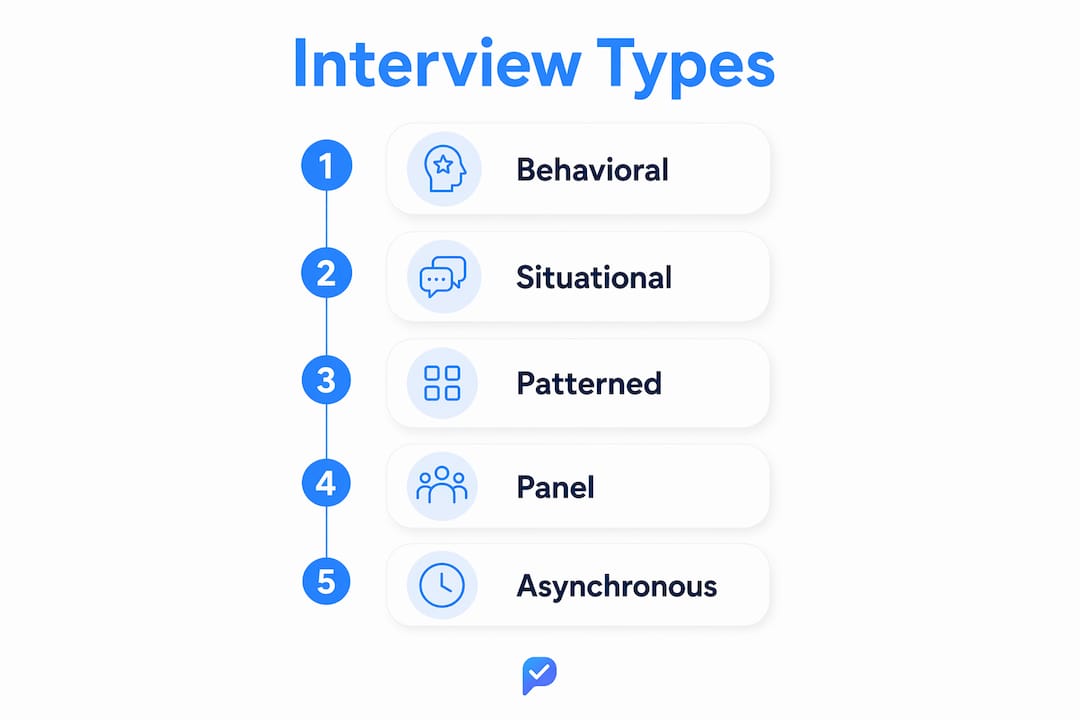
Types of structured interviews you should know
Structured interviewing is not a single format. Several distinct types exist, each suited to different hiring contexts.
Behavioral description interviews focus entirely on past experience, using questions that follow the STAR format (Situation, Task, Action, Result). They work best when candidates have directly relevant prior experience to draw from.
Situational interviews present hypothetical scenarios and ask candidates to describe their intended response. They are particularly useful for entry-level roles where past experience is limited, since they assess judgment and values rather than history.
Patterned behavior description interviews are a structured variant that uses a standardized question bank developed from critical incidents identified during job analysis. The questions are tightly anchored to specific, documented job behaviors.
Panel interviews use multiple interviewers asking from the same question set and scoring independently. The structured interview formats overview from Evy covers eight distinct formats, including panel configurations that improve inter-rater reliability by averaging scores across evaluators.
Computer-based or asynchronous video interviews apply structured principles at scale: candidates receive the same questions, record responses within set time limits, and are scored against the same rubric. This format is increasingly common for high-volume screening, though it introduces questions about candidate authenticity that platforms like Evy address directly through real-time eye tracking and attention pattern analysis.
Legal considerations in structured interviewing
Structured interviews carry legal weight precisely because they are designed to be defensible. Employment interviews used in hiring decisions are subject to the same legal and psychometric requirements as written tests under Title VII of the Civil Rights Act and the Uniform Guidelines on Employee Selection Procedures.
Three practices directly support legal defensibility. First, grounding every question in a formal job analysis ties the assessment to legitimate, job-related criteria. Second, applying a consistent rating scale to all candidates eliminates the appearance of differential treatment. Third, documenting the development process, including the job analysis, question rationale, and scoring criteria, creates an auditable record if a hiring decision is ever challenged.
The OPM guidance is direct: unstructured interviews are susceptible to legal challenges because their lack of standardization makes it difficult to demonstrate that all candidates were assessed on the same basis. Structured interviews do not guarantee immunity from legal scrutiny, but they provide a documented, consistent framework that is far easier to defend. For teams managing compliance at the screening stage, this consistency is one of the strongest arguments for adopting the format.
Key Takeaways
Structured interviewing delivers measurably better hiring outcomes because it replaces interviewer intuition with a consistent, job-grounded evaluation process backed by decades of research.
| Point | Details |
|---|---|
| Validity advantage | Meta-analyses show structured interviews produce validity coefficients twice as high as unstructured ones. |
| Core requirements | True structure requires both standardized questions and anchored rating scales — not just one. |
| Preparation depth | OPM recommends assessing four to six competencies and pilot testing all questions before full rollout. |
| Bias reduction | Withholding resumes until scoring is complete directly counters the halo effect during evaluation. |
| Legal defensibility | Job analysis documentation and consistent scoring create an auditable record that withstands legal scrutiny. |
Structured interviews set the standard for fair, consistent candidate assessment. Evy builds on that foundation by adding real-time eye tracking to verify that candidates are engaging honestly, not relying on off-screen AI assistance. If you are running structured interviews at scale and need confidence that your scores reflect genuine candidate performance, explore Evy's features to see how integrity monitoring fits into your existing process.