
 By Adrian Pascual•Hiring insight•Published
How to Reduce Interviewer Subjectivity in Hiring
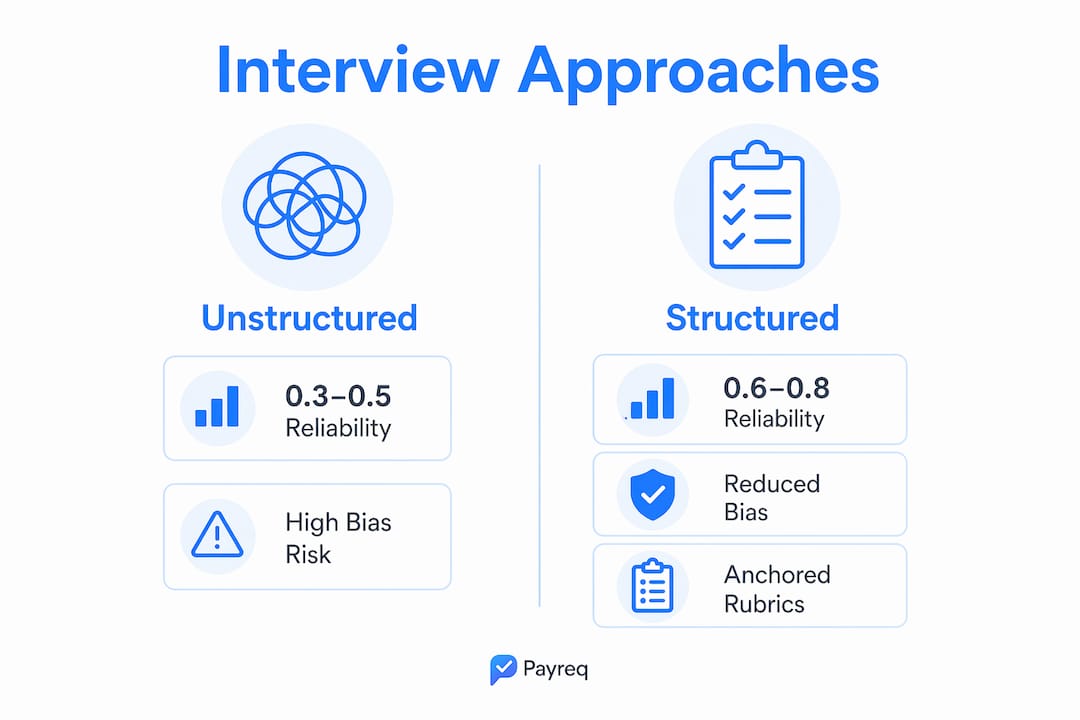
Interviewer subjectivity is defined as the tendency for personal impressions, unconscious preferences, and inconsistent evaluation criteria to influence hiring decisions rather than job-relevant evidence. The industry term for addressing this is "structured interviewing," and it is the most research-supported method to reduce interviewer subjectivity in hiring. Unstructured interviews produce inter-rater reliability scores of just 0.3–0.5, meaning two interviewers evaluating the same candidate often reach opposite conclusions. That gap costs organizations qualified candidates and exposes them to legal risk under EEOC guidelines. The good news is that structured techniques, anchored rubrics, and the right technology can close that gap measurably.
How structured interviews and anchored rubrics reduce subjectivity in hiring
Structured interviews use a fixed set of vetted, role-relevant questions asked in the same order to every candidate. This removes the conversational drift that lets interviewers unconsciously favor candidates who remind them of themselves. The questions target specific competencies, such as conflict resolution or analytical reasoning, and every answer is measured against the same criteria.
Anchored rubrics are the mechanism that makes structured interviews work. A rubric defines what "poor," "solid," and "outstanding" look like for each question, in concrete behavioral terms. Without that definition, the word "good" becomes an interviewer-specific interpretation, and the validity gap reopens. Anchored rubrics force evaluators to match observed behavior to a shared standard rather than a gut feeling.

The data on this is clear. Structured interviews with anchored rubrics achieve inter-rater reliability of 0.6–0.8, compared to 0.3–0.5 for unstructured formats. That improvement means two interviewers are far more likely to score the same candidate similarly, which produces fairer and more defensible hiring decisions.
Interviewer calibration is the maintenance step that keeps rubrics effective. Teams should run scoring exercises on recorded or written sample responses before each hiring cycle. Calibration sessions expose where interviewers interpret rubric language differently and correct those gaps before real candidates are affected.
Pro Tip: Rotate your interview question bank every two to three hiring cycles. Candidates increasingly share questions with peers online, and stale questions reward preparation over genuine competence.
| Approach | Inter-rater reliability | Bias risk |
|---|---|---|
| Unstructured interview | 0.3–0.5 | High |
| Structured interview with rubric | 0.6–0.8 | Significantly reduced |
| Structured interview with calibration | 0.7–0.8+ | Low |
Why panel interviews improve objectivity when done correctly
Panel interviews bring multiple evaluators into the process, which distributes the risk of individual bias across several perspectives. A panel composed of people with different functional backgrounds, seniority levels, and demographic profiles is less likely to converge on a single blind spot. Each panelist brings a different lens to the same candidate response.
The critical rule is that panelists must score independently before any group discussion begins. Allowing group discussion before independent scoring causes conformity bias, collapsing evaluations toward the first confident voice in the room. That dynamic undermines the entire point of having multiple evaluators.
Best practices for panel composition and process:
- Assign each panelist a specific competency area to evaluate. Overlap is fine, but defined ownership prevents everyone from asking the same questions.
- Limit panels to three to five interviewers. Larger groups increase coordination costs without proportional accuracy gains.
- Collect written scores from every panelist before opening the debrief discussion.
- Designate a neutral facilitator for the debrief who surfaces disagreements rather than resolving them prematurely.
- Document the rationale behind final scores, not just the scores themselves.
Pro Tip: Assign a "devil's advocate" role in your debrief. That person's job is to argue against the emerging consensus. It surfaces overlooked evidence and prevents groupthink from masking individual bias.
Standardizing the interview process: scripts, scoring, and documentation
Scripted questions are the foundation of a fair process. Every candidate for the same role should hear the same questions, framed the same way, in the same sequence. Deviation from the script, even well-intentioned probing, introduces variability that makes scores incomparable across candidates.
Quantitative scoring rubrics applied consistently across all candidates create an auditable record. That record matters for two reasons. First, it gives hiring managers objective data to compare candidates side by side. Second, it provides legal protection if a rejected candidate challenges the decision. Detailed notes tied to specific rubric criteria are far more defensible than summary impressions.
Feedback documentation should capture what the candidate said, not what the interviewer felt about it. The distinction is significant. "Candidate described a three-step conflict resolution process with a clear outcome" is auditable. "Candidate seemed confident" is not. Training interviewers to document observations rather than interpretations is one of the highest-return changes a hiring team can make.
Structured versus unstructured approaches differ sharply in practice:
- Structured: Fixed questions, anchored rubrics, independent scoring, documented rationale
- Unstructured: Conversational flow, impressionistic scoring, group consensus, minimal documentation
The interview preparation checklist approach formalizes these steps so nothing is left to chance on the day of the interview.
How technology can minimize bias in the hiring process
AI-powered screening tools handle early-stage candidate evaluation at a scale no human team can match. They apply the same criteria to every applicant, removing the fatigue and inconsistency that affect human reviewers after the first few dozen resumes. That consistency is the primary fairness benefit of algorithmic screening.
The caution is that consistency is not the same as fairness. AI hiring systems that pass standard fairness tests can still exhibit significant discrimination when evaluated across intersecting demographic dimensions. A system that treats gender fairly may still disadvantage candidates at the intersection of gender and age. Single-metric fairness testing creates an illusion of compliance without delivering actual equity.
"Optimizing for a single fairness metric without intersectional awareness can create false fairness. Comprehensive bias evaluation, across multiple demographic dimensions simultaneously, is the only way to detect and correct the discrimination that standard tests miss."
Employers carry full legal liability for discriminatory outcomes from AI hiring tools, even when those tools are built and maintained by vendors. Annual independent bias audits are the recommended compliance practice under current EEOC guidance. Relying on vendor assurances alone does not satisfy that obligation.
Behavioral data analytics add another layer of objectivity. Recording interview responses and analyzing patterns in language, structure, and content supplements the subjective impressions interviewers form in real time. Evy integrates real-time eye tracking with transcript analysis to flag attention patterns that may indicate AI-assisted responses, adding a dimension of integrity verification that purely behavioral scoring cannot provide. For a deeper look at how these tools work together, the AI bias in interview systems analysis covers the technical and compliance dimensions in detail.
Continuous monitoring matters as much as the initial audit. AI models drift over time as the candidate pool and labor market shift. Integrating bias monitoring into hiring workflows rather than treating it as an annual event catches problems before they affect real candidates. The goal is a feedback loop, not a one-time certification.
Key Takeaways
Structured interviews with anchored rubrics, independent panel scoring, and continuous AI bias audits are the three pillars of a defensible, fair hiring process.
| Point | Details |
|---|---|
| Use anchored rubrics | Define "poor," "solid," and "outstanding" in behavioral terms to unify evaluator standards. |
| Score independently before debriefing | Require written scores from every panelist before group discussion to prevent conformity bias. |
| Script and document everything | Use fixed questions and observation-based notes to create an auditable, legally defensible record. |
| Audit AI tools annually | Conduct independent bias audits with multi-dimensional metrics; vendor assurances are not sufficient. |
| Calibrate interviewers regularly | Run scoring exercises before each hiring cycle to maintain rubric consistency across your team. |
Why bias reduction is harder than most hiring teams expect
Bias reduction is a systems problem, not a training problem. I have seen organizations invest heavily in unconscious bias workshops and walk away believing the work is done. It is not. Training can suppress bias momentarily but does not eliminate it. The interviewers who score highest on bias awareness assessments often carry the most confidence in their own objectivity, which is itself a risk factor.
The pitfalls I see most often are conformity bias in debrief sessions and interviewer overconfidence in pattern recognition. A senior interviewer who "just knows" a good candidate is not exercising judgment. They are applying a template built from past hires, which encodes whatever biases shaped those hires. Structural guardrails, not individual awareness, are what break that cycle.
The organizations that make real progress treat their interview process as a product. They version it, test it, measure inter-rater reliability, and iterate. They treat a drop in reliability scores the same way an engineering team treats a regression in production. That level of rigor is rare, but it is the only approach that produces durable results.
Cultural commitment matters too. Fairness cannot be a compliance checkbox. When hiring managers see structured processes as bureaucratic friction rather than quality control, they find workarounds. Leadership has to model the behavior, and the process has to be designed so that doing it right is easier than cutting corners.
— Hudson
Evy's approach to objective, integrity-verified interviews
Reducing bias in hiring requires both process discipline and technology that holds up under scrutiny.
Evy is the only AI interview platform with real-time eye tracking, built to catch candidates using AI assistance during interviews. That integrity layer matters because objective scoring is only meaningful when the responses being scored are genuine. Evy's anti-cheat interview features combine transcript analysis, attention pattern detection, and structured scoring to give hiring teams data they can trust. The platform screens candidates at scale, 24/7, and surfaces honest, qualified talent without adding manual review burden. For teams committed to fair, auditable hiring, Evy provides the infrastructure to make that commitment real.
FAQ
What is interviewer subjectivity in hiring?
Interviewer subjectivity is the influence of personal impressions, unconscious preferences, and inconsistent criteria on hiring decisions. Structured interviewing methods are the recognized solution for reducing this effect.
How much do structured interviews improve consistency?
Structured interviews with anchored rubrics achieve inter-rater reliability of 0.6–0.8, compared to 0.3–0.5 for unstructured formats. That improvement significantly increases the consistency of evaluations across interviewers.
Why must panelists score independently before discussing a candidate?
Group discussion before independent scoring triggers conformity bias, where evaluations collapse toward the first confident voice. Independent written scores preserve the objectivity that panel interviews are designed to provide.
Are employers liable for bias in AI hiring tools?
Yes. Employers carry full legal liability for discriminatory outcomes from AI hiring tools, even when a vendor built and maintains the system. Annual independent audits are the recommended compliance practice under EEOC guidance.
How does Evy help reduce bias in the interview process?
Evy combines structured interview delivery with real-time eye tracking and transcript analysis to verify that candidate responses are genuine. That integrity layer ensures that objective scoring reflects actual candidate performance, not AI-assisted answers.