
 By Adrian Pascual•Hiring insight•Published
Job-Specific Interview Design: A Guide for HR Teams
Job-specific interview design is defined as the intentional development of interview questions, scoring rubrics, and evaluation criteria that assess candidate competencies directly tied to a role's actual requirements. This approach is the recognized industry term for what selection researchers call "structured interviewing" applied at the role level. Understanding what is job-specific interview design matters because structured interviews achieve validity coefficients around 0.51, compared to roughly 0.20 for unstructured interviews. That gap represents the difference between predicting job performance with confidence and making expensive guesses. Foundational standards like the Uniform Guidelines on Employee Selection Procedures (UGESP) and EEOC guidelines require that selection tools be job-related and defensible. Job-specific interview design satisfies both requirements by anchoring every question to verified role competencies.
What is job-specific interview design and how does it work?
Job-specific interview design is a structured interview technique that builds every question, probe, and scoring anchor around the competencies a specific role demands. It is not a generic question bank applied to all openings. The design process starts with a job analysis that identifies 4–5 capabilities predictive of success in that particular position, not just the job title.
Competency mapping is foundational for effective interview design. Once you identify the competencies, you write questions that directly test evidence of those competencies in a candidate's past or hypothetical behavior. Every question gets a scoring rubric before the first interview begins.

The four core question types
Effective job-specific interview design draws on four question types, each serving a distinct purpose.
- Behavioral questions ask candidates to describe specific past actions. They follow the STAR format: Situation, Task, Action, Result. Behavioral question framing significantly improves signal quality because past behavior predicts future performance more reliably than stated intentions.
- Situational questions present a hypothetical scenario and ask what the candidate would do. They work well for roles where direct experience is rare, such as first-time manager positions.
- Knowledge questions test technical or procedural understanding. They suit roles where specific expertise is non-negotiable, such as regulatory compliance or software engineering.
- Trait-attribution questions ask candidates to describe their own personality or work style. These show much weaker predictive power than behavioral or situational formats and should be used sparingly, if at all.
Why pre-authored probes matter
Most interview guides stop at the main question. That is a design flaw. Pre-authoring follow-up probe questions alongside main questions prevents evaluation drift and keeps depth consistent across all candidates. Without prepared probes, interviewers improvise. Improvisation introduces bias. A probe like "What specifically did you do, as opposed to your team?" turns a vague answer into a measurable one.
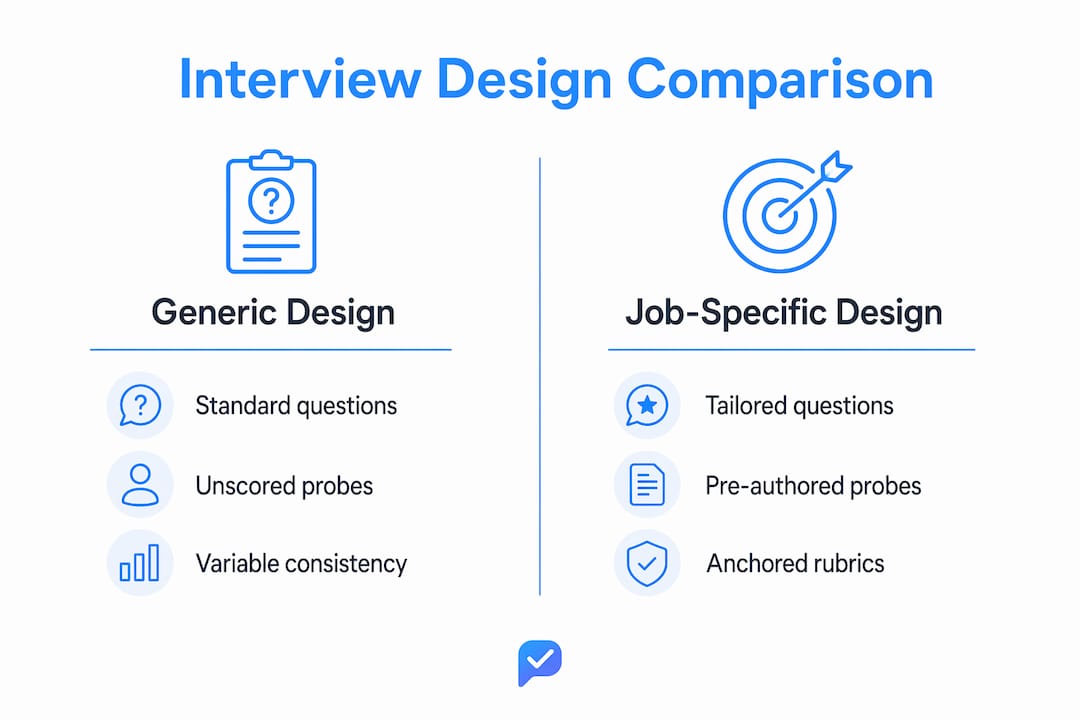
Pro Tip: Write at least two follow-up probes for every main behavioral question before your first interview. Treat them as required, not optional.
How does job-specific interview design improve hiring validity and reduce bias?
The validity advantage of structured, job-specific interviews is well-documented. Structured interviews consistently outperform unstructured ones in predicting job performance, with validity coefficients near 0.51 versus approximately 0.20 for unstructured formats. That difference is not marginal. It means structured interviews are roughly two and a half times more predictive of actual on-the-job results.
"Culture fit is a vague and risky hiring metric. Replacing it with competency-focused evaluation improves fairness and legal defensibility." Structured design gives hiring teams a concrete alternative: measurable behaviors tied to real job requirements, evaluated the same way for every candidate.
Replacing "culture fit" with competency-focused evaluation reduces disparate impact risk and strengthens legal defensibility under UGESP and EEOC guidelines. Culture fit judgments are impression-based. Competency assessments are evidence-based. The distinction matters enormously in an adverse impact audit.
Scoring discipline is equally critical. Independent scoring before panel debrief prevents dominant voices from skewing group consensus. When evaluators discuss candidates before recording individual scores, the most senior or most vocal person in the room effectively makes the hiring decision. Score-before-discussion practices remove that distortion. Each interviewer submits scores independently, and the panel then calibrates from a position of recorded evidence rather than shared impressions.
Hiring teams that use structured interview frameworks to minimize bias report greater confidence in their decisions and fewer post-hire surprises. The process creates an auditable record that protects both the organization and the candidate.
What are best practices for designing effective job-specific interviews?
The most common mistake in interview design is starting with questions instead of competencies. Effective design works in the opposite direction: define what success looks like in the role, identify the behaviors that produce that success, then write questions that surface evidence of those behaviors.
A repeatable design process
- Conduct a job analysis. Interview current high performers and their managers. Identify 4–6 competencies that separate strong performers from average ones. Focus on behaviors, not traits.
- Assign competency ownership. Assigning specific competencies to individual interviewers reduces redundancy and deepens assessment quality. One interviewer owns problem-solving. Another owns communication. No one covers everything superficially.
- Write questions with rubrics. Draft each question alongside a three-point or five-point scoring anchor. Define what a strong answer looks like, what an average answer looks like, and what a weak answer looks like. Do this before interviewing anyone.
- Pre-author all probes. Write two to three follow-up probes per question. Include probes that push for specificity, such as "What was your personal contribution?" or "What would you do differently now?"
- Fix the question order. Consistent question order ensures every candidate is measured against the same sequence. Changing order mid-process introduces context effects that distort comparisons.
- Run a calibration session. Before interviews begin, walk the panel through the rubric together. After the first two or three interviews, reconvene to check that scores are being applied consistently.
Pro Tip: Use an interview preparation checklist to confirm rubrics, probes, and competency assignments are complete before any candidate enters the process.
The table below compares two common approaches to interview design across key quality dimensions.
| Dimension | Generic interview design | Job-specific interview design |
|---|---|---|
| Question source | Standard question banks | Role-specific competency analysis |
| Scoring method | Gut feel or general impression | Anchored rubrics per competency |
| Bias control | Minimal | Score-before-discussion, calibration |
| Legal defensibility | Low | High, aligned with UGESP and EEOC |
| Predictive validity | Near 0.20 | Near 0.51 |
How to apply job-specific interview design across different roles?
Job-specific interview design adapts to any role type. The competencies change. The structure does not.
- Technical roles (engineering, data science, finance) benefit from a mix of knowledge questions and behavioral questions. A software engineer interview might assess debugging logic through a knowledge question and cross-functional communication through a behavioral one. Evy's guide on interview questions for technical roles covers this split in detail.
- Customer-facing roles (sales, support, account management) rely heavily on situational questions. Scenarios like "A client calls to cancel their contract. Walk me through how you handle the first five minutes of that call" reveal judgment, empathy, and process simultaneously.
- Leadership roles require behavioral questions that probe decision-making under ambiguity, conflict resolution, and team development. Trait-attribution questions are especially weak here. Ask for evidence of leadership behavior, not self-descriptions of leadership style.
- Volume hiring (retail, logistics, contact centers) demands standardized question banks and digital scoring tools. Consistency at scale is only achievable when every interviewer uses the same rubric and the same question set. Structured interview formats designed for HR teams show how to adapt these frameworks for high-volume contexts.
Multi-stage interview loops benefit from job-specific design at each stage. A phone screen might assess one or two threshold competencies. A panel interview covers the full competency set. A final conversation with a senior leader focuses on culture and growth potential, defined in behavioral terms. Each stage has its own question set, rubric, and scoring protocol.
For teams exploring how AI consulting for structured hiring can support competency framework development, external expertise can accelerate the design process significantly, particularly for organizations building interview programs from scratch.
Job-relevant interview tasks can also supplement structured questions in technical and analytical roles, providing a behavioral signal that questions alone cannot capture.
Key Takeaways
Job-specific interview design is the most evidence-backed method for improving hiring accuracy, reducing bias, and building a legally defensible selection process.
| Point | Details |
|---|---|
| Start with competencies, not questions | Identify 4–6 role-specific behaviors before writing a single interview question. |
| Use behavioral and situational formats | These question types achieve validity near 0.51 and outperform trait-attribution questions. |
| Score before you discuss | Independent scoring before panel debrief prevents dominant voices from skewing results. |
| Pre-author all probes | Prepared follow-up questions prevent improvisation bias and keep depth consistent. |
| Calibrate continuously | Run rubric calibration sessions before and during the interview process to prevent drift. |
Why most interview programs fail before the first candidate walks in
The uncomfortable truth I've observed across many hiring programs is this: most teams treat interview design as a one-time task. They build a question set, run it for a year, and never revisit the rubrics. By month six, different interviewers are applying the same rubric in completely different ways. The structured interview becomes unstructured in practice, even though it looks structured on paper.
The second failure point is competency selection. Teams often pick competencies that sound good rather than competencies that actually predict performance in that specific role. "Communication" appears on nearly every competency list. But communication for a sales engineer looks nothing like communication for a financial analyst. Generic competencies produce generic assessments.
What actually works is treating interview design as a living program, not a document. That means calibration sessions after every hiring cycle, rubric reviews when a role changes significantly, and interviewer training that goes beyond a one-hour onboarding. The teams that do this consistently report fewer regretted hires and faster consensus in debrief sessions. The discipline pays for itself quickly.
— Hudson
How Evy supports structured, job-specific interview design
Evy is the only AI interview platform with real-time eye tracking to catch candidates using AI during interviews. That integrity layer matters most when your interview design is already strong.
When your questions are job-specific and your rubrics are anchored, you need to know that candidate responses are genuine. Evy's anti-cheat interview features embed structured scoring, competency-based question libraries, and calibration support directly into the interview workflow. Hiring teams can assign competencies per interviewer, score independently before debrief, and review recordings for quality assurance. Evy screens at scale, 24/7, so your structured process runs consistently whether you are hiring one person or one hundred.
FAQ
What is job-specific interview design?
Job-specific interview design is a structured interview approach that builds questions, scoring rubrics, and evaluation criteria around the specific competencies a role requires. It improves hiring accuracy by replacing impression-based judgment with measurable, job-related evidence.
How is a structured interview different from an unstructured one?
A structured interview uses identical questions, a fixed order, and anchored scoring rubrics for every candidate. Unstructured interviews vary by candidate and produce validity coefficients near 0.20, compared to 0.51 for structured formats.
How many competencies should a job-specific interview cover?
Best practice recommends identifying 4–6 role-specific competencies per position. Covering more than six dilutes assessment depth and increases the risk of redundant or unfocused questions across the panel.
What is the STAR method in behavioral interviewing?
STAR stands for Situation, Task, Action, and Result. It is a framework for framing behavioral interview questions so candidates provide specific, action-oriented responses that reveal actual past performance rather than hypothetical intentions.
How does job-specific interview design reduce hiring bias?
Competency-based questions replace vague metrics like "culture fit" with measurable behaviors, reducing disparate impact risk. Score-before-discussion practices and anchored rubrics further limit the influence of evaluator bias on final hiring decisions.