
 By Adrian Pascual•Hiring insight•Published
Reduce Hiring Bias at the Screening Stage
Hiring bias at the screening stage is defined as the systematic, often unconscious, tendency for recruiters to favor or reject candidates based on identifiers unrelated to job performance. Structured, anonymized, and skill-based screening processes are the most reliable methods to reduce hiring bias at the screening stage and produce fairer candidate pools. The core tools are anonymized CVs, standardized evaluation rubrics, applicant tracking system (ATS) screening modes, and calibrated assessor training. GOV.UK and Google re:Work both provide evidence-based frameworks that HR professionals can implement today. Getting the screening stage right matters more than any downstream intervention, because bias that enters at shortlisting shapes every hiring decision that follows.
How to reduce hiring bias at the screening stage with structured processes
Structured screening is not about adding more steps. It is about replacing judgment calls with defined criteria applied consistently to every applicant.
The single most effective redesign is shifting CV evaluation from subjective impression to role-relevant competencies. GOV.UK advises standardizing screening criteria and pairing them with anonymized CVs and assessor training to fairly evaluate applicant capabilities. That combination removes the two biggest entry points for bias: vague criteria and visible personal identifiers.

A second structural change addresses career gaps directly. Listing experience by duration, for example "4 years in product management" rather than "2019 to 2023," reduces disadvantages for candidates with unpaid care responsibilities or employment gaps, and boosts interview chances by 15%. That is a meaningful shift in who reaches the interview stage, achieved through a formatting decision rather than a policy overhaul.
A practical structured screening process follows this sequence:
- Define the role's core competencies before reviewing any applications.
- Build a scoring rubric that maps each competency to observable evidence on a CV.
- Apply the rubric to every application in the same order and format.
- Require screeners to record a score and a brief rationale for each competency before moving to the next candidate.
- Review shortlist demographics before advancing candidates to interview.
Pro Tip: Pair structured CV screening with structured interview questions built from the same competency framework. Bias that is blocked at screening can re-enter at the interview stage if the evaluation criteria shift.
Does anonymizing CVs actually reduce bias?
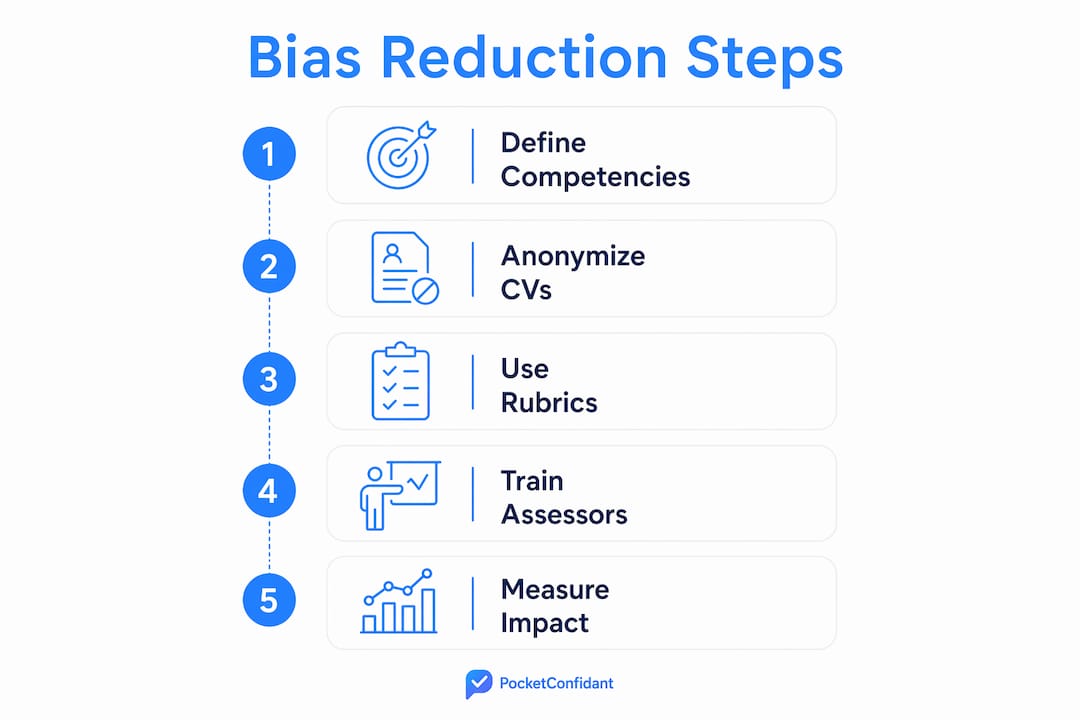
Anonymization works, but only when it is implemented completely. Hiding identifiers such as names and gender gives women better chances of being interviewed and hired. The mechanism is straightforward: screeners evaluate what candidates have done rather than who they appear to be.
The practical steps for anonymization include:
- Remove names, photos, addresses, and graduation years from CV templates before distribution to screeners.
- Enable the "screening mode" in your ATS so that identifiable data is hidden at the point of review, not just redacted from a PDF copy.
- Train screeners to assess anonymized CVs against the rubric rather than making holistic judgments, since holistic review reintroduces subjectivity.
- Audit free-text fields and cover letters for inadvertent identifiers such as gendered pronouns or references to specific institutions associated with particular demographics.
One important caveat: anonymization may conflict with some DEI initiatives, particularly targeted outreach programs that track whether underrepresented candidates are progressing through the funnel. HR teams need to decide at which stage anonymization applies and where demographic tracking serves a different equity goal.
Pro Tip: Partial anonymization often fails because identifiers leak through free text or metadata. Treat anonymization as an end-to-end ATS configuration, not a manual redaction task. A single visible identifier is enough to reactivate unconscious bias in a screener.
What role do ATS tools and AI play in fair candidate evaluation?
Applicant tracking systems and AI screening tools can support unbiased recruitment processes, but they carry their own risks that require active management.
The table below summarizes the key capabilities, risks, and safeguards for the most common automated screening approaches:
| Approach | Capability | Key Risk | Required Safeguard |
|---|---|---|---|
| ATS screening mode | Hides identifiers during CV review | Partial configuration leaves gaps | End-to-end setup with assessor training |
| Keyword-based filtering | Applies consistent criteria at scale | Replicates historical bias in job descriptions | Regular keyword audits against demographic data |
| AI scoring models | Ranks candidates by predicted fit | Amplifies bias from biased training data | Monthly bias reviews across demographic groups |
| Automated shortlisting | Reduces time-to-screen significantly | Removes human judgment where it adds value | Human review of all automated rejections |
ICO guidance emphasizes monthly bias reviews, transparency with candidates about automated decisions, and clear safeguards for any AI-driven hiring process. That is not optional compliance language. It reflects the practical reality that automated tools trained on historical hiring data will reproduce historical patterns unless actively corrected.
Transparency with candidates about how automated screening works also matters. Informing job seekers about automated decision-making and their rights builds trust and improves fairness perceptions. HR teams using AI candidate screening should document their bias monitoring process and make it available to candidates on request.
How should HR teams train assessors for unbiased screening?
Training is the mechanism that makes structured processes work in practice. Without it, rubrics become box-ticking exercises and anonymization becomes a formality.
Effective assessor training for fair candidate evaluation covers four areas. First, screeners need to understand the specific competencies they are scoring and what evidence on a CV constitutes a strong, acceptable, or weak demonstration of each. Second, calibration sessions where multiple screeners independently score the same sample CVs and then compare results expose inconsistency and correct it before it affects real candidates. Third, screeners need to understand how unconscious bias operates at the point of reading, not just in the abstract. Knowing that a name can trigger bias is less useful than practicing the habit of scoring each competency before forming an overall impression.
Google re:Work documents positive outcomes from structured interviewing that reduces bias and improves predictive validity. The same principles apply directly to screening: vetted criteria, standardized rubrics, and trained assessors produce more consistent and fairer outcomes than unstructured review. GOV.UK similarly recommends panels, planned questions, and clear scoring to make evaluation less biased and more transparent.
Ongoing development matters as much as initial training. Quarterly calibration reviews, periodic refreshes of the competency framework, and regular analysis of shortlist demographics by assessor keep the process honest over time. The role of the hiring manager in modeling and enforcing these standards is as important as the training itself.
How do you measure whether your screening reforms are working?
Measurement is what separates a genuine bias-reduction program from a policy document. Without baseline data and consistent tracking, you cannot know whether your changes are having any effect.
A practical measurement framework follows this sequence:
- Establish baseline shortlist rates by sex, ethnicity, and disability status before implementing any changes.
- Track application-to-interview conversion rates by demographic group after each reform is introduced.
- Collect candidate feedback surveys at the screening stage to capture fairness perceptions from applicants who were not shortlisted.
- Monitor downstream effects: do demographic patterns at the shortlist stage predict patterns at offer and hire?
- Conduct a formal bias audit every six months, comparing shortlist demographics against the applicant pool and the broader labor market.
GOV.UK recommends tracking applicant shortlist rates by sex, ethnicity, and disability alongside candidate survey feedback to evaluate the real impact of screening reforms. That data serves two purposes: it validates what is working, and it surfaces where bias is persisting despite the changes.
Pro Tip: Measuring the effect of screening changes requires clear baseline data before you start. If you implement anonymization and structured rubrics simultaneously, you will not be able to isolate which change drove the improvement. Introduce reforms sequentially where possible.
Key takeaways
Reducing hiring bias at the screening stage requires process redesign, not just awareness training. Structured criteria, anonymization, calibrated assessors, and continuous measurement work together as a system.
| Point | Details |
|---|---|
| Structured criteria first | Define role competencies and scoring rubrics before reviewing any applications. |
| Anonymize end-to-end | Configure ATS screening mode fully; partial anonymization allows identifiers to leak through free text. |
| Train and calibrate assessors | Calibration sessions using sample CVs expose inconsistency before it affects real candidates. |
| Monitor AI tools actively | Run monthly bias reviews on any automated screening model to prevent historical bias from compounding. |
| Measure with baseline data | Track shortlist rates by demographic group before and after each reform to validate impact. |
Why process redesign beats bias training every time
Most organizations respond to hiring bias concerns by booking a training session. The research does not support that approach as a primary intervention. Hiring bias reduction is a process redesign challenge, and structured systems make the biggest difference, not awareness alone.
In my experience working with HR teams across industries, the organizations that make the most progress are the ones that treat screening as an engineering problem. They ask: where in this process does subjective judgment enter, and how do we replace it with a defined criterion? That question leads to rubrics, anonymization, and calibration. It does not lead to a one-day workshop.
The tension between anonymization and DEI tracking is real and worth taking seriously. Hiding demographic data at screening protects against bias in that moment, but it can obscure whether underrepresented candidates are progressing through the funnel at all. The solution is not to choose one goal over the other. It is to anonymize at the point of evaluation and track demographics at the aggregate level, separately from the screening decision itself.
Bias can return at downstream stages if structured, calibrated assessments do not continue beyond screening into interviews. The screening stage is the right place to start, but it is not the right place to stop. Leadership commitment to consistent evaluation standards across every hiring stage is what makes the difference between a reform that holds and one that fades after six months.
— Hudson
How Evy supports fair, structured screening at scale
Evy is built for HR teams that need to screen at scale without sacrificing fairness or integrity. Evy's AI interview platform automates candidate evaluation with structured, consistent scoring so that every applicant is assessed against the same criteria, regardless of when or where they complete their interview.
Evy's real-time eye tracking adds a layer of integrity that no other platform provides. It identifies candidates using AI assistance during interviews, so your shortlist reflects genuine capability rather than coached responses. For teams working to build unbiased screening workflows, Evy combines the consistency of structured evaluation with the transparency your candidates and compliance teams expect. Explore Evy's full feature set to see how it fits into your hiring process.
FAQ
What is the most effective way to reduce bias at the screening stage?
Structured, skill-based screening using standardized rubrics and anonymized CVs is the most evidence-based approach. GOV.UK research shows that combining anonymization with defined competency criteria and assessor training produces measurably fairer shortlists.
Does anonymizing CVs always improve hiring fairness?
Anonymization reduces gender and name-based bias, but it must be configured end-to-end in your ATS to work. Partial anonymization fails when identifiers leak through free text, cover letters, or metadata.
How do ATS tools help eliminate bias in hiring?
ATS screening modes hide identifiable data during CV review and apply consistent scoring criteria at scale. However, AI-driven tools require monthly bias reviews and human oversight to prevent automated systems from replicating historical hiring patterns.
How should HR teams measure the impact of screening reforms?
Track application-to-interview conversion rates by sex, ethnicity, and disability before and after each change. GOV.UK recommends pairing demographic shortlist data with candidate feedback surveys to get a complete picture of screening fairness.
Can structured screening at the CV stage prevent bias in interviews too?
Structured screening reduces bias at shortlisting, but bias can re-emerge at the interview stage without consistent evaluation criteria and calibrated interviewers. Google re:Work and GOV.UK both recommend extending structured, rubric-based assessment through every hiring stage.