
 By Adrian Pascual•Hiring insight•Published
Types of Interview Questions for Technical Roles
Types of interview questions for technical roles fall into five distinct categories: coding challenges, system design problems, behavioral questions, hypothetical scenarios, and domain-specific queries. Each category targets a different dimension of candidate ability, and using all five gives you a far more accurate picture than any single format alone. HR professionals and hiring managers who understand how these question types work, and when to use each, consistently make better hiring decisions in technical roles. This guide breaks down every category with concrete examples, evaluation criteria, and practical guidance for building a stronger interview process.
1. Types of interview questions for technical roles: an overview
The architecture of a technical interview typically includes a recruiter screen, one or more coding rounds, a system design session for mid-level and senior candidates, and a behavioral interview. This structure is not arbitrary. Each stage filters for a different competency, and skipping any one of them leaves a meaningful gap in your assessment. Structured interviewing, as defined by Google re:Work, requires vetted questions, scoring rubrics, and calibrated interviewers rather than gut feel. The result is a process that is fairer to candidates and more reliable for your organization.
2. Coding questions: the foundation of technical screening
Coding questions are the most widely recognized format in technical hiring. They test algorithmic thinking, problem-solving under pressure, and the ability to write correct, efficient code. Common formats include algorithm challenges, data structure manipulation, and logic puzzles drawn from real engineering problems.
Typical examples include:
- Two Sum: Given an array of integers, return indices of two numbers that add up to a target. This tests hash map usage and time complexity awareness.
- Linked list reversal: Reverse a singly linked list in place. This probes pointer manipulation and memory management.
- Binary search variants: Find the first or last occurrence of a target in a sorted array. This evaluates understanding of edge cases and loop invariants.
- String parsing: Validate or transform strings according to a rule set. This tests attention to detail and handling of boundary conditions.
Evaluation goes beyond whether the candidate gets the right answer. You are watching for how they communicate their reasoning, whether they ask clarifying questions, and how they respond when their first approach fails. A candidate who talks through a wrong solution clearly is often more valuable than one who silently produces a correct answer. Coding problems in technical screens are most effective when they reflect the actual complexity of the work your team does, not abstract puzzles with no real-world analog.
Pro Tip: Give candidates a few minutes to read the problem silently before asking them to speak. Candidates who feel rushed often skip the clarifying questions that reveal their best thinking.

3. System design questions: assessing architectural thinking
System design questions are the primary tool for evaluating mid-level and senior engineers. They assess a candidate's ability to think at scale, make trade-offs, and reason about reliability, data flow, and operational ownership. System design rounds emphasize architecture, scalability, and the ability to justify decisions under constraint.
A well-structured system design question typically progresses through four stages: clarifying requirements, estimating scale, proposing a high-level architecture, and then drilling into specific components. This multi-step approach is what interviewers expect to see from candidates at the mid-senior level. Candidates who skip directly to a solution without asking about scale or constraints are signaling a gap in design maturity.
Common system design questions include:
- Design a URL shortener like bit.ly, covering storage, hashing, and redirect latency.
- Design a notification system for a social platform, addressing fan-out, delivery guarantees, and rate limiting.
- Design a ride-sharing backend, covering real-time location updates, matching algorithms, and database partitioning.
- Design a distributed cache, discussing eviction policies, consistency models, and failure handling.
For junior candidates, you can simplify the scope. Ask them to design a single component rather than a full system. This still reveals their reasoning process without penalizing limited experience. For senior candidates, push on trade-offs: ask why they chose a relational database over a document store, or how they would handle a 10x traffic spike.
4. Behavioral questions tailored for technical candidates
Behavioral questions probe how candidates have actually behaved in past situations, which is a stronger predictor of future performance than hypothetical questions alone. Behavioral interview questions in technical contexts focus on communication, ownership, conflict resolution, and handling ambiguity. These are not soft-skill add-ons. They are core competencies for any engineer working on a team.
The STAR method (Situation, Task, Action, Result) gives candidates a framework for structuring answers and gives you a consistent basis for comparison. Structured behavioral questions also validate resume claims by asking candidates to describe specific situations rather than speak in generalities.
Common behavioral questions for technical roles include:
- "Tell me about a time you disagreed with a technical decision made by your team. What did you do?"
- "Describe a project where requirements changed significantly mid-development. How did you adapt?"
- "Give me an example of a time you identified a performance problem before it became a production incident."
- "Tell me about a time you had to explain a complex technical concept to a non-technical stakeholder."
- "Describe a situation where you took ownership of a problem that was not strictly your responsibility."
Situational questions, which ask "what would you do if..." rather than "tell me about a time when...", are useful for assessing judgment in scenarios a candidate may not have encountered yet. They work best as a complement to behavioral questions, not a replacement.
Pro Tip: Prepare follow-up probes for each behavioral question in advance. Asking "what was the outcome?" or "what would you do differently?" surfaces the depth of self-awareness that separates strong candidates from polished ones.
5. Domain-specific questions for specialized technical roles
Domain-specific questions verify deep expertise in a candidate's area of specialization. Specialized technical questions are critical for roles where generalist skills are not sufficient, such as machine learning engineers, security specialists, or cloud architects. A candidate who performs well on general coding problems may still lack the domain knowledge your role requires.
Examples by domain include:
- Frontend: How does JavaScript's event loop handle asynchronous callbacks? What is the difference between "useEffect and useLayoutEffect` in React?
- Backend: How would you optimize a slow SQL query on a table with 50 million rows? What are the trade-offs between connection pooling strategies?
- Machine learning: Explain the bias-variance trade-off and how you would diagnose it in a deployed model. How do you handle class imbalance in a training dataset?
- Cloud and infrastructure: What is the difference between horizontal and vertical scaling in AWS? How would you design a multi-region failover strategy?
- Security: How does a SQL injection attack work, and what are the standard mitigations? What is the difference between authentication and authorization?
The challenge for HR professionals is that evaluating domain-specific answers requires a subject matter expert in the room. If your team does not have one, consider using a structured scoring rubric prepared by a senior engineer, or a take-home technical assessment reviewed by a domain expert. Balancing generalist and specialist questions in the same loop gives you a fuller picture without overloading the candidate on niche knowledge.
6. Comparison of question types: when to use each
Choosing the right mix of question types depends on the role level, the team's needs, and what you most need to verify. The table below summarizes the purpose, best use, and evaluation focus for each type.
| Question type | Primary goal | Best for | Evaluation focus |
|---|---|---|---|
| Coding challenges | Problem-solving and algorithmic skill | All levels | Correctness, efficiency, communication |
| System design | Architectural judgment and scalability | Mid to senior | Trade-offs, design maturity, ownership |
| Behavioral | Past behavior and soft skills | All levels | Communication, ownership, conflict handling |
| Situational | Judgment in novel scenarios | All levels | Reasoning, values, decision-making |
| Domain-specific | Deep technical expertise | Specialist roles | Accuracy, depth, applied knowledge |
Sequencing matters as much as selection. A recruiter screen should filter for basic qualifications and communication. A coding round should follow to establish technical baseline. System design comes next for senior roles, where architectural thinking is non-negotiable. Behavioral questions work best near the end of the loop, once you have enough context about the candidate's technical background to ask meaningful follow-up probes.
Rubric clarity and interviewer calibration are the two most common failure points in technical interview loops. When two interviewers score the same answer differently, the problem is almost always the rubric, not the candidate. Reviewing scoring definitions as a team before the interview loop begins prevents this and keeps your process defensible.
Key takeaways
Effective technical hiring requires a deliberate mix of coding, system design, behavioral, and domain-specific questions, each scored against a calibrated rubric.
| Point | Details |
|---|---|
| Use all five question types | Coding, system design, behavioral, situational, and domain-specific questions each reveal different competencies. |
| Match question type to role level | System design is non-negotiable for senior roles; coding baselines apply across all levels. |
| Structure behavioral questions with STAR | STAR-based prompts produce comparable answers and reduce evaluator subjectivity. |
| Calibrate rubrics before each loop | Inconsistent scoring usually reflects rubric ambiguity, not candidate performance. |
| Sequence questions deliberately | Move from recruiter screen to coding to design to behavioral for the most reliable signal. |
Why the interview format you choose matters more than you think
I have reviewed hundreds of technical interview loops across engineering teams of every size, and the most consistent finding is this: the format of the interview predicts the quality of the hire more reliably than the difficulty of the questions. Teams that use a single question type, usually coding challenges, consistently miss candidates who would have excelled in the role and pass candidates who cannot collaborate or communicate under pressure.
The shift toward structured interviewing practices has been one of the most meaningful changes in technical hiring over the past decade. But structure alone is not enough. I have seen teams with beautifully designed rubrics that still produced inconsistent results because interviewers were not calibrated on what a "strong" answer actually looked like. The rubric is only as good as the conversation that happens before the loop begins.
There is also a growing concern that I think deserves more attention: the integrity of the interview itself. As AI tools become more accessible, candidates can generate plausible-sounding answers to behavioral questions or receive real-time coding assistance during remote screens. This does not mean every candidate is cheating, but it does mean that the signals you are reading may not always reflect genuine ability. Choosing the right interview platform and building in verification mechanisms is no longer optional for teams that care about fair, accurate assessment.
— Hudson
How Evy supports structured, secure technical interviews
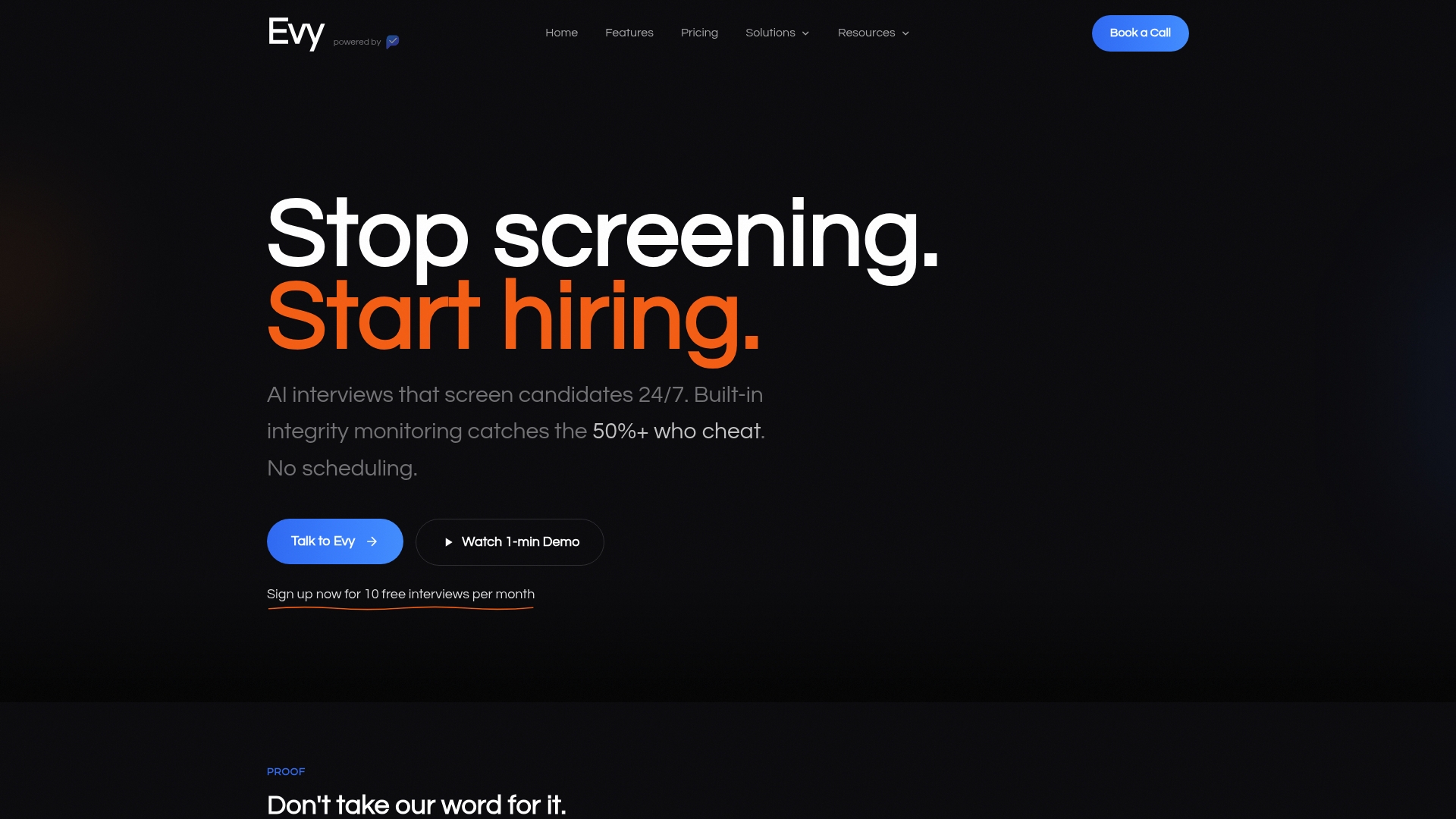
Evy is the only AI interview platform with real-time eye tracking designed to catch candidates using AI assistance during live screens. For HR professionals running technical interview loops at scale, this matters. A candidate who appears to answer a system design question fluently may be reading from an AI-generated response off-screen. Evy's attention pattern analysis surfaces these discrepancies so your team evaluates genuine thinking, not assisted performance. You can explore Evy's full suite of anti-cheat interview features to see how structured scoring, 24/7 screening, and integrity monitoring work together to surface honest, qualified technical talent.
FAQ
What are the main types of technical interview questions?
The five main types are coding challenges, system design questions, behavioral questions, situational questions, and domain-specific questions. Each targets a different competency, from algorithmic thinking to communication and specialized expertise.
When should system design questions be used?
System design questions are most appropriate for mid-level and senior technical roles. System design rounds assess architectural judgment, trade-off reasoning, and scalability thinking that junior candidates are not yet expected to demonstrate.
How do behavioral questions differ from situational questions?
Behavioral questions ask candidates to describe past experiences using the STAR method, while situational questions ask how they would handle a hypothetical scenario. Both are useful, but behavioral questions provide stronger evidence of actual performance.
How do you write effective screening questions for technical roles?
Effective screening questions are tied to specific competencies, use consistent scoring rubrics, and are reviewed by calibrated interviewers before the loop begins. Guidance on writing screening questions aligned with technical role requirements can help your team build a more defensible process.
Why does rubric calibration matter in technical interviews?
When interviewers score the same answer differently, the problem is almost always rubric ambiguity. Rubric clarity and calibration prevent divergent interpretations and make your hiring decisions more consistent and legally defensible.