
 By Adrian Pascual•Hiring insight•Published
AI Candidate Screening for HR: What Hiring Managers Need
Use AI candidate screening for first-pass triage now, with human review, explainability, and audit trails enabled from day one. The throughput gains are real: recruiters who automate initial resume review can process hundreds of applications in the time it previously took to skim a single stack manually.
TL;DR:
- Who should use it: Teams filling high-volume roles (customer support, early-career, corporate graduate programs) and tech-heavy positions where skills validation matters
- What to enable immediately: Audit trails, explainability notes on every decision, and a human-in-the-loop sign-off on all rejections
- Immediate next step: Design a pilot lasting a few months with multiple screens, a manual baseline for comparison, and adverse-impact testing built in from the start
Table of Contents
- What does AI candidate screening actually include?
- How does AI screening work under the hood?
- What types of AI screening tools should you consider?
- Where does AI screening create measurable value?
- What concrete benefits should HR expect?
- What are the legal and ethical risks of AI screening in the U.S.?
- What should you look for in an AI screening vendor?
- How do you validate a tool and measure ROI?
- What does a realistic implementation timeline look like?
- How does Evy address the integrity gap in AI-assisted screening?
- Key Takeaways
- The part of AI screening most teams get wrong
- Evy screens at scale with integrity built in
- Useful sources and references
What does AI candidate screening actually include?
AI candidate screening is the use of machine learning and natural language processing to evaluate job applicants at one or more stages of the hiring funnel — from resume parsing through asynchronous video interviews — before a human recruiter makes a final judgment call.
The scope matters here, because the term gets stretched. Screening is triage, not sourcing. It starts after a candidate applies and ends when a shortlist reaches a recruiter's desk. It is distinct from ATS automation (which routes and tracks applications) and from sourcing tools (which find passive candidates). If a vendor conflates all three, that is worth noting.
Common features HR encounters in screening tools:
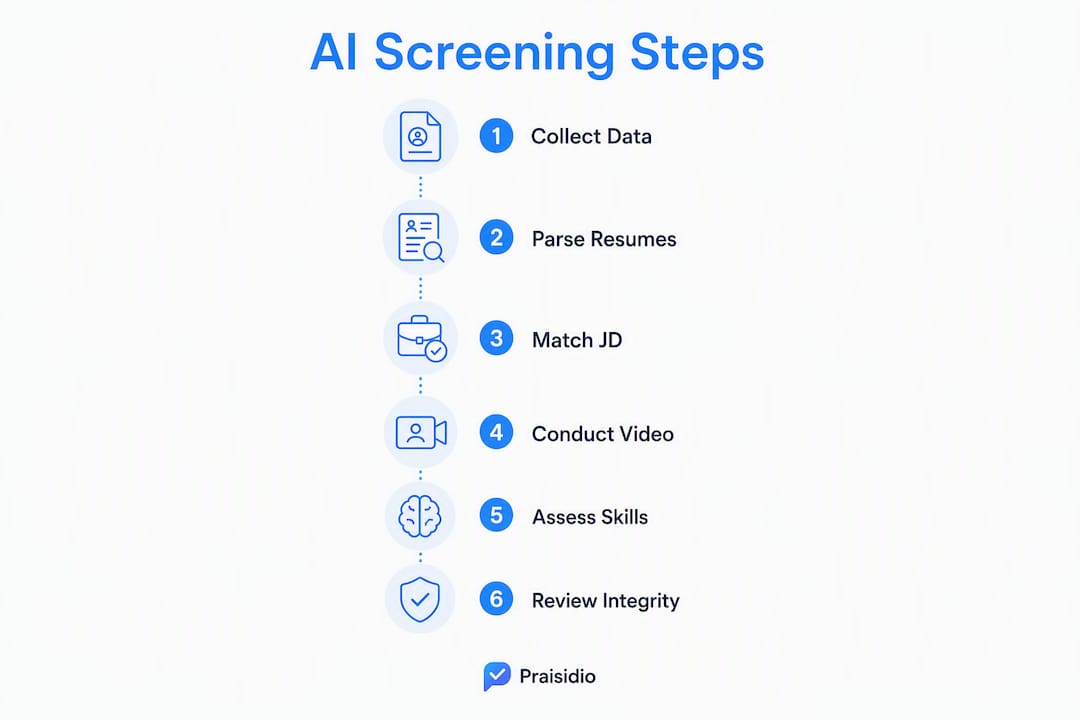
- Resume parsing and job-description matching: Extracts structured data from PDFs, DOCX files, and scanned images, then scores candidates against a pasted or uploaded job description
- Semantic skill matching: Goes beyond keyword overlap to identify equivalent skills (e.g., "Python" and "data scripting") using embedding models
- Asynchronous video interviews: Candidates record responses to preset questions; the platform analyzes speech, language, and sometimes behavioral signals
- Structured skills assessments: Timed, role-specific tests for coding, writing, numerical reasoning, or domain knowledge
- Behavioral scoring: Flags attention patterns, response consistency, or anomalies that may indicate unauthorized assistance
- Explainability outputs: Match scores with written rationale, strengths/gaps summaries, and Advance/Maybe/Reject verdicts
Typical inputs include resumes, LinkedIn profiles, GitHub repositories, video recordings, and assessment results. Expected outputs are a match score (often 0–100), a structured verdict, and a rationale note the recruiter can review and override.
How does AI screening work under the hood?
The workflow chains together in a predictable sequence, even when the underlying models differ across vendors. Understanding each step helps HR teams configure the system correctly and know exactly where human judgment must stay in the loop.
The core workflow:
- Ingest: The platform receives the application package (resume, cover letter, portfolio links, assessment responses).
- Parse and normalize: NLP models extract structured fields: job titles, tenure, skills, education, certifications. Scanned documents go through OCR first.
- Feature extraction: The system builds a candidate feature vector, pulling semantic signals from free-text fields and cross-checking public profiles where permitted.
- Scoring and rules engine: A scoring model compares the feature vector against the role rubric. Hard knockout rules (e.g., required license) apply first; weighted scoring follows.
- Explainability output: The platform generates a rationale note: which criteria drove the score, what gaps were identified, and the resulting verdict.
- Downstream actions: Based on the verdict, the system triggers an ATS status update, a scheduling webhook, a rejection email, or a hold queue for human review.
The ML techniques behind each step vary. Resume parsing and JD matching rely on NLP and transformer-based embeddings for semantic similarity. Video screens add computer vision for attention and behavioral signals, plus audio analysis for speech clarity and response coherence. Structured assessments use psychometric scoring models.
Where do HR decisions live? At two points: rubric definition before the system runs (the most consequential configuration decision) and human sign-off on rejections before any candidate communication goes out. Screening quality correlates directly with rubric precision, not with the sophistication of the underlying model. A well-configured rubric on a mid-tier platform will outperform a poorly configured enterprise tool every time.

On the integration side, most platforms connect to ATS systems via API or native connectors, trigger scheduling through calendar webhooks, and store audit logs in exportable formats for compliance reviews.
What types of AI screening tools should you consider?
Not every team needs every category. The right tool type depends on hire volume, role complexity, and where integrity risk is highest in your funnel.
- High-volume resume matchers: Best for roles receiving 200+ applications per opening. Inputs are resumes and job descriptions; outputs are ranked shortlists with match scores. Most valuable at the top of the funnel, before any human review. Technical role screening often pairs these with skills tests for a two-stage filter.
- Asynchronous video interview platforms: Best for roles where communication, presence, or culture fit matters early. Candidates record responses on their own schedule; the platform scores language, structure, and behavioral signals. Most valuable as a second-stage filter after resume shortlisting.
- Skills assessment platforms: Best for technical, analytical, or domain-specific roles. Inputs are timed test responses; outputs are percentile scores and pass/fail verdicts against a benchmark. Most valuable when a resume cannot reliably signal actual capability.
- Integrity and proctoring solutions: Best for any role where candidate deception is a material risk, including remote-first hiring and high-stakes technical screens. Inputs include real-time behavioral signals (eye tracking, attention patterns, tab-switching detection); outputs are integrity flags and confidence scores alongside the assessment result.
| Use case | Resume matcher | Async video | Skills assessment | Integrity/proctoring |
|---|---|---|---|---|
| High-volume hiring | Primary tool | Optional second stage | Selective | Recommended |
| Specialized technical roles | Supporting filter | Low priority | Primary tool | Recommended |
| Diversity-focused hiring | Use with bias audit | Use with structured prompts | Preferred (objective) | Optional |
| Compliance-heavy hiring | Required audit trail | Required audit trail | Required audit trail | Required |
The use-case matrix above is a starting point, not a prescription. A compliance-heavy role may need all four categories in sequence. A small team hiring for one specialized position may only need a skills assessment with integrity monitoring.
Where does AI screening create measurable value?
The clearest gains show up in three areas: triage speed, funnel consistency, and downstream hire quality. Each is measurable, which matters when you are building a business case for a pilot budget.
Primary value areas:
- Triage speed: Automated resume review processes applications in seconds per candidate rather than the few seconds of manual attention most resumes receive, which means a 500-application role can be shortlisted in hours rather than days.
- Funnel consistency: Every candidate is evaluated against the same rubric, eliminating the variance that comes from different recruiters applying different mental models to the same role.
- Standardized feedback: Candidates who are not advanced receive a structured rationale rather than silence, which reduces complaints and improves employer brand perception.
- Funnel hygiene: Automated scoring surfaces candidates who would have been missed in a manual review, particularly those whose resumes are formatted unconventionally or whose skills are described in non-standard terms.
- Interview-to-offer improvement: When screening is more accurate at the top of the funnel, the candidates who reach final interviews are better matched, and conversion rates improve.
Metrics HR teams should track from day one:
- Resumes processed per hour (screened vs. manual baseline)
- Time from application close to shortlist delivery
- Interview-to-offer conversion rate (pilot cohort vs. control)
- Recruiter hours saved per role
- Adverse-impact ratio by protected class
The roles that see the biggest gains are high-application-volume positions (customer support, retail management, early-career corporate programs) and roles where skills validation is currently inconsistent. For hire quality improvements, the gains tend to compound: better screening inputs produce better shortlists, which produce better hires, which reduce early attrition.

What concrete benefits should HR expect?
Speed is the benefit that gets cited most often, but consistency is the one that compounds over time. A team that screens 1,000 applications manually will apply slightly different standards on Monday morning versus Friday afternoon. An AI screening system applies the same rubric to application 1 and application 1,000.
Benefits HR can expect and measure:
- Faster time-to-shortlist: Automated first-pass triage compresses what can be a multi-day manual process into hours, directly reducing time-to-fill.
- Consistent evaluation standards: Every candidate is scored against the same documented rubric, which also makes the process easier to audit and defend.
- Scalable interviewing capacity: Asynchronous video and adaptive conversational interviews let a team of three recruiters run the equivalent of hundreds of structured screens per week.
- Tailored interview prompts: Well-configured platforms generate role-specific questions based on the job description and the candidate's resume, rather than relying on generic question banks.
- Better measurement: Scoring data creates a feedback loop. Teams can track which rubric criteria actually predict downstream performance and refine the model over time.
Candidate experience also improves when screening is paired with clear communication. Candidates who receive a structured explanation of why they were not advanced are significantly less likely to leave negative reviews or disengage from future applications. Treat transparency as a performance lever, not just a courtesy.
Pro Tip: Before running a pilot, establish your baseline metrics manually: average hours per shortlist, current interview-to-offer rate, and time-to-fill by role type. Without a baseline, you cannot measure the actual impact of automation.
What are the legal and ethical risks of AI screening in the U.S.?
The risks are real and specific. Deploying an automated screening tool without the right controls exposes your organization to EEOC complaints, OFCCP audits, and state-level enforcement actions. Understanding the risk buckets before you select a vendor is not optional.
Main risk categories:
- Adverse impact and bias: If a screening model produces selection rates for a protected class that fall below the four-fifths (80%) threshold relative to the highest-scoring group, that is a prima facie adverse-impact finding under EEOC guidelines. Vendors must be able to produce impact-ratio reports on demand.
- Privacy and data retention: Candidate PII collected during screening must be handled under applicable law. California candidates are covered by the CCPA; EU candidates trigger GDPR Article 22, which requires meaningful human review of automated decisions and the right to contest them.
- Candidate deception: AI-generated responses and unauthorized assistance during assessments undermine the validity of screening results. A score that does not reflect the candidate's actual ability is a liability, not an asset.
- Inaccurate inference: Models that infer protected characteristics (age, gender, national origin) from proxy signals in resumes or speech patterns can introduce bias even when those fields are explicitly excluded.
- Candidate experience and transparency: Candidates who are rejected by an automated system without explanation have grounds for complaints and, in some jurisdictions, legal challenges.
Compliance checks HR must run:
- EEOC four-fifths rule: Require vendors to produce adverse-impact reports segmented by protected class before production rollout.
- OFCCP data segregation: Federal contractors must maintain applicant-flow data separately from scoring data and be able to export both for audits.
- NYC Local Law 144: If you hire candidates based in New York City, your automated employment decision tool must undergo an annual bias audit by an independent third party, and candidates must receive advance notice.
- CCPA: California candidates have the right to know what data is collected and how it is used. Vendor data processing agreements must reflect this.
- GDPR Article 22: For EU candidates, automated decisions with legal or significant effects require human review, an explanation, and a right to contest.
Pro Tip: Require vendors to provide a sample adverse-impact report and a sample audit log export before signing any contract. If they cannot produce both within 48 hours of a request, that is a red flag about their compliance readiness.
Separate demographic data from scoring data in your ATS. Require human sign-off on every rejection before communication goes out. Document the rubric, the model version, and the configuration settings used for each role. These three practices cover most of the practical compliance exposure.
What should you look for in an AI screening vendor?
The vendor evaluation process is where most teams lose time. The checklist below maps directly to the comparison dimensions that matter for compliance, accuracy, and operational fit.
Vendor scorecard dimensions:
- Use-case fit: Does the platform handle your hire volume and role types? A tool built for high-volume customer support hiring may not score well on specialized technical roles.
- Data inputs and channels: Which inputs does the platform accept (resume, video, assessment, LinkedIn, GitHub)? Can it handle your current application format?
- Explainability and audit trail: Does every score come with a written rationale? Can you export the full audit log for any candidate, including the rubric version used?
- Compliance and bias mitigation: Can the vendor produce adverse-impact reports by protected class? Do they redact protected-class signals before scoring? Are they NYC Local Law 144 audit-ready?
- Integrations: Does the platform connect natively to your ATS and HRIS? Does it support SSO? Can it trigger scheduling webhooks?
- Scalability and throughput: What is the platform's maximum concurrent screen capacity? What is the SLA for score delivery?
- Pricing model: Is pricing per-interview, per-seat, or usage-based? What is the cost per screen at your expected volume?
- Anti-cheat capability: Does the platform detect AI-generated responses, unauthorized assistance, or attention anomalies during live screens?
Questions to ask every vendor:
- Can you produce an impact-ratio report segmented by race, gender, and age for a sample dataset?
- Do you redact protected-class signals (name, address, graduation year) before the scoring model runs?
- How do you store audit logs, and can we export them in a format our legal team can use?
- What proctoring methods do you use, and how are integrity flags surfaced to recruiters?
- Where is candidate PII hosted, and what is your data retention policy?
- Can you export applicant-flow data in OFCCP-compliant format?
- What is your model retraining cadence, and how do you notify customers of model changes?
Red flags to watch for:
- No audit log or an audit log that cannot be exported
- Black-box scoring with no written rationale per candidate
- Inability to produce adverse-impact reports on request
- Mandatory use of vendor-only training data with no performance statistics provided
- Vague answers about where candidate PII is stored or how long it is retained
For a deeper evaluation framework and vendor questions, the criteria above map directly to what separates compliant, explainable tools from marketing claims.
How do you validate a tool and measure ROI?
A pilot is not a proof of concept. It is a structured measurement exercise with a control group, defined success metrics, and a governance gate before production rollout.
Pilot design checklist:
- Define goals: What does success look like? Faster shortlists, better interview-to-offer conversion, reduced recruiter hours, or all three? Write it down before the pilot starts.
- Set sample size: Aim for a sufficient number of screens to generate statistically meaningful adverse-impact data, since small sample sizes make the four-fifths calculation unreliable.
- Establish a control group: Run the AI screening tool on one cohort while a second cohort goes through your current manual or ATS-based process. The delta between cohorts is your ROI signal.
- Define duration: A few months is the standard pilot duration balancing seasonal variation and timely decisions.
- Assign governance: Decide in advance who reviews the pilot results, who signs off on production rollout, and what the pass/fail thresholds are for adverse impact and accuracy.
- Run adverse-impact testing: Apply the four-fifths rule to the pilot cohort. If any protected class falls below the 80% selection rate threshold relative to the highest-scoring group, pause and investigate before proceeding.
- Measure recruiter time saved: Track hours from application close to shortlist delivery for both cohorts. The difference is your efficiency gain.
- Track conversion deltas: Compare interview-to-offer rates between the AI-screened cohort and the control. A meaningful improvement here is the strongest ROI signal.
Illustrative pilot metric table:
| Metric | Baseline (manual) | AI-screened cohort | Target delta |
|---|---|---|---|
| Hours per shortlist | Measure before pilot | Measure during pilot | Reduction |
| Time-to-first-interview | Measure before pilot | Measure during pilot | Reduction |
| Interview-to-offer rate | Measure before pilot | Measure during pilot | Improvement |
| Adverse-impact ratio | N/A | Measure during pilot | Above the four-fifths (80%) threshold |
| Cost per screened candidate | Calculate before pilot | Calculate during pilot | Reduction |
Fill in your baseline numbers before the pilot starts. The table is only useful if the baseline column has real numbers in it.
What does a realistic implementation timeline look like?
Most teams underestimate the time required for rubric definition and legal review, and overestimate how long integration takes. The phases below reflect a realistic production rollout for a mid-size HR team.
Implementation phases:
- Discovery and rubric definition (weeks 1–3): HR ops and hiring managers define role-specific scoring criteria, knockout rules, and weighting. Legal reviews the rubric for protected-class signal exposure. This phase is the most important and the most commonly rushed.
- Integration and data mapping (weeks 2–4): IT connects the screening platform to the ATS and HRIS via API. SSO is configured. Audit log storage and export paths are tested.
- Pilot run (weeks 4–10): The platform screens a live cohort against a manual control. Recruiters review scores and provide feedback on rubric accuracy. Adverse-impact data is collected.
- Validation and legal review (weeks 10–12): HR ops and legal review pilot results, adverse-impact reports, and audit log exports. Pass/fail decision against pre-defined thresholds.
- Rollout and change management (weeks 12–16): Production deployment for approved roles. Recruiter training on score interpretation, override procedures, and candidate communication. Hiring manager briefings on what the scores mean and what they do not.
| Phase | Duration | Owner |
|---|---|---|
| Discovery and rubric definition | 3 weeks | HR ops + hiring managers + legal |
| Integration and data mapping | 2–3 weeks | IT + HR ops |
| Pilot run | 6 weeks | Recruiting team + HR ops |
| Validation and legal review | 2 weeks | Legal + HR leadership |
| Rollout and change management | 4 weeks | HR ops + IT + recruiting |
For practical guidance on efficient screening workflows during the rollout phase, particularly for smaller teams, the implementation steps above can be compressed when rubric definition and integration run in parallel.
Change management deserves more attention than most implementation plans give it. Recruiters who do not understand how scores are generated will either over-rely on them or ignore them. Both outcomes undermine the investment. Short, role-specific training sessions on score interpretation and the override process are more effective than a single all-hands demo.
How does Evy address the integrity gap in AI-assisted screening?
Most AI screening platforms solve for speed and consistency. Fewer address the question that keeps hiring managers up at night: how do you know the candidate actually produced the responses you are scoring?
Evy's core capability is real-time eye tracking and integrity verification during AI-assisted interviews. The platform monitors attention patterns throughout the screen, flagging behavior that suggests a candidate is reading from an off-screen source, using AI-generated text, or receiving unauthorized assistance. That signal sits alongside the interview transcript and score, giving recruiters a complete picture rather than a score they have to take on faith.
Evy features relevant to screening integrity and quality:
- Real-time eye tracking: Monitors gaze patterns during live interview responses to detect attention anomalies consistent with AI assistance or off-screen reference
- Adaptive conversational interviewing: Generates follow-up questions based on the candidate's actual responses, making it harder to use pre-written AI answers effectively
- Automated scoring combining resume and live response: Produces a composite score that weights both the application materials and the live interview performance
- Video and transcript recording: Full session recording with timestamped transcript for recruiter review and audit purposes
- ATS integrations: Connects to existing applicant tracking systems so scores and integrity flags flow directly into the recruiter's existing workflow
- Anti-bias structured interview flow: Standardized question delivery and scoring rubrics reduce the influence of interviewer bias on outcomes
- Audit logs and compliance features: Exportable logs for every screen, including the rubric version, score rationale, and integrity flag history
- Dashboards for tracking and reporting: Role-level and cohort-level reporting on screening outcomes, integrity flags, and funnel conversion
A practical example: A hiring team running a high-volume remote screen for a technical support role noticed that a meaningful share of candidates who scored well on asynchronous video interviews were underperforming in subsequent live technical assessments. After adding Evy's real-time eye tracking to the screen, integrity flags identified a subset of candidates whose attention patterns during the video interview were inconsistent with natural thinking. Removing those candidates from the shortlist improved the correlation between screen scores and live assessment results.
Pro Tip: When piloting Evy, run multiple screens over several weeks with integrity monitoring enabled from the start. Track the correlation between integrity flag rates and subsequent live assessment performance. That correlation is the clearest signal of whether the integrity layer is adding real predictive value for your roles.
For a detailed look at how AI interview platforms work and where integrity monitoring fits in the broader workflow, the platform mechanics are worth reviewing before configuring your first rubric.
Key Takeaways
Effective AI candidate screening requires a documented rubric, human-in-the-loop review, adverse-impact testing, and integrity verification to produce shortlists that are both fast and defensible.
| Point | Details |
|---|---|
| Rubric quality determines outcomes | Define role-specific scoring criteria before enabling any AI screening tool; poor configuration causes most failures. |
| Compliance requires specific controls | Require adverse-impact reports, audit log exports, and OFCCP-compatible applicant-flow data from every vendor. |
| Pilot before production | Run 100–300 screens over 30–90 days with a manual control group and pre-defined pass/fail thresholds for adverse impact. |
| Integrity monitoring closes a real gap | Screening scores that cannot be verified against actual candidate behavior are a liability in high-stakes or remote hiring. |
| Evy adds integrity verification | Evy's real-time eye tracking and adaptive interviewing surface honest, qualified candidates alongside a full audit trail. |
The part of AI screening most teams get wrong
Most conversations about automated candidate screening focus on speed and bias. Speed is easy to measure and bias is legally urgent, so both get attention. What gets less attention is the validity problem: a fast, unbiased screen that scores AI-generated responses as genuine candidate performance is not an improvement over manual review. It is a more expensive version of the same mistake.
The integrity gap is not a niche concern. Remote hiring is now standard for a wide range of roles, and the availability of AI writing tools means that a candidate can produce a polished, on-topic video response without demonstrating any of the underlying capability the response appears to show. Screening systems that do not account for this are measuring something other than what they think they are measuring.
The trade-off is real. Adding integrity monitoring to a screen increases friction for candidates. Some will drop off. That is a cost worth acknowledging honestly, because the alternative is a shortlist that looks good on paper and underperforms in practice. The teams that get the most value from AI screening are the ones that treat integrity verification not as a punitive measure but as a quality control step, the same way a skills assessment is a quality control step.
Speed and fairness are not in tension with integrity. They require it. A shortlist that is fast, consistent, and verified is worth more than one that is merely fast and consistent.
Evy screens at scale with integrity built in
Hiring teams that have automated their resume review still face one unresolved question: are the candidates who score well on AI-assisted screens actually the candidates they appear to be? Evy is built specifically to answer that question.
Evy's AI interview platform combines real-time eye tracking, adaptive conversational interviewing, and automated scoring into a single screen that runs 24/7 at any volume. Every session produces a composite score, an integrity report, a full transcript, and an exportable audit log. The result is a shortlist you can defend to a hiring manager, a legal team, or a regulator.
Pricing is usage-based with pay-per-interview options and monthly or annual seat plans for teams running consistent volume. There is no minimum commitment to start a pilot.
Start your Evy pilot with 100–150 screens over 30–45 days and measure the correlation between integrity flags and downstream performance. That is the fastest way to know whether integrity-verified screening changes your outcomes.
Useful sources and references
The sources below are the most authoritative references for the claims and compliance guidance in this article. Use them for deeper reading, vendor evaluation, and legal checks before production rollout.
- SHRM: HR's Role in AI Adoption — SHRM survey data on how HR teams are currently deploying AI in hiring; useful for benchmarking your team's adoption stage
- Evy: What Is AI Candidate Screening? — Evy's definition and scope guide for HR teams new to automated screening
- Evy: Recruiting AI for HR Teams — Practical implementation guidance including change management and rollout planning
- LocateHire: How to Screen Job Applicants Efficiently — Tactical guidance for efficient screening workflows, particularly useful for smaller teams
For legal and compliance checks, consult these primary sources directly:
| Resource | What it covers | Where to use it |
|---|---|---|
| EEOC Uniform Guidelines on Employee Selection Procedures | Four-fifths rule, adverse-impact testing standards | Vendor evaluation, pilot design |
| NYC Local Law 144 | Bias audit requirements for automated employment decision tools | Any hiring involving NYC candidates |
| CCPA (California Consumer Privacy Act) | Candidate data rights and disclosure requirements | California candidate screening |
| GDPR Article 22 | Automated decision-making rights for EU candidates | International hiring |
| OFCCP Applicant Flow Log requirements | Data segregation and export standards for federal contractors | Federal contractor compliance |