
 By Adrian Pascual•Hiring insight•Published
Types of Candidate Screening Methods: HR Guide 2026
Candidate screening methods are systematic tools and processes used to evaluate the suitability of job applicants efficiently and accurately. The industry term for this practice is pre-employment assessment, and it spans everything from resume reviews to cognitive tests and structured video interviews. HR professionals who rely on a single screening method consistently make weaker hiring decisions than those who combine validated approaches. This guide covers the most effective types of candidate screening methods, explains the research behind each one, and shows you how to build a process that holds up under scrutiny.
What are the most common types of candidate screening methods?
Candidate screening methods fall into several distinct categories, each designed to measure a different dimension of candidate fit. The strongest hiring processes layer multiple methods rather than relying on any one signal.
1. Resume and CV screening
Resume screening is the most widely used first filter in recruitment. It evaluates a candidate's stated experience, education, and qualifications against the job requirements. The critical limitation is that resume screening is one of the weakest predictors of future job performance. It reflects past opportunity and presentation skill, not actual capability. Use it to eliminate clear mismatches, not to rank finalists.

Automated applicant tracking systems (ATS) can parse resumes for keywords and minimum qualifications at high volume. The risk is that rigid keyword filters screen out qualified candidates who describe skills differently. Manual review adds judgment but introduces inconsistency. The most defensible approach combines automated filtering with a human review of borderline cases.
2. Phone screening
Phone screening is a short, structured conversation, typically 15–20 minutes, used to confirm basic fit before investing in deeper assessment. It covers motivation, availability, salary expectations, and any role-specific must-haves. A recruiter can quickly identify candidates who misrepresent qualifications or who have unrealistic expectations. Phone screening is low cost and high speed, making it the right tool for high-volume pipelines.
The weakness of phone screening is subjectivity. Without a defined question set and scoring rubric, two recruiters will evaluate the same candidate differently. Standardize your phone screen with four to six fixed questions and a simple rating scale to make the data usable.
3. Cognitive ability tests
Cognitive ability tests measure reasoning, numerical analysis, verbal comprehension, and problem-solving speed. They are among the strongest predictors of job performance across a wide range of roles, particularly those requiring learning agility or analytical work. Talent acquisition experts recommend pairing cognitive tests with structured interviews to improve both predictive accuracy and legal defensibility. Neither method alone is as strong as the two combined.
Cognitive tests work best when they are role-relevant. A data analyst role justifies a numerical reasoning test. A customer service role may call for a verbal reasoning assessment instead. Generic tests applied indiscriminately add friction without adding signal.
4. Personality questionnaires
Personality questionnaires assess traits such as conscientiousness, openness, and emotional stability. They are most useful for evaluating cultural fit and predicting behavior in team environments. The validity of personality tools depends heavily on the instrument used. Validated frameworks like the Big Five (OCEAN) model produce more defensible results than proprietary tools with limited published research.
Personality questionnaires should not be used as standalone filters. They are best positioned as one input in a composite scoring model, weighted alongside cognitive and skills-based data. Candidates can also present themselves favorably on self-report tools, which limits their standalone reliability.
5. Situational judgment tests
Situational judgment tests (SJTs) present candidates with realistic workplace scenarios and ask them to choose the most effective response. They measure judgment, values alignment, and decision-making under realistic conditions. SJTs are particularly effective for roles where interpersonal judgment matters, such as management, customer-facing, or compliance-heavy positions.
Well-designed SJTs are difficult to game because there is no single obvious correct answer. They also tend to show lower adverse impact than purely cognitive measures, which makes them a useful addition to any assessment battery focused on fairness.
6. Video interviews
Video interviews come in two formats: asynchronous and live. Asynchronous video interviews ask candidates to record responses to standardized questions on their own time. Live video interviews allow adaptive dialogue between recruiter and candidate. Standardized questions in asynchronous formats reduce variability and allow direct comparison across candidates. Live formats allow follow-up questions and a more natural conversation.
The growing concern with video interviews is AI-assisted cheating. Candidates increasingly use AI tools to generate responses in real time, which undermines the validity of the assessment. Platforms that monitor attention patterns and eye movement during interviews address this directly. Evy is built specifically for this problem, using real-time eye tracking to detect when candidates are reading AI-generated responses rather than thinking independently.
Pro Tip: For asynchronous video interviews, limit response time to 90 seconds per question. Longer windows give candidates more opportunity to use external tools and reduce the natural quality of responses.
7. Work samples and job simulations
Work sample tests ask candidates to complete a task that mirrors actual job duties. A writing sample for a content role, a code review for a software engineer, or a mock sales call for a business development hire are all examples. These tests provide direct evidence of relevant skills and reduce reliance on resume cues. They are especially effective for specialist roles where technical output is measurable.
Job simulations go further by placing candidates in a simulated version of the work environment. They are resource-intensive to design but produce highly valid results. For high-stakes or senior roles, the investment is justified.
8. Background and reference checks
Background checks verify employment history, credentials, criminal records, and professional licenses. Reference checks gather qualitative feedback from former managers and colleagues. Both methods validate what candidates have claimed rather than predict future performance. They are most valuable as a final-stage safeguard, not as an early screening tool.
Reference checks are often treated as a formality, but structured reference interviews with specific behavioral questions produce far more useful data than open-ended conversations. Ask former managers to describe specific situations where the candidate demonstrated the competencies your role requires.
9. Structured interviews
Structured interviews use the same predetermined questions and anchored rating scales for every candidate. This consistency reduces interviewer variability and produces valid, comparable competency signals. Unstructured interviews, where interviewers ask whatever comes to mind, are significantly less predictive and more vulnerable to bias.
Behavioral and competency-based questions are the backbone of structured interviews. "Tell me about a time when you managed a conflicting deadline" produces more useful data than "Where do you see yourself in five years?" Calibrate your rubric before the interview process begins so all reviewers share the same standard.
10. Automated ATS screening and AI-assisted triage
Automated rule-based disqualification can reduce recruiter triage time by 60–75%. Recruiters screening more than 25 candidates per role or with more than five days to first contact benefit most from automation. ATS platforms apply deterministic rules, such as minimum years of experience or required certifications, to filter applications before a human ever reviews them. AI-assisted tools go further by scoring candidates against a rubric and routing the strongest profiles directly to recruiters.
The limitation of automation is that it only works when the input criteria are well defined. Without agreed-upon must-haves, no automation tool can effectively filter candidates. Automation amplifies your intake process. If your intake process is vague, automation amplifies the vagueness.
Pro Tip: Before activating any automated filter, align with the hiring manager on exactly 3–5 non-negotiable criteria. Write them down. Every filter rule should map directly to one of those criteria.
How does automation improve screening efficiency?
AI-driven screening tools integrate with ATS platforms to apply scoring rules, schedule candidate communications, and route qualified profiles to the right reviewers. The efficiency gains are real, but they depend entirely on the quality of the criteria fed into the system.
| Automation feature | Primary benefit | Key limitation |
|---|---|---|
| Rule-based disqualification | Cuts triage time by 60–75% | Requires clearly defined must-have criteria |
| AI rubric scoring | Consistent candidate ranking at scale | Rubric quality determines output quality |
| Automated scheduling | Reduces time-to-first-contact | Does not replace human judgment on fit |
| Candidate routing | Surfaces top profiles faster | Risk of filtering out non-traditional candidates |
Human judgment remains indispensable at the evaluation stage. Automation handles volume. Recruiters handle nuance.
Which methods are the most predictive?
The most predictive candidate assessment techniques combine cognitive ability tests and structured interviews. Composite scoring models that combine multiple validated methods outperform any isolated approach. The Society for Industrial and Organizational Psychology (SIOP) sets the standard for construct validity and criterion-related validity in selection instruments. Methods that meet these standards produce results that hold up legally and statistically.
- Cognitive ability tests paired with structured interviews produce the strongest predictive validity.
- Work samples and job simulations provide direct, role-relevant evidence.
- Situational judgment tests add behavioral prediction with lower adverse impact.
- Personality questionnaires contribute when weighted appropriately in a composite model.
- Resume screening and unstructured interviews rank lowest in predictive validity.
Anchoring bias in scoring is reduced when reviewers score independently and provide detailed notes supporting each rating. Numerical scores without specific evidence from candidate responses are unreliable. Train every interviewer to document the specific candidate behavior that justifies their score.
"High-performing teams shift focus away from resume cues toward evidence-based signals because manual resume screening primarily reflects past opportunity, not future potential." — Plum.io
Practical tips to avoid common screening pitfalls
Screening bottlenecks rarely come from the tools. They come from unclear role definitions and inconsistent scoring. Screening failures most often stem from insufficiently defined must-have criteria established during intake calls between recruiters and hiring managers.
Define your candidate selection criteria before you open a requisition. Three to five non-negotiable requirements give every screening tool a clear target. Without them, you will waste time reviewing candidates who were never right for the role.
Score independently before discussing. When interviewers share impressions before scoring, the first opinion anchors everyone else. Require each reviewer to complete their scorecard before any debrief conversation. This single practice significantly reduces group-think and anchoring bias.
Layer your methods based on role volume and seniority. High-volume, entry-level roles benefit most from automated ATS filtering, cognitive tests, and asynchronous video interviews. Senior or specialist roles warrant work samples, structured panel interviews, and reference checks. Applying the same process to every role wastes resources and frustrates candidates.
Pro Tip: For roles with more than 50 applicants, use a two-stage screen: automated ATS filter first, then a 15-minute phone screen for the top 20%. This keeps your pipeline moving without sacrificing quality.
Key takeaways
The strongest hiring outcomes come from combining at least two validated screening methods, with cognitive tests and structured interviews forming the most defensible core.
| Point | Details |
|---|---|
| Combine methods for accuracy | Pairing cognitive tests with structured interviews outperforms any single screening tool. |
| Resume screening has limits | It reflects past opportunity, not capability; use it only to eliminate clear mismatches. |
| Automation requires clear criteria | Automated filters only work when 3–5 must-have criteria are defined before screening begins. |
| Score independently to reduce bias | Reviewers should score before debriefing to prevent anchoring and group-think. |
| Match methods to role type | High-volume roles need automated triage; senior roles need work samples and panel interviews. |
Where I land on candidate screening after years in this field
The intake call is the most underrated part of the process
Every screening failure I have seen traces back to the same root cause: the intake call was either skipped or treated as a formality. Hiring managers say they want "someone great." Recruiters nod and open the requisition. Three weeks later, everyone is frustrated because the pipeline is full of candidates who are technically qualified but wrong for the team.
The intake call is where you define what "great" actually means for this specific role, this specific team, and this specific moment. Without that definition, no screening method, automated or manual, can do its job.
I am also skeptical of the idea that AI screening tools solve the hard problems. They solve the volume problem. They do not solve the judgment problem. A well-calibrated recruiter reviewing 10 candidates with a clear rubric will outperform an AI tool reviewing 500 candidates with a vague one. The tools are only as good as the criteria you give them.
The other thing I have learned is that feedback loops matter more than most teams realize. If you are not tracking which screening methods predicted success for hires who stayed and performed, you are flying blind. Build a simple tracking system. Review it quarterly. Adjust your methods based on what the data tells you, not what feels right.
The future of screening is not about replacing human judgment. It is about protecting it. Structured methods, validated tools, and honest intake conversations give recruiters the foundation they need to make decisions they can defend.
— Hudson
How Evy fits into your screening process
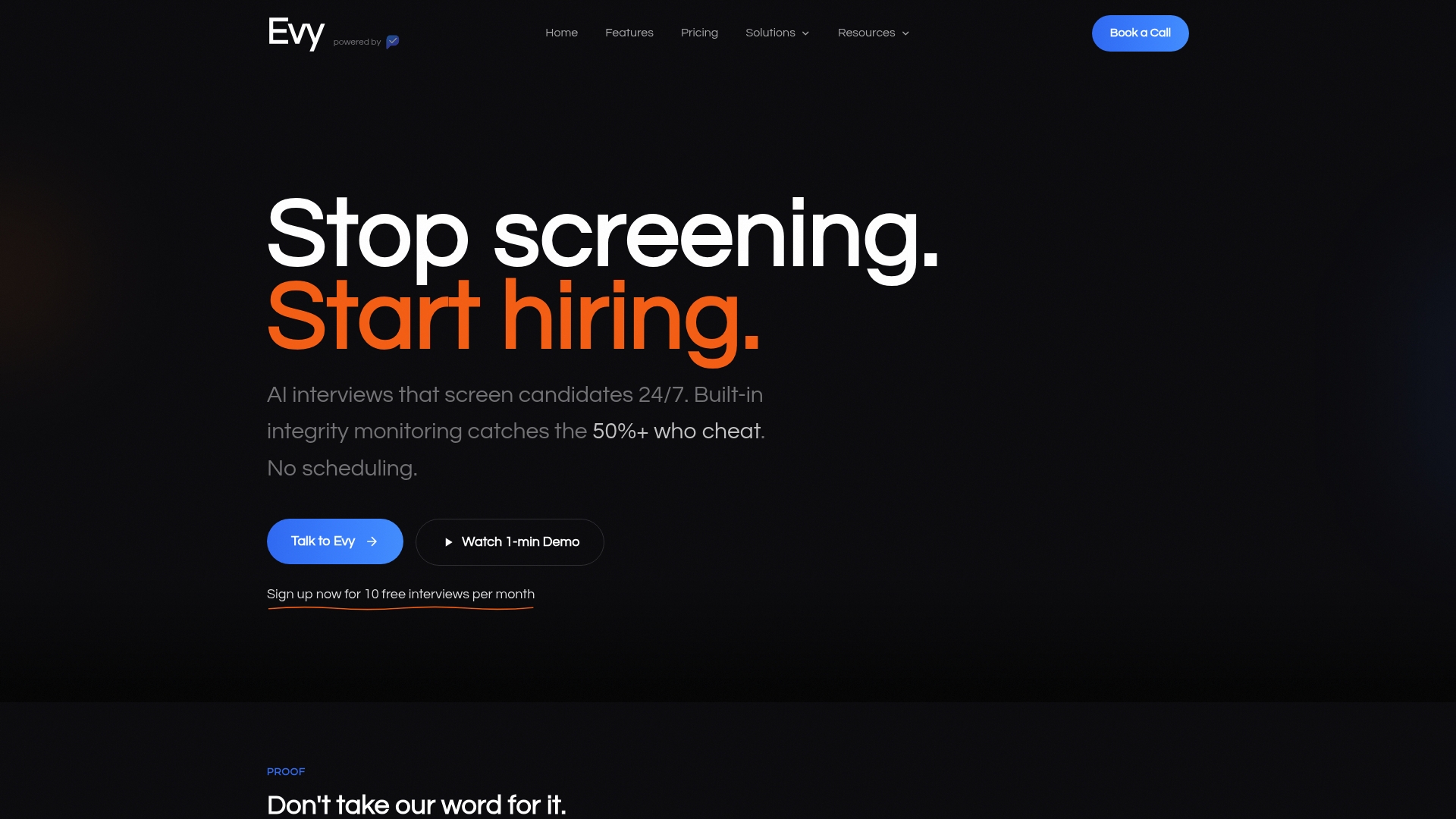
Evy is built for the part of screening that most platforms ignore: verifying that the candidate you are evaluating is actually the one answering the questions. As AI-assisted cheating in video interviews becomes more common, the validity of your screening data depends on knowing responses are genuine. Evy's real-time eye tracking detects when candidates are reading from an external source rather than thinking independently. You get honest, comparable data from every interview. Explore Evy's anti-cheat interview features to see how it fits alongside the screening methods you already use.
FAQ
What are the most effective candidate screening methods?
Cognitive ability tests combined with structured interviews produce the strongest predictive validity. Composite models that layer multiple validated methods outperform any single approach.
How does automated screening reduce recruiter workload?
Automated rule-based disqualification can cut recruiter triage time by 60–75%. The gains are largest when must-have criteria are clearly defined before automation is applied.
Why is resume screening considered a weak predictor?
Resume screening reflects past opportunity and presentation skill rather than actual job capability. High-performing teams shift toward evidence-based signals like work samples and structured interviews.
How many screening methods should a hiring process include?
Most roles benefit from two to four complementary methods. High-volume roles suit automated filtering plus a phone screen. Senior roles warrant cognitive tests, work samples, and structured panel interviews.
How do you reduce bias in candidate scoring?
Require each reviewer to score independently before any group debrief. Scores must be supported by specific evidence from candidate responses, not numerical impressions alone.