
 By Adrian Pascual•Hiring insight•Published
The Role of Hiring Manager in Screening Candidates
Most hiring managers think their job starts when a recruiter drops a shortlist in their inbox. That assumption costs companies good candidates every day. The role of hiring manager in screening is far broader than conducting a final interview. From writing job requirements that actually reflect how the role performs day to day, to making the call on who moves forward, hiring managers shape every meaningful decision in the process. This guide covers what that responsibility looks like in practice, how to do it fairly and legally, and where technology fits in.
Table of Contents
- Key takeaways
- The role of hiring manager in screening, defined
- Screening consistency, fairness, and compliance
- Practical screening stages hiring managers lead
- Integrating technology into screening workflows
- My take on where hiring managers actually lose control
- How Evy helps hiring managers screen with confidence
- FAQ
Key takeaways
| Point | Details |
|---|---|
| Hiring managers lead screening | Their involvement spans job definition, resume review, interviews, and final selection. |
| Structure reduces bias | Scorecards tied to job-specific criteria produce fairer, more defensible hiring decisions. |
| Compliance is non-negotiable | EEOC and ADA requirements apply to every screening step, including AI-assisted tools. |
| Recruiters and managers are partners | Recruiters source and filter; hiring managers evaluate fit against real job expectations. |
| Technology requires oversight | AI screening tools must be tested for accessibility and bias before deployment. |
The role of hiring manager in screening, defined
There is a persistent misconception in many organizations: recruiters handle screening, and hiring managers handle hiring. The reality is that hiring managers define success criteria and evaluate candidates against them, often acting as primary interviewers after an initial recruiter pass. The division of labor is more nuanced than most job descriptions suggest.
Recruiters manage process flow. They source candidates, post jobs, run initial qualification screens, and keep the pipeline moving. Hiring managers do something different. They translate what the role actually requires into evaluation criteria that reflect real performance expectations. Their domain knowledge is what separates a technically qualified candidate from one who will actually succeed in the role.
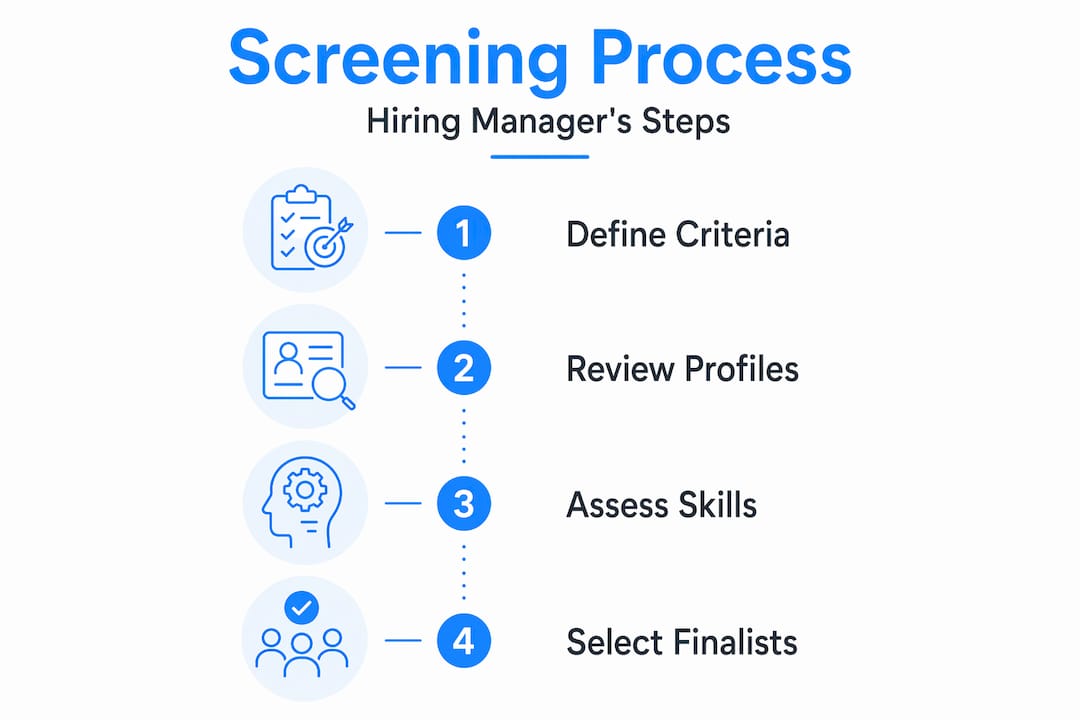
In practice, hiring manager responsibilities during screening include four distinct activities. First, collaborating with HR to build job descriptions that go beyond a list of duties and instead capture what success looks like at 30, 60, and 90 days. Second, reviewing resumes and application materials against those criteria, not just scanning for keywords. Third, participating in phone or video screens and structured assessments at key decision points. Fourth, making the final shortlisting call from the qualified applicant pool.
Pro Tip: When building your job description, write one sentence for each core responsibility that describes what "done well" looks like. That sentence becomes your evaluation benchmark during resume review and interviews.
The role of recruiters is to get qualified people in front of you efficiently. Your job as a hiring manager is to make sure the criteria they are screening against actually reflect the role. If you have not reviewed and approved those criteria before sourcing begins, you are evaluating candidates against someone else's assumptions.
Screening consistency, fairness, and compliance
Consistency is not just a best practice. It is a legal requirement. Uniform Guidelines on Employee Selection Procedures require that selection procedures be job-related and documented. Hiring managers who skip scorecards or vary their questions between candidates create defensibility problems that can surface during audits or litigation.
Structured interviews are the most reliable tool for reducing that risk. When every candidate answers the same questions, evaluated against the same scoring dimensions derived from a job analysis, you produce decisions that are both fairer and easier to explain. Structured interview scorecards reduce rater drift, the tendency for evaluators to unconsciously shift their standards between candidates, and force evaluation against predefined job-relevant criteria.
Here is a practical framework for building a compliant screening process:
- Conduct a job analysis before writing interview questions. Identify the three to five functions that define success in the role.
- Map each interview question directly to one of those functions. If a question does not connect to a job function, remove it.
- Build a scoring rubric for each question with defined anchors. For example, a score of 1 means the candidate could not describe a relevant experience; a score of 4 means they described a clear example with measurable outcomes.
- Document every evaluation. Keep scorecards, notes, and any assessment results for a minimum of one year, or longer if your organization requires it.
- Review your process for ADA compliance. AI tools and assessments must not unfairly exclude qualified individuals with disabilities, and accommodations must be available at every stage.
"Hiring managers must produce defensible, job-related screening decisions to comply with EEOC and equal employment opportunity laws. That defensibility starts with documentation, not good intentions."
Record keeping is where many hiring managers fall short. Audit readiness means being able to show, for any hire or rejection, exactly what criteria were used and how the candidate was scored against them. That paper trail protects both the organization and the candidate.
Practical screening stages hiring managers lead
Understanding the typical workflow helps hiring managers know exactly where their involvement is most critical and where they can trust the process to run without them.
The stages generally look like this:
- Resume and eligibility review. Hiring managers should validate that the minimum qualifications used to filter resumes actually reflect the role. Resume screening workflows combine resume review with initial eligibility checks before any interview time is spent. Reviewing ATS formatting standards helps you understand why qualified candidates sometimes disappear before they reach you.
- Initial video or phone screen. This is often recruiter-led, but hiring managers should define the pass/fail criteria in advance. A 15-minute alignment call between the recruiter and hiring manager before screening begins prevents misaligned candidates from advancing.
- Skills assessments and work samples. Hiring managers are best positioned to evaluate these because they understand what good output actually looks like. A generic rubric will not catch the difference between a candidate who can complete a task and one who can do it at the level the role demands.
- Final shortlist and collaborative feedback. Predefined evaluation criteria and collaborative review reduce bottlenecks and keep the process moving without sacrificing quality.
| Screening stage | Hiring manager's primary action | Recruiter's primary action |
|---|---|---|
| Job definition | Approve success criteria and requirements | Translate into sourcing strategy |
| Resume review | Validate eligibility criteria and spot-check | Filter against approved criteria |
| Initial screen | Define pass/fail benchmarks | Conduct and score screens |
| Skills assessment | Design or approve assessment and rubric | Administer and collect results |
| Final shortlist | Make selection decision | Facilitate scheduling and logistics |
The handoff points in this table are where most screening breakdowns happen. When hiring managers and recruiters have not explicitly agreed on who owns each stage, candidates fall through gaps or advance without proper evaluation.
Integrating technology into screening workflows
AI-assisted screening tools have changed how hiring managers engage with large candidate pools. The efficiency gains are real. Automated scheduling, resume parsing, and video interview platforms can reduce time-to-screen significantly. But technology introduces risks that hiring managers are responsible for managing.
The core risks worth understanding:
- Bias in automated scoring. AI models trained on historical hiring data can encode past biases. If your organization has historically underrepresented certain groups, an AI trained on your data may perpetuate that pattern.
- Accessibility failures. Over-trusting AI screening outputs without testing for accessibility risks filtering out qualified candidates with disabilities. Hiring managers should confirm that every automated tool offers reasonable accommodations before deployment.
- Loss of human judgment. Automation is best used for repetitive, low-stakes steps like scheduling or initial eligibility checks. Final evaluation decisions require human judgment informed by job-specific expertise.
AI candidate screening offers real advantages when used deliberately. The key is knowing which decisions belong to the technology and which belong to you.
Pro Tip: Before deploying any AI screening tool, run a small audit: take 20 recent hires you know were successful and run their profiles through the tool. If the tool would have screened out more than two or three of them, recalibrate the criteria before going live.
Hiring managers who treat AI as a filter rather than a decision-maker get the best outcomes. Use it to surface candidates worth your attention. Use your own judgment to evaluate them.

My take on where hiring managers actually lose control
I've watched a lot of hiring processes break down, and the failure point is almost never where people expect it to be. It is rarely a bad interview question or a weak recruiter. It is the gap between what the hiring manager said they wanted and what actually got screened for.
In my experience, the most common mistake is delegating the criteria definition to HR or recruiting without a real conversation about what the role requires. You end up with a job description that reads like a template, screening criteria that favor credentials over capability, and a shortlist that looks right on paper but misses the point entirely.
I've also seen hiring managers overcorrect with technology. They adopt AI screening tools because the volume is high, then stop questioning the outputs. The interview guide must map questions to actual job functions. When that connection breaks, you get defensibility problems and, more practically, you get bad hires.
What actually works is treating the screening process as a design problem. You are building a system that should reliably surface the right candidates and filter out the wrong ones. That system needs clear inputs, defined criteria, structured evaluation, and a human being at the end who understands what the role actually demands. Speed matters, but not more than that.
— Hudson
How Evy helps hiring managers screen with confidence
Hiring managers who want consistent, compliant, and honest screening need tools built for that purpose. Evy is the only AI interview platform with real-time eye tracking, designed to catch candidates using AI assistance during interviews so you are evaluating genuine capability, not coached responses. Every interview is scored against structured criteria, giving your team a defensible record of each evaluation.
For HR teams managing high-volume screening, Evy's platform supports 24/7 asynchronous interviews with automated scoring and attention monitoring. For startups moving fast, Evy's anti-cheat features give hiring managers the confidence that what they see in screening reflects what they will get on the job.
FAQ
What is the role of a hiring manager in screening?
The hiring manager defines job success criteria, reviews candidates against those criteria, participates in structured interviews, and makes the final shortlisting decision. Recruiters manage process flow; hiring managers evaluate role fit.
How does a hiring manager differ from a recruiter in screening?
Recruiters source and filter candidates based on approved criteria. Hiring managers apply domain expertise to evaluate whether candidates can actually perform the job, and they make the final selection call.
What makes candidate screening legally defensible?
Screening is defensible when every decision is tied to documented, job-related criteria. Structured interviews, scored against a rubric derived from a job analysis, produce records that satisfy EEOC requirements and withstand audit review.
How should hiring managers handle AI screening tools?
Hiring managers should test AI tools for bias and accessibility before deployment, confirm that accommodations are available for candidates with disabilities, and treat AI outputs as a starting point for human evaluation rather than a final decision.
What are the most important skills for hiring managers in screening?
The most critical skills are writing precise job requirements, designing structured interviews tied to job functions, applying consistent scoring criteria, and knowing when to override an automated recommendation based on role-specific judgment.