
 By Adrian Pascual•Hiring insight•Published
How AI Screening Improves Hire Quality in 2026
Understanding how AI screening improves hire quality is no longer a theoretical question for HR teams. It is a practical one with real compliance stakes, measurable outcomes, and growing legal scrutiny. Many hiring managers still assume AI screening is just faster resume sorting. The reality is more nuanced and more promising. Nearly 90% of large employers now use automated screening tools, and the evidence shows these systems can predict candidate success better than human evaluators when implemented responsibly. This article covers how AI screening actually works, where it creates risk, and how to use it in a way that holds up legally and ethically.
Table of Contents
- Key Takeaways
- How AI screening improves hire quality through predictive analytics
- Reducing bias and legal compliance
- Practical benefits for HR teams
- Risks, challenges, and best practices
- Choosing and integrating AI screening tools
- My perspective on responsible AI hiring
- Screen smarter with Evy's AI interview platform
- FAQ
Key Takeaways
| Point | Details |
|---|---|
| AI predicts candidate fit | AI learns from prior hire data to identify soft skills and potential that resume scanning misses. |
| Bias reduction requires oversight | AI can reduce human bias, but without audits and human review, it can encode historical discrimination. |
| Employers hold legal liability | Under EEOC rules, you are responsible for discriminatory outcomes even when using third-party AI tools. |
| Efficiency and quality go together | AI reduces interview volume without lowering candidate quality when configured correctly. |
| Governance is non-negotiable | Ongoing audits, diverse review teams, and candidate disclosures are the foundation of compliant AI hiring. |
How AI screening improves hire quality through predictive analytics
Most people think AI screening means keyword matching. A resume either contains "Python" or it does not. That is the old model, and it is largely obsolete. Modern AI-powered candidate evaluation works differently. It learns from patterns in your historical hiring data, including which candidates performed well after being hired, how long they stayed, and what combination of signals predicted their success.
This distinction matters because soft skills and growth potential rarely appear in a resume as keywords. A candidate who asks clarifying questions, demonstrates structured thinking, or communicates with precision under pressure is showing you something a keyword filter cannot detect. AI assessment tools predict employment success better than human recruiters by capturing exactly these kinds of signals, and a 2026 field experiment with over 3,000 applicants found that AI tools scored women and underrepresented minorities higher than human evaluators, who showed measurable cognitive bias.
The mechanism behind this is predictive analytics. The system maps candidate attributes against outcomes from prior hires, then assigns a probability score to new applicants. Over time, as you feed it post-hire performance data, the model recalibrates. It gets better at identifying what "good" looks like for your specific organization and role type.
Here is what this looks like in practice for an HR team:
- Resume triage is handled automatically, with candidates ranked by predicted fit rather than surface-level criteria.
- Soft skill indicators from structured assessments or video interviews are weighted alongside experience.
- Candidates who would have been filtered out by keyword matching but show strong predictive signals get surfaced.
- Post-hire performance data feeds back into the model to sharpen future predictions.
Pro Tip: Before deploying any AI screening tool, document what "successful hire" means for each role. The model is only as good as the outcome data you give it. Vague or inconsistent performance reviews will produce vague predictions.
Understanding what AI candidate screening actually measures versus what it approximates is the first step toward using it well.
Reducing bias and legal compliance
There is a persistent belief that AI hiring tools are inherently biased. The more accurate statement is that AI tools can encode bias if they are trained on biased historical data, but they can also reduce the kind of inconsistent, subjective judgment that human recruiters apply differently to different candidates on different days. The research supports this. The same field experiment cited above found that human evaluators showed cognitive bias against women and minorities, while the AI model did not.
That said, legal compliance is not optional, and the rules are specific. The EEOC's four-fifths rule is the primary screening tool for adverse impact. Under the four-fifths rule, if the selection rate for any protected group falls below 80% of the highest-selected group, that constitutes evidence of adverse impact and shifts the burden of justification to the employer. You need to be monitoring this metric continuously, not just at implementation.
One legal reality that surprises many HR teams: you cannot outsource your liability. Employers retain full legal liability for discriminatory outcomes even when AI screening is delegated to a third-party vendor. The EEOC treats vendor tool use as the employer's own employment practice under Title VII. That means your vendor's audit results are your audit results.
"Legal enforcement of AI hiring bias will require transparent documentation, bias audits, and human review." This is not a future prediction. It is the current direction of EEOC enforcement, and HR teams that are not already building this documentation trail are behind.
The practical implication is that automated rejections without human review increase your exposure to discrimination claims significantly. Experts consistently advise maintaining human-in-the-loop oversight and documenting the rationale for any overrides as evidence of good-faith compliance. The human review step is not bureaucratic friction. It is your legal record.
For guidance on balancing AI fairness with workflow integration, Evy's resource on AI screening risks and fairness covers the practical considerations in detail.
Practical benefits for HR teams
The efficiency argument for AI in recruitment is well-documented, but the more important argument is the quality argument. AI helps recruiters act earlier on high-quality candidates and decreases interview volume without lowering candidate quality. That is a meaningful distinction. The goal is not to process more resumes faster. The goal is to spend your limited interview time on the candidates most likely to succeed.
Here is how that plays out operationally for most HR teams:
- Automated resume triage removes the cognitive load of sorting through hundreds of applications manually, freeing recruiters to focus on candidate engagement.
- Data-driven ranking means your top candidates are identified by predictive signals, not by whoever submitted first or formatted their resume most attractively.
- Reduced decision noise comes from applying consistent evaluation criteria across every applicant, rather than varying standards based on recruiter mood, time of day, or implicit preferences.
- Shorter time-to-hire results from moving qualified candidates through the funnel faster, which also reduces the risk of losing top talent to competitors.
- Cost reduction follows from fewer wasted interviews, lower recruiter hours per hire, and better retention because the predictive model is selecting for fit.
Pro Tip: Track your pre-AI and post-AI metrics separately for at least two hiring cycles before drawing conclusions. Time-to-hire improvements often show up in the first cycle, but quality improvements in retention and performance ratings typically take six to twelve months to surface clearly.
The benefits of AI screening are real, but they require intentional configuration. Out-of-the-box tools with default settings rarely deliver the quality gains that well-configured systems do.

Risks, challenges, and best practices
AI screening carries genuine risks that responsible HR teams need to understand before deployment. The most serious is proxy bias. Even when a model is not explicitly trained on protected characteristics, it can learn to use correlated variables as proxies. A model trained on historical data from a predominantly male engineering team may learn to associate certain communication styles or career trajectories with success, effectively encoding gender bias without any explicit instruction to do so.
The second major risk is concept drift. A model trained on 2021 hiring data may perform well initially, but as your organization changes, as roles evolve, and as the labor market shifts, the model's predictions can degrade. NIST guidance emphasizes ongoing measurement beyond one-time testing to catch this kind of drift before it produces bad hiring decisions at scale.
| Risk | Mitigation |
|---|---|
| Proxy bias from historical data | Audit training data for demographic correlations before deployment |
| Automated rejections | Require human review for all final-stage decisions |
| Concept drift over time | Schedule quarterly model performance reviews against post-hire outcomes |
| Vendor liability gap | Obtain contractual commitments on bias audits and audit access from vendors |
| Homogeneous governance | Build diverse review teams to identify blind spots in model behavior |
Diverse AI governance teams identify harmful biases more reliably than homogeneous groups. This is not a soft recommendation. The NIST AI Risk Management Framework links workforce diversity directly to better AI risk identification and mitigation outcomes.
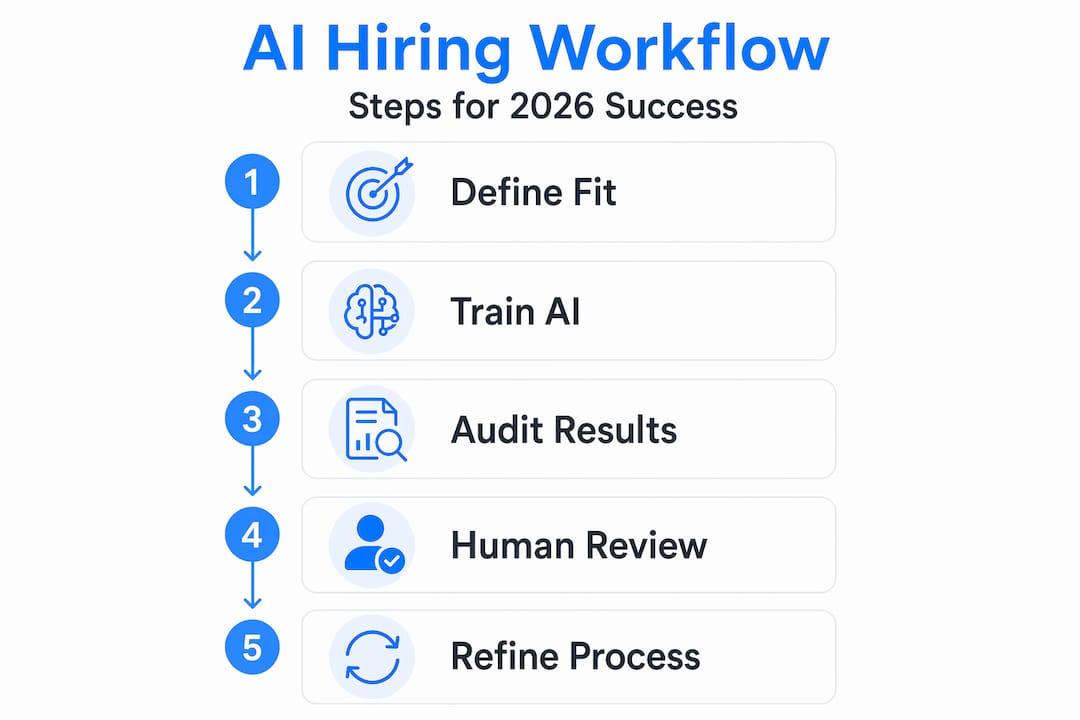
The governance toolkit for ethical AI screening implementation should include ongoing bias audits, transparent documentation of model criteria, candidate disclosures about AI use in the screening process, and a clear escalation path for human review. Overreliance on automated decisions without this infrastructure is where organizations get into serious legal and reputational trouble.
Choosing and integrating AI screening tools
Selecting the right AI tools for talent acquisition requires more than comparing feature lists. The questions that matter most are about transparency, auditability, and fit with your existing workflow.
When evaluating vendors, focus on these criteria:
- Explainability: Can the vendor explain what signals the model uses to rank candidates? If the answer is "the algorithm is proprietary," that is a compliance risk.
- Audit access: Does the vendor provide demographic breakdown reports and adverse impact analysis? You need this data to meet your EEOC obligations.
- Integration depth: Does the tool connect with your existing applicant tracking system, or does it create a parallel workflow that recruiters will ignore?
- Human override documentation: Does the platform log when human reviewers override AI recommendations, and does it capture the rationale?
- Candidate disclosure support: Does the vendor provide compliant language for informing candidates that AI is used in the screening process?
Training your HR staff on AI oversight is as important as the tool itself. Recruiters who do not understand how the model works will either over-trust it or dismiss it entirely. Neither outcome serves your hiring quality goals. The effectiveness of AI in hiring depends heavily on how well your team is equipped to work alongside it, not just with it.
AI screening should function as one layer in a broader talent acquisition strategy, not as a replacement for structured interviews, skills assessments, or reference checks. The strongest hiring processes use AI to surface candidates efficiently and then apply rigorous human judgment to make the final call.
My perspective on responsible AI hiring
I've spent considerable time studying how AI tools perform in real hiring environments, and my honest view is this: the organizations getting the most out of AI screening are not the ones with the most sophisticated tools. They are the ones with the most disciplined processes around those tools.
What I've seen repeatedly is that HR teams adopt AI screening for the efficiency gains, which are real, and then underinvest in the governance infrastructure that makes those gains sustainable. The bias audits get skipped. The human review step becomes a rubber stamp. The model runs on stale training data for two years without anyone noticing. And then a discrimination claim surfaces, and the documentation trail is thin.
The uncomfortable truth is that ethical AI application requires strict human oversight to address blind spots and data biases. That is not a limitation of the technology. It is the design requirement for using it responsibly. AI is a tool for reducing noise and surfacing signal. The judgment call still belongs to a human being.
My take on where this is heading: legal scrutiny of AI hiring tools is intensifying, and organizations that built their governance frameworks early will be in a far stronger position than those scrambling to document their processes after a complaint is filed. The investment in compliance infrastructure now is significantly cheaper than the cost of defending a discrimination claim later.
The most encouraging thing I've observed is that when AI screening is implemented well, with diverse governance teams, regular audits, and genuine human oversight, it genuinely does surface better candidates. Not faster candidates. Better ones.
— Hudson
Screen smarter with Evy's AI interview platform
If you are building out your AI screening process and want a solution designed with integrity from the ground up, Evy is worth a close look. Evy is the only AI interview platform with real-time eye tracking to detect candidates using AI assistance during interviews, which means the candidates who make it through your funnel are genuinely qualified, not coached by a language model in real time.
Evy screens at scale, 24/7, and surfaces honest, qualified talent without sacrificing the human oversight that compliance demands. Whether you are an HR team managing high-volume hiring or a startup hiring engineers fast, Evy's platform is built to improve hire quality without creating new legal exposure. Explore Evy's anti-cheat AI interview features to see how the platform supports transparent, auditable, and fair candidate evaluation at every stage.
FAQ
How does AI screening improve the quality of new hires?
AI screening improves hire quality by using predictive analytics to identify candidates whose attributes match patterns from successful past hires, capturing soft skills and potential that keyword-based resume filters miss entirely.
Can AI screening tools reduce bias in hiring?
AI tools can reduce the inconsistent, subjective bias that human recruiters apply unevenly, but they require regular audits and human oversight to prevent encoding historical bias from training data.
Who is legally responsible when an AI screening tool discriminates?
The employer holds full legal liability. The EEOC treats third-party AI vendor tools as the employer's own employment practice under Title VII, meaning you cannot transfer responsibility to the vendor.
What is the four-fifths rule and why does it matter for AI hiring?
The four-fifths rule states that if any protected group's selection rate falls below 80% of the highest-selected group, adverse impact is evidenced and the burden shifts to the employer to justify the screening criteria.
How often should AI screening tools be audited?
NIST guidance recommends ongoing measurement rather than one-time testing, with regular audits scheduled to catch model drift, demographic disparities, and degradation in predictive accuracy over time.