
 By Adrian Pascual•Hiring insight•Published
How AI Interview Platforms Work for HR Teams
AI interview platforms are software systems that autonomously conduct, analyze, and score job candidate interviews using natural language processing, machine learning, and video analysis to reduce manual screening time and improve evaluation consistency. Understanding how AI interview platforms work is no longer optional for hiring teams. AI adoption in HR has nearly doubled, with 43% of organizations now using AI in HR functions, up from 26% the prior year. That growth reflects a fundamental shift in how companies source, screen, and evaluate talent at scale.
How AI interview platforms work: the technical pipeline
The core of any AI interview platform is a multi-step processing pipeline that converts a candidate's spoken words into structured, scored data. Each stage builds on the previous one, and the speed of the entire chain determines whether the experience feels natural or robotic.
Here is how the pipeline operates from start to finish:
- Audio capture and transcription. The platform records the candidate's spoken response and breaks it into short audio segments. Systems like the Whisper transcription model process these audio in 1-3 second chunks, converting speech to text with high accuracy across accents and speaking speeds.
- Question detection and classification. Once transcribed, the text passes through a classifier, often a model like DeBERTa, that identifies what type of question was asked and what kind of answer is expected. This step happens in under 50ms, fast enough to support dynamic, adaptive follow-up questions without awkward pauses.
- Resume context retrieval. The platform pulls relevant sections from the candidate's resume using retrieval-augmented generation (RAG) techniques. This grounds the evaluation in the candidate's actual background rather than treating every response in isolation.
- Semantic scoring. The scored output is not a simple keyword match. Modern platforms use large language models combined with graph neural networks to understand context, career progression, and skill relationships. These hybrid matching models achieve F1 accuracy scores above 0.9, meaning the system correctly identifies qualified candidates with very high precision.
- Report generation. The platform compiles transcripts, scores, and evidence into a structured report that recruiters can review asynchronously. Standardized scoring rubrics normalize results across all candidates, so a candidate interviewed on a Tuesday is evaluated against the same criteria as one interviewed the following Friday.
Pro Tip: Ask any AI interview vendor to explain their transcription model and scoring rubric before signing a contract. If they cannot describe both clearly, the platform likely lacks the technical depth to produce reliable evaluations.
The entire pipeline is optimized for speed. Real-time systems aim to keep answer generation latency under 3 seconds to fit within natural human response pauses. That constraint forces every stage of the pipeline to operate at sub-second speeds, which is a meaningful engineering challenge that separates mature platforms from early-stage tools.

What sets AI interview platforms apart from traditional methods
The operational differences between AI-driven and traditional interview processes go well beyond speed. The structural changes affect scheduling, question consistency, and the quality of data available to hiring managers.
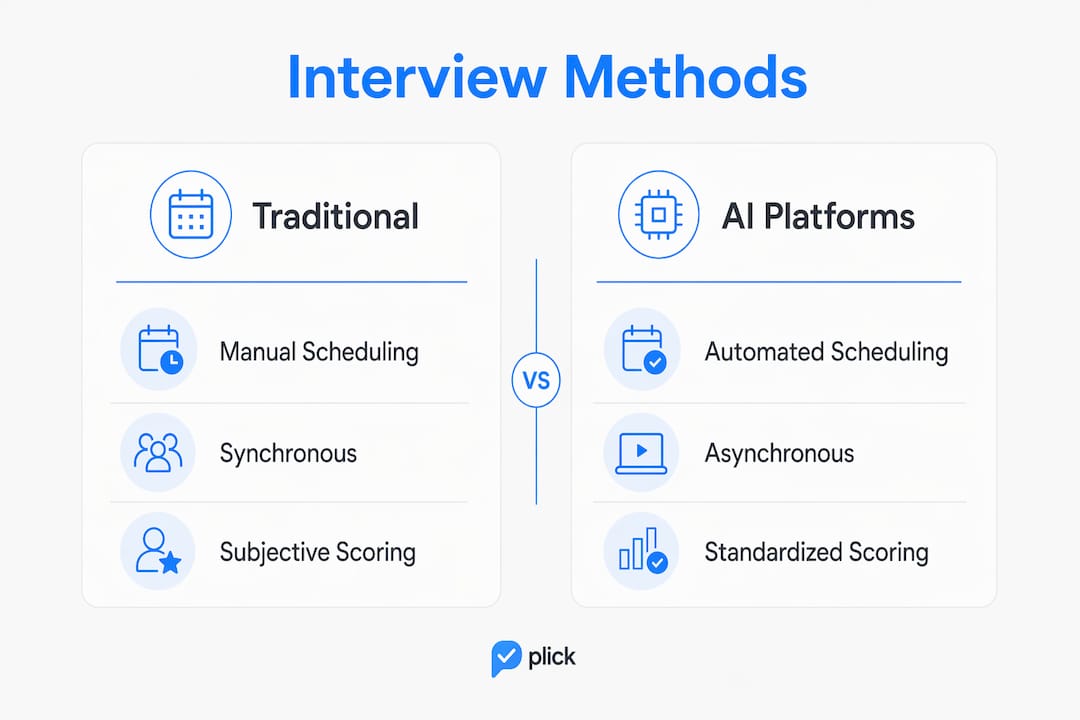
Asynchronous vs. synchronous interviews. Traditional interviews require both parties to be available at the same time. AI interview platforms allow candidates to complete interviews on their own schedule, 24 hours a day, seven days a week. This expands the candidate pool significantly, particularly for roles that attract applicants across time zones.
Automated scheduling and follow-up. Manual scheduling is one of the most time-consuming parts of early-stage recruitment. AI platforms integrate directly with calendar systems and send automated reminders. This automation reduces interview no-shows by up to 40%, a figure that translates directly into fewer wasted recruiter hours and faster time-to-hire.
Adaptive questioning. Static interview scripts treat every candidate identically regardless of their background. AI-driven recruitment processes generate personalized interview paths based on resume content, role requirements, and real-time response quality. A candidate with five years of project management experience receives different follow-up questions than a recent graduate applying for the same role.
Standardized, bias-reduced scoring. Human interviewers are susceptible to affinity bias, halo effects, and inconsistent note-taking. AI platforms deliver detailed reports with transcripts and evidence-backed scores that apply the same rubric to every candidate. This does not eliminate bias entirely, but it removes several of the most common sources of inconsistency in early-stage screening.
| Feature | Traditional interview | AI interview platform |
|---|---|---|
| Scheduling | Manual, calendar-dependent | Automated, self-service |
| Question consistency | Varies by interviewer | Standardized rubric |
| Availability | Business hours only | 24/7 asynchronous |
| Scoring | Subjective notes | Normalized, evidence-based |
| Candidate volume | Limited by recruiter time | Scales to any volume |
Understanding why platform choice affects outcomes is critical before committing to any vendor, because the structural differences above produce meaningfully different data quality.
What are the key challenges and risks of AI interview platforms?
AI interview technology carries real risks that HR teams must address before deployment. Ignoring them creates legal exposure and damages candidate trust.
- Bias in training data. AI models learn from historical hiring data, which often reflects past discrimination. The EEOC and DOJ have issued guidance and pursued enforcement actions against employers whose AI hiring tools produced discriminatory outcomes. Settlements and class actions are not hypothetical. They are documented risks that require active mitigation through regular audits and diverse training datasets.
- Candidate transparency. Candidates have a reasonable expectation to know when AI is evaluating them. Failing to disclose AI use in the interview process erodes trust and, in some jurisdictions, creates legal liability. Clear disclosure at the start of the interview is both an ethical obligation and a practical risk management step.
- Technical accuracy limitations. Transcription models can struggle with strong accents, background noise, or domain-specific terminology. A mistranscribed response can produce an inaccurate score, and the candidate has no opportunity to correct the record. Quality platforms build in human review checkpoints for borderline cases.
- Candidate experience and AI cheating. As AI interview technology becomes more common, so does the use of AI tools by candidates to generate responses in real time. This creates a fairness problem. A candidate reading AI-generated answers may score well on content quality while demonstrating none of the actual competency being assessed. Platforms that lack integrity controls cannot distinguish between a genuinely strong candidate and one who is simply reading from a screen. Reviewing strategies to combat cheating should be part of any platform evaluation.
Pro Tip: Before deploying any AI recruitment software, conduct a bias audit on a sample of historical hiring decisions using the platform's scoring model. Disparate impact analysis across protected categories is the minimum standard for responsible deployment.
The risks and fairness considerations in AI screening are not reasons to avoid the technology. They are reasons to adopt it carefully, with clear governance and human oversight built into the process from day one.
How AI interview platforms integrate into the broader hiring ecosystem
AI interview platforms do not operate in isolation. Their value multiplies when connected to applicant tracking systems, HR information systems, and analytics tools that inform hiring decisions beyond the interview itself.
| Integration point | Function | Outcome |
|---|---|---|
| ATS (e.g., Greenhouse, Lever) | Syncs candidate records and interview status | Eliminates duplicate data entry |
| HRIS (e.g., Workday, BambooHR) | Transfers hired candidate data directly | Reduces onboarding friction |
| Calendar tools (e.g., Google Calendar, Outlook) | Automates scheduling and reminders | Cuts scheduling time significantly |
| Analytics dashboards | Aggregates interview scores and hiring outcomes | Enables predictive hiring decisions |
The data generated by AI interviews is itself a strategic asset. When platforms track scores, response patterns, and hiring outcomes over time, they enable predictive analytics that identify which candidate profiles succeed in specific roles. This moves recruitment from reactive screening to proactive talent strategy.
AI platforms also source candidates automatically across multiple channels using NLP to generate inclusive, optimized job descriptions and identify passive candidates who match role requirements. The shift from keyword-based to semantic candidate matching means the system infers skills and career fit from context rather than requiring exact phrase matches. A candidate whose resume says "led cross-functional teams" will surface for a project management role even if the word "project manager" never appears.
The practical result is that recruiters spend less time on manual screening and more time on high-value conversations. AI-filtered shortlists with ranked candidates and detailed feedback reports allow hiring managers to enter final-round interviews with a clear picture of each candidate's strengths and gaps. That preparation improves decision quality and reduces the likelihood of a costly mis-hire. For a closer look at how this plays out in practice, the research on how AI screening improves hire quality is worth reviewing before selecting a platform.
Key takeaways
AI interview platforms deliver the most value when technical depth, bias controls, and system integrations are evaluated together rather than treated as separate purchasing criteria.
| Point | Details |
|---|---|
| Multi-stage pipeline | Platforms transcribe, classify, retrieve context, and score responses in under 3 seconds per exchange. |
| Standardized scoring | Rubric-based evaluation removes common interviewer biases and produces comparable candidate data. |
| Scheduling automation | Automated reminders and self-scheduling reduce no-shows by up to 40%, saving recruiter time. |
| Bias and legal risk | EEOC enforcement actions make bias audits a legal necessity, not an optional best practice. |
| Ecosystem integration | Connecting platforms to ATS and HRIS systems converts interview data into predictive hiring intelligence. |
Why the integrity question is the one most teams underestimate
I have spent years watching HR teams evaluate AI interview platforms almost entirely on feature checklists: Does it integrate with our ATS? Can it handle asynchronous interviews? Does it produce a scorecard? Those are legitimate questions. But the one question most teams skip is the one that determines whether the data they collect is worth anything at all.
The integrity of the interview itself is the foundation everything else rests on. If candidates are using AI tools to generate responses in real time, the platform is not measuring candidate competency. It is measuring how well a candidate can operate a prompt interface under time pressure. That is a very different skill set, and it is not what most roles require.
What I find most concerning is that many platforms have no mechanism to detect this behavior. They produce polished transcripts and high scores, and hiring managers trust those outputs without questioning whether the responses were genuinely the candidate's own. The result is a false sense of confidence in the screening process.
The platforms that take this seriously are building detection into the core product, not treating it as an add-on. Eye tracking, attention pattern analysis, and behavioral signals during the interview are the kinds of signals that reveal whether a candidate is thinking through a response or reading one. That distinction matters enormously for roles where judgment, communication, and independent thinking are the actual job requirements.
My recommendation: treat interview integrity as a first-order evaluation criterion, not an afterthought. Ask vendors directly how they detect AI-assisted responses. If the answer is vague, assume the problem is unaddressed.
— Hudson
See how Evy protects the integrity of your interviews
Evy is the only AI interview platform built with real-time eye tracking specifically designed to detect candidates using AI tools during interviews. While other platforms generate scores from responses that may not reflect genuine candidate ability, Evy surfaces honest, qualified talent by monitoring attention patterns and flagging behavior that looks different from natural thinking. Evy runs asynchronous interviews at scale, 24 hours a day, integrates with your existing hiring stack, and delivers evidence-backed candidate reports your team can trust. If interview integrity matters to your hiring process, explore Evy's platform features to see how the technology works in practice.
FAQ
What does an AI interview platform actually do?
An AI interview platform autonomously conducts, transcribes, scores, and reports on candidate interviews using natural language processing and machine learning, replacing or supplementing manual screening at early hiring stages.
How does AI assess candidate responses during an interview?
The platform transcribes spoken responses using models like Whisper, classifies the content using tools like DeBERTa, retrieves relevant resume context, and scores answers against a standardized rubric, all within a few seconds per response.
Can AI interview platforms reduce hiring bias?
AI platforms reduce several common sources of interviewer bias by applying consistent scoring rubrics across all candidates. However, bias in training data remains a documented risk, and the EEOC has issued guidance on legal exposure from discriminatory AI hiring tools.
How do AI interview platforms integrate with existing HR systems?
Most platforms connect directly with applicant tracking systems like Greenhouse or Lever and HRIS tools like Workday, syncing candidate records, scores, and status updates to eliminate duplicate data entry and support predictive analytics.
How can hiring teams detect candidates using AI during interviews?
Platforms with integrity controls use eye tracking, attention pattern analysis, and behavioral signals to identify responses that appear AI-generated rather than naturally composed. Standard platforms without these features cannot reliably distinguish genuine responses from AI-assisted ones.