
 By Adrian Pascual•Hiring insight•Published
How AI Identifies Qualified Candidates for HR Leaders
AI identifies qualified candidates by producing an explainable, weighted match score that combines multiple signal types: resume data, structured interview responses, skills assessment results, and behavioral markers captured during the interview itself. The score is only as trustworthy as the reasoning behind it. Platforms that return a plain-language explanation for every ranking give recruiters something they can verify, defend, and hand to an auditor. Evy adds a layer most platforms skip: real-time eye tracking that detects AI-assisted cheating during the interview, so the signals feeding that score reflect genuine candidate performance.
Three things HR leaders should expect from any AI screening system:
- Explainable outputs: every score should carry a human-readable reason, not just a percentage
- Auditability: decision records, override logs, and consent documentation must be retained
- Anti-cheat integration: integrity signals (eye tracking, synthesis detection, behavioral consistency) should be part of the candidate record, not a separate afterthought
Table of Contents
- What inputs does AI actually read to rank candidates?
- How do signals become a ranked candidate list?
- How does an AI interview platform detect cheating?
- How should recruiters interact with AI outputs to stay compliant?
- How do you validate that AI screening actually predicts hiring success?
- What does implementation actually look like, step by step?
- What AI screening will not do, and the red flags that should worry you
- Key Takeaways
- The gap between what AI promises and what actually matters in practice
- Evy screens candidates honestly, at scale, with full audit trails
- Useful sources and further reading
What inputs does AI actually read to rank candidates?
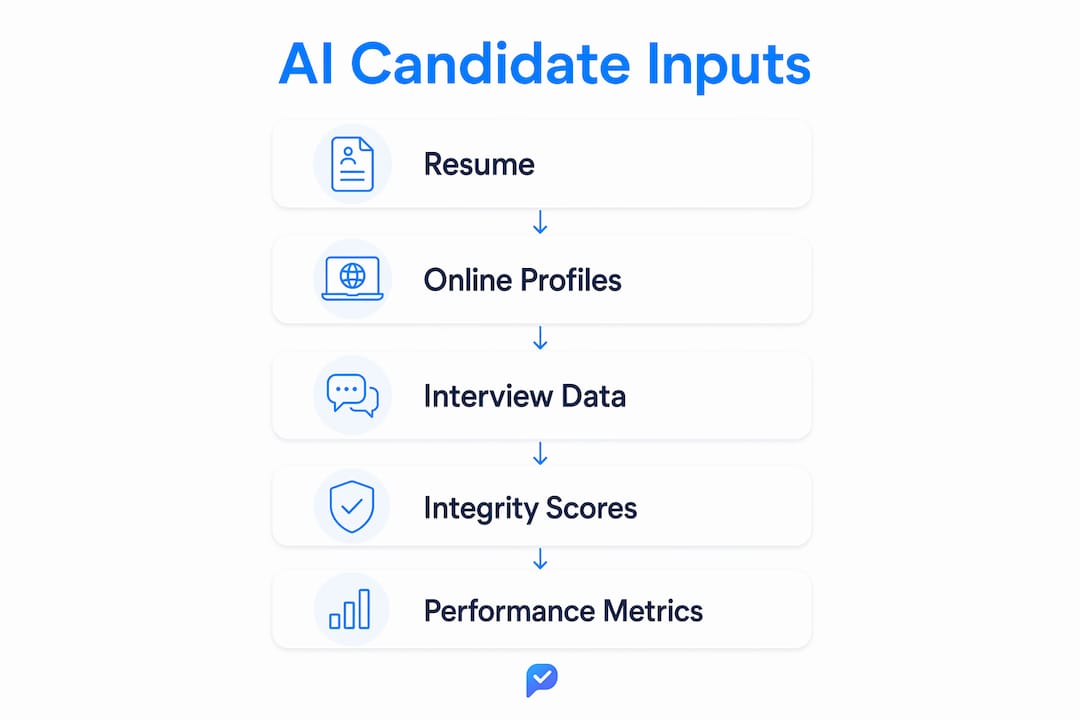
Modern AI candidate assessment systems draw from far more than a resume. The quality of the ranking depends directly on the breadth and recency of what gets ingested. Systems that read the full candidate relationship — CV, screening call transcripts, interview notes, and message threads — produce meaningfully stronger matches than those working from a stale resume snapshot alone.
| Input | Signal extracted | Recruiter use case |
|---|---|---|
| Resume / CV | Skills, tenure, career trajectory, recency | Initial fit scoring against role requirements |
| Structured interview transcript | Depth of answer, behavioral indicators, communication clarity | Ranking candidates on role-specific competencies |
| Skills / coding assessment | Demonstrated ability, accuracy under time pressure | Filtering for technical minimums |
| Previous interview notes | Hiring manager sentiment, red flags, cultural observations | Contextualizing AI score with human judgment |
| ATS metadata | Application timing, source channel, prior engagement | Pipeline prioritization |
| Video / audio artifacts | Answer latency, pacing, consistency with transcript | Integrity and engagement signals |
| Passive signals | Time on assessment, answer revision patterns | Effort and motivation proxies |
Semantic matching fixes a persistent problem with keyword filters: a candidate who "built ML pipelines" is a strong match for a "machine learning engineer" role even though the exact phrase never appears on their resume. Meaning-space comparisons surface transferable skills that Boolean search consistently misses.
How do signals become a ranked candidate list?
Four model types do most of the work in production recruitment systems.
- NLP embeddings convert job descriptions and candidate profiles into numerical vectors, then measure semantic distance. Candidates whose experience maps closest to the role's meaning space rank highest, regardless of vocabulary differences.
- Supervised ranking models are trained on historical hire and performance data. They learn which combinations of signals predicted a successful hire at your organization, not just a generic one.
- Ensemble scorers combine structured inputs (assessment scores, tenure) with unstructured ones (transcript content, answer quality) into a single weighted score. No single signal dominates.
- Reinforcement learning closes the loop. As outcome data feeds back into the model — who got hired, who performed well at six months, who churned — the scoring weights update automatically.
The shift that matters most right now is from black-box scoring to explainable AI outputs that return plain-language reasons for every ranking. An "87% match" with no explanation is insufficient for recruiter trust and nearly impossible to defend under an EEO audit. Explainability techniques include feature attribution (which inputs drove the score), counterfactual reasoning (what would have changed the ranking), and human-readable reason summaries.
Questions HR should ask any vendor before signing:
- Which inputs are used, and can you see the full list?
- Are explanations human-readable, or do they require a data scientist to interpret?
- How are scoring weights adjusted, and who controls that process?
- Is there a complete audit trail of every score and override?
- How does the model handle candidates with non-linear career paths?
How does an AI interview platform detect cheating?
Anti-cheat controls operate across several layers simultaneously. Evy's real-time eye tracking is the most direct signal: gaze patterns during a live interview look different when a candidate is reading from an off-screen AI tool versus thinking through an answer naturally. That difference is measurable and logged.
Other controls that well-architected platforms use:
- Browser and OS proctoring: locks the interview environment and flags tab switches or application changes
- Synthesis detection: classifiers trained to identify AI-generated answer text in transcripts
- Voice and face liveness checks: confirm the person on camera matches the registered candidate
- Timing anomalies: unusually fast or uniform answer delivery that suggests copied text
- Behavioral consistency checks: flags when transcript content and audio/video delivery diverge significantly
A practical flagging workflow runs like this: the platform assigns a real-time integrity confidence score as the interview progresses. Candidates who cross a defined threshold trigger a human reviewer queue. The reviewer examines the flagged signals, the transcript, and the eye-tracking log, then either clears the candidate or escalates to disqualification. Every step gets logged with a timestamp for the audit record.
Pro Tip: Set your human review threshold conservatively at first. A threshold that flags too few candidates saves reviewer time but misses real integrity issues; one set too aggressively creates false positives that damage candidate experience. Run a calibration pass on your first 50–100 interviews to find the right balance for your role type and volume.
How should recruiters interact with AI outputs to stay compliant?
Human-in-the-loop is not optional under U.S. hiring law. The EEOC's guidance on algorithmic decision-making makes clear that automated tools do not eliminate employer liability for disparate impact. Recruiters need structured workflows, not just access to a dashboard.
A practical compliance checklist for U.S. employers:
- Obtain candidate consent and provide notice that AI tools are used in screening
- Retain AI scores, explanations, and override records for the duration required by OFCCP/EEO record-keeping rules (generally two years for federal contractors)
- Sample B-tier candidates periodically to check for false negatives the model may be systematically missing
- Document every human override with a business reason
- Run adverse-impact analysis on score distributions across protected classes at least quarterly
- Confirm the vendor's model has been tested for bias and that results are available for review
Two policy snippets HR teams can adapt:
Candidate disclosure language: "This position uses an AI-assisted screening process that evaluates your interview responses, resume, and assessment results. A human recruiter reviews all AI recommendations before any hiring decision is made."
Internal decision record template: "Candidate [ID] received an AI fit score of [X] on [date]. Score explanation: [plain-language summary]. Human reviewer: [name]. Decision: [advance / hold / decline]. Override reason (if applicable): [reason]."
Structured, role-specific interviews that evaluate what candidates say rather than how they look or sound also support EEO-friendly evaluation by reducing the influence of appearance-based bias.
How do you validate that AI screening actually predicts hiring success?
Start with a baseline run on historical roles before touching live candidates. Feed closed roles through the model and check whether the candidates who were actually hired score in the top tier. If they do not, the model needs recalibration before it goes live.
| Metric | What it measures | Target benchmark |
|---|---|---|
| Precision@top N | Share of top-ranked candidates who advance to interview | Above 70% for most roles |
| False-negative sampling rate | Qualified candidates the model ranked low | Below 10% on sampled review |
| Adverse-impact ratio | Score distribution across protected classes | 80% rule (4/5ths rule) minimum |
| Predictive validity | Correlation of AI score with 6-month performance rating | Positive correlation required |
| Candidate NPS | Candidate satisfaction with the screening experience | Track and trend over time |
Organizations that train models on hire and retention outcome data report meaningful lifts in quality-of-hire metrics. A controlled pilot on new roles, run in parallel with your existing process for 4–8 weeks, gives you the comparison data you need to make that case internally.

What does implementation actually look like, step by step?
A phased rollout reduces risk and gives you validation data at each stage.
- Discovery and data audit (2–4 weeks): map your existing ATS data, identify gaps in historical outcome records, and define the role types for the pilot
- Pilot (4–8 weeks): run AI screening in parallel with your current process on two to three active roles; compare rankings and outcomes
- Scale and integration (2–3 months): connect to your ATS, configure scoring criteria per role family, and train recruiters on the review workflow
- Continuous validation (ongoing): run adverse-impact analysis quarterly, refresh model weights with new outcome data, and audit anti-cheat thresholds annually
Main cost drivers to budget for:
- Per-interview pricing or subscription seat plan (varies by platform and volume)
- ATS integration and implementation services
- Data cleanup and historical outcome enrichment
- Customization of scoring criteria per role family
- Legal and compliance review of candidate disclosure language
For AI tools for HR teams running high-volume screening, per-interview pricing often costs less than the recruiter hours saved in the first month of a pilot.
What AI screening will not do, and the red flags that should worry you
AI screening does not replace recruiter judgment. It surfaces signal so recruiters can focus their attention on high-value conversations. Common misconceptions that cause real operational problems:
- "AI replaces recruiters" — it reduces manual triage, not human decision-making
- "Keyword matching equals semantic matching" — they are fundamentally different; keyword filters miss transferable skills that semantic models catch
- "A high score means culture fit" — AI scores role-fit signals; culture fit requires human conversation
- "The system is automatically fair" — fairness requires active bias monitoring, not just a diverse training set
Red flags that should trigger a vendor audit or re-evaluation:
- Scores with no plain-language explanation attached
- Auto-rejection pathways with no human review step
- Anti-cheat flags with no human escalation workflow
- Stale or incomplete data inputs (resumes only, no transcript or assessment data)
- Adverse-impact ratios that consistently fall below the 4/5ths rule threshold
- Vendor unwilling to share model documentation or bias-testing results
For each red flag, the remediation is usually straightforward: widen your human review sampling, require a documented override for any auto-rejection, fix the data pipeline to include transcripts and assessment results, and request the vendor's bias audit report in writing.
Key Takeaways
AI identifies qualified candidates most reliably when explainable scoring, multi-modal inputs, anti-cheat integrity controls, and human review checkpoints operate together as a single auditable system.
| Point | Details |
|---|---|
| Demand explainable outputs | Every AI score must carry a plain-language reason; a bare percentage is not auditable or defensible. |
| Validate against real outcomes | Run a baseline on historical hires before going live; track predictive validity and adverse-impact ratios quarterly. |
| Keep humans in the loop | Human review of AI recommendations is required for U.S. EEO compliance, not just good practice. |
| Require integrated anti-cheat signals | Eye tracking, synthesis detection, and behavioral consistency checks should be part of the candidate record. |
| Evy's differentiator | Evy combines real-time eye tracking with explainable scoring and audit logs, addressing integrity and compliance in one platform. |
The gap between what AI promises and what actually matters in practice
The conversation around AI screening tends to focus on speed: how many resumes it can process, how fast it can rank a pool. Speed matters, but it is the wrong primary metric. The real question is whether the ranking holds up when you check it against who actually succeeded in the role.
Most AI screening failures trace back to two problems. First, the model was trained on hiring decisions rather than performance outcomes, so it learns to replicate past hiring patterns, including their biases, rather than predict future success. Second, the system produces scores without explanations, which means recruiters either trust rankings they cannot verify or ignore them entirely.
The platforms worth using are the ones that treat explainability and integrity as core product requirements, not compliance checkboxes. Real-time eye tracking during an AI interview is a good example of this philosophy: it does not just flag a potential integrity issue, it creates a logged, reviewable record that a recruiter can examine and a legal team can produce if challenged. That combination of signal, explanation, and audit trail is what separates a tool that builds recruiter confidence from one that creates liability.
Evy screens candidates honestly, at scale, with full audit trails
Most AI interview platforms give you a score. Evy gives you a score you can trust. Real-time eye tracking catches candidates using AI assistance during the interview itself, so the responses feeding your ranking reflect genuine ability. Explainable scoring surfaces plain-language reasons for every result, and every session produces a complete audit log your compliance team can review.
Evy runs structured, role-specific interviews 24/7, integrates with your existing ATS, and prices per interview so you pay for what you use. For HR leaders screening at volume, that means faster shortlists without the integrity risk that comes with unproctored AI interviews. Review Evy's anti-cheat features and request a pilot to see how the rankings compare against your current process.
Useful sources and further reading
- Evy Features: Anti-Cheat AI Interviews — Full documentation of Evy's real-time eye tracking, explainable scoring, ATS integrations, and audit log capabilities.
- How AI Scores Interview Responses | Evy — Detailed explanation of how scoring models work and why explainability matters for recruiter trust and compliance.
- AI's Role in Reducing Interview Bias | Evy — Evy's approach to structured flows, bias mitigation, and audit documentation for U.S. hiring teams.
- How AI Candidate Matching Works Behind the Scenes | Cadient — Technical explainer on reinforcement learning, outcome-based model training, and quality-of-hire improvements.
- How AI Finds the Best Candidates, Step by Step | Spott — Covers the four-step matching pipeline, the importance of multi-modal candidate data, and explainability requirements.
- AI Candidate Matching: How It Works for Hiring | CVVIZ — Clear comparison of keyword filtering versus semantic matching, with practical implications for transferable-skill identification.