
 By Adrian Pascual•Hiring insight•Published
How AI Assists Technical Role Screening in 2026
AI-assisted technical screening is defined as the use of algorithms, natural language processing, and adaptive assessment models to evaluate technical candidates at scale before a human recruiter reviews a single resume. As of 2026, 87% of companies use AI in some part of hiring. That figure signals a fundamental shift in how HR teams approach the front end of the recruiting pipeline. Platforms like Codility and tools built on real-environment coding simulations have made automated technical evaluations both practical and defensible. This guide explains how AI in recruitment works for technical roles, where it adds the most value, and how to implement it without sacrificing fairness or candidate quality.
How AI assists technical role screening at scale
AI-assisted technical screening automates four core tasks that previously consumed the most recruiter time: resume triage, skills assessment, structured interviews, and candidate ranking. Each of these tasks benefits from a different AI capability, and understanding which technology does what helps you configure your screening workflow more deliberately.
Resume parsing with context-aware evaluation moves well beyond keyword matching. Modern AI screening evaluates project size, system scale, and domain expertise to build a competency picture from a candidate's actual work history. A backend engineer who built a distributed system handling millions of transactions reads differently to an AI model than one who maintained a small internal tool, even if both resumes list "Python" and "AWS." That distinction matters enormously when you are hiring for a senior infrastructure role.

Automated coding assessments now run inside real development environments. Candidates complete tasks in VS Code rather than whiteboard-style editors, and the assessment captures how they debug, search documentation, and use available tools. AI-driven coding assessments simulate real codebase tasks using AI assistants, reflecting how engineers actually work today rather than testing rote algorithm recall. This shift produces a more honest signal about on-the-job performance.
Adaptive interview models conduct structured conversations using speech recognition and natural language processing. The system asks consistent questions, scores responses against a predefined rubric, and generates a transcript for recruiter review. Consistency is the key advantage here. Every candidate answers the same questions in the same order, which removes the variability that plagues unstructured phone screens.
Candidate ranking synthesizes resume scores, assessment results, and interview transcripts into a prioritized shortlist. Customers report over 40 hours saved in engineering time per hire, with a 20% or greater reduction in time-to-hire. That time savings compounds quickly when you are running multiple technical searches simultaneously.
Pro Tip: Never configure your AI screening tool to issue automatic pass/fail rejections. Use it to produce ranked shortlists with evidence-backed recommendations, then have a recruiter or hiring manager review the top and bottom of the list before any candidate is eliminated.
AI screening platforms: how do the key features compare?
Choosing the right platform for technical screening requires evaluating more than assessment quality. You need to understand each tool's AI posture controls, integrity features, and integration capabilities. The table below outlines the core dimensions to assess when comparing options.
| Feature | What to Look For | Why It Matters |
|---|---|---|
| Assessment environment | Real IDE or VS Code integration | Reflects actual engineering workflows |
| AI posture controls | Enable, restrict, or monitor AI per role | Lets you set appropriate rules for each position |
| Integrity monitoring | Behavioral signals, similarity checks, eye tracking | Detects AI-assisted cheating without false positives |
| Scoring transparency | Rubric-based scores with audit logs | Supports compliance and recruiter review |
| ATS integration | Native connectors or API access | Reduces manual data entry and workflow friction |
| Bias monitoring | Adverse impact reporting and fairness dashboards | Required for legal compliance in many jurisdictions |
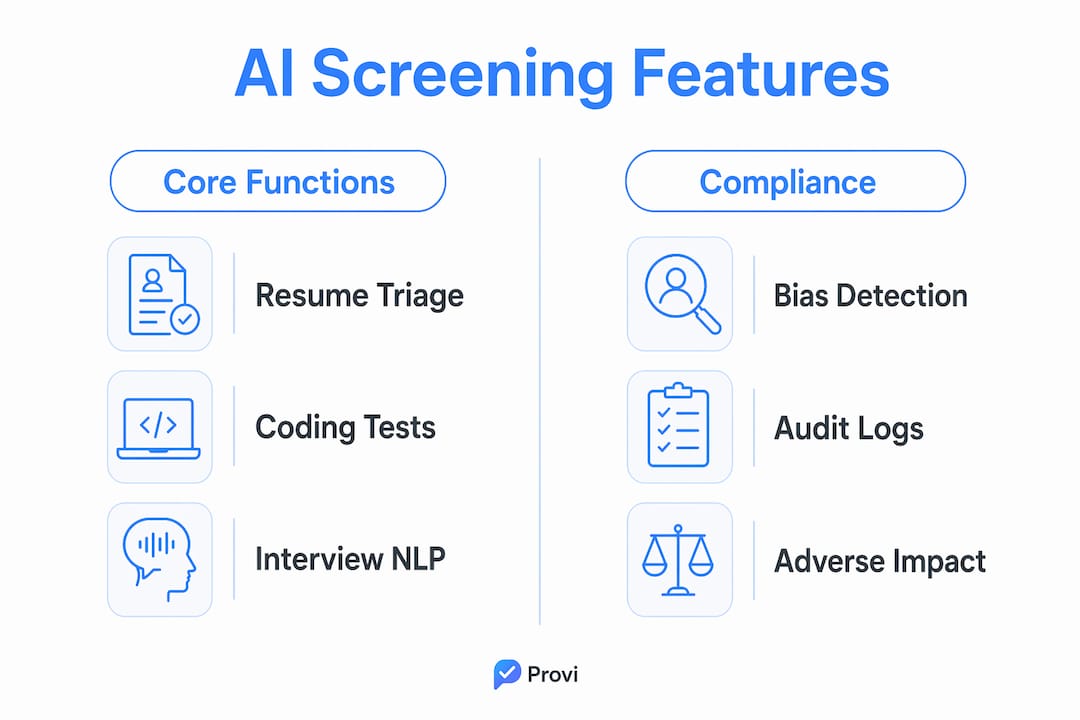
AI screens candidates in real VS Code environments with configurable AI posture, logging every interaction to manage AI usage during assessments securely. That logging capability is not just a security feature. It is also an audit trail that protects your organization if a hiring decision is ever challenged.
Integrity features deserve particular attention in 2026. Candidates increasingly use AI tools to answer interview questions in real time, and platforms that cannot detect this behavior produce unreliable signals. Look for tools that combine behavioral monitoring with attention pattern analysis. Eye movement that follows a second screen reads differently from the natural gaze of someone thinking through a problem. Evy addresses this directly with real-time eye tracking built into its interview platform, giving hiring teams a layer of verification that transcript analysis alone cannot provide.
Integration with ATS systems reduces recruiter workflow friction and increases efficiency. If your screening platform does not connect cleanly to Greenhouse, Lever, or Workday, you will spend significant time on manual data transfer, which erodes the time savings AI is supposed to deliver.
For a detailed side-by-side evaluation of AI screening tools, Evy's comparison guide covers feature sets, pricing structures, and use cases across the major platforms.
When should human judgment override AI screening?
Human judgment should override AI screening at the final decision point, every time. Candidates selected by AI and then evaluated by humans have an 18% higher offer-acceptance rate than those processed through fully automated pipelines. That gap reflects something real: candidates who interact with a human at some point in the process feel more respected, and they are more likely to accept an offer when one comes.
The risks of removing humans from the loop entirely are well documented. Fully automated rejection pipelines lose top talent because no algorithm captures every signal that makes a candidate exceptional. A developer with an unconventional resume who built something genuinely impressive in an open-source project may score below average on a keyword-weighted rubric and above average on every dimension that actually predicts job performance.
Here is how to calibrate AI outputs with hiring manager input effectively:
- Share ranked shortlists with hiring managers before any candidate is eliminated, not after.
- Ask hiring managers to flag candidates they want to review regardless of AI score, then track whether those candidates perform differently in later stages.
- Use AI interview transcripts as a briefing document for the human interview, not as a replacement for it.
- Review AI scoring rubrics quarterly with your technical team to confirm they still reflect what the role actually requires.
Pro Tip: Ask your AI screening vendor to show you the scoring rubric before you go live. If they cannot explain how a candidate's score was calculated in plain language, that tool is not ready for your hiring process.
Transparency in AI scoring is not just a best practice. Hiring managers must comply with automated decision-making directives, choosing AI tools that offer transparency and audit logs to explain candidate rankings and decisions. That compliance requirement is only becoming stricter.
What are the bias and compliance risks of AI screening?
AI screening carries real bias risk, and ignoring it creates legal exposure. Advanced adversarial learning frameworks improve detection of intersectional bias in recruitment systems by 12–18 percentage points compared to traditional methods. That improvement matters because intersectional bias, where a candidate is disadvantaged by the combination of two or more identity characteristics, is harder to detect than single-axis bias and more damaging when it goes unaddressed.
Leading platforms are now required to provide adverse impact data and fairness documentation to comply with evolving standards, including the EU AI Act. The practical implication for HR teams is straightforward: if your AI screening vendor cannot produce a fairness report showing pass rates by demographic group, you are exposed.
The table below maps the key compliance requirements to the platform features that address them.
| Compliance Requirement | Platform Feature Needed | Standard or Directive |
|---|---|---|
| Adverse impact documentation | Demographic pass-rate reporting | EU AI Act, EEOC guidelines |
| Explainable decisions | Rubric-based scoring with audit logs | Automated decision-making directives |
| Bias detection | Adversarial learning and fairness dashboards | Scientific best practice |
| Data retention | Secure transcript and interaction logs | GDPR, state privacy laws |
Transparency and explainability in AI screening tools are essential for mitigating bias and complying with emerging regulations like the EU AI Act. Building competency models from project metadata rather than keywords also helps here. Skills-graph approaches identify non-traditional candidates with deep experience but uncommon resume markers, improving both diversity outcomes and overall hire quality.
For a deeper look at bias and fairness risks in AI screening, Evy's guide covers detection methods, documentation practices, and workflow adjustments that reduce exposure.
How to implement AI screening workflows in your HR team
Implementing AI screening effectively requires more than purchasing a platform. The following steps reflect what high-performing technical recruiting teams actually do to get consistent results.
- Audit your current screening process first. Map every step from application receipt to first human interview. Identify where time is lost and where scoring is inconsistent. This baseline tells you which AI features will deliver the most immediate value.
- Build role-specific competency models before you configure assessments. Generic coding tests produce generic signals. Work with your technical leads to define the specific skills, project types, and problem-solving patterns that predict success in each role. Then configure your AI rubrics to reflect those criteria.
- Integrate your screening platform with your ATS before launch. Manual data transfer between systems creates errors and delays. Confirm that candidate scores, transcripts, and status updates flow automatically into Greenhouse, Lever, or whichever system your team uses.
- Run a calibration cohort before going fully live. Screen a small batch of candidates using both your old process and the new AI workflow. Compare outcomes. Adjust rubrics where the AI score and recruiter judgment diverge significantly.
- Measure and iterate every quarter. Track time-to-hire, offer-acceptance rate, and 90-day retention for candidates who came through the AI screening process. These three metrics tell you whether the system is producing quality hires or just fast ones.
Screening automation scales hiring efforts by handling high-volume candidate evaluation without adding recruiter headcount. The return on investment becomes visible within the first hiring cycle when you measure engineering time saved against cost per hire.
Key takeaways
AI-assisted technical screening delivers the most value when it automates structured evaluation tasks while keeping human judgment at the final decision point.
| Point | Details |
|---|---|
| AI automates four core tasks | Resume triage, coding assessments, structured interviews, and candidate ranking all benefit from AI automation. |
| Human review improves outcomes | Candidates evaluated by AI then reviewed by humans show an 18% higher offer-acceptance rate. |
| AI posture controls matter | Choose platforms that let you enable, restrict, or monitor AI usage per role to protect assessment integrity. |
| Compliance requires documentation | Fairness reports, audit logs, and adverse impact data are now required under the EU AI Act and related directives. |
| Iteration drives ROI | Measure time-to-hire, offer-acceptance rate, and 90-day retention quarterly to confirm your AI screening process is working. |
Where i think most HR teams get this wrong
After watching organizations adopt AI screening tools across dozens of technical hiring cycles, the pattern I see most often is this: teams treat the AI score as the answer rather than as one input among several. They configure a cutoff, automate rejections below it, and then wonder why their offer-acceptance rate drops or why their new hires underperform.
The score is not the answer. The score is a structured summary of observable signals. What it cannot capture is the candidate who took an unconventional path, built something genuinely difficult in an environment the rubric did not anticipate, or who performs differently under the pressure of a real interview than they did in an asynchronous assessment. Those gaps are where human judgment earns its place in the process.
What I find genuinely encouraging is the shift toward testing how candidates use AI tools rather than testing whether they can recall information without them. Modern technical interviews now evaluate candidates' skill at using AI tools effectively, reflecting real-world engineering work. That is a more honest test of what engineers actually do on the job, and it produces better signal for hiring decisions.
The caution I would offer is this: do not adopt an AI screening tool because it is popular or because a vendor demo looked impressive. Evaluate it on transparency. Can the vendor show you exactly how a candidate's score was calculated? Can they produce a fairness report by demographic group? If the answer to either question is no, the tool is not ready for a defensible hiring process.
— Hudson
See how Evy handles technical screening integrity
Evy is the only AI interview platform with real-time eye tracking built in to detect candidates using AI assistance during interviews. For HR teams running technical screening at scale, that capability closes the gap that transcript analysis and behavioral monitoring alone cannot address.
Evy's configurable AI posture controls let you set different rules for different roles, from enabling AI tools for senior positions to restricting them entirely for roles where independent problem-solving is the core competency. Every interaction is logged, giving you the audit trail that compliance requires. Evy integrates with major ATS platforms and uses rubric-based scoring that your team can review and adjust. If you are evaluating anti-cheat AI interview features for your technical hiring process, Evy's features page shows exactly how each capability works in practice.
FAQ
How does AI reduce time-to-hire for technical roles?
AI automates resume triage, coding assessments, and structured interviews, compressing days of recruiter work into hours. Customers using AI screening report over 40 hours saved in engineering time per hire, with a 20% or greater reduction in time-to-hire.
What is AI posture control in technical screening?
AI posture control lets hiring teams configure whether candidates can use AI tools during an assessment, restricting, enabling, or monitoring usage on a role-by-role basis. This ensures the assessment conditions match the actual expectations of the job.
How do AI screening tools detect candidate cheating?
Advanced platforms combine behavioral monitoring, similarity checks, and attention pattern analysis to flag AI-assisted responses. Evy adds real-time eye tracking, which detects when a candidate's gaze follows a second screen rather than reflecting natural thinking patterns.
Is AI screening legally compliant in 2026?
AI screening tools must provide adverse impact data, audit logs, and explainable scoring to comply with the EU AI Act and automated decision-making directives. Hiring managers are responsible for selecting tools that meet these documentation requirements.
Should AI make the final hiring decision?
No. Only 31% of companies allow AI to make final hiring decisions, and research shows that human review after AI screening produces an 18% higher offer-acceptance rate. AI should rank and summarize candidates; humans should make the call.