
 By Adrian Pascual•Hiring insight•Published
Why Video Interviews Replace Phone Screens in 2026
Video interviews are the dominant initial screening method in modern recruitment, replacing phone screens because they deliver richer candidate data, greater scheduling flexibility, and measurable cost savings. Where a phone call captures only voice and verbal fluency, a video interview surfaces body language, eye contact, professional presentation, and communication style in a single session. Platforms like Hireflix and Jobma have made asynchronous video screening accessible to teams of any size, and AI-enhanced tools like Evy have added a new layer of integrity verification that phone screens simply cannot match. For HR professionals weighing video screening vs phone screening, the case for video is no longer theoretical. It is operational.
Why video interviews replace phone screens in efficiency
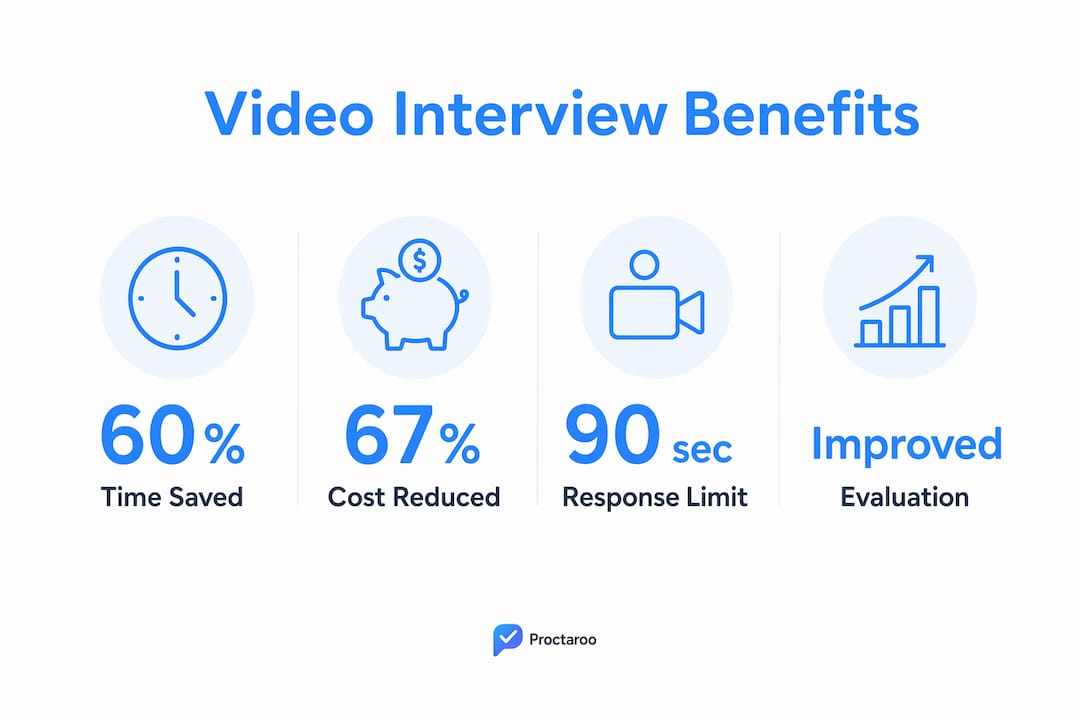
The most immediate reason organizations make the switch is time. Screening time drops by up to 60% when companies move from phone screens to asynchronous video interviews. That figure translates directly into recruiter capacity: a team that previously spent 30 minutes per candidate on scheduling and live phone calls can now review a recorded video response in under 10 minutes, at any hour.
Scheduling alone accounts for a significant share of that savings. Asynchronous video interviews eliminate the calendar conflicts that plague phone screens, particularly when candidates span multiple time zones or hold jobs that restrict daytime availability. A candidate in Chicago applying to a company in San Francisco no longer needs to find a mutual 30-minute window. They record their responses when it suits them, and the recruiter reviews when it suits the team.

Cost reduction follows the same logic. Virtual interviewing reduces travel costs by up to 67% compared to traditional in-person or phone-to-in-person pipelines. For high-volume hiring, that figure compounds quickly across hundreds of candidates per quarter. You can read more about how video reduces logistical costs in tech hiring workflows specifically.
The efficiency gains also extend to reviewer collaboration. A recorded video response can be shared with a hiring manager, a department lead, or a second recruiter without scheduling a separate call. Everyone reviews the same content, at their own pace, and evaluates against the same criteria. This parallel review structure is simply not possible with a live phone screen.
Pro Tip: Set a maximum response time of 90 seconds per video question during initial screening. This keeps review time predictable and forces candidates to communicate concisely, which is itself a useful signal.
How video interviews improve candidate evaluation
Phone screens assess verbal communication. Video interviews assess the full picture. Video reveals soft skills, professional presence, and body posture that a phone call cannot capture. A candidate who sounds confident on the phone but maintains poor eye contact, reads from a script, or appears disengaged on camera provides a meaningfully different signal to a hiring team.
The benefits of video interviews for evaluation go beyond what any single reviewer notices in the moment. Because responses are recorded, multiple team members can assess the same candidate independently, then compare notes. This reduces the influence of any one person's first impression and creates a more defensible hiring decision. Structured video questions, where every candidate answers the same prompts in the same order, reduce unconscious bias compared to the freeform nature of most phone screens.
There is also a preparation effect worth noting. Candidates who complete asynchronous video interviews often report feeling more in control of their responses because they can record in a comfortable environment and, in some formats, re-record if the platform allows it. This tends to surface a more accurate representation of the candidate's communication ability rather than a stress-distorted phone performance.
Consider a practical scenario: a recruiter screening 40 candidates for a customer success role. On the phone, each conversation drifts based on the recruiter's mood, the candidate's opening line, and whatever tangent emerges. With structured video questions, all 40 candidates answer "Describe a time you resolved a difficult client situation" on camera. The recruiter reviews each response with the same rubric. The comparison is direct, fair, and documented.
Pro Tip: Include one open-ended video question with no right answer, such as "Tell us something about yourself that isn't on your resume." Responses to unstructured prompts often reveal communication style and personality more clearly than competency questions.
Asynchronous vs synchronous video: what the research shows
Not all video interviews are the same format, and the distinction matters for candidate experience and hiring outcomes. Asynchronous video interviews, where candidates record responses to pre-set questions without a live interviewer present, offer maximum scheduling flexibility and cost efficiency. Synchronous video interviews, conducted live over platforms like Zoom or Microsoft Teams, more closely replicate the interpersonal dynamic of an in-person meeting.
Research draws a clear line between the two on candidate perception. Synchronous video produces higher trust and satisfaction than asynchronous formats, which candidates often describe as impersonal. This is a real trade-off. The format that saves the most recruiter time is also the format candidates find least engaging. HR teams need to weigh that tension deliberately.
The table below summarizes the key differences for recruitment planning:
| Format | Scheduling flexibility | Candidate experience | Cost efficiency | Best use case |
|---|---|---|---|---|
| Asynchronous video | High | Lower perceived warmth | Highest | Mass screening, first-round filtering |
| Synchronous video | Moderate | Higher trust and rapport | Moderate | Second-round, senior roles |
| Phone screen | Low | Familiar but limited | Low | Legacy workflows only |
The most effective approach blends asynchronous screening with synchronous follow-ups for relationship-building at later stages. Use asynchronous video to filter efficiently at scale, then bring shortlisted candidates into a live video conversation before making an offer. This preserves the efficiency gains of video screening without sacrificing the human connection that candidates value. For a broader view of how video fits remote hiring, the format choice becomes even more consequential when candidates never visit an office.
Addressing candidate experience and technical challenges
The video interview advantages are real, but so are the friction points. Technology literacy and connectivity issues can affect interview ratings and candidate outcomes in ways that have nothing to do with job performance. A candidate with an unstable internet connection or limited experience with video software may perform worse on camera than they would in person, creating a form of unintended bias in the process.
Candidate concerns about privacy and recording are also legitimate. Many candidates feel uncomfortable knowing their responses are stored and reviewed by multiple people they have never met. Without clear communication about how recordings are used, stored, and who reviews them, this discomfort can translate into lower engagement or withdrawal from the process entirely.
Three practices reduce these friction points significantly:
- Send candidates a clear technical guide before the interview, including browser requirements, lighting tips, and a test link to check their setup in advance.
- Explain the format rationale directly. Communicating the flexibility and fairness benefits of video interviewing improves candidate acceptance and perception of the process.
- State explicitly how recordings are used, who reviews them, and when they are deleted. Transparency on data handling builds trust before the interview begins.
On the integrity side, video interviews introduce a challenge that phone screens never faced: AI-assisted cheating. Candidates can use generative AI tools to feed answers in real time, undermining the validity of responses. AI-enhanced platforms detect impersonation and cheating through behavioral signals, attention patterns, and eye tracking, restoring the credibility that unmonitored video formats can erode. This is an area where platform choice directly affects the quality of your hiring data.
Pro Tip: Include a brief video from your hiring manager explaining the interview format and what the team is looking for. This personal touch significantly reduces candidate anxiety about the asynchronous format and improves response quality.
How to implement video interviews to replace phone screens
Replacing phone screens with video interviews is a process change, not just a technology swap. The implementation decisions you make in the first 90 days will determine whether the transition delivers its promised efficiency gains or creates new friction for your team and your candidates.
- Choose a platform with integration capabilities. Your video interview tool should connect to your applicant tracking system, whether that is Greenhouse, Lever, Workday, or another platform. Manual data transfer between systems eliminates the time savings video screening is supposed to create. Review how platform choice affects hiring outcomes before committing to a vendor.
- Write structured question sets before launch. Define three to five questions per role, aligned to the competencies you are actually hiring for. Avoid generic prompts. A question like "Walk me through how you would prioritize three competing deadlines" produces more useful signal than "Tell me about yourself."
- Communicate clearly with candidates at every stage. Send an email that explains the format, the technology requirements, the expected time commitment, and who will review the responses. Candidates who understand the process perform better and withdraw less often. A practical guide on candidate communication during transitions is worth reviewing before your first rollout.
- Pilot with one role or one team before scaling. Run the video screening process in parallel with your existing phone screen for four to six weeks. Compare the quality of candidates who advance, the time spent per hire, and recruiter satisfaction. Use that data to refine your question sets and evaluation rubrics before expanding.
- Use AI screening features responsibly. Analytics on response length, attention patterns, and transcript content can surface useful signals, but they should inform human judgment, not replace it. Set clear internal policies on how AI-generated scores are weighted in hiring decisions.
Key takeaways
Video interviews replace phone screens because they deliver faster screening, fairer evaluation, and lower costs while surfacing candidate signals that audio alone cannot provide.
| Point | Details |
|---|---|
| Screening time savings | Asynchronous video reduces initial screening time by up to 60% versus phone screens. |
| Cost reduction | Virtual interviewing cuts recruitment travel costs by up to 67% compared to traditional workflows. |
| Richer candidate data | Video captures body language, eye contact, and professional presence that phone calls cannot assess. |
| Format trade-offs | Asynchronous video maximizes efficiency; synchronous video builds higher candidate trust and satisfaction. |
| Integrity and fairness | AI-enhanced platforms with eye tracking and attention analysis protect the validity of video screening at scale. |
The case for video is clear, but the execution is where teams fail
I have watched organizations adopt video interviews with genuine enthusiasm, only to see the process collapse within a quarter because no one thought carefully about the candidate experience or the question design. The technology is not the hard part. The hard part is treating video screening as a structured evaluation method rather than a phone call with a camera attached.
The teams that get the most from video interviewing are the ones that invest time upfront in writing precise questions, training reviewers on consistent evaluation criteria, and communicating transparently with candidates about how the process works. They also recognize that asynchronous video is a filtering tool, not a relationship-building one. The moment you try to use it as a substitute for genuine human connection at the offer stage, you will lose candidates to competitors who understand that distinction.
There is also a real integrity concern that too many HR teams are not taking seriously yet. Generative AI has made it trivially easy for candidates to receive real-time answer coaching during an unmonitored video interview. If your platform cannot detect that behavior, your screening data is compromised. This is not a hypothetical risk. It is happening in every high-volume hiring pipeline right now, and the teams ignoring it are making hiring decisions based on AI-generated responses rather than actual candidate capability. Evy's approach to this, using real-time eye tracking and attention pattern analysis, is the most direct technical response to the problem that exists today.
The shift from phone to video is the right move. Make it deliberately.
— Hudson
See how Evy handles video screening at scale
Evy is built for HR teams that need to screen at volume without sacrificing integrity. The platform runs 24/7 asynchronous video interviews with real-time eye tracking to detect AI-assisted cheating, so the candidates who advance are the ones who actually earned it. Reviewers get structured transcripts, attention pattern data, and recorded responses in one place, eliminating the scheduling overhead of phone screens entirely. If your team is ready to move beyond phone screens and wants a platform designed around fairness and security, explore Evy's AI interview features to see how the technology works in practice.
FAQ
Why are video interviews replacing phone screens?
Video interviews replace phone screens because they reduce screening time by up to 60%, capture nonverbal cues that phone calls miss, and allow multiple reviewers to evaluate the same recorded response. They also standardize the evaluation process, which reduces unconscious bias in early-stage hiring.
What is the difference between asynchronous and synchronous video interviews?
Asynchronous video interviews are pre-recorded responses to set questions, reviewed later by the hiring team. Synchronous video interviews are conducted live. Asynchronous formats offer greater scheduling flexibility and cost efficiency, while synchronous formats produce higher candidate trust and satisfaction.
How do video interviews improve fairness compared to phone screens?
Structured video interviews require every candidate to answer the same questions in the same format, which reduces the influence of conversational drift and interviewer mood that affect phone screens. Research confirms that standardized video questions improve the validity and consistency of hiring decisions.
What are the biggest challenges with video interviews?
Technical difficulties, including poor internet connectivity and unfamiliarity with video software, can negatively affect candidate performance and interview ratings. Candidates also report lower comfort with asynchronous formats. Clear pre-interview communication and technical support materials reduce both issues significantly.
How can HR teams prevent AI cheating in video interviews?
AI-enhanced platforms that use real-time eye tracking, attention pattern analysis, and transcript review can detect when candidates are reading AI-generated responses during a video interview. Choosing a platform with built-in integrity features is the most direct way to protect the validity of your screening data.