
 By Adrian Pascual•Hiring insight•Published
Interview Platform Integration Benefits for HR Teams
Fragmented recruitment tools are one of the most persistent sources of wasted time and poor hiring decisions in modern HR operations. When your applicant tracking system, interview scheduling tool, and candidate scoring process all live in separate places, errors multiply and good candidates slip through the cracks. The interview platform integration benefits that matter most to HR professionals and hiring managers go well beyond convenience. They touch fairness, data quality, speed, and candidate experience in ways that directly affect your ability to hire the right people. This article breaks down exactly where those advantages show up and how to capture them.
Table of Contents
- Key takeaways
- 1. Interview platform integration benefits start with structured fairness
- 2. Scheduling automation reduces time-to-interview and candidate drop-off
- 3. Centralized candidate data improves decision quality
- 4. Real-time data sync supports better reporting and compliance
- 5. Candidate experience improves when systems communicate
- 6. Comparing integration approaches and technology considerations
- My honest take on interview platform integration
- How Evy brings these integration benefits together
- FAQ
Key takeaways
| Point | Details |
|---|---|
| Structured interviews reduce bias | Integrated platforms enforce standardized questions and rubrics, producing fairer, more defensible hiring decisions. |
| Scheduling automation cuts drop-off | Native ATS calendar syncing reduces time-to-interview and prevents candidate loss from scheduling delays. |
| Centralized data improves decisions | Unified feedback, scores, and notes in one auditable system reduces inconsistencies that derail hiring. |
| Candidate experience drives acceptance | Real-time status updates and faster scheduling directly improve offer acceptance rates. |
| Integration requires planning | Successful integration demands change management, training, and clear data governance, not just a technical connection. |
1. Interview platform integration benefits start with structured fairness
One of the most significant advantages of interview platform integration is how it enforces structured interview practices at scale. Without integration, interviewers across a panel often ask different questions, score candidates on different criteria, and record feedback in different formats. The result is a comparison that is more about personal impression than actual evidence.
Integration solves this by locking every interviewer into the same question set, the same scoring rubric, and the same feedback form, all within a single workflow. Structured interviews reduce gender bias and improve hiring fairness because they remove the informal variation that allows personal characteristics to influence outcomes. The UK government's guidance on fair hiring is explicit on this point: structured approaches are more likely to produce defensible decisions.
Google re:Work research reinforces this, showing that standardized rubrics and vetted questions produce more reliable candidate comparisons than unstructured conversations. When those rubrics live inside an integrated platform, they are not optional. Every interviewer follows the same process, which makes calibration far easier for hiring managers.
Pro Tip: Before connecting your interview platform to your ATS, audit your current question banks and scoring rubrics. Integration amplifies whatever process you already have. If your rubrics are inconsistent, integration will just make inconsistency faster.
2. Scheduling automation reduces time-to-interview and candidate drop-off
Scheduling is where many hiring processes lose momentum. Coordinating a multi-interviewer panel across calendars, time zones, and availability windows is genuinely complex. When your interview platform does not connect to your ATS or calendar systems, recruiters handle this manually, and manual coordination introduces delays that cost you candidates.
Native ATS integrations sync calendars and enforce permissions to schedule interviews in minutes without switching between tools. That speed matters more than most hiring teams realize. Research shows that scheduling delays correlate with candidate drop-off and reduced offer acceptance, particularly for in-demand technical roles where candidates are interviewing with multiple employers simultaneously.
Here is what scheduling integration typically handles that manual processes cannot:
- Automatic detection of interviewer availability across multiple calendars
- Conflict resolution when panel members have overlapping commitments
- Candidate self-scheduling within pre-approved time windows
- Automated reminders and confirmation messages to all parties
- Immediate ATS status updates when interviews are booked or rescheduled
Each of these steps, done manually, adds hours to a process that should take minutes. Integrated platforms eliminate that overhead entirely.
Pro Tip: Set up your scheduling integration with buffer rules that prevent back-to-back interviews for your interviewers. Fatigued interviewers produce inconsistent assessments, which undermines the fairness benefits you are trying to capture.
3. Centralized candidate data improves decision quality
When interview feedback, scores, and notes live in separate systems, hiring decisions rely on whoever speaks loudest in the debrief room rather than on the actual evidence. This is a data governance problem as much as a process problem, and integration addresses it directly.

An integrated platform keeps all candidate feedback centralized and auditable. Scoring guides and comprehensive feedback recorded in a single system increase interviewer calibration and decision consistency, according to Google re:Work. When every interviewer's notes and scores are visible to the hiring manager before the debrief, the conversation is grounded in evidence rather than recollection.
The table below illustrates the practical difference between fragmented and integrated data environments:
| Dimension | Fragmented tools | Integrated platform |
|---|---|---|
| Feedback location | Email, notes apps, spreadsheets | Single auditable record in ATS |
| Score aggregation | Manual compilation, prone to error | Automatic, real-time rollup |
| Duplicate data entry | Common, causes inconsistencies | Eliminated through sync |
| Compliance readiness | Difficult to audit | Full audit trail available |
| Decision transparency | Low, relies on memory | High, evidence-based |
Avoiding duplicate data entry is not just an efficiency gain. Duplicate records create genuine compliance risk, particularly in jurisdictions with data protection requirements. An integrated system writes candidate data once and keeps it consistent across every connected tool.
4. Real-time data sync supports better reporting and compliance
Beyond individual hiring decisions, the advantages of interview platform integration extend to how your organization reports on and audits its hiring practices. When data flows automatically between your interview platform and ATS, you gain access to reporting that would be impossible to produce manually.
You can track time-to-interview by role, department, or recruiter. You can measure interviewer participation rates and identify panel members who consistently score outliers. You can generate compliance reports that document every touchpoint in a candidate's journey without reconstructing records from scattered sources.
Integration security relies on permission-aware writes and immutable audit trails. Role-based access controls determine who can view or modify candidate records, and every change is logged. This is not just good practice. In regulated industries or jurisdictions with equal employment opportunity requirements, it is a legal necessity.
The reporting capability alone justifies integration investment for many HR teams. When you can demonstrate, with documented evidence, that your process was consistent and fair, you reduce legal exposure and build organizational trust in the hiring function.
5. Candidate experience improves when systems communicate
Candidates form impressions of your organization during the interview process. Slow scheduling, missed communications, and status ambiguity all signal disorganization. Integration addresses each of these directly by keeping candidates informed in real time without requiring manual recruiter intervention.
Syncing interview schedules and statuses via webhooks improves candidate portals and communication flow. When a candidate can see their interview stage update automatically after each step, they feel respected and informed. That experience influences whether they accept your offer.
The qualitative benefits here include:
- Faster confirmation messages after interview scheduling, reducing candidate anxiety
- Consistent messaging across all touchpoints, since content is controlled centrally
- Transparent status updates that reduce the volume of "where do I stand?" emails to recruiters
- A professional impression that reflects well on your employer brand
These effects compound over time. Candidates who have a positive interview experience, even when not selected, are more likely to reapply, refer others, and speak well of your organization. Integration is not just an internal efficiency tool. It shapes how your brand is perceived in the talent market.
6. Comparing integration approaches and technology considerations
Not all integrations are created equal, and the approach you choose affects both what you can do and how much ongoing maintenance you will face. The three most common models are native integrations, custom API connections, and webhook-based event triggers.
| Integration type | Setup complexity | Flexibility | Maintenance burden | Best for |
|---|---|---|---|---|
| Native app integration | Low | Limited to supported features | Low | Teams wanting quick deployment |
| Custom API connection | High | High, fully configurable | High | Organizations with specific data needs |
| Webhook-based triggers | Medium | Event-driven, real-time | Medium | Real-time status sync use cases |
Write operations in ATS integrations require careful design due to provider variability and idempotency needs. In plain terms, this means that pushing data into an ATS is more technically demanding than reading from it. Different ATS providers handle stage transitions differently, and without retry logic and deduplication, you can end up with corrupted records or missed updates.
For most HR teams, native integrations offer the best balance of speed and reliability. Custom API connections make sense when your organization has specific data requirements that native connectors cannot meet. Webhook-based triggers are particularly useful for candidate-facing portals where real-time updates matter.
Security considerations apply regardless of integration type. Biometric and permission-aware systems require audit logs and access controls that match the sensitivity of the data being processed. Any integration that touches candidate records should enforce role-based permissions and log every data write.
Pro Tip: Before committing to a custom API integration, ask your vendor for documentation on their write endpoints specifically. Many platforms have mature read APIs but limited or inconsistent write support. That asymmetry will affect what your integration can actually do.
My honest take on interview platform integration
I've worked with enough HR teams to know that integration is almost never the plug-and-play experience vendors describe. The technical connection is usually the easy part. What takes real effort is everything around it.
In my experience, the teams that get the most from integration are the ones that treat it as a process change, not a software purchase. They spend time before go-live mapping exactly how data should flow, who owns each step, and what happens when something breaks. The teams that struggle are the ones that assume the integration will fix a process that was already broken.
I've also seen a pattern that I think deserves more attention: the tension between automation and human touch. Integration makes it easy to automate candidate communications, but there is a real risk of over-automating. Candidates notice when every message feels templated. The best implementations I've seen use automation for logistics and preserve human contact for moments that actually matter, like delivering feedback or discussing next steps.
What I've learned is that measuring integration impact requires looking beyond time saved. Track interviewer calibration scores over time. Track candidate satisfaction at the interview stage specifically. Track how often hiring decisions are reversed after the fact, which is often a sign that the evidence base was weak. Those metrics tell you whether integration is actually improving your hiring, not just making it faster.
— Hudson
How Evy brings these integration benefits together
HR teams that want to capture the full range of interview platform integration benefits need a platform built with those outcomes in mind from the start, not one where integration is an afterthought.
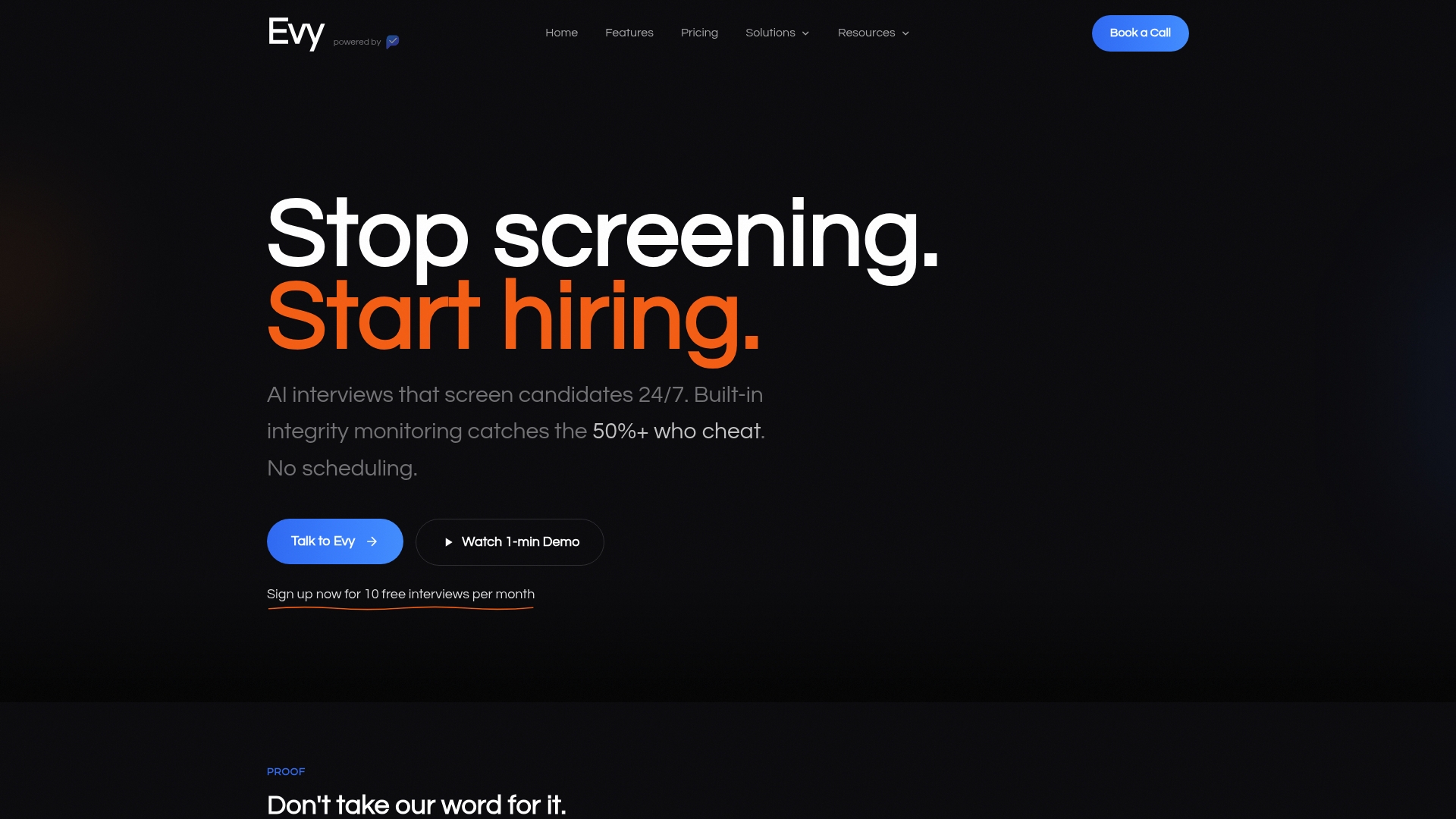
Evy is designed specifically for this. It is the only AI interview platform with real-time eye tracking to catch candidates using AI assistance during interviews, which means the structured, standardized assessments your integration enables are also protected against the integrity risks that undermine them. You can screen candidates at scale, around the clock, and surface talent that is genuinely qualified and genuinely honest.
For HR teams managing high-volume hiring, Evy's anti-cheat AI features work alongside ATS syncing and structured scoring to give you a complete picture of each candidate. Startups that need to hire engineers fast without sacrificing assessment quality will find that Evy's integrated approach reduces time-to-hire without the compliance and fairness risks that come with informal processes. The integration is built to support your workflow, not replace your judgment.
FAQ
What are the main interview platform integration benefits?
The primary benefits include structured, bias-reduced assessments, faster scheduling through calendar sync, centralized candidate data, real-time reporting, and improved candidate experience through automated status updates.
How does interview platform integration reduce hiring bias?
Integration enforces consistent question sets and scoring rubrics across all interviewers. UK government guidance confirms that structured interviews are more likely to produce fair outcomes by reducing the influence of personal characteristics on hiring decisions.
What integration type is best for most HR teams?
Native integrations offer the fastest deployment and lowest maintenance for most teams. Custom API connections are worth the complexity only when your organization has data requirements that native connectors cannot support.
Can integration improve candidate offer acceptance rates?
Yes. Research shows that scheduling delays reduce offer acceptance, and integrated platforms that automate scheduling and status updates keep candidates engaged and informed throughout the process.
What should HR teams do before implementing an interview platform integration?
Audit your existing question banks, scoring rubrics, and data governance policies before connecting systems. Integration amplifies your current process, so inconsistencies in your pre-integration workflow will carry forward into the connected environment.