
 By Adrian Pascual•Hiring insight•Published
On-Demand Video Interviewing: What HR Teams Need to Know
Many recruiters assume that on-demand video interviewing is simply a Zoom call recorded for later review. It is not. On-demand video interviewing is a fundamentally different format where candidates record responses to pre-set questions on their own schedule, and recruiters review those recordings whenever it suits their workflow. No live coordination required. As approximately 60% of recruiters now use video technology for candidate screening, understanding how this format actually works, and how to use it responsibly, is no longer optional for HR professionals who want to hire efficiently and fairly.
Table of Contents
- Key takeaways
- What on-demand video interviewing is and how it works
- Benefits of on-demand video interviewing for recruiters and candidates
- Challenges, legal considerations, and ethics
- Best practices for integrating on-demand video interviewing
- How on-demand platforms compare
- My honest perspective on where most teams get this wrong
- How Evy helps you hire honestly at scale
- FAQ
Key takeaways
| Point | Details |
|---|---|
| Asynchronous by design | Candidates record responses on their schedule; recruiters review recordings at their own pace. |
| Significant time savings | Removing live scheduling from early screening reduces time-to-hire and scales across high-volume roles. |
| Legal risk is real | Employers bear full responsibility for discriminatory outcomes from AI-driven video tools, regardless of which vendor built them. |
| Standardization matters | Structured, job-relevant questions applied consistently to every candidate are the foundation of a defensible and fair process. |
| Interview security is a growing concern | Real-time AI detection tools, including eye tracking and attention analysis, are addressing the rise of AI-assisted cheating in recorded interviews. |
What on-demand video interviewing is and how it works
On-demand video interviewing, sometimes called one-way or asynchronous video interviewing, is a screening method where candidates receive a set of pre-recorded or text-based questions and record their video responses independently. There is no interviewer present. The candidate logs into the platform, reads or hears each question, and records their answer within a set time limit, often between 60 and 180 seconds per response.
This is a meaningful departure from both phone screens and live video calls. In a traditional live interview, both parties must be available simultaneously. Scheduling alone can add days or even weeks to an early-stage screening process. On-demand interviewing removes that friction entirely. Candidates record responses at their convenience, and recruiters review those recordings on their own schedule, sometimes in batches, which makes evaluating large candidate pools far more manageable.
From a technology standpoint, on-demand interview platforms typically handle the following:
- Sending candidates a secure, time-limited interview link
- Delivering questions in a standardized format across all candidates
- Recording and storing video responses with controlled access
- Providing recruiters with a review dashboard where they can rate, comment on, and compare responses
- Integrating with applicant tracking systems to keep the hiring workflow connected
Pro Tip: Set a response deadline of 48 to 72 hours after sending the interview link. This keeps your pipeline moving without placing undue pressure on candidates who may need to find a quiet space and adequate lighting.
The recruiter experience is where the efficiency gains become most apparent. Rather than blocking calendar time for ten phone screens, a recruiter can review the same ten recorded interviews across two hours on a Tuesday afternoon, pausing, rewatching, and scoring responses with a consistent rubric.
Benefits of on-demand video interviewing for recruiters and candidates
The case for adopting on-demand video interviewing is strongest when you examine it from both sides of the hiring process.
For recruiters and HR teams, the scheduling problem disappears almost entirely. High-volume roles, think customer service, retail management, or engineering associate positions, can generate hundreds of applications within days of posting. Live screening at that scale is not feasible without a large team. On-demand interviewing lets one recruiter evaluate dozens of candidates without any back-and-forth coordination. That directly accelerates time-to-hire and frees up capacity for higher-value work.

Broader geographic reach is another concrete benefit. When candidates do not need to be available at a specific time in a specific time zone, you can realistically recruit from across the country or internationally without logistical headaches. That widens the talent pool in ways that scheduling-dependent interviews simply cannot.
For candidates, the format offers a degree of control that phone screens and live video calls do not. A candidate working a full-time job who cannot take a call at 2 p.m. on a Wednesday can still complete their interview after hours when they are focused and prepared. AI-powered video interviewing can also shift evaluation away from gut instinct and toward data-informed decisions when used thoughtfully, which benefits candidates who present well in structured formats but may struggle with the social dynamics of live interviews.
Consider the following documented advantages:
- Scheduling flexibility removes the coordination bottleneck that slows early-stage screening.
- Faster candidate volume processing allows recruiters to screen three to five times more candidates in the same time window compared to phone screens.
- Consistency across evaluations comes from every candidate answering the same questions under the same conditions.
- Cost reduction in travel, venue, and recruiter time compounds quickly across multiple roles.
- Richer data for comparison because reviewers can rewatch responses and share them with hiring managers for second opinions.
Video retention policies vary between 90 days and 2 years depending on data privacy regulations, which means your platform choice also affects your compliance posture from day one.
Challenges, legal considerations, and ethics
The benefits are real, but so are the risks. On-demand video interviewing introduces legal and ethical considerations that demand active attention, not just a vendor contract review.
The most significant legal concern involves AI-driven analysis within these platforms. Some tools use facial expression analysis, tone detection, or speech pattern scoring to generate candidate ratings. Employers are legally liable for discriminatory outcomes from these tools under EEOC and DOJ guidelines, even when the vendor built and operates the software. That responsibility does not transfer. If a tool systematically scores candidates with certain speech patterns or facial characteristics lower, the employer faces exposure regardless of what the vendor's terms of service say.
EEOC guidance reinforces this. Employers must assess AI tools for disparate impact, document business necessity, and evaluate whether less discriminatory alternatives exist. Reviewing a vendor's claims about bias mitigation is not sufficient. You need to understand the methodology and review outcomes data from your own hiring process over time.
Additional concerns include:
- Accessibility. Candidates with disabilities may require accommodations such as extended response times or alternative question formats. Your process must account for this explicitly.
- Privacy and data retention. Recorded videos containing biometric data in some jurisdictions fall under specific privacy laws. Know where your data is stored and for how long.
- Candidate anxiety. Recording a video response alone, with no human present, is stressful for many candidates. A poorly communicated process can damage your employer brand before the person even gets to a first interview.
- Perceived impersonality. Candidates may feel they are being evaluated by an algorithm rather than a person. Clear communication about the review process helps address this perception.
"The candidate experience in video interviewing remains critical. Impersonal or poorly communicated processes can damage employer brand in ways that are difficult to recover from." — Radancy
Mitigation starts with transparency. Tell candidates who will review their video, how scoring works, and what happens next. That alone reduces anxiety and signals that your organization takes fairness seriously.
Best practices for integrating on-demand video interviewing
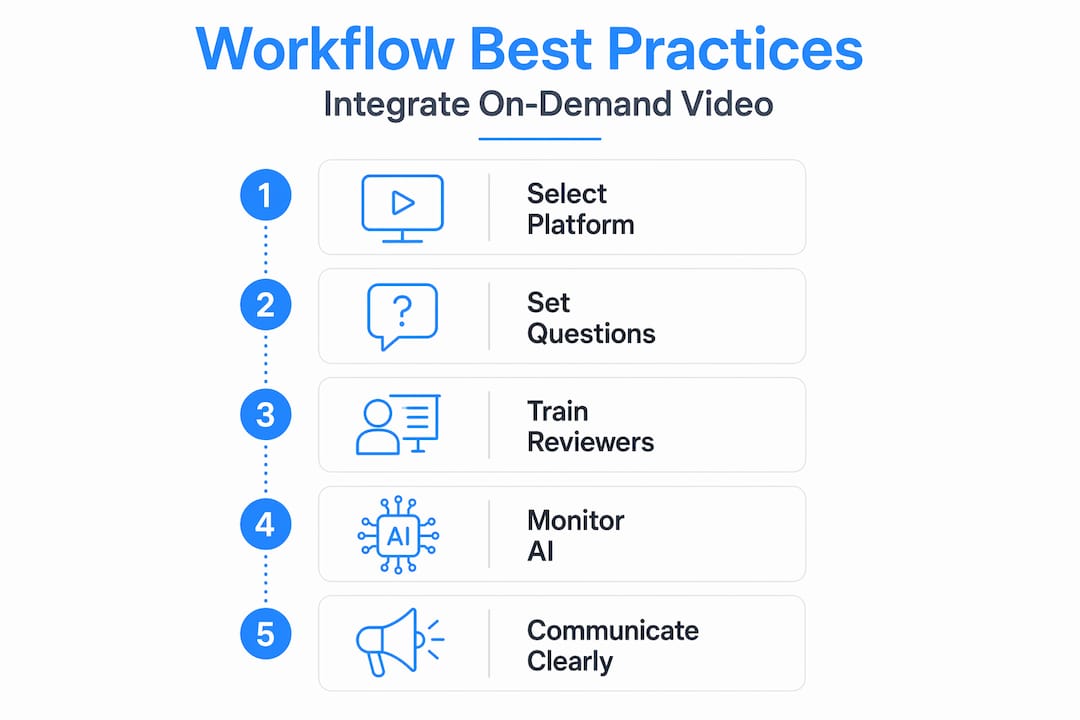
Adopting on-demand video interviewing effectively requires deliberate choices at every stage, from platform selection to how your team evaluates what they see.
Choosing the right platform
Not every platform offers the same capabilities. When comparing options, focus on four criteria: AI explainability, anti-cheating technology, ATS integration, and compliance tooling. A platform that scores candidates without explaining why a score was generated creates legal and operational risk. You need to know what the system is measuring and whether those measures are job-relevant.
Anti-cheating capabilities matter more than many teams initially expect. On-demand video interviews are completed without supervision, which creates genuine opportunities for candidates to use AI assistants, read from scripts, or have someone else respond on their behalf. Platforms with real-time attention tracking, eye movement analysis, and transcript analysis can detect patterns that suggest AI-assisted responses. This is an area where AI scoring and anti-cheat safeguards are increasingly standard expectations rather than premium features.
Structuring fair and effective questions
Every candidate should receive the same questions in the same order. This standardization makes evaluation more defensible and comparison more meaningful. Questions should map directly to job-relevant competencies, not broad assessments of "culture fit," which are difficult to define objectively and under regulatory scrutiny when applied through AI tools.
Aim for three to five questions per screening interview. More than that creates fatigue without proportionally improving your insight into a candidate's fit.
Training your reviewers
Structured scoring rubrics reduce the impact of personal bias on evaluation. Before deploying on-demand interviews for a role, define what a strong, adequate, and weak response looks like for each question. Calibrate among reviewers using sample responses before the live process begins. This takes an hour upfront and pays off significantly in score consistency.
Clear communication with candidates about technical requirements, response time limits, and what to expect from the review process is one of the simplest best practices and one of the most frequently overlooked.
Pro Tip: Send a short preparation email before the interview link, covering device requirements, lighting suggestions, and what topics the questions will focus on. Candidates who are technically prepared and contextually informed perform more authentically, which benefits your evaluation quality.
Separately, your team should be conducting ongoing checks on AI-assisted features. Scrutinize AI tools for disparate impact on an ongoing basis rather than relying solely on vendor assurances. Build that review into your process at least annually.
How on-demand platforms compare
Selecting among on-demand interview platforms is less about brand recognition and more about feature alignment with your specific hiring context. Here is a functional comparison of criteria to apply:
| Feature | What to look for | Why it matters |
|---|---|---|
| AI scoring methodology | Explainable, rubric-aligned outputs | Reduces legal risk and supports fair evaluation |
| Anti-cheating technology | Eye tracking, attention analysis, transcript review | Detects AI-assisted responses and script reading |
| ATS integration | Native connectors or API access | Keeps your hiring workflow unified |
| Candidate experience tools | Branding, prep resources, mobile access | Reduces dropout and improves perception |
| Data retention and privacy controls | Configurable retention windows, consent management | Meets jurisdiction-specific compliance requirements |
| Scalability | Volume handling, concurrent sessions | Supports high-volume hiring without performance degradation |
Platforms that combine AI-powered scoring with anti-cheat tools and ATS integration are increasingly the baseline expectation for enterprise and high-growth teams. The question is whether those features are transparent in how they operate, not just present on a feature list. For guidance on evaluating AI screening tools against fairness and workflow criteria, the distinction between what a platform claims and what it can document becomes critical during procurement.
My honest perspective on where most teams get this wrong
I have watched organizations roll out on-demand video interviewing with genuine enthusiasm, only to see adoption stall within six months. The reason is almost never the technology. It is the gap between deployment and thoughtful integration.
Here is what I have consistently observed: teams select a platform based on a demo, build a question bank in a week, and then hand it off to recruiters who have received no training on scoring calibration. The result is that each reviewer applies their own informal rubric. The efficiency gains materialize. The fairness gains do not.
What I have learned is that the structured rubric is not optional. It is the entire point. Without it, on-demand video interviewing becomes a faster way to apply the same biases that in-person interviews have always produced. The technology scales your process. The rubric determines whether what you are scaling is defensible.
The AI component deserves its own honest conversation. AI can genuinely improve consistency when it measures things that are clearly job-relevant and explainable. What concerns me is when AI tools analyze attention patterns or eye movements without giving reviewers the context to interpret what they are seeing. A candidate who is reading from a script moves their eyes differently than someone thinking through a genuine response. That distinction has real value when the analysis is transparent and explained. It becomes a liability when it is treated as a black box score.
My take: use AI as a signal to guide human review, not as a replacement for it. The most defensible and effective processes I have seen pair AI-generated flags with mandatory human assessment before any candidate is advanced or rejected. That combination produces better decisions and holds up under scrutiny.
— Hudson
How Evy helps you hire honestly at scale
If you are ready to move beyond manual screening without sacrificing integrity, Evy was built for exactly that challenge. Evy is the only AI interview platform with real-time eye tracking to catch candidates using AI assistance during recorded interviews. That matters because on-demand interviews are completed without supervision, and the current generation of AI tools makes it straightforward for candidates to receive live coaching or generate scripted answers in real time.
Evy's platform combines anti-cheat AI and compliance tools with explainable scoring and ATS integration, giving your team the efficiency of asynchronous screening alongside the security controls that honest evaluation requires. Whether you are an enterprise HR team managing hundreds of open roles or a startup hiring engineers at speed, Evy surfaces qualified, honest candidates without the scheduling bottlenecks or the security gaps that standard platforms leave open.
FAQ
What is on-demand video interviewing?
On-demand video interviewing is an asynchronous hiring format where candidates record responses to pre-set questions on their own schedule, and recruiters review those recordings independently. No live interaction takes place during the interview itself.
How does on-demand video interviewing differ from a live video call?
A live video call requires both the recruiter and candidate to be available simultaneously. On-demand video interviewing removes that requirement entirely, allowing candidates to record responses at a convenient time and recruiters to evaluate them in batches.
What are the main benefits of video interviewing for recruiters?
The primary benefits include faster screening of high-volume candidate pools, elimination of scheduling coordination, geographic flexibility, and more consistent evaluation when standardized questions and scoring rubrics are used.
Are employers legally responsible for AI used in video interviews?
Yes. Employers are legally liable under EEOC and DOJ guidance for discriminatory outcomes produced by AI-driven video tools, even when the technology was developed and operated by a third-party vendor.
How can you prevent candidates from cheating in on-demand video interviews?
Platforms with real-time eye tracking, attention pattern analysis, and transcript review can detect signs of AI-assisted responses or script reading. Anti-cheating safeguards built into the platform are increasingly a necessary feature for any organization that prioritizes interview integrity.