
 By Adrian Pascual•Hiring insight•Published
The Role of Video in Modern Recruiting in 2026
Video is no longer a nice-to-have in your hiring toolkit. The role of video in modern recruiting has grown from employer branding filler into a functional, measurable strategy that affects application rates, candidate quality, and time-to-hire. Yet most recruiting teams still treat it as a content problem rather than a hiring problem. They produce a polished culture video, post it on their careers page, and wonder why nothing changes. This guide breaks down how video actually works across the entire recruiting funnel, where it creates real value, and how to avoid the legal and operational pitfalls that catch teams off guard.
Table of Contents
- Key takeaways
- The role of video in modern recruiting across the funnel
- Data behind video's impact on hiring outcomes
- Legal and ethical considerations in video hiring
- Video formats and where to use them
- Building a strategic video recruiting plan
- My honest take on where video recruiting goes wrong
- How Evy helps you screen at scale with confidence
- FAQ
Key takeaways
| Point | Details |
|---|---|
| Video spans the full funnel | Use different video types for awareness, role clarity, trust building, and candidate screening. |
| Data supports video adoption | Job postings with video see 34% higher application rates and up to 157% better SEO performance. |
| Compliance is non-negotiable | AI-powered video tools must meet ADA requirements to avoid unlawful screening of candidates with disabilities. |
| Strategy precedes production | Define your hiring problem first, then select the video format and distribution channel to solve it. |
| Authenticity outperforms polish | Candidates respond more to genuine employee stories than to high-budget promotional content. |
The role of video in modern recruiting across the funnel
Many HR teams assume video has one job: make the company look attractive. In practice, video serves four distinct functions depending on where a candidate sits in the recruiting process. Mixing them up, or relying on just one type, is where most strategies fall short.
Different video content types should be mapped to specific funnel stages for maximum impact. Here is how each category functions:
- Employer brand (EVP) videos sit at the top of the funnel. Their purpose is awareness. A strong EVP video communicates your culture, values, and work environment to candidates who may not know you exist or who have misconceptions about what it is like to work there. These are the videos that live on LinkedIn, YouTube, and your careers page.
- Role clarity films sit in the middle of the funnel. These are short, specific videos that explain what a job actually involves day-to-day. When candidates understand the role deeply before applying, you get fewer mismatched applications and better self-selection. A 90-second "day in the life" video for a warehouse supervisor will filter out candidates who expect an office environment and attract those who thrive in hands-on settings.
- Leadership and culture videos serve the offer stage. When a finalist candidate is deciding between two offers, a direct message from a team lead or department head can be the deciding factor. These videos build the human connection that written offer letters cannot replicate.
- Video interviews serve the screening stage. They allow you to evaluate candidates asynchronously, reach talent across time zones, and reduce the scheduling load on your recruiting team.
Pro Tip: Before producing any video, ask yourself which stage of the funnel it serves and what specific candidate perception shift you want to achieve. If you cannot answer both questions clearly, you are not ready to produce.
Data behind video's impact on hiring outcomes
The numbers make a compelling case for video recruitment strategies, but not all metrics are created equal. Reach and engagement tell only part of the story.
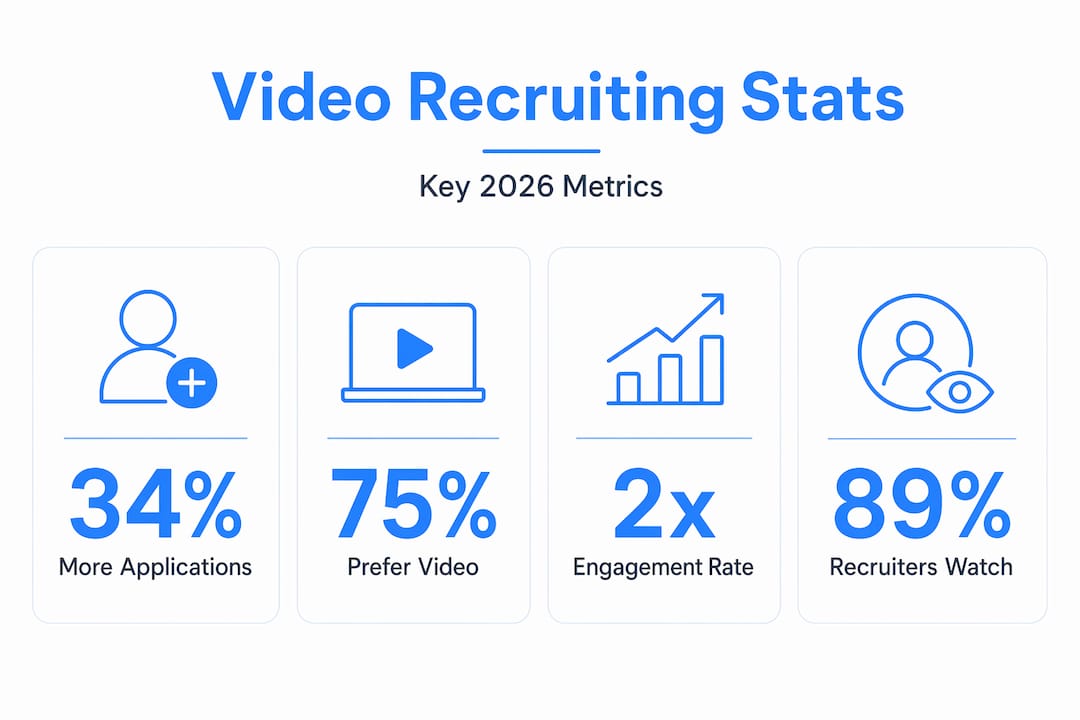
Job postings with video see 34% higher application rates, and 75% of candidates say the look and feel of a company's presence influences their decision to apply. Those figures alone justify the investment for most teams. But the downstream effects are just as significant. Recruitment marketing videos can boost job views by 12%, applications by 34%, and improve SEO performance by up to 157%, which means your careers page starts ranking for competitive role-specific search terms.

Video also extends your reach without proportional cost increases. A single well-placed LinkedIn video can generate ten times the organic reach of a text post for the same job. On mobile, where most candidates now browse job opportunities, video is the format that holds attention longest.
Three additional factors drive the impact of video in hiring:
- Speed of trust. Video builds human connection in a way that text-based job descriptions simply cannot. Candidates who feel a sense of familiarity with a company before they apply are more likely to complete the application and accept an offer.
- Candidate quality. Recruiters who use role clarity videos consistently report fewer unqualified applicants because the video pre-screens for expectation fit before a single resume is reviewed.
- Reduction in ghosting. Candidates who have seen real employees and heard from actual team members are more invested in the process, which means lower drop-off rates at the interview stage.
Legal and ethical considerations in video hiring
The practical benefits of video are real, but the risks are equally concrete. Two categories deserve your full attention: legal compliance and bias.
On the legal side, AI hiring tools must meet ADA requirements to avoid unlawfully screening out candidates with disabilities. This applies directly to video interviewing platforms that use AI to analyze speech patterns, facial expressions, or attention behavior. If those systems measure traits that are affected by a disability rather than job performance, they can create discriminatory outcomes even when that is not the intent. Compliance leaders should evaluate AI hiring tools carefully and verify that any trait being measured is demonstrably job-related.
Bias risks extend beyond AI. Candidate-created videos, such as video cover letters or video resumes, introduce visual and demographic information early in the process. A recruiter reviewing a video application sees race, age, gender, and appearance before evaluating competency. Without structured evaluation criteria, this creates discrimination exposure that text resumes largely avoid.
On the workflow side, only 17% of recruiters have ever viewed a video resume despite 89% saying they would. The gap exists because most applicant tracking systems do not handle video files natively. Videos get uploaded, ignored, and lost. If you encourage candidates to submit video applications, you need a clear and functional process for reviewing them. Otherwise you create a compliance risk and a candidate experience failure simultaneously.
Pro Tip: Before rolling out any AI-powered video interview tool, document which specific behavioral signals it measures, confirm those signals are validated for job-relevance, and verify the vendor has completed ADA compliance testing. Ask for documentation, not just assurances.
- Require structured scoring rubrics for all video-based evaluations
- Audit video screening tools annually for disparate impact across demographic groups
- Provide alternative formats for candidates who face barriers to video participation
- Train hiring managers on unconscious bias risks specific to visual candidate presentation
Video formats and where to use them
Knowing which format to use matters as much as deciding to use video at all. The wrong format for the wrong channel wastes budget and misses candidates entirely.
Authentic video content featuring real employees consistently outperforms polished promotional content in candidate engagement. Candidates are fluent in identifying corporate messaging, and they trust peers more than brands. An employee sharing a genuine story about why they stayed with the company for five years will connect more than a scripted highlight reel.
| Video format | Best funnel stage | Ideal distribution channel |
|---|---|---|
| EVP brand film | Awareness | LinkedIn, YouTube, paid social |
| Day-in-the-life video | Consideration | Careers page, job postings |
| Employee story / testimonial | Consideration to trust | Careers page, email outreach |
| Leadership message | Offer stage | Direct candidate email, ATS |
| Asynchronous video interview | Screening | AI interview platform |
| Office / team tour | Trust building | Careers page, social media |
Distribution channel matters as much as format. A day-in-the-life video posted on LinkedIn reaches passive candidates who are browsing but not actively applying. The same video embedded directly in a job posting serves candidates who are already interested and want confirmation before committing. Treating them as interchangeable is a common and costly mistake.
For mobile specifically, keep videos under two minutes, front-load the most compelling content within the first ten seconds, and use captions. Most social video is watched on mute. If your video requires audio to be understood, you are excluding a significant portion of your potential audience.
Workforce technology platforms have noted that employee advocacy, meaning real staff sharing company content to their own networks, dramatically amplifies video reach without additional production costs. If your team is proud of where they work, that is your most cost-effective distribution channel.
Building a strategic video recruiting plan
The difference between teams that see results from video and teams that do not usually comes down to one thing: whether they started with a strategy or with a camera.
A repeatable planning framework looks like this:
- Define the hiring problem. Are you struggling with low application volume, poor candidate quality, high offer rejection rates, or slow screening? Each problem calls for a different video response. Low volume needs brand awareness content. High rejection rates may need better leadership visibility at the offer stage.
- Identify the candidate perception shift. What does the candidate currently believe about your company or role, and what do you need them to believe instead? A strong recruitment video strategy ties content directly to that shift rather than producing generic material.
- Match format to problem. Use the funnel framework from earlier sections to select the video type that addresses the specific gap you identified.
- Map distribution to the candidate journey. A candidate who has never heard of you needs a different touchpoint than one who is already in your ATS. Put content where candidates are, at the moment they need it.
- Measure beyond views. Views are vanity metrics in recruiting. Track application completion rates, quality of hire, and offer acceptance rates for roles where video was part of the process. That is where the real signal lives.
Pro Tip: Pilot video in one high-volume role before scaling across your entire job portfolio. Document baseline metrics before launch and compare at 60 and 90 days. This gives you defensible ROI data and a chance to iterate before committing company-wide.
My honest take on where video recruiting goes wrong
I've reviewed a lot of recruiting video programs, and the pattern I see most often is this: teams invest in production before they invest in thinking. They hire a video crew, produce a beautiful two-minute brand film, and call it a video strategy. Then six months later, when application rates haven't moved, they conclude that video doesn't work for their industry.
What I've found is that video doesn't fail because of the format. It fails because the content isn't tied to a real hiring problem. A gorgeous EVP film won't fix a poor candidate experience in the interview process. A polished office tour won't help if your job descriptions are vague and the role expectations are misaligned.
In my experience, the teams that get the most from video are the ones that treat it like any other hiring intervention. They define the problem, measure the baseline, test a solution, and iterate. They also take compliance seriously from the start, not as an afterthought when legal raises a concern.
The future of video in recruiting is deeply connected to AI-assisted screening, and that brings both promise and responsibility. As platforms get better at analyzing candidate responses at scale, the importance of fairness, transparency, and bias auditing only grows. Using AI candidate screening thoughtfully means understanding what the system is actually measuring, not just accepting its outputs.
— Hudson
How Evy helps you screen at scale with confidence
Video interviews only deliver value when you can trust what you're seeing. Evy is the only AI interview platform with real-time eye tracking designed to detect when candidates are using AI assistance during an interview. For HR teams managing high application volumes, that means you can screen candidates asynchronously, 24/7, while maintaining the integrity of your process.
Beyond anti-cheat technology, Evy's platform features are built with compliance in mind. The system is designed to evaluate job-relevant behaviors, not demographic signals, which directly addresses the bias and ADA concerns outlined in this guide. If you are building or refining a video interviewing process and need a tool that matches the seriousness of your hiring standards, explore what Evy offers HR teams who need to hire faster without cutting corners on fairness.
FAQ
What is the role of video in modern recruiting?
Video serves multiple functions across the recruiting funnel, from employer brand awareness to candidate screening. Its primary value lies in improving engagement, accelerating screening, and building trust with candidates before and during the hiring process.
Do video job postings actually get more applications?
Yes. Job postings that include video see 34% higher application rates compared to those without, and they also benefit from significantly improved search engine visibility.
What legal risks come with AI video interviewing?
AI video interviewing tools must comply with ADA requirements and avoid measuring traits that could unfairly screen out candidates with disabilities. Employers should validate that any AI-measured behaviors are demonstrably job-related before deployment.
Why do video resumes rarely work in practice?
The primary issue is ATS compatibility. Despite 89% of recruiters saying they would watch a video resume, only 17% ever have because most applicant tracking systems do not support video file formats natively.
How do you measure the success of a video recruiting strategy?
Track application completion rates, candidate quality scores, and offer acceptance rates for roles where video was used, rather than focusing on views or click counts. Those downstream metrics tell you whether video is actually improving hiring outcomes.