
 By Adrian Pascual•Hiring insight•Published
The Role of Video Interviews in Remote Hiring
Video interviews are the primary method for evaluating remote candidates at scale, replacing in-person screening across industries from technology to financial services. The role of video interviews in remote hiring extends beyond simple convenience. They shape candidate experience, influence fairness perceptions, and increasingly determine whether top talent completes your application process at all. This guide examines what the research actually shows about synchronous versus asynchronous formats, how social presence affects both candidates and evaluators, and how AI is changing the integrity equation for hiring teams in 2026.
What is the role of video interviews in remote hiring?
Video interviews serve three distinct functions in a remote hiring workflow: initial screening, structured assessment, and culture communication. Each function carries different requirements for format, technology, and candidate experience design. Understanding these distinctions is what separates teams that use video interviews well from those that simply use them.
The benefits of video interviews are well documented. They reduce recruitment costs, eliminate geographic constraints, and allow hiring teams to evaluate far more candidates per week than in-person processes allow. At the same time, video interviews reduce perceived fairness and can lower interviewer ratings compared to face-to-face meetings. That tradeoff is not a reason to avoid video. It is a reason to design your process carefully.

The industry standard term for this category is "technology-mediated interviewing," which covers both live video and pre-recorded formats. HR professionals and hiring managers should understand both the efficiency gains and the perception costs before deciding how to deploy each format.
How do synchronous and asynchronous video interviews differ in impact?
The format you choose has measurable consequences for who completes your process and how they feel about your organization afterward.
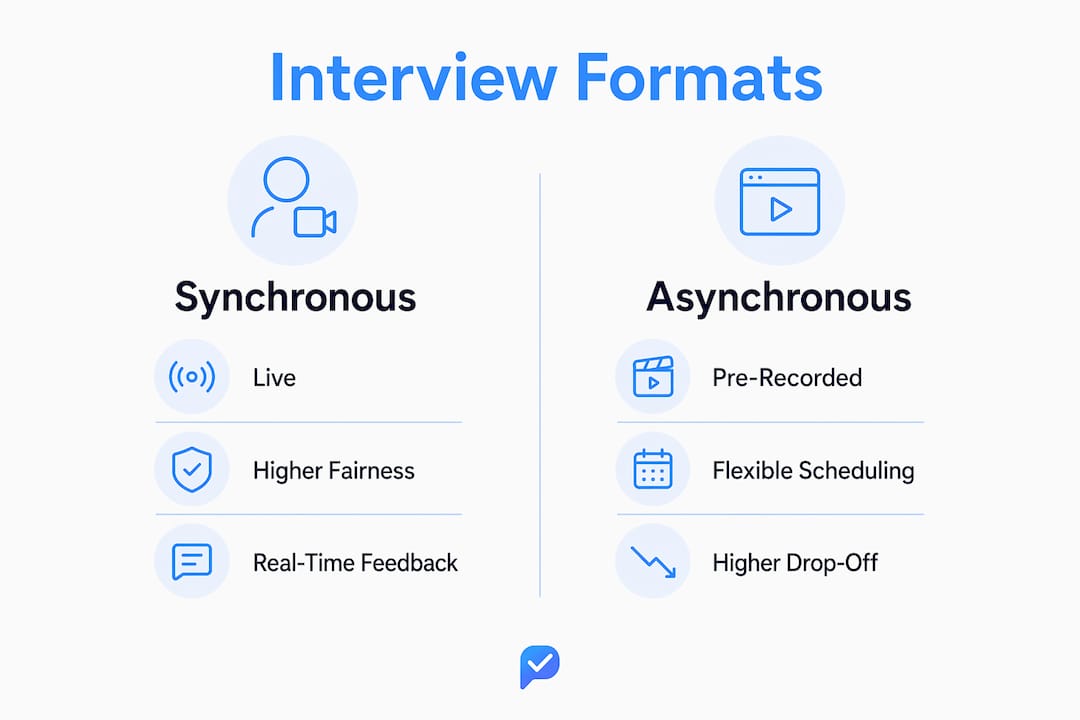
Synchronous video interviews are live, two-way conversations conducted over platforms like Zoom, Microsoft Teams, or Google Meet. They closely replicate the social dynamics of face-to-face interviews. Synchronous formats generate applicant attitudes closer to in-person interviews, which means higher perceived fairness and stronger organizational attractiveness signals. For senior roles or final-round assessments, this format preserves the relational quality that candidates expect.
Asynchronous video interviews are pre-recorded responses to set questions, reviewed by hiring teams on their own schedule. They offer genuine scheduling flexibility and allow structured, consistent evaluation. However, the research findings here are stark. A 2026 field experiment with over 3,000 applicants found that asynchronous interviews caused a 50% drop in application continuation rates, with women disproportionately affected due to fairness concerns. That is not a minor friction point. It represents a significant loss of qualified candidates before evaluation even begins.
Here is a direct comparison of the two formats:
| Dimension | Synchronous | Asynchronous |
|---|---|---|
| Candidate fairness perception | Higher | Lower |
| Scheduling flexibility | Lower | Higher |
| Application drop-off risk | Lower | Higher |
| Evaluator consistency | Variable | Higher |
| Social presence quality | High | Low |
A structured staffing workflow for remote tech hiring typically uses asynchronous formats for early screening and synchronous formats for mid-to-late stage assessment. This sequencing limits drop-off risk while preserving scheduling efficiency.
Key considerations when choosing a format:
- Use asynchronous video for high-volume, early-stage screening where consistency matters more than relationship-building.
- Use synchronous video for roles requiring strong interpersonal skills, senior positions, or any stage where candidate experience directly affects offer acceptance.
- Always communicate the format and its purpose clearly before candidates begin. Unexplained asynchronous requests feel impersonal and raise red flags about your organization.
Pro Tip: When deploying asynchronous video interviews, include a short video message from the hiring manager explaining the process. This single addition measurably reduces candidate anxiety and improves completion rates.
How does social presence shape candidate experience in video interviews?
Social presence is defined as the degree to which a communication medium conveys the feeling of real human interaction. In interview research, it is the variable that explains most of the gap between video and face-to-face outcomes.
Candidates who rely heavily on nonverbal cues to manage their impression during interviews are hit hardest by low social presence environments. Research confirms that high nonverbal cue expectations reduce fairness perceptions significantly in video interview settings. When a candidate cannot read the interviewer's body language or receive real-time feedback signals, they lose the ability to calibrate their responses. The result is frustration, reduced confidence, and lower self-reported fairness ratings.
For interviewers, the effect runs in the opposite direction. Lower social presence can cause evaluators to rate candidates less favorably, not because of actual performance differences, but because the medium itself creates a less engaging interaction. A 2026 meta-analysis based on 31 samples and over 3,800 participants found that organizational attractiveness and behavioral intentions are consistently lower in technology-mediated interviews compared to face-to-face, even when candidates rate the functionality of the technology positively.
"Lower social presence leads to candidate frustration during video interviews due to less capacity for real-time impression management." — Research finding from How does the job interview medium affect fairness perceptions?
Practical steps to improve social presence in your video interview setup:
- Use high-resolution video systems and position the camera at eye level to simulate natural eye contact.
- Optimize lighting so your face is clearly visible. A ring light or a well-positioned window works well.
- Reduce audio latency and background noise. Poor audio quality disrupts conversational rhythm more than video quality does.
- Build in brief conversational moments at the start and end of structured interviews. This is not small talk for its own sake. It restores the relational texture that structured formats strip away.
The interview platform you choose directly affects social presence quality. Platforms with stable low-latency connections, high-definition video, and intuitive interfaces reduce the technical friction that erodes candidate experience.
What are the benefits and challenges of AI in video interviews?
AI is now embedded in the video interview process at multiple points, from automated scheduling and transcription to behavioral analysis and candidate scoring. The evidence on its effectiveness is genuinely encouraging in some areas and genuinely concerning in others.
On the performance side, AI evaluation tools have demonstrated real advantages. A 2026 field experiment found that AI assessment predicts employment success substantially better than human recruiters and assesses diversity more fairly in certain contexts. This matters for HR teams managing high-volume hiring where human evaluator consistency is difficult to maintain across hundreds of interviews.
The challenges, however, are not trivial:
- Candidate perception of AI evaluation is often negative. Many candidates feel that algorithmic scoring is less fair than human judgment, even when the reverse is true. Transparency about how AI is used in your process is not optional. It is a fairness obligation.
- Privacy and data concerns are growing. Behavioral analysis tools that assess facial expressions, speech patterns, or eye movement raise legitimate questions about consent and data retention. HR teams need clear policies before deploying these tools.
- AI-assisted cheating is now a documented problem in virtual interviews. Major employers including Deloitte, Deutsche Bank, Meesho, and Scaler have reported detecting candidates using ChatGPT and similar tools to generate answers in real time. These organizations now use scenario questions and monitoring tools to identify AI-assisted responses during virtual interviews.
| AI application | Benefit | Risk |
|---|---|---|
| Automated scoring | Consistency at scale | Perceived unfairness |
| Behavioral analysis | Reduces human bias | Privacy concerns |
| Cheat detection | Protects process integrity | False positives |
| Transcript analysis | Structured evaluation | Context loss |
Pro Tip: Disclose AI use in your interview process in the candidate-facing instructions. Candidates who understand how AI is used report higher fairness perceptions than those who discover it after the fact.
Employers increasingly enforce policies and technologies to detect AI-assisted answering in video interviews, balancing hiring innovation with integrity risks. For HR teams, the question is no longer whether to use AI in video interviews. It is how to use it responsibly while protecting the integrity of your candidate pool.
How can HR teams integrate video interviews into remote hiring strategies?
Effective integration of video interviews into remote hiring strategies requires more than selecting a platform and sending calendar invites. The process design, candidate communication, and technical environment all affect outcomes in ways that are easy to underestimate.
Video interviews should not replace phone screens without careful thought about how the format change affects candidate behavior and drop-off rates. The shift from a low-pressure phone call to a recorded video response is significant for many candidates, particularly those less familiar with the format. Framing matters. Explain why you use video, what candidates should expect, and how their responses will be evaluated.
Practical recommendations for HR teams building video interview workflows:
- Define the format by stage and role. Use asynchronous video for volume screening of individual contributor roles. Reserve synchronous video for leadership positions, roles requiring strong communication skills, and any stage where candidate experience affects offer acceptance rates.
- Standardize your question sets. Structured interviews with consistent questions across all candidates reduce evaluator bias and improve legal defensibility. This applies to both formats.
- Test your technical setup before every interview. Audio and video failures are the single most common source of candidate complaints in remote hiring. Assign a technical check-in step before live interviews begin.
- Integrate with your ATS. Platforms that connect directly with applicant tracking systems like Greenhouse, Lever, or Workday reduce manual data entry and keep candidate records current without additional administrative work.
- Review completion and drop-off data regularly. If your asynchronous video stage shows high abandonment, the problem is usually in the instructions, the question format, or the perceived effort required. Audit these before assuming candidate quality is the issue.
The on-demand video interviewing model works best when candidates receive clear timelines, know how long the process takes, and understand what happens next. Uncertainty at any of these points increases drop-off.
Key takeaways
Video interviews are a high-impact remote hiring tool, but their effectiveness depends entirely on format choice, social presence quality, and how honestly AI is integrated into the evaluation process.
| Point | Details |
|---|---|
| Format choice drives drop-off | Asynchronous video caused over 50% drop in application continuation in a 2026 study. |
| Social presence affects fairness | Low social presence reduces candidate fairness perceptions and interviewer ratings independently of actual performance. |
| AI outperforms humans in prediction | AI assessment tools predict employment success better than human evaluators but require transparent disclosure to candidates. |
| Cheat detection is now standard | Employers like Deloitte and Deutsche Bank actively monitor for AI-assisted responses in virtual interviews. |
| Process framing reduces friction | Clearly communicating the video interview format and purpose improves candidate completion rates and fairness perceptions. |
What I've learned from watching video interview practices evolve
The research confirms what many experienced hiring managers already sense: video interviews are not a neutral medium. They carry their own social dynamics, and those dynamics affect who applies, who completes the process, and who gets hired.
What concerns me most is how many organizations deploy asynchronous video interviews without understanding the drop-off risk. A 50% reduction in application continuation is not an acceptable tradeoff for scheduling convenience, especially when that drop-off disproportionately affects women. The format choice is a fairness decision, not just a logistics one.
On the AI side, I think the industry is moving faster than its ethical frameworks can keep up with. Behavioral analysis tools that score facial expressions or attention patterns are genuinely useful for detecting AI-assisted cheating, but they also raise questions about what we are actually measuring. Eye movement during a video interview may look different from someone thinking naturally versus someone reading from a screen. The difference matters, and not every platform is equipped to distinguish between the two.
The organizations getting this right are the ones treating video interviews as a designed experience rather than a default process. They choose formats deliberately, communicate clearly with candidates, and audit their data for drop-off and bias signals. That discipline is what separates a video interview program that works from one that quietly filters out good candidates before they ever get evaluated.
— Hudson
How Evy supports fair and secure remote video hiring
Remote hiring teams face a real tension: scale requires automation, but automation creates new integrity risks. Evy is built to resolve that tension. As the only AI interview platform with real-time eye tracking, Evy detects when candidates are using AI tools to generate answers during video interviews, giving hiring teams confidence that the talent they surface is genuinely qualified. Evy screens at scale, operates 24/7, and flags attention patterns that indicate AI assistance without disrupting the candidate experience for honest applicants. If your team is managing high-volume remote hiring and needs a reliable way to protect process integrity, explore Evy's anti-cheat features to see how the platform fits your workflow.
FAQ
What is the role of video interviews in remote hiring?
Video interviews serve as the primary tool for candidate screening, structured assessment, and culture communication in remote hiring workflows. They replace in-person evaluation by enabling hiring teams to assess candidates at scale across geographic boundaries.
How do asynchronous and synchronous video interviews compare?
Synchronous video interviews generate higher fairness perceptions and closer to face-to-face candidate attitudes, while asynchronous formats offer scheduling flexibility but carry a significantly higher application drop-off risk. A 2026 field experiment found asynchronous interviews caused over 50% fewer candidates to continue their applications.
What is social presence and why does it matter in video interviews?
Social presence is the degree to which a communication medium conveys real human interaction. Lower social presence in video interviews reduces candidate fairness perceptions and can cause interviewers to rate candidates less favorably, independent of actual performance quality.
How are employers detecting AI cheating in virtual interviews?
Organizations including Deloitte, Deutsche Bank, Meesho, and Scaler use scenario-based questions and behavioral monitoring tools to identify candidates using ChatGPT or similar AI tools to generate real-time responses during virtual interviews.
What are the best practices for integrating video interviews into remote hiring?
Use asynchronous video for high-volume early screening and synchronous video for senior or communication-intensive roles. Standardize question sets, communicate the process clearly to candidates, and integrate your video platform with your ATS to reduce administrative overhead.