
 By Adrian Pascual•Hiring insight•Published
Why Screen Candidates at Scale: Prioritize Top Talent
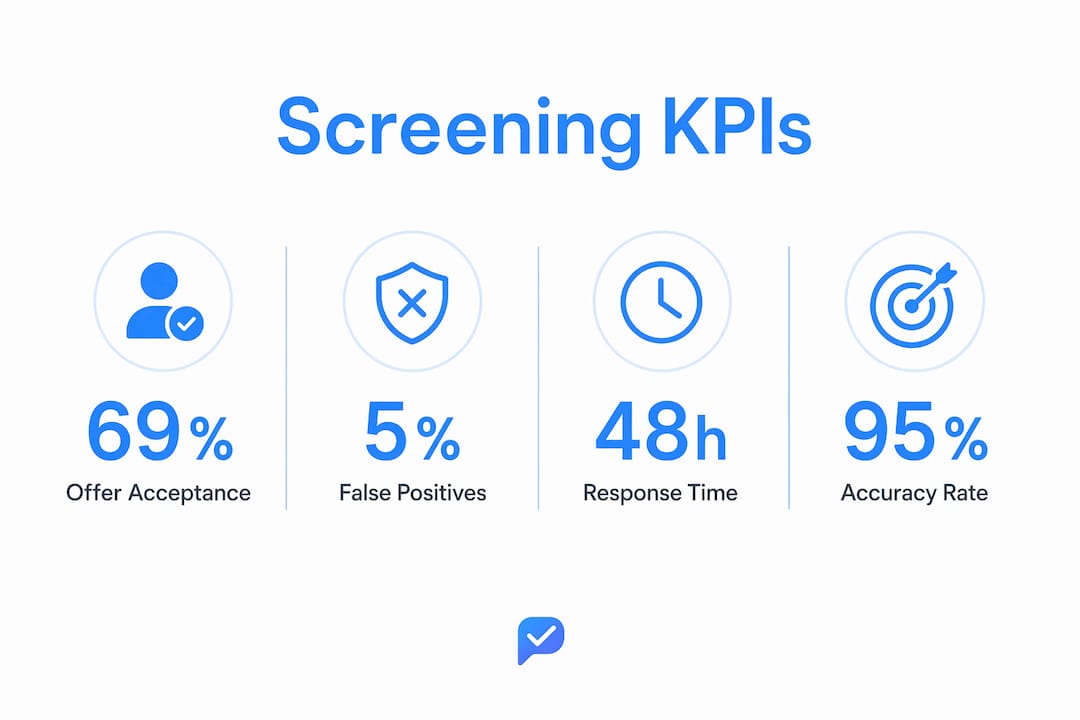
Screening candidates at scale turns a slow, administrative rejection task into a strategic prioritization engine that surfaces your top 5% of applicants within hours, not weeks. The core logic is simple: talent acquisition leaders who treat screening as a prioritization tool allocate human attention to the candidates most likely to succeed, rather than spending days processing the rest. With 69% of candidates accepting competing offers when response times drag, the cost of slow screening is measurable and immediate.
Primary business reasons to screen at scale:
- Speed: Surface qualified candidates within 48–72 hours and respond before competitors do.
- Consistent signal: Evaluate every applicant against the same structured criteria, reducing noise.
- Reduced recruiter hours: Automate the bottom 95% of the funnel so your team focuses on the top tier.
Table of Contents
- Why screening candidates at scale is a strategic advantage
- What risks come with scaling screening, and how do you manage them?
- How to roll out large-scale screening in six practical steps
- Which metrics actually tell you if scaled screening is working?
- Day-to-day operating rules that protect candidates and recruiters
- How Evy solves the specific problems of screening at scale
- Key Takeaways
- The case for building integrity into screening from the start
- Run a pilot with Evy before your next high-volume role opens
- Useful sources
Why screening candidates at scale is a strategic advantage
The business case for scalable screening rests on three pillars: speed, quality, and cost. Manual screening of many resumes takes a single recruiter many hours. A structured AI-assisted flow compresses that same work into hours, freeing your team for higher-value conversations.
Stat: Organizations using validated pre-hire assessments report approximately 39% lower turnover than those relying on resumes and interviews alone (SHRM).
Quality improves alongside speed. Cognitive screening carries a meta-analytic validity of r ≈ .51 for predicting job performance, compared to r ≈ .18 for resume-based biodata. That gap translates directly into better downstream retention and performance.
Business outcomes from scalable screening:
- Faster time-to-fill, with top candidates surfaced within 48–72 hours.
- Lower recruiter burnout from repetitive resume review.
- Improved shortlist quality through structured, comparable data.
- Reduced cost-per-hire by eliminating unqualified interviews early.
- Stronger employer brand through faster, more transparent candidate communication.
What risks come with scaling screening, and how do you manage them?
Scaling screening introduces four operational risks worth addressing before wide rollout.
Cheating and AI-assisted fraud. As candidates increasingly use AI tools during assessments, score validity erodes. Real-time cheating detection, such as eye-tracking combined with audit logs and recorded interviews, is the most direct mitigation. Explainable scoring adds a second layer by flagging anomalous response patterns for human review.
Adverse impact and bias. Automated screening can scale existing bias if the underlying signals are weak. Mitigation requires running adverse impact analyses by demographic group before full rollout, using job-relevant criteria only, and conducting periodic validation studies. The EEOC's Uniform Guidelines on Employee Selection Procedures remain the governing framework in the United States; consult legal counsel before deploying any scored assessment at scale.
False positives and false negatives. No automated system is perfect. A sampling review of rejected applicants, roughly 5–10% of the "not a match" pool, catches false negatives before they become permanent losses. Configure your system to sort, not cut: route borderline candidates to a talent pool with reasons attached rather than deleting them outright.
Candidate drop-off. Long or opaque assessments increase abandonment. Keep cognitive or skills assessments to 10–15 minutes, communicate clearly about the process, and set response SLAs of 48–72 hours.
Pre-rollout checklist:
- Adverse impact analysis completed for each scored criterion.
- Audit log and recording capability confirmed.
- Human-in-the-loop rules documented for borderline and rejected candidates.
- Legal review of assessment design and data retention policy.
- Candidate-facing communication drafted (what the process involves and when they'll hear back).
Pro Tip: Before launching at scale, run a fairness and workflow audit on a sample of 50–100 historical applications to confirm your criteria are job-relevant and your pass rates are defensible across demographic groups.
How to roll out large-scale screening in six practical steps
A structured rollout reduces noise and builds recruiter confidence in AI scoring.
- Align on intake must-haves. Before applications open, agree on 3–5 non-negotiable criteria with hiring managers. Intake alignment at this stage dramatically improves AI sorting accuracy downstream and reduces post-screen disputes.
- Design the screening stack. Combine structured application fields, a short cognitive or skills assessment (10–15 minutes), a video-first AI interview with real-time cheating detection, and ATS integration for seamless handoff.
- Set pass/fail thresholds. Define cut scores based on job analysis, not convenience. Document the rationale for each threshold so you can defend it under EEOC scrutiny.
- Run a pilot. Start with 50–200 candidates. Track completion rate, pass rate by demographic, fraud detection rate, and time-to-first-response. AI screening systems can process 100–200 resumes per hour with explainable scoring, so even a small pilot generates meaningful data quickly.
- Audit and iterate. After the pilot, sample rejected candidates, review explainability outputs, and adjust rubrics where the data shows drift or unexpected demographic patterns.
- Scale and integrate. Connect your screening platform to your ATS and outreach workflows. Route top-tier candidates to recruiters within 48–72 hours; route borderline candidates to a talent pool for future roles.
Pilot metrics template:
- Target completion rate: above 70%.
- Pass rate: document baseline and monitor by demographic group.
- Time-to-first-response: target under 48 hours.
- Fraud detection rate: track flagged sessions per 100 interviews.
- Shortlist-to-hire conversion: measure after first full cycle.
Which metrics actually tell you if scaled screening is working?
Tracking the right KPIs separates a screening program that improves over time from one that quietly drifts.
| KPI | How to measure | Action threshold |
|---|---|---|
| Time-to-first-response | Hours from application to candidate notification | Intervene if median exceeds 72 hours |
| Completion rate | % of invited candidates who finish the assessment | Review UX and length if below 70% |
| Pass rate by demographic | % advancing per group | Investigate if any group's rate is notably below the highest group's rate (4/5ths rule) |
| Fraud detection rate | Flagged sessions per 100 interviews | Audit flagged sessions within 24 hours |
| Shortlist-to-hire conversion | % of shortlisted candidates who receive offers | Raise cut scores if consistently low |
| Quality of hire | — | Recalibrate rubric if ratings trend below target |
Audit logs and explainable scoring outputs feed directly into this KPI set. When a score is challenged, a plain-English summary of why a candidate passed or failed is the difference between a defensible decision and a compliance exposure. For deeper guidance on interpreting AI fit signals, the KPI interpretation layer matters as much as the score itself.
Day-to-day operating rules that protect candidates and recruiters
Governance on paper means little without operating rules that recruiters actually follow.
Keep humans as final decision-makers. AI scoring surfaces and ranks; it does not hire. Every offer and every rejection at the shortlist stage should carry a human sign-off. This is both an ethical standard and a legal protection.

Audit rejected candidates regularly. A monthly sample review of 5–10% of "not a match" decisions catches systematic errors before they compound. Pair this with a quarterly adverse impact report.
Do/don't list for daily operations:
- Do communicate the screening process to candidates before they start.
- Do offer accessibility accommodations for assessments (extended time, alternative formats).
- Do provide a clear timeline: when candidates will hear back and what the next step is.
- Don't delete rejected candidates. Route them to a talent pool with reasons attached.
- Don't rely on a single score. Combine resume signals, assessment results, and interview performance.
- Don't skip the human review layer for borderline candidates.
Pro Tip: Batch your human review sessions twice weekly rather than reviewing candidates one at a time. Structured batch review reduces inconsistency caused by decision fatigue and keeps your 48–72 hour response SLA intact.
How Evy solves the specific problems of screening at scale
Evy is built around the integrity gap that most AI screening platforms ignore: candidates using AI assistance during interviews. Its real-time eye-tracking detects attention patterns that differ from natural thinking, flagging likely AI-assisted responses for human review without blocking candidates outright.
The platform maps directly to the risks and KPIs covered above:
- Real-time eye tracking: Detects AI-assisted cheating during live interviews, preserving score validity at scale.
- Explainable automated scoring: Combines resume signals and live response quality into a single score with a plain-English rationale, supporting audit and compliance needs.
- Structured interview flows: Anti-bias question design reduces adverse impact risk from the start.
- ATS integration: Routes shortlisted candidates directly into your existing workflow without manual handoff.
- Audit logs and recorded interviews: Every session is documented for compliance and human review.
- 24/7 screening: Candidates complete interviews on their schedule, reducing drop-off and accelerating time-to-first-response.
Evy operates on a pay-per-interview model with optional monthly or annual seat plans for volume. That structure makes a small pilot genuinely low-risk: run 50–100 interviews, measure the KPIs from the table above, and validate the rubric before committing to full-scale deployment. For how AI screening improves hire quality across a full hiring cycle, the evidence is consistent with the validity numbers cited earlier in this guide.
Key Takeaways
Screening candidates at scale works when it functions as a prioritization engine, not a rejection filter, with integrity controls and human oversight built in from day one.
| Point | Details |
|---|---|
| Speed is a competitive necessity | 69% of candidates accept other offers when response is slow; target first response within 48–72 hours. |
| Cognitive screening outperforms resumes | Validity correlations show structured assessments predict performance far better than resume review alone. |
| Fraud detection protects score validity | Real-time cheating detection and audit logs are required controls, not optional add-ons, when screening at scale. |
| Human oversight is non-negotiable | AI scores surface and rank candidates; humans make final decisions and audit rejected pools monthly. |
| Evy for integrity-first screening | Evy's real-time eye tracking and explainable scoring address the fraud and fairness risks that undermine most scaled screening programs. |
The case for building integrity into screening from the start
Most conversations about scaling candidate screening focus on speed and cost. Those matter. But the risk that tends to get underestimated is integrity: what happens to your screening data when a meaningful share of candidates are using AI to generate their answers?
The honest answer is that your scores stop measuring what you think they measure. A high score on a video interview where the candidate was reading AI-generated responses tells you nothing about their actual capability. It tells you they know how to use a tool. That is a different signal, and conflating the two leads to shortlists that look strong on paper and disappoint in the role.
The fix is not to ban AI use broadly. Candidates will use the tools available to them, and understanding why they do matters for designing better assessments. The fix is to build detection into the screening layer so that the scores you act on reflect genuine capability. That is the design principle behind Evy, and it is the reason integrity controls belong in the implementation plan from day one, not as an afterthought.
Run a pilot with Evy before your next high-volume role opens
Honest shortlists start with honest screening. Evy gives recruiting teams the only AI interview platform with real-time eye tracking to catch AI-assisted cheating as it happens, not after the fact. Every interview is recorded, scored with a plain-English rationale, and logged for compliance review.
The pilot path is straightforward: choose pay-per-interview pricing to screen your next 50–100 candidates, track time-to-first-response, pass rate, and fraud detection rate, and compare shortlist quality against your current process. No long-term commitment required to see the data. Review Evy's full feature set and request a demo to configure your first structured screening flow.
Useful sources
- High-Volume Hiring: How to Screen 1,000 Applicants Without Sacrificing Quality — Cogn-IQ.org: source for cognitive screening validity (r ≈ .51) and SHRM turnover reduction data.
- Applicant Screening at Scale: The Signal-vs-Noise Framework — Metaview Blog: source for the 69% candidate dropout statistic, intake alignment guidance, and the "sort, not cut" best practice.
- How to Screen 1000 Resumes Fast (Without Burning Out Your Team) — HireFormly: source for the 16–25 hour manual screening estimate and the four-stage funnel model.
- AI Candidate Screening: How to Automate Top-of-Funnel Screens in 2026 — Noon Blog: source for AI throughput rates (100–200 resumes per hour) and explainability/audit trail requirements.
- Screening and Evaluating Job Candidates — SHRM: authoritative toolkit on screening methods, legal compliance, and structured evaluation practices.