
 By Adrian Pascual•Hiring insight•Published
Why Candidates Use AI During Interviews in 2026
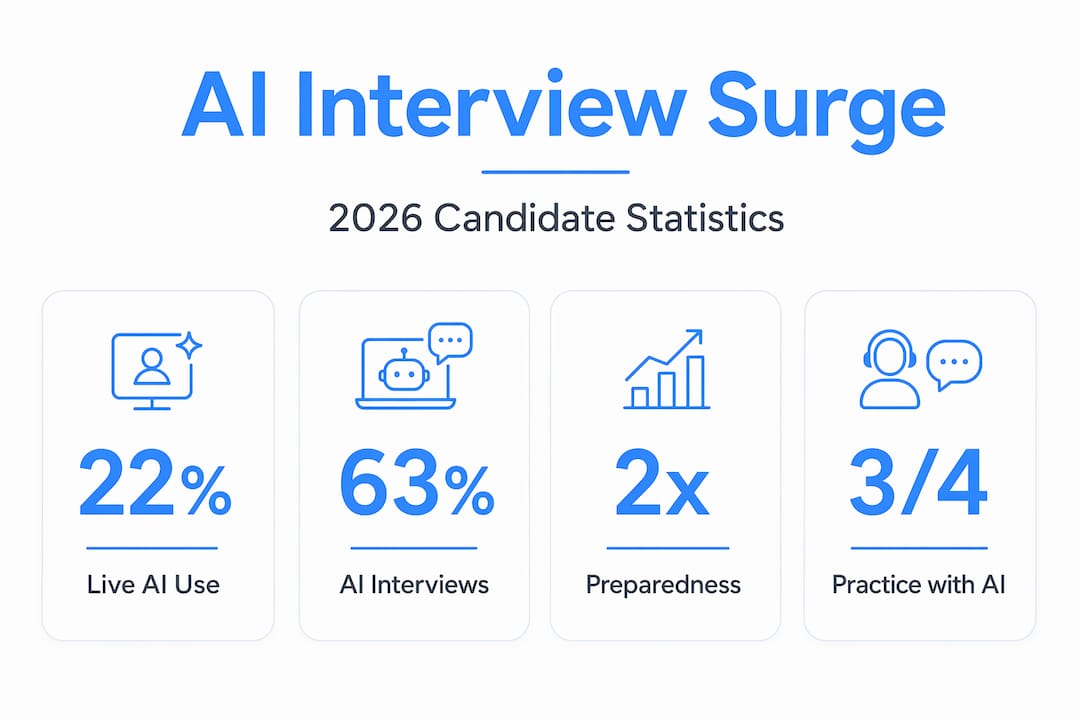
More candidates are using AI during live job interviews than most hiring teams realize. 22% of U.S. workers admit to using AI in real time to answer questions during live interviews, and 13.6% credit it with landing their current job. Understanding why candidates use AI during interviews goes beyond curiosity about technology trends. It reveals something meaningful about competitive pressure, candidate anxiety, and the gap between what interviews test and what jobs actually require. This article covers the motivations, tools, ethical limits, and best practices you need to make informed decisions.
Table of Contents
- Key Takeaways
- Why candidates use AI during interviews
- Types of AI tools candidates use
- Ethical considerations and employer policies
- How to use AI responsibly in your interview prep
- The future of AI in hiring
- My take on AI, interviews, and authenticity
- See how Evy supports fair, transparent AI interviews
- FAQ
Key Takeaways
| Point | Details |
|---|---|
| AI use is widespread | Over 1 in 5 candidates use AI live during interviews, making it a mainstream practice worth understanding. |
| Tools vary significantly | From generative models for answer drafting to real-time coding assistants, the type of AI matters as much as the decision to use it. |
| Disclosure is the safest path | Lying about AI use carries more risk than the use itself; transparency protects candidates from blacklisting. |
| Employer policies are inconsistent | No universal standard exists, so candidates must research company-specific rules before each interview. |
| AI fluency is becoming a skill | Forward-thinking employers like Google now evaluate how well candidates direct and validate AI, not just whether they use it. |
Why candidates use AI during interviews
The most direct answer is competitive pressure. When job markets tighten and hundreds of candidates apply for the same role, anything that sharpens performance feels worth considering. AI tools address several specific pain points candidates face in modern interviews.
Reducing anxiety and improving answer quality. Interviews are high-stakes, time-pressured environments. Even highly qualified candidates can freeze under pressure or struggle to articulate complex experience clearly. AI tools help candidates organize their thoughts faster, structure responses using frameworks like STAR (Situation, Task, Action, Result), and avoid rambling. For many, it is less about cheating and more about managing nerves.
Handling unexpected or highly technical questions. Interviews increasingly include questions that require deep, current knowledge. A candidate in a data science role might face a question about a specific algorithm they have not worked with recently. Real-time AI assistance can surface relevant context quickly, reducing the chance of a blank pause derailing an otherwise strong conversation.

Competing against AI-prepared peers. This is where the logic gets circular, but it is real. Candidates and employers face a measurement mismatch when some candidates use AI assistance while others do not, yet both are evaluated on the same scale. Candidates who suspect others are using AI tools feel disadvantaged if they do not.
The benefits of AI in interviews also include better preparation. Candidates use AI to simulate mock interviews, generate likely questions based on job descriptions, and receive instant feedback on practice answers. This preparation use is widely accepted and genuinely useful regardless of live use decisions.
Pro Tip: Use AI to generate five to ten role-specific behavioral questions before every interview, then practice answering them out loud without AI assistance. This builds genuine fluency while using the tool where it adds clear value.
Types of AI tools candidates use
Not all AI assistance in interviews looks the same. The technology candidates use falls into two broad categories: preparation tools and live-assist tools. Understanding the difference matters both practically and ethically.
Preparation AI vs. live-assist AI
| Category | Examples | When used | Ethical status |
|---|---|---|---|
| Preparation AI | ChatGPT, Claude, Gemini | Before the interview | Widely accepted |
| Live-assist AI | Real-time screen tools, AI whispering devices | During the interview | Depends on employer policy |
| Coding AI assistants | GitHub Copilot, Gemini in IDE | Technical interview rounds | Emerging, company-specific |
| ATS optimization tools | Resume parsers like ParseWorks | Application stage | Generally accepted |
Generative language models like ChatGPT are the most common preparation tool. Candidates use them to anticipate questions, draft and refine practice answers, and research companies deeply in a fraction of the time manual research would take. This is AI interview preparation in its most widely accepted form.
Live-assist tools are more controversial. These include browser extensions that display generated responses on screen, hidden earpiece setups, and specialized applications designed to provide real-time coaching during video calls. The risk with these tools scales directly with employer detection capability.
Google's pilot of Gemini for coding interviews represents a notable shift. Rather than treating AI as cheating in technical rounds, Google tested giving candidates access to an AI coding assistant and then assessing AI fluency directly. The interview measured how well a candidate directed, validated, and debugged AI outputs rather than whether they could write code from memory. This format rewards a different, arguably more relevant, skill set.
Prompt engineering has become a skill in its own right here. Candidates who know how to ask precise questions of an AI model get faster, more accurate responses than those who type vague queries. In a live coding session where AI is permitted, the quality of your prompts directly shapes the quality of the output you can build on.
Pro Tip: Before any technical interview, practice using AI tools to debug and explain code, not just generate it. Interviewers evaluating AI fluency care far more about your ability to critically review output than your ability to produce a clean prompt.
Ethical considerations and employer policies
The ethical picture around AI use during interviews is genuinely complicated. There is no universal standard. Employer policies on AI usage form a patchwork with no consistent rules across industries, company sizes, or even departments within the same organization.
Some employers explicitly prohibit all AI use during interviews. Others have no stated policy. A growing number actively permit or even encourage AI use in specific rounds. The absence of a clear policy does not mean AI use is acceptable. It means the burden falls on candidates to ask.
"The most damaging action for candidates is lying about AI use, not the fact of use itself. Transparency wins trust — and trust is what interviews are ultimately designed to establish."
This principle matters because the consequences of dishonesty are severe. Candidates risk permanent blacklisting if caught misrepresenting their AI use. In tight professional communities, a reputation for dishonesty can travel further than a rejected application. Employers who discover undisclosed AI use after an offer has been extended have rescinded offers. Some pursue this further depending on the nature of the role and the information shared during the interview process.
The transparency challenge extends in both directions. 63% of candidates who face AI-conducted interviews walk away when they feel the process lacks transparency. Candidates who feel deceived by employers are more likely to accept that two-way opacity is the norm, which is not a healthy place for hiring to land.
Before each interview, ask your recruiter directly: "What is your policy on candidates using AI tools during this interview?" The answer tells you where the organization stands and signals that you are someone who takes the process seriously. That combination of curiosity and honesty is genuinely impressive to most hiring teams.
Employers are also increasing their detection capabilities. Post-hoc audits using keystroke and gaze tracking can identify AI-assisted responses through response latency patterns and attention behaviors that differ from natural, unassisted thinking. Eye movement from a candidate reading a generated response on a second screen looks measurably different from someone formulating a thoughtful answer independently.
How to use AI responsibly in your interview prep
Responsible AI use during interviews is not about avoiding the technology. It is about knowing where AI adds genuine value and where it undermines the outcome you actually want.
- Use AI heavily for preparation, not performance. Mock interviews powered by AI, question anticipation, company research summaries, and answer framework practice are all areas where AI makes you legitimately better. The skills you build through AI-assisted practice translate into stronger unaided answers on the day.
- Check employer policy before the interview, not after. Contact your recruiter during the scheduling phase. Ask clearly about their position on AI use during the session. Document the response. If AI use is permitted in specific rounds, confirm which rounds and what tools are acceptable.
- Disclose AI use if it comes up or if you are asked directly. Honesty about how you prepared, including AI tools you used, is far safer than evasion. Most hiring managers are not trying to catch you using ChatGPT to prepare. They are trying to assess whether you are trustworthy and self-aware.
- Develop your AI validation skills intentionally. Practice identifying when AI outputs are wrong, incomplete, or confidently incorrect. This is the skill that actually matters in modern technical roles, and it is the one that well-designed interview processes are beginning to measure directly.
- Do not use live-assist AI unless explicitly told it is permitted. The upside of a slightly better answer in one interview round does not outweigh the downside of a rescinded offer, a blacklisted profile, or a professional reputation that takes years to rebuild.
Pro Tip: After every AI-assisted practice session, force yourself to answer the same questions without the tool. The gap between your AI-assisted answer and your solo answer shows you exactly where your actual knowledge needs work.
The future of AI in hiring
The direction of travel is clear. Companies like Google, Meta, and Canva are normalizing AI tool use in interviews rather than fighting it. The impact of AI on job interviews is shifting from "did the candidate use AI?" to "how effectively did the candidate use AI?" This is a meaningful change in what interviews are designed to measure.
Interview formats are adapting alongside this shift. Rather than testing unaided knowledge recall, evolving interview formats increasingly focus on assessing a candidate's ability to direct AI outputs, catch errors, and make judgment calls that require human context. For candidates who have invested in building real AI fluency, this shift is an advantage.
The risk for candidates who ignore AI entirely is not that they appear more authentic. It is that they appear less prepared for the reality of modern work. Organizations hiring for technical roles in 2026 expect candidates to have a working relationship with AI tools. Arriving at an interview with no familiarity signals a gap that is hard to explain away.
At the same time, legal and ethical frameworks around AI in hiring are still forming. Fairness and diversity considerations are part of this conversation. AI-assisted candidates may perform better in ways that have nothing to do with job-relevant skills, which creates a measurement problem for employers and a fairness concern for candidates who cannot or choose not to use these tools.
My take on AI, interviews, and authenticity
Ignoring AI tools as a candidate in 2026 is not a principled stance. It is a competitive disadvantage dressed up as integrity. I have watched qualified candidates underperform in interviews not because they lacked the skills but because the interview format created artificial barriers that AI would have easily cleared.
That said, the candidates who use AI to avoid developing real competence are making a longer-term mistake. Interviews are imperfect filters, but most roles will eventually expose a gap between performed capability and actual capability. The real use of AI in preparation is not to fake knowledge you do not have. It is to organize and surface knowledge you already possess more effectively.
What concerns me most is the anxiety angle. A lot of candidates are using AI during live interviews not out of a strategic decision but out of fear. That fear often comes from interview processes that are poorly designed, where one bad answer costs you the role regardless of everything else. The solution there is better interview design, not better AI concealment.
Candidates who master prompt engineering and AI validation are, in fact, demonstrating skills that are highly relevant to most knowledge work roles today. The framing of that as cheating says more about outdated interview design than it does about the candidates using the tools. A hopeful direction is one where interviews are designed to evaluate both human judgment and AI collaboration simultaneously, with full transparency on both sides.
— Hudson
See how Evy supports fair, transparent AI interviews
Evy is built for the reality that AI use in interviews is already happening at scale. Whether you are a candidate preparing for an AI-assisted process or a hiring team trying to evaluate candidates fairly, the question is not whether AI is present. It is whether the process is honest.
Evy's interview platform uses real-time eye tracking and attention pattern analysis to create interviews where honesty is verifiable and AI fluency can be assessed transparently. For candidates, that means a level playing field where preparation and genuine skill are what surface. For hiring teams, it means confident decisions grounded in accurate data. If you want to understand how modern interview security actually works, explore Evy's features and see what fair AI-era hiring looks like in practice.
FAQ
Why do candidates use AI during live interviews?
Candidates use AI during live interviews primarily to reduce anxiety, improve answer quality under pressure, and handle complex or unexpected questions more confidently. Over 22% of U.S. workers report using AI in real time during live interviews, with competitive pressure cited as a core motivation.
Is it ethical to use AI tools during an interview?
It depends entirely on the employer's stated policy. Using AI without disclosing it in a process that prohibits it is deceptive. The most damaging action is lying about use, not the use itself, so transparency with recruiters is always the safer path.
What are the risks of using AI in interviews without permission?
Risks include offer rescission, permanent blacklisting, and reputational damage in professional networks. Employers increasingly use keystroke and gaze tracking to identify AI-assisted responses after the fact, so undisclosed use carries measurable detection risk.
What AI tools do candidates use most for interview preparation?
Generative language models like ChatGPT and Gemini are the most widely used tools for AI interview preparation. Candidates use them to simulate mock interviews, anticipate questions, and structure answers. For technical roles, coding AI assistants are increasingly part of the preparation process, and some employers now allow Gemini in coding rounds as an official part of evaluation.
Will AI use in interviews become standard practice?
Evidence points strongly in that direction. Companies are already shifting interview formats to evaluate AI fluency rather than exclude AI tools entirely. Candidates who develop prompt engineering, validation, and AI oversight skills now are positioned well for the hiring processes that are already emerging.