
 By Adrian Pascual•Hiring insight•Published
How Screening Automation Scales Hiring Efforts in 2026
Recruiter screening is one of the most persistent bottlenecks in high-volume hiring. What should take days routinely stretches into weeks, creating vacancy costs that add up fast. Understanding how screening automation scales hiring efforts is no longer a niche interest for enterprise HR teams. It is a practical necessity for any organization managing more than a few dozen open roles at a time. Automation can compress screening time from roughly 14 days to under two days, and the downstream effects on recruiter capacity, cost, and hire quality are substantial.
Table of Contents
- Key Takeaways
- How screening automation scales hiring efforts
- The real ROI of automated screening
- Compliance and fairness at scale
- Strategic implementation for scalable recruitment
- Automated hiring solutions worth knowing
- My honest take on scaling with automation
- Scale smarter with Evy's AI screening platform
- FAQ
Key Takeaways
| Point | Details |
|---|---|
| Dramatic time savings | Screening automation cuts time-to-fill from 14 days to under 2 days, unlocking recruiter capacity immediately. |
| Measurable financial ROI | Cost-per-screen drops by over 80%, generating annual net benefits exceeding $127,000 for mid-size recruiting teams. |
| Compliance is non-negotiable | ADA and EEOC rules require ongoing adverse impact monitoring and human oversight whenever AI tools are used in selection. |
| Strategic implementation matters | Predefining criteria collaboratively and limiting interview rounds maximizes what automation actually delivers. |
| Integrity requires active safeguards | Scaling AI interviews without anti-cheat measures risks surfacing candidates who performed well with unauthorized help, not on merit. |
How screening automation scales hiring efforts
Screening automation refers to a category of AI-driven tools that handle the early, repetitive stages of candidate evaluation without constant recruiter involvement. The industry-standard term for this broader practice is automated candidate screening, and it typically includes resume parsing, candidate ranking, knockout question scoring, interview scheduling, and status communications sent on your behalf.
The foundational mechanism is consistency. When you automate screening criteria, every applicant is evaluated against the same job-relevant factors in the same sequence. There is no Friday afternoon fatigue affecting how the 200th resume gets read compared to the first. That consistency is what makes automation genuinely scalable.
Here is what a standard automated screening workflow covers:
- Resume parsing and ranking: AI extracts structured data from unstructured resumes and scores candidates against predefined qualifications, surfacing the top percentile for human review.
- Knockout question filtering: Automated yes/no questions remove unqualified applicants instantly, before any recruiter time is spent.
- Asynchronous video or text screening: Candidates complete assessments on their own schedule, 24/7, without requiring recruiter coordination.
- Scheduling automation: Calendar integrations eliminate the back-and-forth of interview booking.
- Candidate communications: Automated status updates keep applicants informed at each stage, reducing ghosting and improving experience.
When these components integrate with your applicant tracking system (ATS) and analytics dashboard, you gain visibility into where your pipeline slows down. That is something manual processes almost never provide.
The real ROI of automated screening
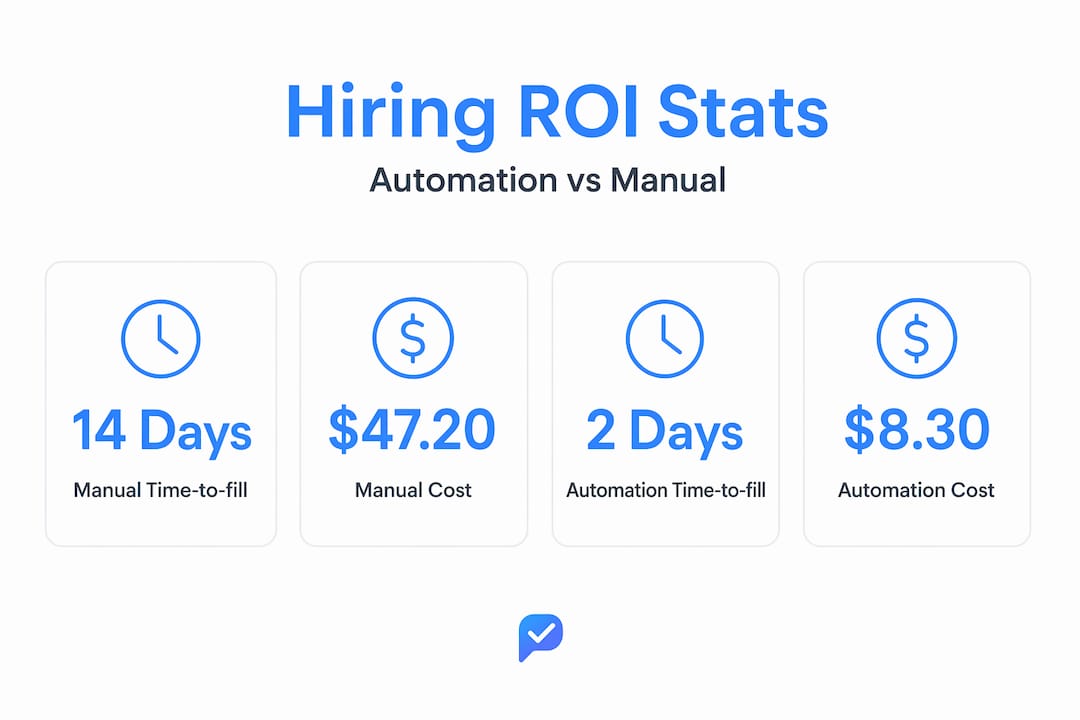
The numbers here are specific enough to be worth examining closely. Screening automation reduces time-to-fill from approximately 14 days to under 2 days for the screening phase alone, and that compression drives productivity gains of roughly 3.4 times per recruiter.

For teams processing 60,000 applications annually, cost-per-screen drops from $47.20 to $8.30. That is a reduction of more than 80%, generating over $2 million in screening cost savings for large-volume operations. Even for a five-recruiter team, the annual net benefit lands between $127,000 and $210,000.
| Metric | Manual screening | Automated screening |
|---|---|---|
| Time-to-fill (screening phase) | ~14 days | Under 2 days |
| Cost per screen | $47.20 | $8.30 |
| Recruiter productivity gain | Baseline | 3.4× increase |
| Annual net benefit (5 recruiters) | Baseline | $127,000–$210,000 |
| Retention rate improvement | 82% | 89% |
Quality-of-hire improvements compound these gains further. Teams making better initial selections through automated, criteria-based screening see retention increase by 7 points, from 82% to 89%, and reduce failed hire costs by over $150,000 annually for organizations making 120 hires per year. A failed hire at the mid-level costs roughly 1.5 to 2 times the annual salary. Preventing even two or three per year pays for most automation platforms.
The internal time cost is also manageable. Initial configuration takes 4 to 8 hours per recruiter, with ongoing monthly maintenance around 1 to 2 hours. Compared to the 17.9 hours of low-value screening time eliminated per role, the math is clear.
Pro Tip: Before signing with any automation vendor, ask for a cost-per-screen calculation specific to your application volume. Generic ROI claims are easy to make. Vendor-provided data scoped to your actual numbers is far more useful for securing internal budget approval.
Compliance and fairness at scale
Scaling automated screening creates legal exposure that many HR teams underestimate until they face a complaint. The ADA and EEOC frameworks both apply directly to AI-assisted hiring, and the obligations are real.
ADA guidance requires that automated assessments measure only job-relevant skills and do not create barriers for candidates with disabilities. If your screening tool includes a timed cognitive assessment, for example, and a candidate with a documented processing disorder cannot request an accommodation within the automated flow, you have a compliance problem. Employers must evaluate their hiring technologies and provide alternatives when needed.
The EEOC's position adds another layer. Employers bear responsibility for the disparate impact of AI tools they use, even when a third-party vendor built the algorithm. You cannot outsource accountability. If your screening tool disproportionately filters out candidates from a protected class, that is on your organization.
Maintaining legal defensibility at scale requires ongoing adverse impact analysis, documented human-in-the-loop override procedures, and clear records of business necessity for each screening criterion.
Practical compliance steps for scaling recruitment processes include:
- Validate your screening criteria against actual job performance data, not assumptions about what a "good candidate" looks like.
- Audit vendor algorithms for disparate impact across race, gender, age, and disability status before deployment and at regular intervals afterward.
- Document everything. If a screening decision is challenged, you need a clear record of how the algorithm was configured, what it measured, and why.
- Build accommodation pathways into every automated stage so candidates with disabilities can request adjustments without derailing the workflow.
For a deeper look at AI screening compliance risks and how fairness monitoring works in practice, Evy's resources provide specific frameworks tailored to ADA and EEOC standards.
Strategic implementation for scalable recruitment
Knowing the benefits of screening automation and actually realizing them are two different things. Most teams that underperform with automation made the same mistake: they automated a broken process instead of redesigning it first.
SHRM recommends predefining evaluation criteria collaboratively between recruiters and hiring managers before any technology is introduced. When the people using the tool and the people benefiting from its output agree on what a qualified candidate looks like, the automated scoring becomes genuinely useful rather than a source of friction.
Here is a practical framework for implementation:
- Audit your current screening workflow. Map where recruiter time actually goes. Most teams discover that 60 to 70% of their screening hours are spent on candidates who fail a single knockout criterion.
- Define criteria collaboratively. Work with hiring managers to identify the three to five factors that actually predict job performance. Build those into your automated scoring rubric.
- Automate scheduling and communications first. These are the lowest-risk starting points and deliver immediate time savings without touching candidate evaluation logic.
- Introduce asynchronous screening assessments. Deploy structured video or text-based questions that candidates complete on their schedule, reducing coordination overhead dramatically.
- Limit interview rounds. SHRM identifies unnecessary interview stages as a major drag on recruiting speed. Automation should enable you to reach hiring decisions faster, not add stages to the process.
- Monitor, adjust, and document. Review screening outcomes monthly for fairness signals and performance correlation. Adjust criteria as you gather data on how screened candidates perform in the role.
Automation's capacity effect is often underappreciated. When recruiters stop spending 17.9 hours per role on manual screening, they can manage 53% more open requisitions without headcount increases. That is not an abstract efficiency gain. It is how a team of five recruiters performs like a team of eight.
Pro Tip: Treat your first 90 days of automation as a calibration period, not a rollout. Expect to refine your scoring criteria two or three times before they reliably surface candidates your hiring managers want to advance.
Automated hiring solutions worth knowing
The market for automated hiring solutions has matured significantly in 2026. Several categories of tools are worth comparing based on your team size, industry, and compliance requirements.
AI-powered sourcing and screening tools like LinkedIn's Hiring Assistant demonstrate what is possible at the enterprise level. LinkedIn's platform saves recruiters roughly 4 hours per role, reduces profiles reviewed by 62%, and improves candidate outreach acceptance rates by learning from recruiter feedback. Siemens reported similar results, with 62% fewer profiles reviewed while maintaining candidate quality through AI-driven screening.
| Tool category | Best for | Key capability | Compliance consideration |
|---|---|---|---|
| AI sourcing assistants | Enterprise, high volume | Candidate discovery and ranking | Adverse impact monitoring required |
| ATS-integrated screening | Mid-size teams | End-to-end workflow automation | Vendor validation documentation needed |
| Asynchronous video platforms | Remote-first hiring | 24/7 candidate screening | ADA accommodation pathways needed |
| Anti-cheat AI interview tools | Any team using AI interviews | Integrity monitoring, eye tracking | Ensures assessment validity at scale |
One area that deserves more attention as AI interviews scale is assessment integrity. When candidates can complete screening interviews asynchronously, without a human present, the opportunity for AI-assisted cheating increases. A candidate who answers questions using an AI tool rather than their own knowledge may score well on your screening criteria while misrepresenting their actual capabilities. This is where platforms like Evy, which uses real-time eye tracking to detect AI-assisted responses, address a gap that traditional screening tools leave open.
My honest take on scaling with automation
I've worked alongside recruiting teams that expected automation to solve their hiring problems without doing the harder work of defining what a good hire actually looks like. In almost every case, the technology delivered exactly what it was configured to deliver. When the criteria were vague, the results were vague.
What I've found is that the most successful implementations treat automation as a precision tool rather than a volume lever. The goal is not to process more resumes faster. The goal is to spend human judgment where it genuinely adds value, which is in evaluating candidates who have already proven they meet the basic requirements.
I've also seen compliance get treated as an afterthought. Teams will spend months selecting and configuring a platform and then add a compliance review as a final checkbox before launch. That is backwards. Adverse impact analysis should start during vendor evaluation, not after deployment. The EEOC's position on employer responsibility for third-party AI tools makes this a legal necessity, not a best practice.
The piece most teams miss entirely is candidate experience. Automated screening can feel cold if it is not designed thoughtfully. A candidate who gets a rejection email from an algorithm with no context has a different experience than one who receives a clear explanation of next steps. That difference shows up in your employer brand over time.
My advice: automate the process, not the relationship. Let the technology handle the logistics. Keep humans in the loop for anything that requires judgment, nuance, or communication. That balance is what sustainable, ethical scaling actually looks like.
— Hudson
Scale smarter with Evy's AI screening platform
If you are building out a screening process that needs to handle real volume without sacrificing integrity, Evy was designed for exactly that challenge.
Evy is the only AI interview platform with real-time eye tracking to catch candidates who use AI tools during assessments, so the results you see reflect actual candidate capability. Beyond integrity monitoring, Evy's screening and interview features cover asynchronous scheduling, automated candidate communications, and structured evaluation criteria, all in one platform. Whether you are screening 50 candidates or 5,000, Evy gives your team the visibility and confidence to surface honest, qualified talent at scale.
FAQ
What does screening automation actually do?
Screening automation handles the repetitive early stages of candidate evaluation, including resume parsing, knockout question scoring, interview scheduling, and status communications, so recruiters can focus on qualified candidates.
How much time can automation save in recruiting?
Automated screening reduces the screening phase from approximately 14 days to under 2 days, freeing roughly 17.9 hours of recruiter time per role and enabling teams to manage 53% more requisitions.
Does AI screening create legal risks for employers?
Yes. The EEOC holds employers responsible for the disparate impact of AI tools they use, and ADA rules require that automated assessments measure only job-relevant skills with accommodation pathways available.
How do you prevent cheating in automated AI interviews?
Platforms with real-time behavioral monitoring, such as eye tracking and attention pattern analysis, can detect when candidates are using AI tools to answer questions, ensuring the screening results reflect genuine candidate ability.
What is the best starting point for implementing screening automation?
Start by automating scheduling and candidate communications before touching evaluation logic. This delivers immediate time savings with minimal compliance risk, and gives your team time to define accurate scoring criteria before deploying AI-driven ranking.