
 By Adrian Pascual•Hiring insight•Published
How to Handle Candidate Screening at Scale
Candidate screening at scale is the practice of evaluating hundreds or thousands of applicants through a structured, repeatable process without sacrificing hiring quality or recruiter judgment. The industry term for this discipline is "high-volume recruiting," and it sits at the intersection of process design, AI automation, and human oversight. When done well, it lets you handle candidate screening at scale while reducing time-to-fill by 33–70% and cutting manual recruiter effort by up to 80%. The challenge is not volume alone. It is building a system that stays fair, auditable, and accurate as that volume grows.
What prerequisites must be defined before scaling candidate screening?
The most critical failure in high-volume recruiting is not a technology problem. It is a requirements problem. Automation cannot substitute for poor alignment between recruiters and hiring managers on what a qualified candidate actually looks like.
The intake call is where this alignment happens. Before any resume parser or async interview tool touches an applicant, recruiters and hiring managers need to agree on three to five non-negotiable qualifications. These are the criteria that, if absent, disqualify a candidate regardless of other strengths. Examples include a specific certification, a minimum years of experience in a defined domain, or geographic availability. Without this list, AI scoring produces noise rather than signal.

Less than half of intake calls produce a clear set of must-haves. That gap is the single largest source of screening bottlenecks, because every ambiguous criterion forces a human decision at exactly the moment you are trying to reduce human load.
Clear criteria also protect you legally. When your screening logic is documented and tied to role requirements, rejection decisions are defensible under EEOC standards and emerging AI hiring regulations.
- Define 3–5 must-have qualifications before posting the role
- Separate must-haves from nice-to-haves in writing, not just conversation
- Confirm that hiring managers and recruiters agree on each criterion before screening begins
- Store criteria in a shared template so future requisitions for the same role start from a baseline
Pro Tip: Document your intake criteria in a reusable template tied to each job family. When you open a similar role six months later, you start from a tested baseline rather than a blank page. This alone reduces intake call time by half.
How can AI and automation tools handle large candidate volumes?
AI resume parsing and scoring is the first layer of any high-volume screening system. Modern enterprise tools process between 500 and 12,000 resumes per hour and can run more than 2,000 asynchronous voice or video screens daily without any recruiter involvement. That throughput is not theoretical. It reflects what production-grade systems deliver when intake criteria are well defined.
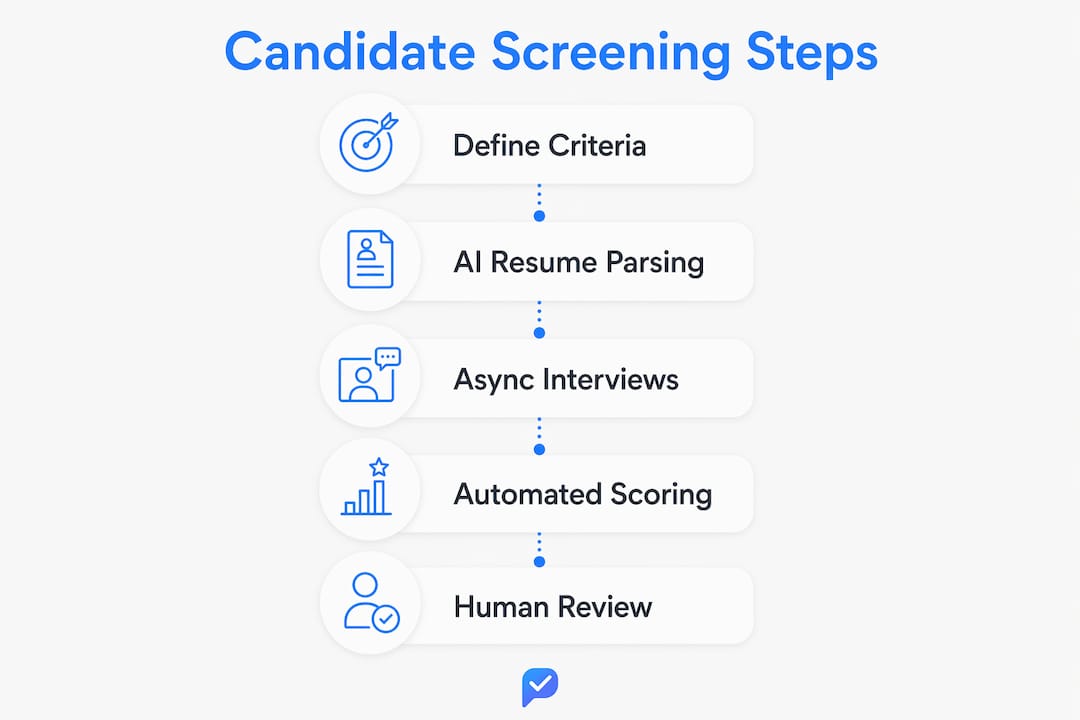
Asynchronous screening interviews are the second layer. Candidates record responses to structured questions on their own schedule, and AI analyzes those responses against the role criteria. This removes the scheduling bottleneck that kills recruiter capacity in high-volume periods. A recruiter who previously spent 15–30 minutes per candidate on phone screens can now review an AI-summarized async interview in 2–5 minutes.
The third layer is automated scoring and ranking. AI assigns each candidate a score with a plain-language explanation tied to the must-have criteria. Recruiters see why a candidate ranked where they did, not just where they landed. This transparency matters for both trust and compliance.
| Screening layer | Tool type | Throughput |
|---|---|---|
| Resume parsing | AI parser | 500–12,000 per hour |
| Async interviews | Voice or video AI | 2,000+ screens per day |
| Scoring and ranking | AI scoring engine | Real-time, continuous |
| Recruiter review | Human judgment | Top 5% of candidates |
Pro Tip: Always run a human-audited sample of auto-rejected candidates, even when your AI is performing well. This is not just a compliance step. It is the fastest way to catch criteria drift before it affects hiring quality.
What is the signal-vs-noise framework for high-volume screening?
The signal-vs-noise framework is a four-stage workflow that separates candidates worth immediate recruiter attention from those who need a different response. Adopting this framework lets recruiters focus on the best candidates while AI manages the bulk, which improves quality and reduces burnout.
- Sort, don't reject. On day one, every applicant gets categorized by AI into tiers based on must-have criteria. No one is permanently rejected at this stage. Categorization is a routing decision, not a final call.
- Act on the top 5% within 48 hours. A 15-minute phone screen with a strong-match candidate within 48 hours is the single largest predictor of offer acceptance eight weeks later. Recruiter time goes to this group first, without exception.
- Manage lower tiers with talent pools and reason tagging. Candidates who meet some but not all criteria go into a talent pool with a tagged reason. "Missing certification" is different from "overqualified." That distinction matters when a similar role opens in 90 days.
- Use feedback loops to refine criteria. After each hiring cycle, compare the AI's top-tier candidates against who actually received offers. If the correlation is weak, the criteria need adjustment. This feedback loop is what separates a system that improves over time from one that stagnates.
The framework also protects candidate experience. Candidates who receive a clear, timely response, even a non-advance, report significantly higher satisfaction than those who receive no communication. Maintaining that experience at scale requires routing logic, not individual recruiter effort.
How do transparency and auditability protect fair screening?
Transparent, explainable AI scoring increases recruiter trust and candidate fairness in automated screening. Every AI score must include a plain-language reason tied to the documented criteria. "Candidate lacks required PMP certification" is defensible. A numeric score with no explanation is not.
Human oversight is non-negotiable. Recruiters must retain final decision authority over every candidate advance or rejection. AI ranks and summarizes. Humans decide. This boundary is both an ethical requirement and a legal one under current EEOC guidance and state-level AI hiring laws.
Maintaining compliance at scale requires an audit workflow that samples automatic rejections and captures recruiter override reasoning. Without that audit trail, automated decisions become legally indefensible, regardless of how accurate the AI is.
Regular audits of rejected candidates catch two problems early. First, they surface systematic bias in the scoring model before it affects a large population. Second, they provide the documentation regulators and internal legal teams need to verify that the process was fair. Risks and fairness considerations in AI screening are not theoretical concerns. They are active compliance requirements in an increasing number of jurisdictions.
Black-box AI, where scores appear without explanation, creates risk on both sides. Candidates cannot understand why they were not advanced. Recruiters cannot verify that the model is working as intended. Both problems erode trust faster than any volume challenge.
What are the most common pitfalls in scaling candidate screening?
Common failures in high-volume screening trace back to process gaps, not technology limits. Understanding where these gaps appear lets you address them before they cost you qualified candidates.
- Skipping intake alignment. Deploying AI without agreed must-haves produces a high-volume output of poorly matched candidates. The automation runs fast, but it runs in the wrong direction.
- Overrelying on automation without audit. Auto-rejecting candidates without a human sample review creates compliance exposure and lets model errors compound undetected.
- Slow response to top candidates. Waiting more than 48 hours to contact a strong-match candidate measurably reduces offer acceptance rates. Speed at the top of the funnel is a competitive advantage, not a courtesy.
- Technical failures in bulk operations. Resume parsers fail on non-standard formats. Async interview platforms drop sessions under load. Build fallback routing for both scenarios before you need them.
Pro Tip: Set a calendar alert for 24 hours after each role opens. If your top-tier candidates have not been contacted yet, something in the routing broke. Catching it at 24 hours costs you one day. Catching it at a week costs you the candidate.
Key Takeaways
Efficient candidate evaluation at scale requires clear intake criteria, AI-powered automation, a structured prioritization framework, and a human-audited compliance process working together.
| Point | Details |
|---|---|
| Define criteria first | Agree on 3–5 must-haves before screening begins; automation without this produces noise. |
| Use AI for throughput | AI parsers and async interviews handle thousands of candidates daily, freeing recruiters for top-tier review. |
| Prioritize the top 5% fast | Contacting strong-match candidates within 48 hours is the strongest predictor of offer acceptance. |
| Audit auto-rejections | Sample rejected candidates regularly to catch bias and satisfy EEOC and AI regulation requirements. |
| Build feedback loops | Compare AI rankings to actual hires after each cycle and adjust criteria to improve accuracy over time. |
What I've learned from watching high-volume hiring go wrong
The teams that struggle most with bulk candidate assessment are rarely under-resourced on technology. They are under-resourced on process clarity. I have watched organizations deploy enterprise AI screening tools and still face the same bottlenecks they had before, because no one ran a proper intake call. The AI was fast. The criteria were vague. The result was a faster version of the same problem.
The 48-hour rule for top candidates is the piece of advice most teams intellectually agree with and practically ignore. Recruiters get busy. The top-tier queue sits. By the time someone reaches out, the candidate has accepted another offer. The fix is not motivation. It is a routing rule that makes the top-tier queue impossible to miss.
I am also cautious about the assumption that more automation means less recruiter involvement. The best implementations I have seen treat AI as a filter and a summarizer, not a decision-maker. Recruiters who stay engaged with the process, who review audit samples and adjust criteria, produce better hires than those who hand the process entirely to the system. Reducing hiring bias at the screening stage requires active human attention, not passive oversight.
The future of screening will include more real-time behavioral signals, not fewer. Eye tracking, attention pattern analysis, and transcript review are already part of how platforms like Evy verify that candidates are engaging authentically. That matters more as AI-assisted responses become harder to detect through content alone. The teams that build audit habits now will be better positioned to use those signals responsibly.
— Hudson
Evy brings integrity to automated screening at scale
Scaling your recruitment process without losing confidence in who you are actually hiring is the core problem Evy solves. Evy is the only AI interview platform with real-time eye tracking, which catches candidates using AI assistance during screening interviews. That means the candidates who surface at the top of your funnel are genuinely qualified, not coached by a language model.
Evy runs structured AI interviews around the clock, supports multi-language assessments, and produces audit-ready transcripts that satisfy compliance requirements. The platform automates the repetitive work of high-volume screening while keeping recruiters in control of final decisions. If you are building or rebuilding your screening workflow for 2026, Evy's features page is the right place to see what that looks like in practice.
FAQ
What does it mean to handle candidate screening at scale?
Candidate screening at scale means evaluating large volumes of applicants, often hundreds or thousands per role, through a structured, repeatable process that combines AI automation with human oversight to maintain quality and fairness.
How much time can AI screening save recruiters?
AI-driven automated screening reduces time-to-fill by 33–70% and cuts manual recruiter effort by up to 80%, depending on role volume and how well intake criteria are defined.
What questions work best for screening candidates at scale?
Structured questions tied directly to the role's must-have criteria work best. Each question should test a specific qualification so AI scoring can compare responses consistently across thousands of candidates.
How do you keep automated screening legally compliant?
Human-audited samples of auto-rejected candidates, plain-language score explanations, and documented recruiter override reasoning are the three requirements for defensible compliance under EEOC standards and current AI hiring regulations.
How quickly should recruiters respond to top-ranked candidates?
Recruiters should contact strong-match candidates within 48 hours of identification. A 15-minute phone screen in that window is the strongest single predictor of offer acceptance eight weeks later.