
 By Adrian Pascual•Hiring insight•Published
Technical Screening Tools Benefits for HR Teams in 2026
Technical screening tools are defined as automated platforms that evaluate candidates' job-relevant skills through standardized tests, asynchronous video interviews, and AI-scored assessments before any human interviewer is involved. Platforms like HackerRank, Skillrobo, and Evy have made this category mainstream, and the data behind their adoption is hard to ignore. Automated screening workflows reduce average time-to-fill by about 14 days per role while improving quality-of-hire scores by 31% and boosting 90-day retention by 23%. For HR professionals managing high-volume technical hiring, the technical screening tools benefits go well beyond convenience. They represent a structural shift in how hiring decisions get made, and this article breaks down exactly what that means for your team.
1. How technical screening tools improve hiring speed and efficiency
Speed is the most immediate and measurable advantage of technical assessment platforms. Manual screening is slow by design: a recruiter reviewing resumes, scheduling phone screens, and coordinating calendars can spend 17.9 hours per role on tasks that automation handles in minutes. That time compounds fast across a team closing 120 hires per year.
Automation compresses the early screening stage from roughly 14 days to under 2 days. Candidates receive an async video or skills test link immediately after applying, complete it on their own schedule, and return scored results to the recruiter without a single calendar invite. This removes the bottleneck that typically stalls technical hiring pipelines.
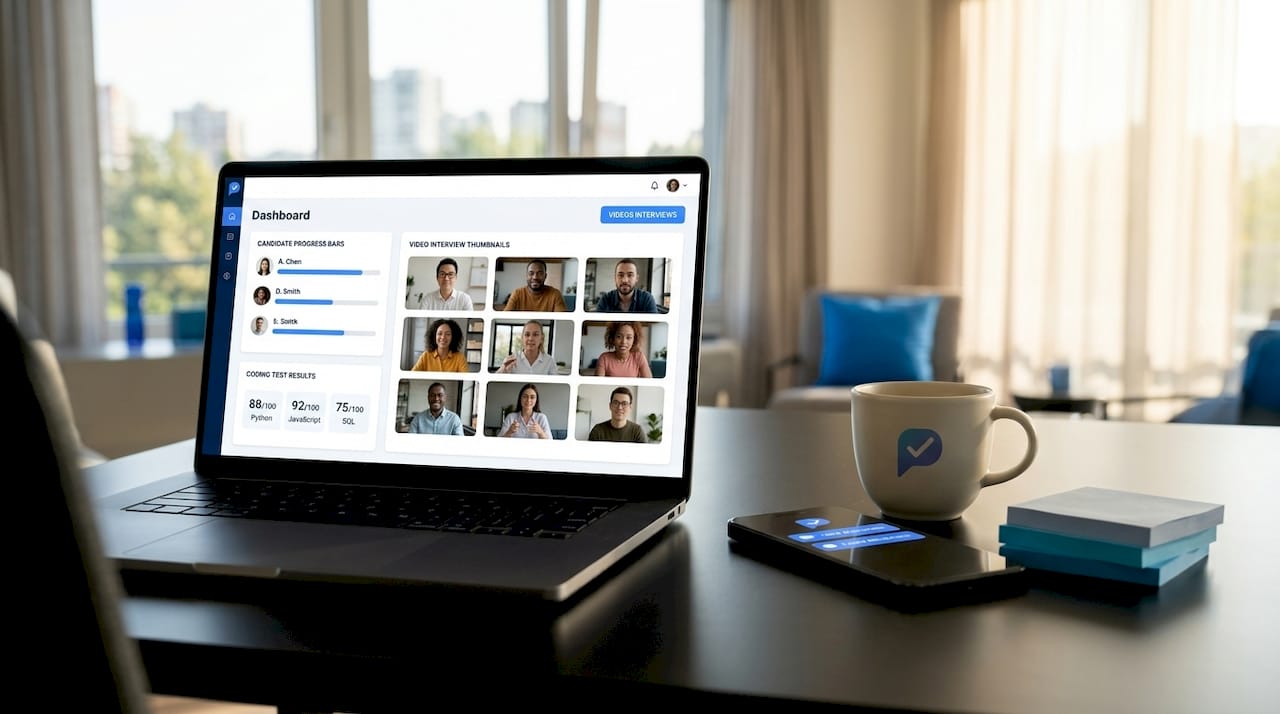
The productivity gains are substantial. Standardized automated screening improves recruiter productivity by 3.4 times per week compared to manual review. That means one recruiter can realistically handle the screening volume that previously required three. For growing teams, this scalability is the difference between keeping up with demand and falling behind it.
Async formats also remove scheduling friction for candidates. No app downloads or login friction means employed senior engineers, who are the hardest candidates to reach, can complete a screening at 10 p.m. on a Tuesday without coordinating with a recruiter. Completion rates among this group rise noticeably as a result.
Pro Tip: Set a 48-hour completion window for async screens. It filters for motivated candidates while giving working professionals enough flexibility to participate without dropping out.
2. What impact do screening tools have on quality of hire and retention?
Quality of hire is the metric that matters most to business leaders, and it is where technical screening tools deliver their most defensible return. The 31% improvement in quality-of-hire scores tied to screening automation is not a soft metric. It reflects candidates who perform better in role, ramp faster, and stay longer.
The 23% improvement in 90-day retention tied to automated screening is particularly significant. Early attrition is expensive. A failed hire at the mid-level engineering range typically costs 50% to 200% of annual salary when you factor in lost productivity, recruiter time, and onboarding investment. Screening tools reduce that risk by surfacing candidates whose skills match the role before the offer is made.
"For a 5-recruiter team closing 120 hires per year, candidate screening automation generates $127,000–$210,000 in annual net benefit, with payback in under four months." — US Tech Automations, 2026
The table below shows how screening automation affects the key hiring metrics that HR teams track most closely.
| Metric | Without automation | With automation |
|---|---|---|
| Average time-to-fill | ~14 days longer | Reduced by ~14 days per role |
| Quality-of-hire score | Baseline | +31% improvement |
| 90-day retention rate | Baseline | +23% improvement |
| Annual net benefit (5-recruiter team) | Minimal | $127,000–$210,000 |
These numbers reflect a compounding effect. Better screening at the top of the funnel means fewer mismatches reach the offer stage, which means fewer failed hires, which means lower total cost of hiring over time. The efficiency of screening tools is not just about speed. It is about protecting the downstream investment your organization makes in every new hire.
3. How screening tools enhance candidate fairness and reduce bias
Bias in hiring is not always intentional. Recruiters make faster, less consistent decisions when fatigued, when reviewing the 80th resume of the day, or when unconsciously favoring candidates who attended familiar schools. Standardized technical assessments remove those variables by applying identical criteria to every candidate.
AI evaluation tools predict employment success substantially better than human recruiters and score underrepresented minorities higher, indicating real potential for reducing structural bias in technical hiring. This is one of the more counterintuitive technical assessment advantages: the machine, when properly calibrated, is fairer than the human.
That said, fairness is not automatic. The same research shows a 50% decrease in application continuation caused by asynchronous interview formats. Some candidate groups, particularly women and candidates from certain demographic backgrounds, drop out of async screening at higher rates than others. This is a known risk that HR teams need to monitor actively.
Practical steps to protect fairness in your screening process include:
- Track completion rates by demographic group and flag significant drop-off disparities for review.
- Provide clear instructions and a low-friction interface so candidates are not deterred by technical confusion.
- Combine async screening with a human touchpoint early enough to retain candidates who prefer direct contact.
- Review AI scoring outputs periodically against actual job performance data to catch model drift.
Pro Tip: Partner with your legal and DEI teams before deploying any AI scoring model. Documenting your fairness monitoring process is both good practice and a compliance safeguard.
4. How data-driven insights from screening tools improve hiring decisions
The technical skills evaluation benefits of modern screening platforms extend beyond pass/fail scores. The best tools generate structured data at every stage of the funnel, giving hiring managers a factual basis for decisions that previously relied on gut feel.
Role-specific test customization is one of the most practical advantages of screening tools for professionals. A backend engineer role requires different signal than a DevOps or data engineering position. Platforms like HackerRank allow teams to build or select assessments mapped to specific job requirements, which means the score a candidate receives reflects actual role fit rather than generic technical ability. You can explore how AI screening improves hire quality when assessments are calibrated to role-specific benchmarks.
Integration with applicant tracking systems is another area where data-driven screening pays off. When screening scores flow automatically into tools like Greenhouse or Lever, recruiters see a complete candidate profile without toggling between platforms. This reduces data entry errors and speeds up the handoff from screening to interview scheduling.
The metrics that matter most for funnel optimization include:
- Screening pass rate by source: Identifies which job boards or sourcing channels produce the most qualified applicants.
- Score distribution by role: Flags whether a test is too easy, too hard, or poorly calibrated for the target candidate pool.
- Time-to-complete by assessment type: Reveals friction points that may be causing candidate drop-off before submission.
- Correlation between screening score and 90-day performance: The most valuable long-term metric for validating your assessment design.
67% of talent acquisition professionals plan to invest more in AI-powered recruiting tools, which reflects a broader recognition that data-backed hiring decisions outperform intuition-based ones. The teams that build this feedback loop between screening data and post-hire performance will consistently outperform those that treat screening as a checkbox.
5. Why a layered screening approach delivers the strongest results
A single screening format rarely captures the full picture of a technical candidate. The most effective approach combines multiple signal types in a deliberate sequence. A three-layer technical screening stack, built around async video, real work artifacts, and code tests, optimizes throughput while respecting the time of both candidates and engineers.
The logic behind this structure is straightforward. Async video screens communication skills and cultural fit signals early, before any engineer time is spent. Work artifacts, such as a GitHub portfolio or a submitted design document, reveal how a candidate actually builds things. Code tests then confirm technical depth for candidates who have already passed the first two filters. Each layer eliminates a portion of the candidate pool so that only the strongest reach the live interview stage.
This separation of signal types also protects your engineering team. Engineers are expensive, and their time in interviews has a real opportunity cost. Multi-format async flows reduce the burden on engineers by ensuring they only meet candidates who have already demonstrated both communication ability and technical competence. The result is a more focused live interview and a better use of everyone's time.
The layered model also creates natural checkpoints for fairness review. Because each stage generates its own data, you can identify exactly where candidates from specific groups are dropping out and adjust the process accordingly. This level of visibility is not possible with a single-format screening approach.
Key takeaways
Technical screening tools deliver the strongest hiring outcomes when automation, structured data, and human judgment are combined in a deliberate, layered process.
| Point | Details |
|---|---|
| Speed and efficiency gains | Automation reduces time-to-fill by ~14 days and boosts recruiter productivity by 3.4x per week. |
| Quality and retention impact | Screening automation improves quality-of-hire by 31% and 90-day retention by 23%. |
| Fairness requires active monitoring | AI scores underrepresented candidates more fairly, but async formats can reduce completion rates by 50%. |
| Data drives better decisions | Role-specific scoring and ATS integration create a feedback loop between screening results and post-hire performance. |
| Layered screening protects engineer time | Combining async video, work artifacts, and code tests filters candidates before any live interview is scheduled. |
My honest read on where most teams go wrong
I have seen a consistent pattern in how HR teams adopt technical screening tools. They implement a platform, celebrate the time savings, and then stop there. The screening score becomes a gate rather than a starting point for a conversation. That is where the value gets left on the table.
The teams that get the most out of these tools treat screening data as one input among several, not as a verdict. A candidate who scores in the 70th percentile on a code test but submits a thoughtful async video response and a well-structured GitHub portfolio is often a stronger hire than someone who aced the test and said nothing interesting on camera. The layered screening approach exists precisely because no single signal is sufficient.
I also think the fairness conversation deserves more attention than most teams give it. Monitoring drop-off rates by demographic group is not a compliance exercise. It is a signal that your process may be filtering out qualified candidates for reasons unrelated to their ability. The risks and fairness considerations in AI screening are real, and ignoring them costs you talent.
The best hiring teams I have observed treat their screening stack as a living system. They review score distributions quarterly, correlate screening results with 90-day performance data, and recalibrate assessments when the signal degrades. That kind of ongoing discipline is what separates teams that hire well consistently from those that get lucky occasionally.
— Hudson
How Evy strengthens your technical screening process
Evy is built for HR teams that need to screen at scale without sacrificing integrity. As the only AI interview platform with real-time eye tracking, Evy detects when candidates are using AI assistance during screening, which gives you confidence that the results you see reflect genuine candidate ability. Automated scoring, async video support, and multi-format assessment capabilities mean your team can run a full screening process 24/7 without manual coordination. Evy integrates with your existing ATS so screening data flows directly into your hiring workflow. If you want to surface honest, qualified technical talent faster, explore Evy's anti-cheat features to see how the platform supports every stage of technical screening.
FAQ
What are the main benefits of technical screening tools?
Technical screening tools reduce time-to-fill by approximately 14 days per role, improve quality-of-hire scores by 31%, and boost 90-day retention by 23%, according to 2026 ROI analysis. They also improve recruiter productivity by 3.4 times per week compared to manual review.
Do technical screening tools reduce hiring bias?
AI-powered screening tools score underrepresented minorities higher and predict employment success more accurately than human recruiters. However, async interview formats can reduce candidate continuation rates by over 50%, so fairness monitoring is required alongside any automated screening deployment.
How do screening tools integrate with existing HR systems?
Most technical assessment platforms integrate directly with applicant tracking systems like Greenhouse and Lever, allowing screening scores and candidate data to flow automatically into your existing hiring workflow without manual data entry.
What is a layered technical screening approach?
A layered approach combines async video interviews, real work artifacts such as code portfolios, and structured code tests in sequence. This method filters candidates progressively so that only the most qualified reach the live interview stage, protecting engineer time and improving signal quality.
Are technical screening tools worth the investment?
For a five-recruiter team closing 120 hires per year, screening automation generates $127,000 to $210,000 in annual net benefit with a payback period of under four months, making the ROI case straightforward for most mid-size recruiting teams.