
 By Adrian Pascual•Hiring insight•Published
Hiring Process Audit: A Practical Guide for HR Teams
A hiring process audit is a systematic, data-driven examination of your organization's end-to-end recruitment workflow, from the initial job requisition through onboarding, designed to uncover inefficiencies, confirm legal compliance, and sharpen performance metrics like time-to-hire and cost-per-hire. For HR professionals and hiring managers, it functions as a structured diagnostic: you map what actually happens in your pipeline, measure it against what should happen, and close the gap.
The core goals of a hiring process audit include:
- Compliance verification: Confirming adherence to EEOC anti-discrimination rules, the Fair Credit Reporting Act (FCRA), "ban the box" statutes, and immigration verification requirements
- Efficiency analysis: Identifying bottlenecks such as approval delays, redundant interview rounds, or slow offer cycles
- Quality assessment: Evaluating whether your selection methods reliably identify the best candidates
- Bias detection: Surfacing inconsistencies in how candidates are screened, interviewed, or scored
- Candidate experience review: Measuring how applicants perceive and respond to your process
Done well, a hiring audit protects your organization from legal exposure and produces measurably better hires. Done poorly, or not at all, it leaves both risks and opportunities invisible.
How to conduct a hiring process audit step by step
A structured approach keeps the audit from becoming an unfocused data-gathering exercise. Cross-functional teams that include recruiters, hiring managers, and HR specialists consistently produce more complete findings than solo audits, because each stakeholder sees a different slice of the pipeline.

Step 1: Define your audit goals and scope
Decide what you are trying to fix or confirm before collecting a single data point. Common goals include shortening time-to-hire, improving offer acceptance rates, closing diversity gaps, or verifying FCRA compliance. Scope determines which roles, departments, or hiring stages fall inside the audit.
Step 2: Map the current recruitment workflow
Follow your process step by step and document every touchpoint: requisition approval, job description creation, sourcing, application screening, phone screens, interviews, assessments, reference checks, offer generation, and onboarding. Note who owns each step and how long it typically takes.
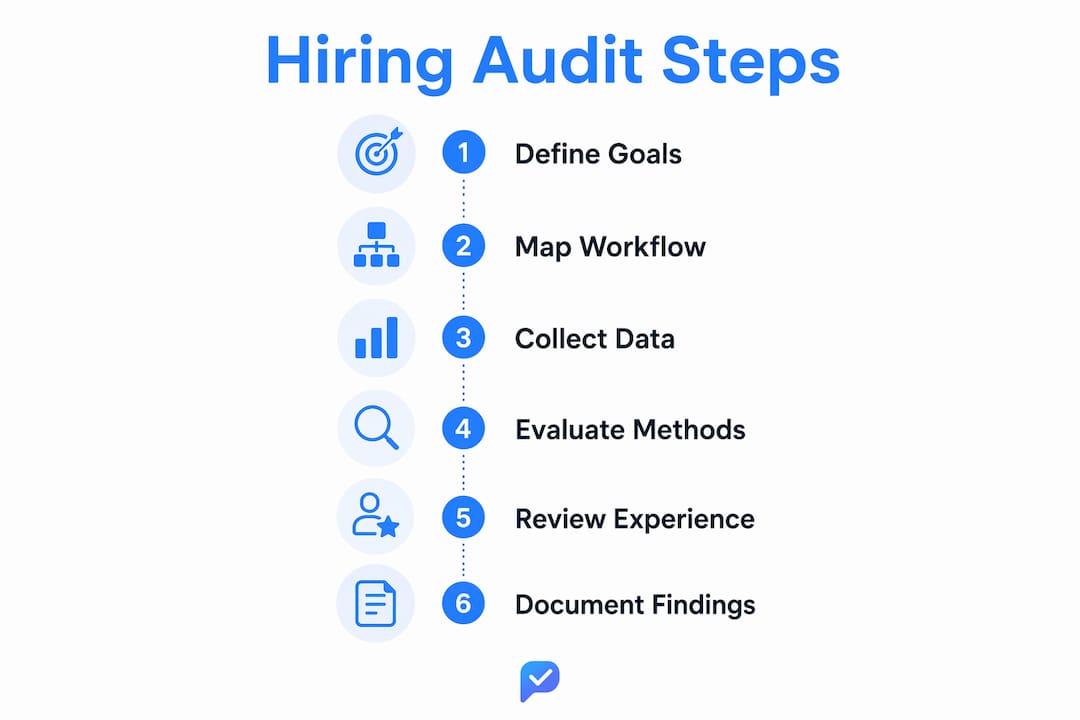
Step 3: Collect and analyze data
Pull metrics from your applicant tracking system (ATS), HRIS, and any assessment platforms you use. Key data points include:
- Time-to-fill and time-to-hire by role and department
- Cost-per-hire broken down by sourcing channel
- Offer acceptance and decline rates
- Candidate drop-off rates at each stage
- Diversity representation across the funnel
Step 4: Evaluate your selection and assessment methods
Review whether your screening tools, interview formats, and assessments are competency-based and legally defensible. Executive Order 13932 mandates that federal agencies continually evaluate assessment effectiveness, and the same discipline applies to private-sector teams that want defensible, high-quality hiring decisions.
Step 5: Review candidate communication and experience
Audit every touchpoint from the candidate's perspective: job ad clarity, application confirmation, interview scheduling responsiveness, and post-interview feedback. Research confirms that applicant reactions to selection procedures directly affect employer brand and downstream hiring outcomes.
Step 6: Document findings and build a recommendation report
Organize findings by severity: compliance gaps that carry legal risk, efficiency problems that inflate cost, and quality issues that affect hire performance. Assign owners and timelines to each recommendation before presenting to leadership.
Common legal compliance issues hiring audits uncover
Legal risk is often the most urgent reason to run a hiring process compliance review. Audits regularly surface the following violations and near-misses.
- EEOC violations: Inconsistent interview questions across candidates of different protected classes, job postings with age or gender-coded language, or selection criteria that produce adverse impact without business justification
- FCRA noncompliance: Running background checks without proper written authorization, failing to provide pre-adverse action notices, or using consumer reports beyond their permissible purpose
- "Ban the box" failures: Asking about criminal history on applications in jurisdictions where it is prohibited, or conducting criminal record checks before a conditional offer is made
- Immigration verification gaps: I-9 forms completed incorrectly, missing re-verification for employees on temporary work authorization, or inconsistent document review practices
- Undocumented interview questions: Interviewers asking questions not on the approved guide, creating a record that is difficult to defend if a candidate files a discrimination complaint
- Inconsistent screening criteria: Applying different minimum qualifications to candidates depending on who is reviewing applications, which can constitute disparate treatment even without intent
Noncompliance in any of these areas can trigger EEOC investigations, FCRA class actions, or state-level enforcement actions. A periodic audit is the most reliable way to catch these issues before a regulator or plaintiff does.
Typical challenges and inefficiencies hiring audits expose
Most organizations discover that their hiring process has drifted from its original design. The gap between the documented process and the actual process is often where the biggest inefficiencies live.
- Excessive interview rounds: Candidates cycling through four or five interviews for roles that could be assessed in two, inflating time-to-hire and increasing drop-off
- Unclear role definitions: Job descriptions written without a current job analysis, leading to misaligned expectations between recruiters and hiring managers
- Approval bottlenecks: Requisitions sitting in queues for days or weeks because approval chains are poorly defined or not enforced
- Poor interviewer coordination: Panel members asking overlapping questions, failing to share notes, or reaching contradictory conclusions without a calibration session
- Technology underuse: ATS features like automated screening, structured interview guides, or analytics dashboards sitting unused while recruiters manage steps manually
- Weak candidate communication: Applicants going days without status updates, which research links to lower offer acceptance rates and damaged employer brand
- Bias in unstructured interviews: Interviewers relying on gut feel rather than scored criteria, which degrades both fairness and predictive validity
Each of these problems has a measurable cost. Excessive rounds extend time-to-hire. Approval bottlenecks raise cost-per-hire. Weak communication reduces offer acceptance. Audits make these costs visible, which is what gives the findings traction with leadership.
Best practices to improve hiring based on audit findings
The most effective improvements share a common thread: they replace informal, variable practices with documented, repeatable ones.
- Adopt structured interview formats: Use a consistent set of competency-based questions for every candidate in a role, scored on a defined rubric. Structured interview formats reduce the influence of irrelevant personal impressions and make your process easier to defend legally.
- Implement multi-hurdle assessments: A multi-stage assessment approach filters candidates sequentially, applying more resource-intensive evaluations only to those who clear earlier screens. This balances assessment quality with recruiter time.
- Track KPIs continuously: Set baseline values for time-to-hire, cost-per-hire, and offer acceptance rate during the audit, then monitor them monthly. Tracking job search metrics like these gives you early warning when a process change is not working.
- Train interviewers before each cycle: Refresher training, not just onboarding training, keeps interviewers calibrated. The F1000Research systematic review on interview bias found that periodic training reduces the risk of snap judgments and improves selection accuracy.
- Standardize candidate communication: Define SLAs for each stage: acknowledge applications within 48 hours, schedule screens within five business days, and provide post-interview feedback within a defined window.
- Build a continuous audit cycle: A single audit is a snapshot. Scheduling quarterly mini-audits on specific pipeline stages and an annual full audit keeps your process current as roles, laws, and technology evolve.
Pro Tip: Set up a shared audit calendar at the start of each fiscal year. Assign one HR team member as the audit owner for each quarter, with a defined scope (e.g., Q1 covers compliance documentation, Q2 covers assessment tools). This prevents the audit from becoming a reactive exercise triggered only by a bad hire or a legal complaint.
How to reduce bias and subjectivity in your hiring audit
Bias is the hardest problem to audit because it often operates below conscious awareness. Structured design is the most reliable countermeasure.
- Use scored interview rubrics: Require interviewers to complete a scorecard immediately after each interview, before discussing the candidate with colleagues. This prevents group discussion from overwriting individual assessments.
- Conduct calibration sessions: After all interviews for a role are complete, bring the panel together to compare scores and surface disagreements. Calibration catches cases where one interviewer's strong reaction is driving a consensus that the data does not support.
- Record or transcribe interviews where legally permitted: Recorded sessions provide a more objective basis for review than memory alone. Transcripts can reveal patterns in how interviewers respond to different candidates, including differences in follow-up question depth or time allocated per candidate.
- Require implicit bias training: Hiring managers and interviewers at the University of Washington, for example, must complete an online implicit bias course before participating in any hiring process. Making training a prerequisite, not a suggestion, changes behavior.
- Audit your screening criteria for proxy bias: Job requirements like "culture fit" or degree requirements for roles where skills matter more can function as proxies for protected characteristics. Replace them with specific, measurable competencies tied to a current job analysis.
- Review hiring bias at screening: The screening stage is where bias most often enters undetected, because volume is high and decisions are fast. Auditing screening criteria and pass-through rates by demographic group is the most direct way to catch it.
"The interview process can be improved by offering interviewer refresher training, utilizing recorded interviews to minimize the effects of selective memory, and implementing bias-mitigation strategies, such as job analysis and interviewer self-awareness, to enhance the validity and reliability of employment selection interviews." — The Interview Trap: A Systematic Review, F1000Research
The tension between human bias and structural design is not resolved by good intentions. It requires deliberate process architecture, and the audit is where that architecture gets examined.
Tools and technologies used for conducting a hiring process audit
The right tools make audit data collection faster and findings more defensible. Most HR teams already have access to the core platforms; the audit is often the first time they use them analytically.

Applicant tracking systems (ATS): Platforms like Greenhouse, Lever, or Workday Recruiting store stage-by-stage candidate data, time stamps, and disposition codes. An ATS is your primary source for pipeline metrics and the documentation trail regulators expect to see.
HRIS platforms: Systems like Workday HCM or SAP SuccessFactors connect hiring data to employee performance and retention data, letting you evaluate whether your selection methods actually predict on-the-job success.
Assessment platforms: Structured cognitive, skills-based, and behavioral assessments generate scored, comparable data across candidates. Technical screening tools are particularly useful for roles where skills are hard to evaluate in a traditional interview.
AI interview platforms: Tools that conduct asynchronous video interviews and analyze responses at scale allow teams to screen more candidates without adding recruiter hours. Evy adds real-time eye tracking to this layer, surfacing attention patterns that indicate whether a candidate is responding authentically or relying on off-screen assistance.
Survey tools: Post-interview candidate surveys (via Typeform, SurveyMonkey, or similar) capture experience data that your ATS cannot. Candidate NPS is a useful proxy for employer brand health.
Compliance documentation tools: I-9 management platforms and background check integrations with FCRA-compliant providers (such as Checkr or Sterling) create the audit trail needed to demonstrate lawful screening practices.
Metrics and KPIs to measure hiring process effectiveness during the audit
Metrics give the audit its teeth. Without baseline numbers, recommendations are opinions. With them, they are evidence.
| Metric | What it measures | Why it matters in an audit |
|---|---|---|
| Time-to-hire | Days from application to accepted offer | Identifies bottlenecks and stage delays |
| Time-to-fill | Days from requisition open to offer acceptance | Measures overall pipeline speed |
| Cost-per-hire | Total recruiting spend divided by hires | Reveals sourcing channel efficiency |
| Offer acceptance rate | Accepted offers as a percentage of offers extended | Signals candidate experience and compensation competitiveness |
| Candidate drop-off rate | Candidates who exit at each stage | Pinpoints where the process loses qualified applicants |
| Diversity funnel metrics | Representation by demographic group at each stage | Detects adverse impact and screening bias |
| Quality of hire | New hire performance ratings at one year | Validates whether selection methods predict success |
| Interviewer completion rate | Percentage of scorecards submitted on time | Measures process compliance among interviewers |
Track these metrics before and after any process change. The delta is what demonstrates ROI to leadership and justifies the audit investment.
Typical timeline for completing a hiring process audit
Most full hiring process audits run four to eight weeks, depending on organization size and audit scope. A rough breakdown:
Week 1: Scope definition, stakeholder identification, and data access setup. This phase often takes longer than expected because pulling ATS and HRIS data in a usable format requires IT coordination.
Weeks 2–3: Workflow mapping, data collection, and stakeholder interviews. HR, recruiters, and a sample of hiring managers each contribute a different perspective on where the process breaks down.
Week 4: Data analysis and compliance review. Legal counsel should review this phase, particularly the EEOC and FCRA documentation.
Weeks 5–6: Findings synthesis and recommendation development. Prioritize by risk level: compliance gaps first, then efficiency problems, then quality improvements.
Week 7–8: Presentation to leadership and implementation planning. A good audit report includes a prioritized action list with owners, timelines, and success metrics.
Smaller organizations with fewer than 100 employees can often complete a focused audit in two to three weeks. Enterprise teams auditing multiple business units or geographies should budget closer to three months.
What hiring process audits look like in practice
Technology company, 400 employees: An audit revealed that engineering roles took longer than typical for comparable roles. The root cause was a five-round interview process with no structured scoring. After the audit, the team reduced interviews to three rounds, introduced a technical assessment in round two, and added a calibration session before offers. Time-to-fill dropped materially within two quarters.
Healthcare system, multi-site: A compliance-focused audit found that background check authorization forms were being collected after screening decisions had already been made in several departments, a direct FCRA violation. The audit also identified that two hiring managers were routinely asking candidates about prior arrests during phone screens, contrary to the state's "ban the box" law. Both issues were corrected through updated workflows and mandatory interviewer training before any regulatory action occurred.
Staffing agency: An audit of screening practices found that pass-through rates from application to phone screen differed by candidate name origin, a pattern consistent with name-based bias in resume review. The agency implemented blind resume screening for the initial stage and retrained recruiters on structured screening criteria. Diversity representation in the interview pool improved in the following hiring cycle.
These examples share a pattern: the audit made a problem visible that had been invisible, and the fix was structural rather than motivational.
Key Takeaways
A hiring process audit is most effective when it combines compliance verification, structured data analysis, and bias-mitigation design into a single, repeatable review cycle.
| Point | Details |
|---|---|
| Define scope before collecting data | Set specific audit goals (compliance, efficiency, diversity) so data collection stays focused and findings are actionable. |
| Cross-functional teams produce better audits | Including recruiters, hiring managers, and HR specialists surfaces blind spots no single role can see alone. |
| Legal compliance gaps carry the highest risk | EEOC, FCRA, and "ban the box" violations are the most urgent findings; address them before efficiency improvements. |
| Structured interviews and scorecards reduce bias | Competency-based rubrics and calibration sessions replace gut-feel decisions with comparable, defensible data. |
| Continuous auditing outperforms one-time reviews | Quarterly mini-audits on specific stages keep the process current as roles, laws, and technology change. |