
 By Adrian Pascual•Hiring insight•Published
Candidate Shortlisting Process: A 2026 HR Guide
Candidate shortlisting is defined as the structured process of narrowing a large applicant pool to a targeted group of interview-ready finalists who meet both essential and desirable criteria for a role. Understanding what is candidate shortlisting process means is critical for any hiring manager who wants to reduce wasted interview time and make defensible, fair hiring decisions. The process follows a 4-step workflow covering criteria definition, application screening, scorecard evaluation, and final list confirmation. Done well, it protects your organization legally, strengthens your employer brand, and surfaces the candidates most likely to succeed.
What is the candidate shortlisting process?
Candidate shortlisting is the formal stage in the candidate selection process where recruiters filter all applications down to the top 5–10% who qualify for interviews. It sits between job posting and the interview stage, and its quality directly determines who you spend time evaluating. A poorly run shortlisting process wastes hours on unqualified candidates and exposes your organization to discrimination claims.
The process works best when it follows a defined sequence. Each step builds on the last, and skipping any one of them introduces inconsistency.
- Define selection criteria. Split requirements into essential (must-have) and desirable (nice-to-have). Essential criteria are non-negotiable: a specific license, a minimum years of experience, or a required certification. Desirable criteria add value but do not disqualify a candidate on their own.
- Screen applications. Use an applicant tracking system (ATS) or manual review to filter out anyone who fails an essential criterion. This pass is binary. Either the candidate meets the threshold or they do not.
- Apply a weighted scorecard. Assign point values to each criterion based on job priority. Evaluate all remaining candidates against the same rubric of 3–5 mandatory competencies before any interviews take place. This step converts subjective impressions into comparable scores.
- Finalize the shortlist collaboratively. Share scores with the hiring panel. Discuss any borderline cases. Confirm the final list and document your reasoning for every exclusion.
- Notify candidates promptly. Contact everyone who applied, not just those who made the cut. Timely communication protects your employer brand and keeps your pipeline warm.
Pro Tip: Cap your shortlist at 5–7 candidates. Larger shortlists cause decision fatigue and reduce the quality of review each candidate receives.
How can HR professionals reduce bias during shortlisting?

Bias in shortlisting is not always intentional. Unconscious preference for familiar university names, certain neighborhoods, or particular career trajectories shapes decisions before a hiring manager consciously registers it. Structured processes are the most reliable defense.
Blind shortlisting is the most direct technique. Removing names and personal identifiers from applications forces evaluators to focus on competency data alone. This prevents unconscious preference for candidates who share a background with the reviewer. Many ATS platforms support anonymized review modes, and the practice is straightforward to implement even in manual processes.
Key practices that reduce bias at the shortlisting stage include:
- Use structured scorecards, not gut feeling. Separating essential from desirable criteria enforces objective evaluation and removes the temptation to favor a candidate based on cultural fit, which is often a proxy for similarity bias.
- Document every rejection reason. Record why each candidate was excluded, referencing the specific criterion they failed to meet. This creates a defensible paper trail if a hiring decision is ever challenged on discrimination grounds.
- Involve multiple reviewers. A panel of two or three evaluators scoring independently, then comparing results, catches individual bias that a single reviewer would miss.
- Audit your criteria before you start. Check that every essential criterion is genuinely required for job performance, not a proxy for a demographic characteristic.
Technology plays a growing role here. AI in resume screening can apply consistent scoring rules across thousands of applications simultaneously, removing the fatigue-driven inconsistency that creeps into manual review at scale. The key is configuring the tool against validated, job-relevant criteria rather than historical hiring patterns, which can encode existing bias.
Pro Tip: Run a bias audit on your shortlisting criteria annually. Ask whether each criterion predicts job performance or simply reflects who you have hired before.
What are common shortlisting criteria and how do you prioritize them?
Shortlist criteria fall into two categories, and confusing them is the most common mistake hiring managers make. Essential criteria are the minimum qualifications without which a candidate cannot perform the job. Desirable criteria improve a candidate's fit but are not disqualifying on their own.
A software engineering role might list a bachelor's degree in computer science or a related field as essential, with experience in a specific framework listed as desirable. A candidate without the degree does not advance. A candidate without the framework experience might still advance if their scorecard total is strong enough. The distinction keeps your shortlist legally defensible and prevents you from eliminating qualified candidates over preferences rather than requirements.
| Criteria type | Definition | Example | Weighting approach |
|---|---|---|---|
| Essential | Non-negotiable for job performance | Valid nursing license | Binary pass/fail |
| Desirable | Adds value but not required | Experience with Epic EHR | Scored 1–5 |
| Behavioral | Soft skills tied to role success | Conflict resolution in client-facing roles | Scored with examples |
| Cultural alignment | Values fit, not demographic similarity | Comfort with remote-first workflows | Scored with caution |
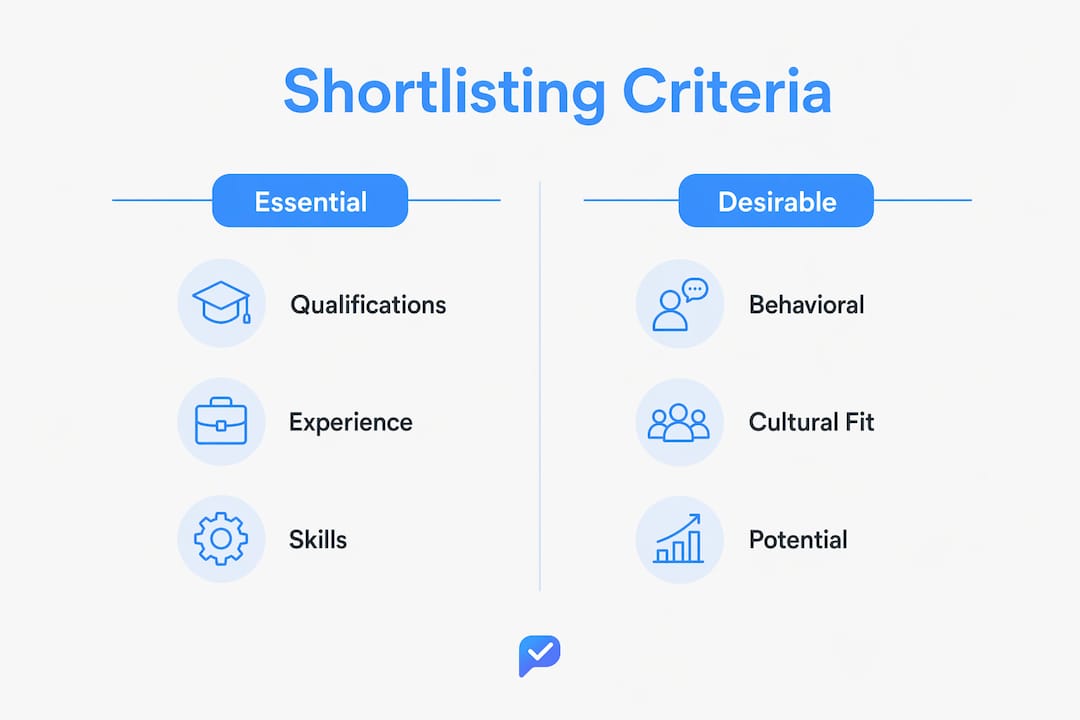
Behavioral indicators deserve a dedicated criterion slot. A sales manager role, for example, might weight "demonstrated ability to coach underperformers" as a desirable criterion scored on evidence from the resume or cover letter. This keeps soft skills in the evaluation without letting them override technical requirements.
Avoid letting your shortlist grow beyond a manageable size. Experienced recruiters cap shortlists at 5–7 candidates to maintain thorough review quality. If your criteria are well-defined, a large shortlist usually signals that the essential criteria were set too loosely.
What are best practices for candidate communication after shortlisting?
Candidate communication after shortlisting directly affects your employer brand. Candidates who receive no response after applying share that experience publicly, on review platforms and in professional networks. The damage compounds over time.
Best practices for post-shortlisting communication include:
- Notify all candidates within 14–21 days. Timely notification avoids ghosting and preserves your reputation as a fair employer. Set a calendar trigger the moment shortlisting is complete.
- Personalize rejection messages where possible. A generic rejection is better than silence, but a brief, specific note ("your application was strong, but we required X certification") leaves candidates with a better impression.
- Send interview invitations with clear logistics. Include the format, duration, panel composition, and any preparation materials. Candidates who know what to expect perform better and withdraw less often.
- Use automation for volume communication. ATS platforms and AI in corporate hiring workflows can trigger templated messages at each stage, so no candidate falls through the cracks during high-volume hiring.
- Maintain a secondary pipeline. Keep near-miss candidates in a buffer for 14–30 days after shortlisting. If your top candidate declines or fails a background check, you have a qualified backup ready without restarting the process.
The secondary pipeline point is underused. Most hiring teams discard near-miss candidates the moment the shortlist is confirmed. Keeping them warm with a brief "we will be in touch if circumstances change" message costs almost nothing and saves weeks of recruiting time when a top candidate drops out.
Key Takeaways
The candidate shortlisting process is most effective when it combines documented criteria, structured scorecards, blind review techniques, and timely candidate communication to produce a defensible, fair, and efficient hiring outcome.
| Point | Details |
|---|---|
| Define criteria first | Split requirements into essential and desirable before reviewing a single application. |
| Cap shortlist size | Limit shortlists to 5–7 candidates to prevent decision fatigue and maintain review quality. |
| Use blind shortlisting | Remove personal identifiers from applications to focus evaluation on competency data alone. |
| Document every exclusion | Record the specific criterion each rejected candidate failed to meet for legal defensibility. |
| Maintain a secondary pipeline | Keep near-miss candidates warm for 14–30 days to cover top candidate dropouts without delay. |
What I have learned from shortlisting under pressure
The most common mistake I see hiring teams make is treating shortlisting as a quick filter rather than a deliberate decision. When a role has been open for weeks and leadership is pushing for speed, the temptation is to move fast and trust instinct. That is exactly when bias does the most damage and when the decisions are hardest to defend later.
Blind shortlisting changed my perspective on how much unconscious preference shapes early screening. When you remove a candidate's name and university, you often find that the person you would have skipped on first glance scores highest on the criteria that actually matter. The process does not slow you down. It redirects your attention to the right signals.
Multi-stakeholder review panels are worth the coordination cost. Two reviewers scoring independently and then reconciling their scores catch more inconsistency than any single reviewer, no matter how experienced. The disagreements are where the real learning happens. When one reviewer scores a candidate a 4 and another scores them a 2, the conversation that follows usually surfaces an assumption that was never written into the criteria.
The advice I give most often is this: refine your criteria after every hire, not before the next one. Look at who succeeded in the role and trace that back to what their application actually showed. That feedback loop is what separates a shortlisting process that improves over time from one that repeats the same mistakes at scale. For teams dealing with high application volumes, reducing interviewer subjectivity at every stage compounds the gains you make during shortlisting.
— Hudson
How Evy supports a fairer, faster shortlisting process
Shortlisting gets candidates to the interview stage. What happens next determines whether your process holds up.
Evy is the only AI interview platform with real-time eye tracking to catch candidates using AI assistance during interviews. After your shortlist is confirmed, Evy screens candidates at scale, 24/7, surfacing honest and qualified talent through attention pattern analysis and transcript review. The platform's anti-cheat AI interview features integrate with structured scoring workflows, so the objectivity you built into shortlisting carries through to the interview stage. Teams that want to go deeper on AI-powered candidate screening will find that Evy extends the same evidence-based logic from resume review all the way to final candidate selection.
FAQ
What is the candidate shortlisting process?
The candidate shortlisting process is a structured method of narrowing a full applicant pool to a small group of interview-ready finalists by evaluating each application against predefined essential and desirable criteria using scorecards and screening tools.
How many candidates should be on a shortlist?
A shortlist of 5–7 candidates is the recommended size. Larger shortlists cause decision fatigue and reduce the quality of review each candidate receives.
What criteria should HR use when shortlisting applicants?
Shortlisting criteria should be split into essential qualifications, which are non-negotiable for job performance, and desirable qualifications, which add value but do not disqualify a candidate on their own.
How does blind shortlisting reduce bias?
Blind shortlisting removes names and personal identifiers from applications before review, which forces evaluators to assess competency data alone and prevents unconscious preference for familiar backgrounds or institutions.
How long should the shortlisting process take?
Shortlisting should be completed and all candidates notified within 14–21 days of the application deadline to protect employer brand and avoid candidate dropout from competing offers.