
 By Adrian Pascual•Hiring insight•Published
Multi-Stage Interview Process: A 2026 Guide for HR Teams
The multi-stage interview process is a structured hiring funnel where candidates move through a sequence of distinct rounds, each designed to evaluate a specific set of competencies. Rather than relying on a single conversation, this approach builds a layered picture of every candidate across technical skills, behavioral traits, and cultural fit. Top talent stays available on the market for only 10–20 days, which means your process must be thorough and fast. When designed well, the multi-step interview process reduces bias, improves quality of hire, and gives every stakeholder a defined role in the decision.
What is the multi-stage interview process and how does it work?
A multi-stage interview process is a sequential hiring method where each round serves a distinct Go/No-Go purpose. The goal is to filter candidates progressively, so only the most qualified reach the final stages. This prevents redundant questioning and keeps the process moving at a pace that respects both the hiring team's time and the candidate's.
A standard process includes 4 to 5 rounds, each targeting different competencies. Senior or specialized roles often require additional phases to validate depth of expertise. The structure typically looks like this:
- Initial screening (15–30 minutes): A recruiter confirms basic qualifications, compensation expectations, and availability. A candidate who fails salary alignment or a core requirement here should receive a decision immediately, not advance to the next round.
- Hiring manager deep dive (45–60 minutes): This round assesses motivation, career trajectory, and role-specific experience. The hiring manager evaluates whether the candidate's background genuinely matches the job's demands.
- Skills or technical assessment (60–90 minutes): Candidates complete a work sample, coding challenge, or case study relevant to the role. This is where abstract claims on a resume get tested against real performance.
- Panel or team interview (60 minutes): Multiple stakeholders assess collaboration style, communication, and cultural fit. Each panelist should own a distinct question area to avoid overlap.
- Final leadership interview (30–45 minutes): A senior leader or executive validates alignment with company direction and long-term expectations. This round often includes the Bar Raiser model, where an interviewer from a different department holds veto power to maintain consistent standards.
Pro Tip: Assign one focused objective to each round before scheduling begins. If two rounds are assessing the same competency, eliminate one. Overlap wastes everyone's time and frustrates candidates.
How does a multi-stage process improve candidate assessment?

Multi-stage interviews move evaluation beyond resume review to test how candidates perform under real conditions. A single interview cannot reliably capture technical ability, behavioral patterns, and cultural alignment at the same time. Separating these into distinct rounds produces cleaner, more reliable data on each dimension.
The benefits of multi-stage interviews are most visible in three areas:
- Bias reduction: When each stage has structured criteria and a single evaluator focus, personal impressions from one interviewer carry less weight. The Bar Raiser model, popularized by Amazon, adds an independent reviewer with veto power, which further limits groupthink and in-group favoritism.
- Improved quality of hire: Candidates who clear multiple focused rounds have demonstrated competency across several dimensions, not just interview performance. This correlation between process rigor and on-the-job success is well established in structured hiring research.
- Stronger retention outcomes: Candidates who experience a thorough, fair process arrive with realistic expectations. They understand the role and the team before accepting an offer, which reduces early attrition.
"Candidates perceive the interview process as a reflection of company culture. Clear communication about stages and timelines promotes transparency and keeps candidate engagement high." — Free-Work Career Advice
The Bar Raiser model is particularly effective in high-volume or critical-role hiring, where consistent standards across diverse interview teams are difficult to maintain. It forces the hiring team to defend their decision against an objective third party, which sharpens the quality of every evaluation.
What challenges do multi-stage interview processes create?
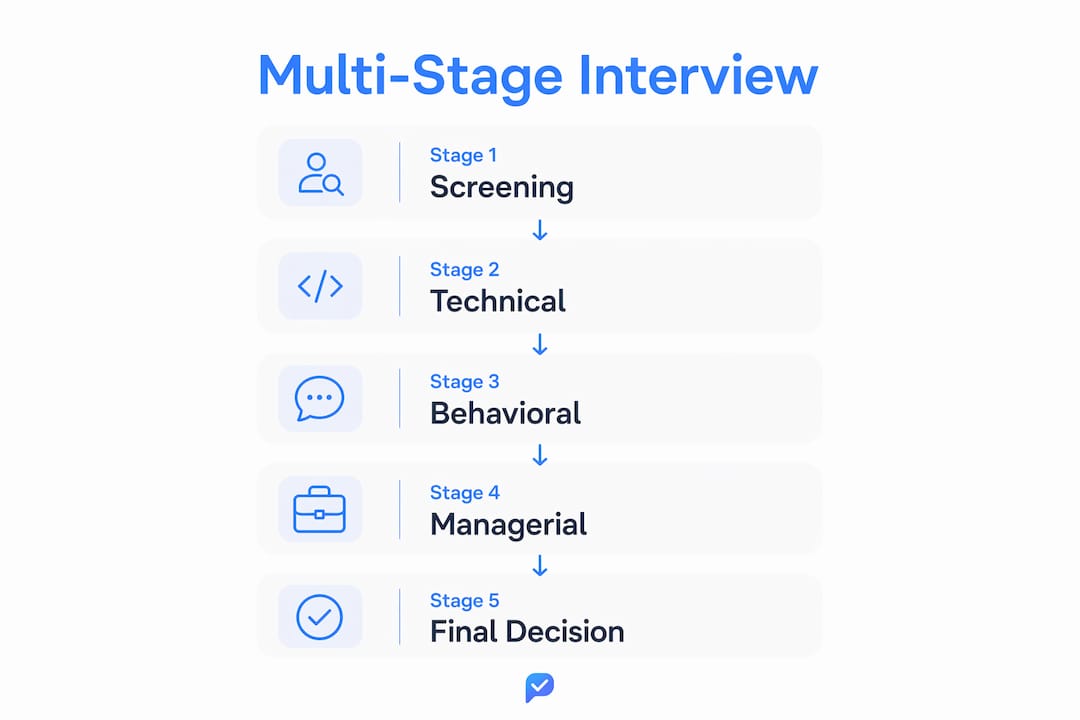
The most common failure in a multi-stage interview overview is an uncoordinated process where multiple stakeholders ask the same questions, wasting time and increasing candidate frustration. Without defined objectives per stage, the process generates redundant data rather than a complete picture. Candidates who experience this kind of disorganization often withdraw before reaching the final round.
Timing is the second major risk. Top talent stays available for only 10–20 days, and processes that stretch beyond 6 weeks consistently lose preferred candidates to faster-moving competitors. The total process should stay under 3 weeks whenever possible.
Common challenges and how to address them:
- Candidate drop-off: Communicate the full process upfront, including the number of rounds, format, and expected timeline. Candidates who know what to expect are far more likely to stay engaged.
- Redundant questioning: Map each stage to a specific competency before the process begins. Use a shared interview guide so every interviewer knows what their colleagues have already covered.
- Slow scheduling: Use asynchronous screening tools for early rounds to remove calendar bottlenecks. Platforms that allow candidates to complete video or written assessments on their own schedule cut days off the process.
- Inconsistent evaluation: Standardize scoring rubrics across all rounds. Without a common framework, two interviewers assessing the same candidate can reach opposite conclusions using different criteria.
Pro Tip: Apply Go/No-Go criteria at every stage. A candidate who fails a core requirement in round one should not advance to round three. Clear exit criteria protect your team's time and keep the pipeline focused on high-potential candidates.
How to design a process tailored to role type and company size
Adapting interview stages to role seniority and specialization keeps assessment relevant without inflating the number of rounds. A customer service role does not require the same depth of technical evaluation as a principal engineer position. Matching the process to the role prevents over-engineering simple hires and under-evaluating complex ones.
The table below shows how stage count and focus shift across role types.
| Role type | Recommended stages | Primary assessment focus |
|---|---|---|
| Entry-level or operational | 2–3 rounds | Culture fit, basic skills, motivation |
| Mid-level professional | 3–4 rounds | Technical skills, behavioral competencies |
| Senior or specialized | 4–5 rounds | Deep technical review, leadership, strategic fit |
| Executive | 5+ rounds | Vision alignment, board or stakeholder interviews |
Smaller organizations often lack the interviewer bandwidth to run five rounds for every open role. In those cases, combining the panel interview and cultural fit assessment into a single structured session with two or three interviewers is a practical solution. The key is that each interviewer still owns a distinct question area, even within a combined round.
Asynchronous assessments work well for early rounds regardless of company size. They remove scheduling friction, allow candidates in different time zones to participate equally, and produce a written or recorded record that the full hiring team can review. For technical role assessments, structured question sets tied to specific competencies produce more consistent data than open-ended conversations alone.
Balancing thoroughness with candidate experience is not optional. A process that is rigorous but respectful of a candidate's time signals that your organization values people. That signal influences acceptance rates, especially at the offer stage.
Key takeaways
A well-designed multi-stage interview process filters candidates progressively, assigns one clear objective to each round, and keeps the total timeline under 3 weeks to protect access to top talent.
| Point | Details |
|---|---|
| Structure each stage with purpose | Assign one competency per round to prevent redundant questioning and improve data quality. |
| Apply Go/No-Go criteria early | Decline unqualified candidates at the first stage to protect recruiter time and pipeline focus. |
| Keep the process under 3 weeks | Top talent stays available for only 10–20 days; a slow process loses candidates to faster competitors. |
| Use the Bar Raiser model for critical roles | An independent reviewer with veto power reduces bias and maintains consistent standards across teams. |
| Match stage count to role complexity | Entry-level roles need 2–3 rounds; senior or specialized roles warrant 4–5 distinct evaluation phases. |
What I've learned from watching multi-stage processes succeed and fail
The most consistent mistake I see is treating the multi-stage interview as a formality rather than a decision-making tool. Teams add rounds because it feels thorough, not because each round answers a specific question. The result is a bloated process that exhausts candidates and produces no additional insight.
The organizations that get this right start by writing down what they need to know after each round, not what they plan to ask. That single shift changes everything. When the question is "what decision does this stage enable?" rather than "what should we ask?", the process becomes genuinely useful.
Transparency with candidates is underrated. Telling a candidate upfront that there are four rounds, what each one covers, and when they can expect a decision is not just courteous. It is a signal about how your organization operates. Candidates who receive that clarity are more engaged, more prepared, and more likely to accept an offer. Candidates who are left guessing often withdraw quietly.
The role of AI in reducing interview bias is also worth taking seriously in 2026. Structured scoring rubrics and data-driven analysis help, but they only work if the underlying interview data is honest. That is a dimension of the process that deserves more attention than most hiring teams currently give it.
Speed and rigor are not opposites. The best processes I have seen complete five rounds in 18 days by running asynchronous assessments in parallel with scheduling for the next live round. The pipeline never stalls because no single step waits on another to finish.
— Hudson
How Evy supports structured, secure multi-stage hiring
Evy is built for hiring teams that need to run multi-stage interviews at scale without sacrificing integrity. As the only AI interview platform with real-time eye tracking, Evy detects when candidates use AI assistance during live assessments, which protects the reliability of your technical and behavioral evaluation data. That matters most in the early screening and skills assessment rounds, where dishonest responses can push unqualified candidates deeper into your pipeline.
Evy runs 24/7, which means asynchronous screening rounds complete faster and your team reviews structured, comparable data rather than inconsistent notes. For HR teams designing or refining a multi-stage process, Evy's interview features cover structured funnels, bias-aware scoring, and secure assessment delivery across every stage.
FAQ
What is a multi-stage interview process?
A multi-stage interview process is a structured hiring method where candidates complete a sequence of distinct rounds, each evaluating a specific competency such as technical skills, behavioral traits, or cultural fit. The goal is to build a complete, reliable picture of each candidate before making a hiring decision.
How many rounds does a multi-stage interview typically include?
A standard process includes 4 to 5 rounds, though entry-level roles may require only 2–3 and executive positions often involve more. The number of stages should match the complexity and seniority of the role.
How long should a multi-stage interview process take?
The total process should stay under 3 weeks. Top talent remains available on the market for only 10–20 days, so processes that stretch beyond 6 weeks consistently lose preferred candidates to competitors.
What is the Bar Raiser model in multi-stage interviews?
The Bar Raiser model assigns an interviewer from a different department the authority to veto a hiring decision. Popularized by Amazon, it reduces in-group bias and maintains consistent candidate standards across diverse interview teams.
How do you prepare candidates for a multi-stage interview process?
Communicate the full process upfront, including the number of rounds, the format of each stage, and the expected timeline. Transparent process communication keeps candidates engaged and improves acceptance rates at the offer stage.