
 By Adrian Pascual•Hiring insight•Published
AI's Role in Reducing Interview Bias: 2026 Guide
The role of AI in reducing interview bias is to create consistent, auditable, and objective candidate evaluations that replace subjective human judgment with structured, data-driven assessment. Research from 2026 confirms that prompt engineering combined with LoRA-based fine-tuning reduces gender bias by 39.6%, racial bias by 27.8%, and socioeconomic bias by 10.6%. That level of measurable improvement is not achievable through interviewer training alone. For HR professionals and hiring managers, AI in recruitment now represents the most reliable path to fair, defensible hiring decisions at scale.
How AI reduces interview bias through standardized evaluation
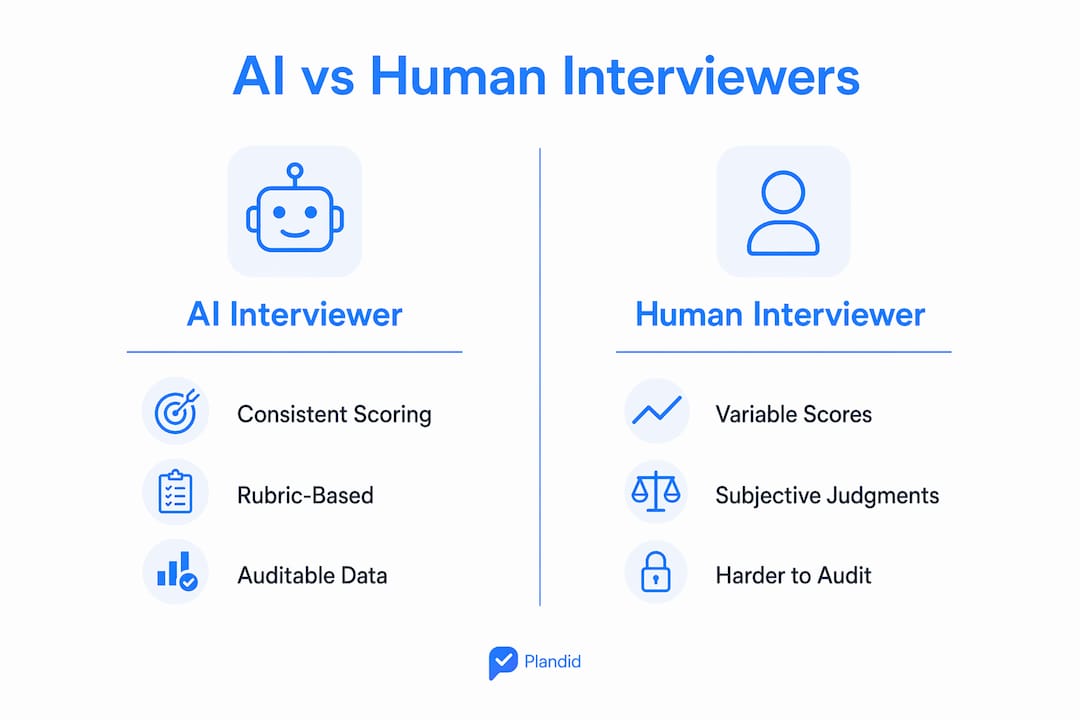
AI reduces interview bias primarily by replacing variable human judgment with consistent, rubric-based evaluation. Human interviewers assessing the same candidate can differ by up to 50% in their scoring. That gap reflects unconscious bias, fatigue, and inconsistent question delivery, not actual differences in candidate quality.
AI interview platforms address this by asking every candidate identical questions in the same sequence and scoring responses against predefined competency rubrics. The result is comparable data across your entire candidate pool. When every applicant answers the same prompt under the same conditions, the evaluation reflects their actual responses rather than the interviewer's mood or cultural assumptions.

Asynchronous AI interviews add another layer of fairness. Candidates complete assessments on their own schedule, removing time-pressure dynamics that can disadvantage certain groups. The AI scores each response without knowing the candidate's name, appearance, or accent, which eliminates several well-documented sources of first-impression bias.
Pro Tip: Before deploying any AI interview tool, audit its scoring rubric against your job description. Rubrics built around vague traits like "culture fit" can encode the same biases you are trying to remove.
A direct comparison helps clarify the practical difference between AI and human interviewers:
| Attribute | AI Interviewer | Human Interviewer |
|---|---|---|
| Scoring consistency | Identical rubric applied every time | Varies up to 50% for the same candidate |
| Availability | 24/7, no scheduling delays | Limited by recruiter capacity and time zones |
| Bias documentation | Fully auditable with logs | Implicit bias is difficult to detect or record |
| Emotional influence | None | Fatigue, affinity bias, and halo effects apply |
| Cost per candidate | Lower at scale | Increases with volume |
AI bias is also documentable and correctable through systematic adverse impact analyses following the EEOC's four-fifths rule. Human implicit bias, by contrast, is difficult to detect and nearly impossible to correct without extensive behavioral training. That auditability is one of the strongest arguments for AI tools in regulated or high-volume hiring environments.
What are the best multi-layer AI bias mitigation strategies?
No single technique eliminates bias in AI recruitment systems. Effective bias mitigation requires combined interventions at the data level, the model level, and the inference stage. Each layer addresses a different source of bias, and skipping any one of them leaves measurable gaps.
The three primary intervention layers work as follows:
- Data-level interventions correct bias in the training data before a model learns from it. Counterfactual data augmentation generates paired examples where only a demographic attribute changes, teaching the model that outcomes should not shift based on gender or race. Corpus reweighting adjusts the influence of underrepresented groups so the model does not learn from a skewed sample.
- Model-level fine-tuning applies fairness objectives during training. The ML-BAMS framework, for example, reduces biased components in recruitment datasets from 2.1% to below 0.5% and improves intersectional bias detection accuracy by 12–18 percentage points. Fine-tuning with LoRA adapters allows targeted adjustments without retraining the entire model from scratch.
- Inference-time filtering applies post-processing rules to model outputs before they reach a recruiter. This stage catches residual bias that survived earlier interventions and allows real-time calibration based on observed outcomes.
The challenge with layered mitigation is what researchers call the Whac-A-Mole dilemma. Removing one bias can unintentionally amplify another in a different demographic dimension. Weighted Rotational DebiasING, known as WRING, reduces bias in targeted model facets without amplifying other biases. It operates across high-dimensional model space, making it one of the more sophisticated post-processing approaches available in 2026.
Pro Tip: Run adverse impact analyses quarterly, not just at deployment. Bias patterns shift as your candidate pool changes, and a model that was fair at launch can drift over time without continuous monitoring.
Instruction-based prompting and in-context learning also show strong results at the inference stage. These techniques improve accuracy by 3.27% to 15.05% in large language model tabular classification while narrowing fairness gaps across demographic groups. For HR teams without deep machine learning resources, prompt engineering offers a practical entry point into bias reduction without requiring model retraining.
Does AI replace human judgment in fair hiring?
AI does not replace human judgment in fair hiring. It structures and informs that judgment so evaluators focus on job-relevant competencies rather than irrelevant personal characteristics. The most useful framing is that AI functions as part of a fairness infrastructure, not a standalone decision-maker.
Inclusion-focused AI illustrates this distinction clearly. When AI prompts evaluators to assess candidates against specific job competencies, it nearly doubles hiring rates for disabled applicants compared to standard AI screening. The AI is not making the hire. It is redirecting evaluator attention toward what actually predicts job performance.
This approach also guards against inverted bias, a risk that emerges when AI systems are calibrated too aggressively toward diversity metrics. Over-correction can disadvantage majority-group candidates in ways that create new legal and ethical exposure. Balanced calibration requires ongoing human oversight, not a one-time configuration.
Transparency and accountability are non-negotiable in this model. AI tools must be integrated with human judgment workflows and include transparent reasoning and audit trails to produce equitable hiring outcomes. Hiring managers should be able to see why a candidate was ranked as they were, not just accept a score as a black box output.
Structured interviews supported by AI-generated rubrics represent the most practical implementation of this principle. The AI defines the criteria and scores the responses. The human reviews the output, applies contextual judgment, and makes the final call. That division of labor preserves accountability while removing the most common sources of subjective error.
How to implement AI interview tools to reduce bias in 2026
Implementing AI interview tools effectively requires more than selecting a platform and turning it on. The workflow integration, verification practices, and oversight structures you build around the tool determine whether it reduces bias or simply automates existing problems.
Start with these foundational practices:
- Define competency-based criteria before configuration. Every scoring rubric should map directly to skills and behaviors the role requires. Avoid trait-based criteria like "executive presence" that have no validated connection to job performance.
- Verify candidate authenticity alongside AI assessments. Generative AI has made it easier for candidates to produce polished responses that do not reflect their actual knowledge. Platforms that combine transcript analysis with behavioral signals, such as eye tracking and attention patterns, provide a more complete picture of genuine competence.
- Maintain human review at decision points. AI screening should narrow the field and surface qualified candidates. A human hiring manager should still conduct final-stage conversations and make the offer decision.
- Document everything. Audit trails are your legal defense and your improvement mechanism. If a rejected candidate challenges the process, you need to show that the criteria were job-relevant, consistently applied, and free of protected-class influence.
Pro Tip: Test your AI interview tool with a blind audit before full deployment. Submit identical responses under different demographic profiles and check whether scores vary. Any gap that cannot be explained by the response content itself signals a calibration problem.
Evy's approach to reducing bias at screening addresses one of the most pressing 2026 concerns directly: candidates using AI tools to generate interview responses in real time. Real-time eye tracking detects attention patterns inconsistent with genuine thinking, which protects the integrity of your candidate data. Fair hiring requires honest data. Without verification, even the most carefully calibrated scoring rubric is measuring AI output rather than candidate capability.
Key takeaways
AI reduces interview bias most effectively when layered mitigation strategies, structured evaluation rubrics, and human oversight operate together rather than independently.
| Point | Details |
|---|---|
| Standardized rubrics cut variability | AI applies identical criteria to every candidate, removing the 50% scoring variance common in human interviews. |
| Multi-layer mitigation is required | Data, model, and inference-level interventions each address different bias sources; no single method is sufficient. |
| Auditability is a core advantage | AI bias is documentable and correctable through adverse impact analysis; human implicit bias is not. |
| Inclusion-focused AI guides evaluators | Prompting evaluators toward job competencies nearly doubles hiring rates for disabled applicants. |
| Verification protects data integrity | Eye tracking and behavioral signals confirm that AI scores reflect genuine candidate responses, not AI-generated outputs. |
Where i think most HR teams get this wrong
The conversation about AI in recruitment tends to focus on what the technology can do. Fewer teams spend enough time on what the technology is actually measuring. That gap is where bias reduction efforts fail.
I have seen organizations deploy AI interview tools, celebrate the reduction in time-to-screen, and assume the fairness problem is solved. It is not. A rubric that scores "communication style" without defining what that means in behavioral terms will encode the same cultural preferences a human interviewer would apply. The AI just applies them faster and at greater scale.
The more uncomfortable truth is that AI can make bias harder to see, not easier, if the audit infrastructure is not in place from day one. When a human interviewer makes a biased call, there is often a paper trail or a witness. When an AI model applies a biased weight across 10,000 applications, the pattern is invisible until someone runs the numbers.
The teams doing this well treat adverse impact analysis as a standing agenda item, not a one-time compliance check. They review scoring distributions by demographic group every quarter. They ask whether the candidates advancing through AI screening reflect the qualified population that applied, not just the population that historically got hired.
The other thing worth saying plainly: generative AI has complicated this significantly. Candidates are now using AI tools to craft responses during live interviews, which means the data your AI is scoring may not represent the candidate at all. Platforms that verify response authenticity through behavioral signals are not a luxury in 2026. They are a prerequisite for any bias reduction effort that depends on honest candidate data.
— Hudson
See how Evy supports fairer hiring at scale
Reducing bias in hiring requires both consistent evaluation and honest candidate data. Evy is built to deliver both.
Evy's anti-cheat AI interview features combine structured, rubric-based screening with real-time eye tracking to detect candidates using AI assistance during interviews. That means your scoring data reflects actual candidate capability, not generated responses. Evy screens at scale, 24/7, so your team evaluates candidates on competence rather than availability or first impressions. If you are building a fair hiring process that holds up to scrutiny, explore how Evy fits into your AI screening workflow and what it means for your candidate evaluation integrity.
FAQ
What is the role of AI in reducing interview bias?
AI reduces interview bias by applying consistent, rubric-based evaluation criteria to every candidate and removing subjective human judgment from early screening stages. Research confirms that prompt engineering and fine-tuning techniques can reduce gender bias by 39.6% and racial bias by 27.8%.
Can AI completely eliminate bias in hiring?
AI cannot completely eliminate bias, but it reduces and documents it more effectively than human interviewers alone. Effective bias reduction requires layered interventions at the data, model, and inference stages, combined with ongoing adverse impact analysis.
How does AI make hiring bias auditable?
AI systems generate logs of every scoring decision, which allows HR teams to run adverse impact analyses following the EEOC's four-fifths rule. Human implicit bias produces no equivalent record, making it far harder to detect or correct.
What is the whac-a-mole dilemma in AI bias reduction?
The Whac-A-Mole dilemma describes the risk that removing one form of bias in an AI model inadvertently amplifies another. Advanced post-processing techniques like WRING address this by targeting specific model facets without disturbing others.
How does AI handle candidates who use AI tools during interviews?
Standard AI interview platforms cannot reliably detect real-time AI assistance, which corrupts the candidate data the scoring system depends on. Platforms like Evy use real-time eye tracking and attention pattern analysis to identify responses that do not reflect genuine candidate thinking.