
 By Adrian Pascual•Hiring insight•Published
Job-Relevant Interview Tasks: 8 Proven Examples
Job-relevant interview tasks are structured exercises that simulate real work scenarios to reliably assess candidate skills and fit. Unlike generic interview questions, these tasks give hiring teams observable, comparable evidence of how a candidate actually performs. Frameworks like Google re:Work, repositories like the vibe-interviewing project, and platforms like AngelList have each demonstrated that work-sample tasks predict job performance more accurately than unstructured conversations. For HR professionals designing or refining their hiring process, the examples below cover the full spectrum of task types, from behavioral questions to live coding challenges.
1. examples of job-relevant interview tasks: behavioral questions
Behavioral questions are the most widely used form of job-specific interview tasks. They ask candidates to describe real past experiences, producing evidence that is far harder to fabricate than a hypothetical answer.
The core format is "Tell me about a time when..." followed by a structured follow-up sequence. Google re:Work recommends using predetermined follow-up questions aligned to specific job attributes, so every candidate is probed at the same depth. This standardization is what makes behavioral questions a reliable assessment tool rather than a casual conversation.
Strong behavioral questions for common roles include:
- For a project manager: "Tell me about a time you had to deliver a project with a reduced budget. What tradeoffs did you make?"
- For a customer success manager: "Describe a situation where a client was at risk of churning. What actions did you take?"
- For a software engineer: "Walk me through a time you identified a critical bug in production. How did you diagnose and resolve it?"
"The goal of a behavioral question is not to hear a good story. It is to collect structured evidence that the candidate has demonstrated the attribute the role requires." — Google re:Work
Each answer should be scored against a predetermined rubric before moving to the next candidate. Scoring after all interviews introduces recall bias and reduces reliability.
2. hypothetical and situational questions
Hypothetical questions assess how candidates reason through novel problems they have not faced before. They are particularly useful for roles where adaptability and judgment matter more than prior experience.
The format is "Imagine you are..." or "What would you do if..." These questions work best when the scenario is drawn directly from real challenges the role faces. A generic scenario produces a generic answer. A scenario pulled from an actual incident your team encountered produces a much more revealing response.
For a hiring manager evaluating a data analyst, a strong hypothetical might be: "Imagine you deliver a report to a senior stakeholder and they immediately question the accuracy of your numbers. How do you respond?" That scenario tests composure, data literacy, and communication in one question. Pairing hypothetical questions with behavioral follow-ups, such as "Has something like this ever happened to you?", gives you both forward-looking judgment and backward-looking evidence.
3. work-sample coding tasks that mirror real duties
Work-sample tasks are the gold standard for technical roles. They ask candidates to perform actual job duties under controlled conditions, producing output that can be evaluated against clear criteria.

AngelList's coding interview is one of the most cited examples in 2026. Candidates work inside a real production-like codebase, submit pull requests, and are expected to critically evaluate AI-generated code rather than accept it blindly. That last point is significant. Allowing AI tool use shifts the assessment from "can you write code from memory" to "can you verify, judge, and improve AI output." That is a far more relevant skill for most engineering roles today.
The vibe-interviewing repository offers a structured set of timed coding scenarios, including a 30–45 minute debug task and a 45–60 minute refactor or feature-build exercise. Each scenario includes an interviewer guide and scoring criteria. This level of structure is what separates a reliable work-sample task from an ad hoc whiteboard session.
Pro Tip: Frame coding tasks around your actual codebase or a sanitized version of it. Candidates who succeed in that context are far more likely to succeed on day one.
4. take-home assignments with bounded scope
Take-home assignments give candidates time to produce thoughtful work without the pressure of a live session. The risk is scope creep. An assignment without clear boundaries can consume 20+ hours of a candidate's time, which is both unfair and legally questionable in some jurisdictions.
Best practice for take-home assignments in 2026 follows four principles:
- Set a time expectation. State clearly that the task is designed for 2–6 hours. Candidates who spend 15 hours are not demonstrating more skill. They are demonstrating poor scope management.
- Define what is in scope. List the specific deliverables you expect. Do not leave room for interpretation that rewards over-engineering.
- Disclose evaluation criteria. Tell candidates what you are assessing. Transparency does not reduce the validity of the task. It reduces noise caused by candidates guessing what you want.
- Avoid unpaid production work. If the output of the assignment could ship directly to your product, the task has crossed a line. Keep it clearly hypothetical or synthetic.
Pro Tip: Include a short written reflection prompt alongside the task. Ask candidates to note what they would do differently with more time. This reveals self-awareness and prioritization skills that the deliverable alone cannot show.
5. role-specific UI and product design tasks
Design and front-end engineering roles benefit from tasks that produce a tangible artifact, whether that is a component, a prototype, or a written specification. The key is defining acceptance criteria before the task is issued, not after.
MetaMask's design engineer assessment is a well-documented example. It is a 3–4 hour React UI take-home that explicitly lists what is in scope and what is not. Backend changes and large routing modifications are excluded. Candidates are required to submit a written notes file describing their decisions, tradeoffs, and what they would improve with more time. That written component is often more revealing than the code itself.
ArborXR's interview brief takes a similar approach, using acceptance criteria checklists tied to specific UI behaviors. Each criterion is observable and binary: either the feature toggle works as specified, or it does not. This removes subjectivity from the evaluation and makes candidate comparison straightforward.
The table below shows how these two approaches differ in structure:
| Feature | MetaMask Assessment | ArborXR Interview Brief |
|---|---|---|
| Task type | React UI component build | Front-end feature implementation |
| Time expectation | 3–4 hours | Defined per brief |
| Evaluation method | Written rationale plus code review | Acceptance criteria checklist |
| Out-of-scope definition | Explicit (no backend, no routing) | Defined per feature set |
| Candidate reflection required | Yes (notes file) | Not specified |
For hiring frontend engineers, role-specific tasks like these produce far more signal than a general coding challenge because they test domain judgment, not just syntax knowledge.
6. structured evaluation rubrics for any task type
A task without a rubric is an opinion. A rubric converts a candidate's output into a comparable, defensible score. Every effective interview exercise needs one.
The Dr.Fit hiring test illustrates this well. Rather than scoring only the final result, it scores intermediate decision steps: did the candidate reproduce the bug correctly, did they locate the fix in the right place, and did they verify the fix against edge cases? This process-oriented scoring approach captures how a candidate thinks, not just what they produced.
A strong rubric for any task type should cover:
- Process quality: Did the candidate follow a logical sequence?
- Decision transparency: Did they explain their reasoning, either verbally or in writing?
- AI interaction: If AI tools were permitted, did the candidate verify outputs or accept them uncritically?
- Scope management: Did they stay within the defined boundaries of the task?
Scoring should happen independently before candidates are discussed as a group. Group discussion before scoring introduces anchoring bias, where the first strong candidate sets an inflated benchmark for everyone who follows.
7. anti-cheat task design for ai-assisted interviews
AI tool access during interviews is now standard in many technical hiring processes. The challenge is distinguishing candidates who use AI thoughtfully from those who let it do all the thinking.
The vibe-interviewing framework addresses this directly. It embeds hidden evaluation constraints into tasks and instructs AI assistants not to reveal direct answers. Candidates are expected to test, verify, and reason through outputs rather than copy them. This design measures decomposition skills and AI verification ability, which are the skills that actually matter in a modern engineering role.
For HR teams managing AI candidate screening, the principle extends beyond coding tasks. Any interview task can be designed to require candidate judgment rather than AI recall. Open-ended written tasks, for example, can include a follow-up verbal debrief where candidates explain their reasoning. A candidate who relied entirely on AI output will struggle to defend specific choices in real time.
8. realistic job previews as assessment tasks
A realistic job preview is a task type that serves two purposes simultaneously. It assesses the candidate and gives them an accurate picture of what the role involves. This dual function reduces early attrition among new hires because candidates self-select based on real information rather than a polished job description.
For assessing technical and soft skills, realistic job previews work best when they include a representative sample of the role's most common and most challenging tasks. A customer support role preview might include a live ticket triage exercise. A content strategy role preview might include a brief content audit with a written recommendation. The task does not need to be long. It needs to be representative.
The most effective realistic job previews include a debrief conversation after the task. Asking candidates what surprised them, what they found straightforward, and what they would want to learn more about gives you behavioral data and a window into their self-awareness and motivation.
Key takeaways
Job-relevant interview tasks produce reliable hiring decisions only when they are structured, scoped, and scored against predetermined criteria before any candidate discussion takes place.
| Point | Details |
|---|---|
| Behavioral questions need rubrics | Score each behavioral answer against fixed criteria before comparing candidates. |
| Scope control protects fairness | Take-home tasks should specify a 2–6 hour time expectation and list explicit deliverables. |
| Process beats output | Rubrics that score decision steps, like the Dr.Fit model, reveal more than final result quality alone. |
| AI use requires verification tasks | Design tasks that require candidates to test and defend AI outputs, not just submit them. |
| Realistic previews reduce attrition | Tasks that mirror actual job duties help candidates self-select, lowering early turnover. |
What i've learned designing interview tasks that actually work
After working through dozens of hiring cycles across technical and non-technical roles, the pattern I keep seeing is this: the tasks that produce the most useful signal are almost always the simplest ones. A 45-minute debug exercise with a clear rubric tells you more than a three-part take-home that takes a weekend to complete.
The biggest mistake I see hiring teams make is designing tasks that test what they find interesting rather than what the role actually requires. A marketing manager role does not need a competitive analysis of six companies. It needs a short brief and a positioning statement. Keep the task anchored to the first 90 days of the job, not to an idealized version of what a perfect candidate might produce.
Transparency is the other thing I would push harder on. Telling candidates what you are evaluating does not reduce the validity of the task. It reduces the noise. Candidates who know you are assessing their reasoning process will show you their reasoning process. That is exactly what you want to see.
The AI dimension is genuinely new territory, and I think most hiring teams are still figuring it out. My view is that banning AI during tasks is a losing strategy. The better approach is designing tasks where AI assistance is permitted but verification is required. That is where the real skill gap shows up.
— Hudson
How Evy keeps job-relevant interview tasks honest
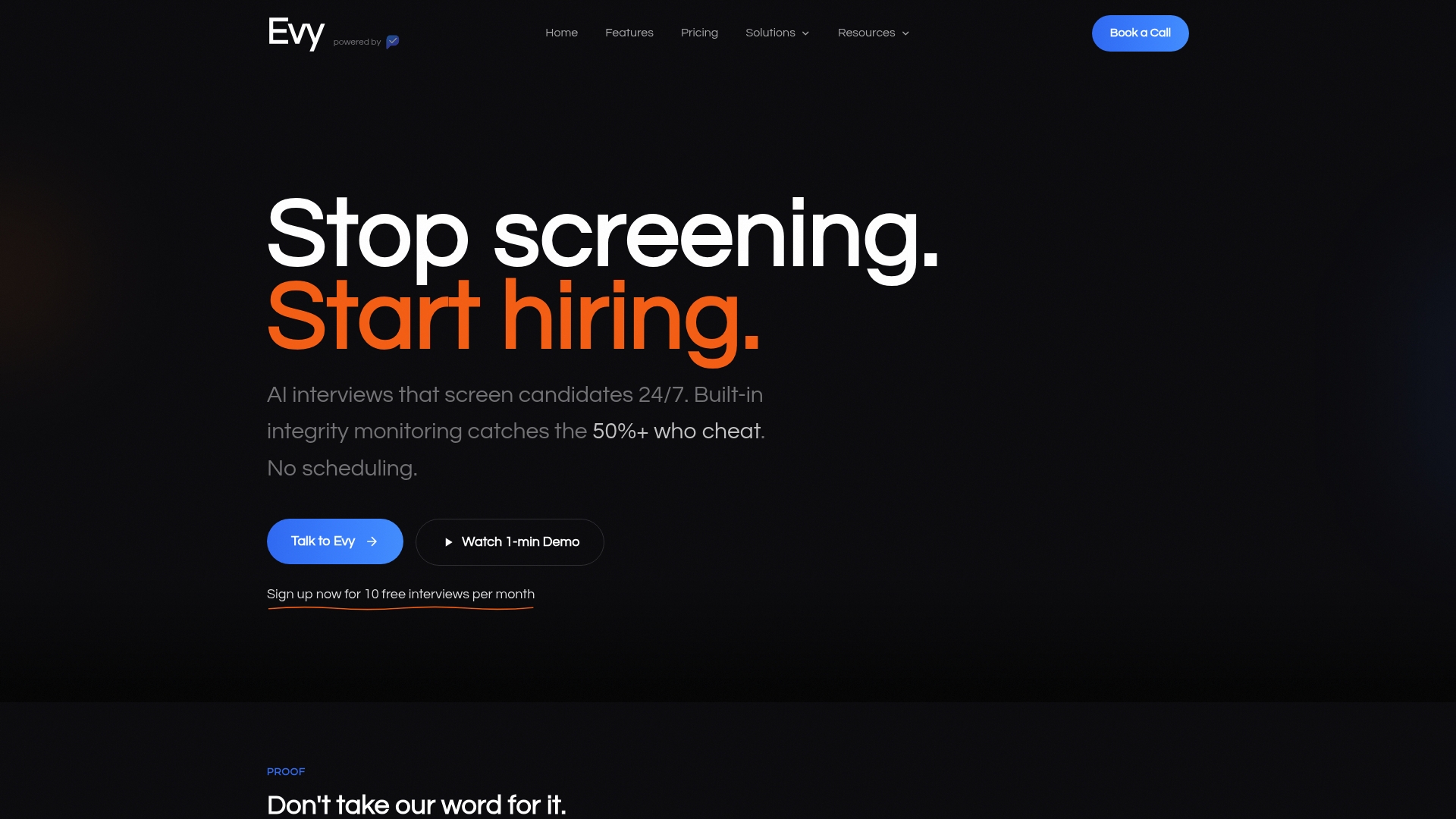
Designing strong interview tasks is only half the challenge. The other half is knowing that candidates are completing them honestly. Evy is the only AI interview platform with real-time eye tracking that detects when candidates are using undisclosed AI assistance during a session. For HR teams running structured technical interviews at scale, that integrity layer matters. Evy screens candidates 24/7, surfaces attention patterns that differ from natural problem-solving, and gives your team a transcript and behavioral record to review. See the full feature set at Evy's anti-cheat interview platform and run assessments you can actually trust.
FAQ
What are job-relevant interview tasks?
Job-relevant interview tasks are structured exercises that replicate actual job duties to assess candidate skills under comparable conditions. They include behavioral questions, work-sample tasks, take-home assignments, and role-specific design or coding challenges.
How long should a take-home interview assignment be?
Take-home assignments should be scoped to 2–6 hours, with the time expectation disclosed to candidates upfront. Assignments that require more time risk being unfair and may cross into unpaid work territory.
How do you prevent cheating on interview tasks?
Tasks can be designed with hidden evaluation constraints and AI verification requirements, as the vibe-interviewing framework demonstrates. Platforms like Evy add a real-time eye-tracking layer to detect undisclosed AI use during live sessions.
Should candidates be told what the task evaluates?
Disclosing evaluation criteria to candidates improves fairness and reduces noise without reducing task validity. Candidates who understand what is being assessed produce more relevant responses, which makes scoring more reliable.
What is the difference between behavioral and hypothetical questions?
Behavioral questions ask candidates to describe past experiences to provide evidence of demonstrated skills. Hypothetical questions present novel scenarios to assess reasoning and judgment in situations the candidate may not have encountered before.