
 By Adrian Pascual•Hiring insight•Published
How to Give Feedback After Video Interviews
Giving feedback after video interviews is the process of delivering clear, specific, and actionable information to candidates about their interview performance to support their professional development and improve hiring outcomes. Done well, it protects your employer brand, helps candidates grow, and sharpens your own evaluation process. Done poorly, it creates confusion, legal exposure, and a candidate experience that reflects badly on your organization. This article walks through proven frameworks, timing best practices, and communication techniques that HR professionals and hiring managers can apply immediately, drawing on 2026 guidance from Leapsome, UCLA teaching resources, and structured video interview evaluation processes.
How to give feedback after video interviews: what you need first
Before you write a single word of feedback, three things must be in place: a clear record of the interview, an agreed scoring rubric, and an understanding of what the candidate was actually assessed on. Without these, feedback becomes impressionistic and legally risky.
Timing matters more than most hiring managers realize. Sending feedback within 48 hours post-interview maximizes receptivity and relevance for candidates. Memory fades quickly on both sides, and a delayed response signals that the candidate's time was not valued.
Your choice of communication channel also shapes how feedback lands. Written feedback via email gives candidates time to process and respond without pressure. A short video or live call works better for senior candidates who expect a more personal exchange. Candidate timing preferences vary: some want immediate verbal feedback, others prefer a written follow-up. Asking upfront which format they prefer takes thirty seconds and prevents a lot of friction.
Here is a quick reference for the tools and platforms most commonly used in the video interview evaluation process:
| Tool / Platform | Primary Use | Feedback Feature |
|---|---|---|
| Evy | AI-powered video interviews with eye tracking | Centralized scoring, transcript analysis, attention pattern data |
| Leapsome | Performance and feedback management | Structured feedback templates, dialogue prompts |
| Asana | Project and workflow management | Feedback step integration in hiring workflows |
| Google Meet / Zoom | Synchronous video interviews | Manual notes; no built-in candidate feedback module |
Before delivering any feedback, run through this checklist:
- Review the interview recording or transcript against your job criteria
- Confirm which competencies were assessed and how the candidate scored on each
- Identify one or two specific areas for improvement rather than a broad list
- Check your organization's legal guidelines on what can and cannot be shared
- Decide whether feedback will be written, verbal, or both
Organizational culture shapes how much candor is appropriate. A startup with a direct communication norm can deliver blunter feedback than a large enterprise where HR legal review is standard. Knowing your context prevents you from either over-softening or overstepping.
How to structure your feedback for clarity and impact
The structure of your feedback determines whether a candidate walks away with something useful or just a vague sense of how things went. A five-step approach covers the full arc from preparation to dialogue.
- Prepare with specifics. Pull the interview recording or your notes and identify two or three concrete moments that illustrate your assessment. Vague feedback like "your communication could be stronger" helps no one. "In your answer to the second question, you used technical jargon without defining it for a non-technical audience" is something a candidate can act on.
- Describe the observable situation. Focus on what you saw and heard, not on personality traits. "Your response ran for four minutes without a clear conclusion" is objective. "You ramble" is a character judgment that triggers defensiveness.
- Use "I" statements. Turning feedback into dialogue with personal framing improves recipient engagement. "I found it difficult to follow the structure of your answer" lands differently than "your answer was confusing."
- Give one or two actionable recommendations. Focused feedback on one or two areas facilitates candidate growth and makes a response more likely. Listing six improvement areas overwhelms and discourages.
- Invite dialogue. Close with a genuine question: "What are your thoughts on this?" or "Is there anything you'd like to clarify?" Encouraging upward feedback and leaving room for candidate questions fosters trust and clarity.
One technique to drop immediately is the feedback sandwich, where you wrap criticism between two pieces of praise. Leapsome's 2026 management guidance recommends replacing it with direct, actionable feedback. The sandwich method causes confusion because candidates often remember only the positive framing and miss the core message entirely.
Pro Tip: Focus on recurring patterns rather than isolated incidents. If a candidate struggled with structuring answers in two separate questions, that is a pattern worth naming. A single stumble in one answer is noise; a theme across the interview is signal.

Tailor your depth based on experience level. A junior candidate benefits from more prescriptive advice: "Try using the STAR method to structure your answers." A senior candidate responds better to reflective prompts: "How do you typically approach communicating technical decisions to non-technical stakeholders?" The goal is the same. The delivery differs.
What are common mistakes when providing post-interview feedback?
Even experienced hiring managers fall into predictable traps when delivering constructive criticism after interviews. Recognizing these patterns is the first step to correcting them.
Vague feedback is the most common failure. Phrases like "we felt you weren't the right fit" or "your experience didn't quite match what we need" tell a candidate nothing they can use. They also create legal ambiguity. Specific, criteria-based feedback is both more useful and more defensible.
Overly polite feedback is nearly as damaging. Filtered, softened feedback is common in formal hiring contexts, and candidates often sense the gap between what is said and what is meant. When feedback is too cushioned, candidates cannot identify what actually needs to change. Self-reflection and reviewing recorded interview responses help bridge that gap, but the hiring team should not rely on candidates to reverse-engineer honest assessments.
The other common pitfalls include:
- Unbalanced tone. Feedback that is entirely critical without acknowledging genuine strengths reads as punitive, not constructive. Acknowledge what worked before addressing what did not, but do not bury the substance.
- Turning feedback into a lecture. Delivering a monologue without pausing for the candidate's response removes the collaborative element that makes feedback useful. Organizational cultures that treat feedback as ongoing dialogue reduce defensiveness and increase the practical impact of the exchange.
- Delayed follow-up. Feedback sent two weeks after an interview loses most of its value. The candidate has moved on mentally, and the specific details that made the feedback meaningful have faded.
- Ignoring legal boundaries. Feedback that references protected characteristics, even indirectly, creates liability. Keep all feedback anchored to observable, job-relevant behaviors.
Pro Tip: Before sending written feedback, ask the candidate one reflective question: "What do you think went well, and what would you approach differently?" Their self-assessment often surfaces the same issues you identified, which makes your formal feedback feel like confirmation rather than judgment. This reduces defensiveness significantly.
Managing candidate reactions requires patience. Some candidates push back on feedback, especially if they felt the interview went well. Acknowledge their perspective without reversing your assessment. "I understand this is disappointing. The feedback reflects what we observed in this specific interview context" is a complete and professional response.
How to adapt feedback for asynchronous video interview formats
Asynchronous video interviews, where candidates record responses to preset questions without a live interviewer present, create a different feedback context than synchronous conversations. The candidate cannot ask clarifying questions in the moment, and the hiring team reviews responses on their own schedule. This separation changes both what you can assess and how you should communicate your findings.
| Feedback Dimension | Synchronous (Live) Interview | Asynchronous (Recorded) Interview |
|---|---|---|
| Timing | Immediate verbal or same-day written | Written follow-up within 48 hours |
| Depth of observation | Real-time behavioral cues | Recorded responses, transcript analysis, attention patterns |
| Candidate context | Can clarify in the moment | No real-time clarification available |
| Consistency | Varies by interviewer | Standardized questions enable direct comparison |
| Feedback format | Verbal or written | Written preferred; video response optional |
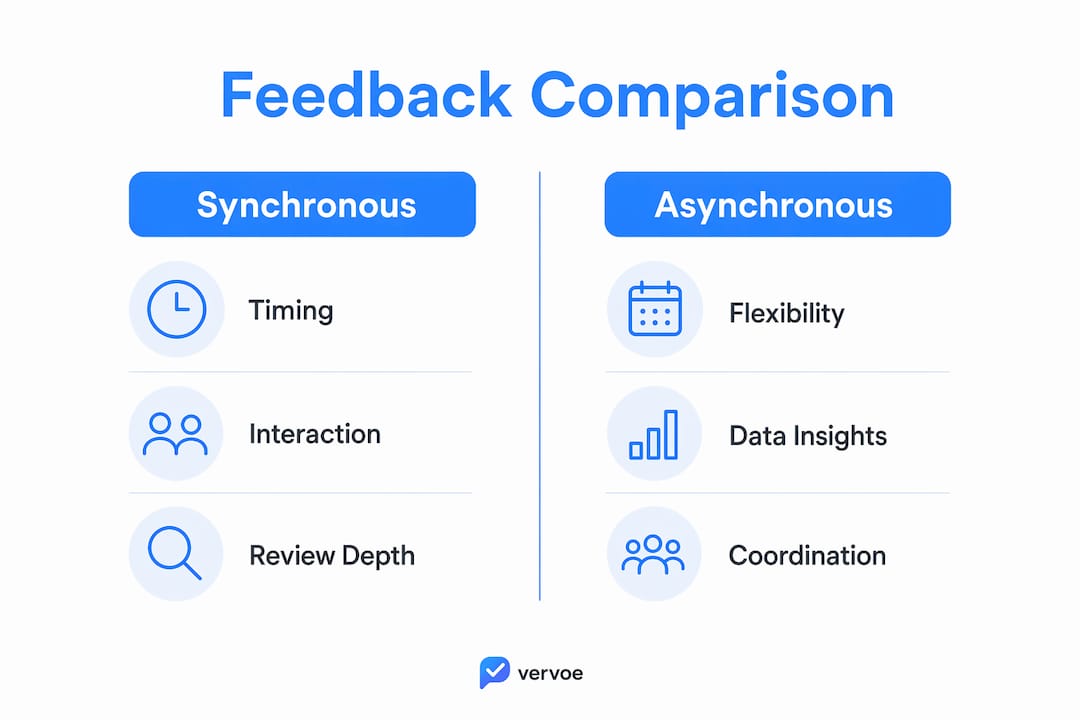
The recorded format actually gives hiring teams more to work with. Most actionable candidate insights come from reviewing recorded interviews and comparing responses to job criteria, since formal feedback is often filtered and cautious in live settings. Transcript analysis lets you quote specific language the candidate used, which makes feedback more precise and harder to dispute.
Platforms like Evy are built for this kind of structured review. Evy's interview data analytics capture attention patterns and response quality across all candidates, giving hiring teams a consistent evidence base for feedback rather than relying on interviewer memory. This matters especially when multiple hiring managers are reviewing the same candidate pool and need to align on a shared assessment before communicating with candidates.
Internal coordination is often the weakest link in the asynchronous feedback process. If three interviewers reviewed a candidate's recorded responses and reached different conclusions, the feedback sent to the candidate should reflect a consolidated view, not three separate opinions. Assign one person to synthesize the team's notes and draft the final message. This prevents contradictory signals and protects the organization's credibility.
Pro Tip: For on-demand video interviews, build your feedback template before the review process begins. Define the two or three criteria you will comment on, and write placeholder sentences for each. This forces consistency across candidates and cuts the time spent drafting individual responses by more than half.
Key takeaways
Effective feedback after video interviews requires specific, criteria-based observations delivered within 48 hours, structured around observable behaviors rather than personality judgments, and framed as a two-way conversation rather than a verdict.
| Point | Details |
|---|---|
| Timing is critical | Send feedback within 48 hours to maximize relevance and candidate receptivity. |
| Structure beats instinct | Use a five-step framework: prepare, describe, use "I" statements, advise, and invite dialogue. |
| Drop the feedback sandwich | Direct, specific feedback outperforms praise-criticism-praise structures every time. |
| Asynchronous formats need extra coordination | Consolidate team notes before sending feedback to avoid contradictory messages. |
| Patterns over incidents | Identify recurring themes across the interview rather than reacting to single moments. |
Why feedback is a conversation, not a verdict
I have reviewed hundreds of post-interview feedback exchanges over the years, and the ones that actually help candidates improve share one quality: they treat the candidate as a professional who can handle honest information. The ones that fail almost always err on the side of excessive caution, wrapping every critical point in so much softening language that the message disappears entirely.
The shift I keep coming back to is moving from "judgment delivery" to "collaborative growth." That is not a soft reframe. It has a practical effect on how candidates receive and act on what you tell them. When a candidate feels they are being assessed fairly and given real information, they engage with the feedback. When they sense they are being managed or handled, they disengage and sometimes push back harder.
One thing that surprises hiring managers when they first try this approach: candidates often give you better information about your own process when you invite them to respond. I have seen candidates identify gaps in job descriptions, unclear question framing, and inconsistent scoring criteria simply because the feedback session left room for their perspective. That kind of upward feedback improves your hiring outcomes in ways that one-directional critique never will.
The organizations that do this well treat every feedback session as a data point, not just a courtesy. They track what candidates say in response, look for patterns in where their process creates confusion, and adjust accordingly. Feedback, at its best, is a loop. Not a closing statement.
— Hudson
How Evy makes the feedback process more consistent
Delivering consistent, evidence-based feedback across a high volume of candidates is genuinely difficult without the right infrastructure. Evy is built to solve exactly that problem. As the only AI interview platform with real-time eye tracking, Evy captures attention patterns, transcript data, and behavioral signals that give hiring teams a precise, documented basis for candidate feedback. Instead of relying on interviewer memory or scattered notes, your team works from a shared, structured record of each candidate's performance. Evy's anti-cheat AI interview features also flag integrity concerns before they distort your evaluation, so the feedback you deliver reflects genuine candidate performance. If you want to improve both the quality and consistency of your post-interview communication, Evy gives you the data to do it right.
FAQ
What is the best time to send feedback after a video interview?
Send feedback within 48 hours of the interview. This window keeps the conversation relevant for both parties and signals respect for the candidate's time.
How specific should post-interview feedback be?
Focus on one or two concrete, observable behaviors tied to the job criteria. Vague feedback like "not the right fit" gives candidates nothing to act on and creates legal ambiguity.
Should feedback after video interviews be written or verbal?
Written feedback works well for most candidates because it gives them time to process the information. For senior roles or candidates who expressed a preference for a live conversation, a short call followed by a written summary is the stronger approach.
What is the feedback sandwich, and why should you avoid it?
The feedback sandwich places criticism between two pieces of praise. Leapsome's 2026 guidance identifies it as a method that causes confusion, because candidates often remember only the positive framing and miss the core message.
How do asynchronous video interviews change the feedback process?
Recorded interviews give hiring teams access to transcripts and behavioral data that make feedback more precise. The main adjustment is internal: consolidate all reviewer notes into a single, consistent message before communicating with the candidate.