
 By Adrian Pascual•Hiring insight•Published
How to Write Effective Screening Interview Questions
Most hiring teams spend more time fixing bad hires than they do preventing them. The root cause is usually the same: screening questions that are too vague, too generic, or simply not designed to surface the right information. When you write effective screening interview questions, you stop relying on gut instinct and start making decisions grounded in evidence. This article walks you through the design principles, question formats, scoring methods, and compliance considerations that separate a rigorous screening process from one that wastes everyone's time.
Table of Contents
- Key takeaways
- How to write effective screening interview questions
- Preparing your question bank
- Writing and structuring questions for results
- Scoring rubrics and consistent evaluation
- Common challenges and how to address them
- My take on what actually changes hiring outcomes
- How Evy supports structured screening at scale
- FAQ
Key takeaways
| Point | Details |
|---|---|
| Structure beats intuition | Structured interviews improve hire quality by 26% and reduce bias-related discrepancies by 40% compared to unstructured ones. |
| Competencies come first | Identify 3 to 6 critical role competencies before writing a single question to keep your question bank focused. |
| Scoring must be defined upfront | A 1-to-5 anchored rubric with behavioral descriptors prevents gut-feeling scoring and supports defensible hiring decisions. |
| Compliance is non-negotiable | Asking only job-related questions is the only legally defensible position under federal employment law. |
| Brevity protects quality | A well-designed screening call runs 20 to 35 minutes with 6 to 12 targeted questions, covering fit, motivation, and competency. |
How to write effective screening interview questions
Before you write a single question, you need to understand what makes a screening question worth asking. The goal of a screening interview is not to build rapport or explore a candidate's personality. It is to qualify or disqualify candidates objectively, based on job-relevant criteria. That distinction matters because small talk introduces bias in ways that are subtle but measurable.
Effective screening questions share four characteristics. They are brief enough for a candidate to answer in under a minute. They are tied directly to a competency or logistical requirement. They produce responses that can be scored consistently across all candidates. And they avoid phrasing that telegraphs the "right" answer before the candidate speaks.
The questions that consistently underperform are the ones that feel safe: "Tell me about yourself," "What's your greatest weakness," or "Where do you see yourself in five years?" These questions produce rehearsed answers that reveal almost nothing about job performance. They persist because they feel comfortable, not because they work.
Research makes the case clearly. Structured interviews yield a predictive validity of 0.51 compared to 0.38 for unstructured ones. That gap translates directly into better hires and fewer costly mistakes. The structure does not come from rigidity. It comes from intentional design.
Pro Tip: Write your questions in plain language. If a question takes more than two sentences to ask out loud, it is too complex. Candidates should be thinking about their answer, not decoding the question.
Preparing your question bank
Good screening questions do not appear out of thin air. They come from a deliberate preparation process that starts with the role, not the question.

Begin by identifying 3 to 6 critical competencies for the position. For a customer success manager, those might be communication clarity, problem resolution under pressure, product knowledge acquisition, and stakeholder management. For a software engineer, they might include debugging methodology, cross-functional collaboration, and technical communication. Every question you write should trace back to one of these competencies.
Once you have your competencies, translate each one into question types. Three formats work best in screening:
- Behavioral questions ask candidates to describe past behavior as a predictor of future performance. Example: "Tell me about a time you had to manage a difficult client expectation. What did you do, and what was the outcome?"
- Situational questions present a hypothetical scenario tied to the role. Example: "If you discovered a critical bug two hours before a product launch, how would you approach the decision to delay or proceed?"
- Technical or logistical questions verify baseline requirements. Example: "This role requires occasional travel to client sites. Is that something you can accommodate?"
A well-structured question bank balances role-agnostic core questions (motivation, communication, work style) with job-specific modules that vary by function. This makes it easier to compare candidates across different hiring cycles while still assessing role-specific skills.
| Question type | Best used for | Example |
|---|---|---|
| Behavioral | Competency assessment | "Describe a time you led a project under a tight deadline." |
| Situational | Problem-solving and judgment | "How would you handle a team member missing repeated deadlines?" |
| Technical | Skill verification | "Walk me through how you would set up a basic SQL query." |
| Logistical | Practical fit | "This role requires being on-call one weekend per month. Does that work for you?" |
Screening calls are typically 20 to 35 minutes, with 6 to 12 questions recommended. That means you have time for roughly two to three questions per competency. Prioritize accordingly.
Pro Tip: Build your question bank in modular blocks. Keep a core set of five questions that every candidate answers, then add a five-question module specific to the role. This gives you consistent data for comparison without making every call feel identical.
Writing and structuring questions for results
How you format interview questions matters as much as what you ask. A question that is grammatically correct but poorly structured will still produce weak answers.
The most reliable format starts with a clear behavioral or situational prompt, followed by an explicit request for evidence. Compare these two versions of the same question:
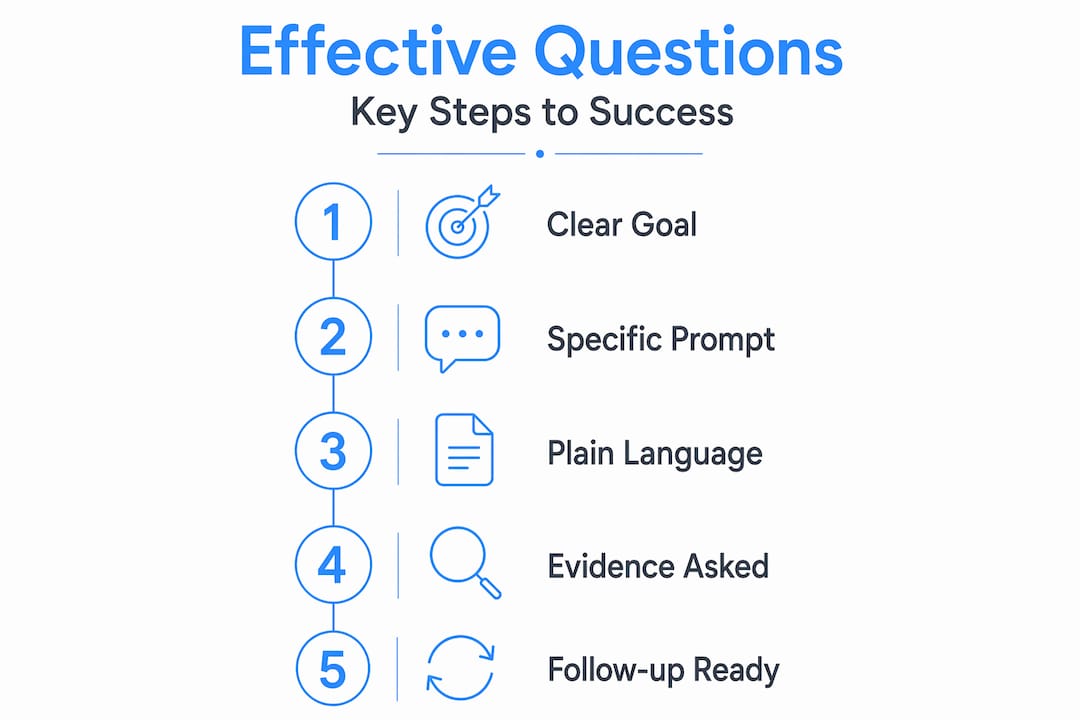
"Are you good at handling conflict?" versus "Tell me about a specific situation where you had a conflict with a colleague. What steps did you take to resolve it, and what was the result?"
The second version gives the candidate a structure to follow (situation, action, result) and signals that you want concrete evidence, not a general self-assessment. That structure produces answers you can actually score.
When writing your questions, watch for these common failure modes:
- Questions that contain the answer ("We value collaboration here. How do you work in a team?")
- Double-barreled questions that ask two things at once ("Tell me about your communication style and how you handle deadlines.")
- Questions that touch on protected characteristics, even indirectly ("Do you have children? How do you handle work-life balance?")
On that last point, legal risks arise when questions about protected traits lead to adverse hiring decisions. The safest and most effective practice is to ask only job-related competency questions. This is not just a legal protection. It also produces better data.
Sequencing matters too. Start with logistical and motivational questions to establish baseline fit before moving into behavioral and technical questions. This mirrors a natural conversation flow and gives candidates time to settle in before the more demanding questions arrive.
"Use predetermined follow-up questions to assess cognitive potential consistently across all candidates." — re:Work by Google
Follow-up questions are one of the most underused tools in screening. When a candidate gives a vague answer, a prepared follow-up like "Can you be more specific about your role in that outcome?" surfaces the detail you need without leading the candidate toward a better answer.
Scoring rubrics and consistent evaluation
Writing great questions is only half the work. Without a consistent scoring system, two interviewers can evaluate the same candidate answer and reach completely different conclusions.
A 1-to-5 anchored scoring rubric with specific behavioral indicators is the most validated tool for structured screening. The key word is "anchored." Each score level must be defined with observable, behavior-based descriptions, not vague adjectives.
Here is what an anchored rubric looks like for a communication competency question:
| Score | Behavioral description |
|---|---|
| 1 | Candidate gave no specific example; response was entirely general or off-topic. |
| 2 | Candidate referenced a situation but provided no detail on actions taken. |
| 3 | Candidate described a situation and actions but did not address the outcome. |
| 4 | Candidate gave a clear situation, specific actions, and a measurable outcome. |
| 5 | Candidate gave a clear example with measurable outcome and reflected on what they learned or would do differently. |
Rubrics without behavioral anchors are ineffective. Specific, observable descriptions are what make consistent scoring possible across multiple interviewers and hiring cycles.
Before your first screening call, define what a strong answer looks like for each question. This benchmark answer does not need to be the only acceptable response. Decide on benchmark answers before interviews but remain flexible enough to recognize valid approaches that differ from your model answer. A candidate who solved the same problem a different way may still deserve a high score.
Calibration training of interviewers is critical to ensure consistent use of scoring rubrics and improve inter-rater reliability. Run a calibration session before a new hiring cycle begins. Have two interviewers independently score the same practice answer, then compare and discuss discrepancies. This exercise surfaces scoring drift before it affects real candidates.
Pro Tip: Never score during the interview. Take notes on what the candidate actually said, then score immediately after the call ends. Scoring in real time splits your attention and leads to less accurate assessments.
Common challenges and how to address them
Even well-designed screening processes run into friction. Knowing what to expect makes it easier to stay consistent.
- Vague answers. When a candidate gives a general response, resist the urge to rephrase your question into a leading prompt. Rephrasing questions into leading prompts diminishes authentic problem-solving demonstration. Instead, create silence. Most candidates will fill it with the specifics you need.
- Culture fit bias. "Culture fit" is one of the most misused concepts in hiring. When assessing fit, tie it to specific, observable behaviors rather than subjective impressions. "Does this person communicate the way our team communicates?" is more defensible than "Do I like this person?"
- Candidate disengagement. If a candidate seems disengaged, it may reflect the question design, not the candidate. Overly long or abstract questions lose candidates quickly. Keep questions direct and grounded in real scenarios.
- Diverse backgrounds. Candidates from non-traditional career paths may answer behavioral questions differently. A question like "Tell me about a time you managed a team" may not apply to someone who led a community organization rather than a corporate department. Adjust your framing while keeping the competency consistent.
- Time management. Stick to your 20 to 35 minute window. If a candidate's answers consistently run long, use a polite redirect: "That's helpful context. I want to make sure we cover a few more areas before we wrap up."
My take on what actually changes hiring outcomes
I've reviewed a lot of screening processes, and the single biggest mistake I see is treating question design as an afterthought. Teams spend weeks crafting job descriptions and then write their screening questions the morning of the first call. That mismatch shows up immediately in the quality of data they collect.
What I've found is that the teams with the best hiring outcomes are the ones who invest two to three hours before a hiring cycle begins to align on competencies, write questions, and define what a strong answer looks like. That upfront investment pays off every time. Not because the questions are perfect, but because the team is aligned on what they are actually trying to measure.
The biggest misconception I encounter is that structured questions make interviews feel robotic. In my experience, the opposite is true. When you know exactly what you are asking and why, you are more present in the conversation. You are listening for specific evidence instead of managing the next question in your head. That makes you a better interviewer, not a worse one.
I've also seen how quickly scoring drift happens without calibration. Two interviewers using the same rubric can score the same candidate three points apart if they have never discussed what a "4" actually looks like. That is not a rubric problem. It is a calibration problem. Run the exercise. It takes 30 minutes and it matters.
The last thing I would say is this: be willing to recognize a strong answer that does not match your benchmark. The goal is to find qualified candidates, not candidates who think exactly like you do. Flexibility within structure is what separates a fair process from a narrow one.
— Hudson
How Evy supports structured screening at scale
Building and running a structured screening process takes real discipline, especially when you are managing high-volume hiring across multiple roles. Evy was designed to take the operational burden off your team without sacrificing the rigor that makes screening effective.
With Evy, you can deploy structured AI-powered interviews that run 24/7, applying your question bank and scoring criteria consistently across every candidate. Evy's real-time eye tracking adds a layer of integrity that phone screens simply cannot provide, catching candidates who rely on AI assistance to answer questions rather than their own knowledge. For HR teams managing compliance requirements, Evy's platform supports bias-aware screening workflows that keep your process defensible and fair. If you want to screen at scale without trading consistency for speed, explore what Evy offers for HR teams.
FAQ
What makes a screening interview question effective?
An effective screening question is tied to a specific job competency, produces a scorable answer, and avoids phrasing that telegraphs the correct response. Behavioral and situational formats consistently outperform open-ended or generic questions.
How many questions should a screening interview include?
Screening calls are typically 20 to 35 minutes and work best with 6 to 12 targeted questions. This range allows you to cover role fit, motivation, logistics, and at least two to three core competencies without overwhelming the candidate.
How do you avoid bias when writing screening questions?
Focus exclusively on job-related competencies and avoid any questions that touch on protected characteristics, even indirectly. Asking only job-related questions is both the legally defensible and the most objective approach to candidate assessment.
What is a behavioral anchor in a scoring rubric?
A behavioral anchor is a specific, observable description of what a candidate response looks like at each score level. Rubrics with behavioral anchors produce far more consistent scoring across interviewers than rubrics that use vague descriptors like "good" or "poor."
How do you handle a candidate who gives vague answers?
Use a prepared follow-up question rather than rephrasing the original. Creating intentional silence after a vague answer often prompts candidates to add the specific detail you need, without steering them toward a particular response.