
 By Adrian Pascual•Hiring insight•Published
How to Create a Repeatable Interview Process for Teams
A repeatable interview process team is defined as a structured hiring system where calibrated interviewers evaluate every candidate against the same competencies, questions, and scoring rubrics. Structured hiring processes improve hire quality by 26% compared to unstructured approaches. That gap exists because structure removes the post-hoc rationalization that lets interviewers justify gut feelings after the fact. The foundation of this system rests on three elements: defined competencies, Behavioral Anchored Rating Scales (BARS), and trained, calibrated interviewers who each own specific evaluation areas.
Most hiring teams underestimate how much variability exists between interviewers assessing the same candidate. One interviewer scores communication a 4; another scores it a 2. Without a shared rubric and calibration practice, those numbers mean nothing. Building a repeatable hiring process eliminates that noise and produces decisions you can defend.
What are the prerequisites for a repeatable interview process?
Before writing a single question, your team needs a clear picture of what the role actually requires. Start with a job and role family analysis to identify the four to six core competencies that predict success. For a software engineering role, those might include problem decomposition, communication under ambiguity, and code quality judgment. For a sales role, they shift to active listening, objection handling, and pipeline discipline.

Once competencies are defined, build a question bank mapped directly to each one. Each competency should have at least three behavioral questions so interviewers can rotate and avoid candidates who have memorized common answers. Behavioral questions follow the STAR format (Situation, Task, Action, Result) and ask candidates to describe past behavior rather than hypothetical responses.
The next step is developing BARS for each competency. BARS define explicit examples for each score anchor, which improves rating reliability across interviewers. A score of 1 might be defined as "candidate could not provide a relevant example," while a 4 means "candidate described a specific situation, took clear ownership, and articulated measurable results." Without these anchors, two interviewers using the same scale will interpret it differently.
Assembling the interview panel requires deliberate selection. Choose interviewers who represent different functions, seniority levels, and perspectives. Diversity on the panel reduces the risk of groupthink and improves the breadth of evaluation.
Pro Tip: Start your question bank in a shared spreadsheet before investing in an applicant tracking system (ATS). Validate the questions through one full hiring cycle, then migrate to your ATS for automation and reporting.
The tools you use for documentation matter. Spreadsheets work for small teams running fewer than 20 interviews per month. An ATS with built-in scorecard functionality becomes necessary at higher volume, where manual tracking creates errors and delays.
How do you design interview questions and rubrics for team consistency?
Effective behavioral interview questions are specific, competency-linked, and impossible to answer well without real experience. A question like "Tell me about a time you disagreed with a manager" tests conflict resolution and communication simultaneously. Pair each question with a rubric that defines what a weak, solid, and strong answer looks like in concrete behavioral terms.
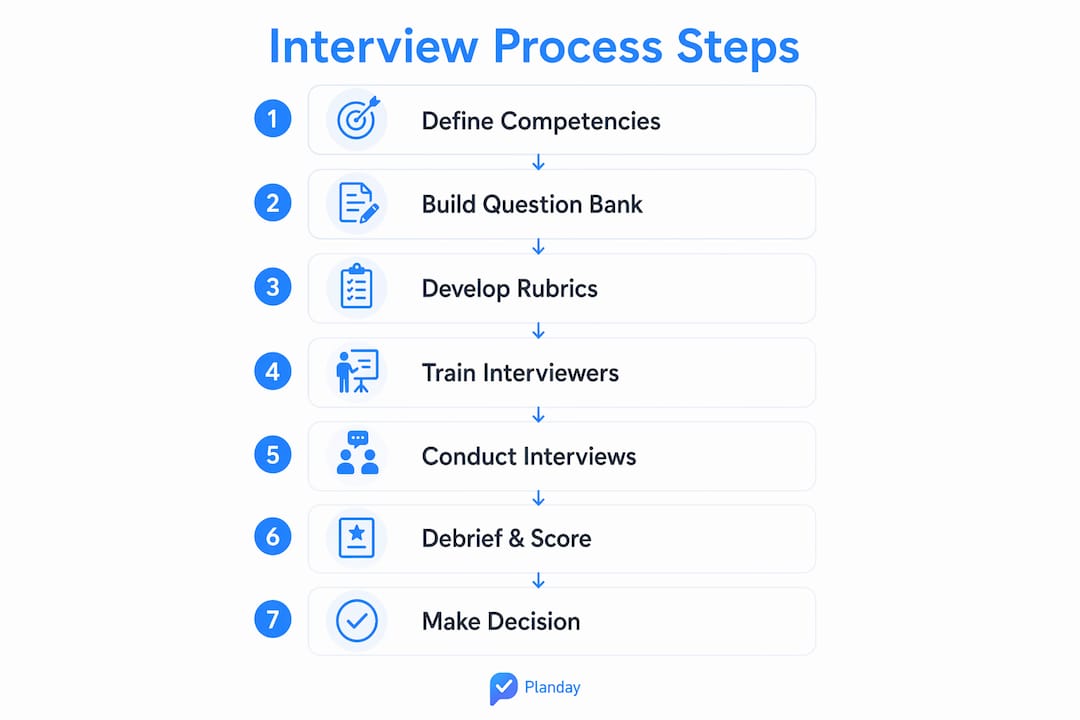
Agreed-upon rubrics defining distinct levels such as "outstanding" and "borderline" answers are the single most important factor in scoring consistency. Without them, interviewers default to subjective impressions. A rubric for "conflict resolution" might define a strong answer as one where the candidate described the specific disagreement, explained their reasoning process, sought to understand the other perspective, and reached a documented resolution. A weak answer is one where the candidate spoke in generalities or avoided describing the outcome.
Assigning each interviewer one or two competencies to assess deeply produces higher-quality evaluation data than spreading all competencies across all interviewers. This focused competency ownership model means each interviewer becomes an expert evaluator for their assigned area rather than a generalist who covers everything superficially.
Here is how to structure competency assignments across a four-person panel:
- Interviewer 1 (Hiring Manager): Role-specific technical competency and problem-solving
- Interviewer 2 (Peer): Communication and collaboration
- Interviewer 3 (Cross-functional): Adaptability and learning orientation
- Interviewer 4 (HR): Values alignment and culture contribution
Scorecards unify these individual evaluations into a single view. Each scorecard row maps to a competency, includes the assigned interviewer's name, and requires a numeric score plus written evidence. The written evidence requirement is critical. It forces interviewers to document the specific candidate behavior that drove their score, not just a number.
Pro Tip: Build a "question rotation log" that tracks which questions each candidate received. This prevents candidates from sharing questions with each other and keeps your bank fresh across high-volume hiring cycles.
What interviewer training and calibration steps ensure reliable scoring?
Interviewer training is where most structured processes fail. Teams invest in rubrics and scorecards, then skip the calibration step that makes those tools work. A 90-minute calibration training session is the standard format, divided into three phases: reviewing competency definitions (20 minutes), independently scoring a recorded test interview (40 minutes), and practicing the debrief protocol (30 minutes).
The recorded interview scoring exercise is the most valuable part. Each interviewer watches the same recording and scores it independently before any discussion. This surfaces divergences in how interviewers interpret the rubric. When two interviewers score the same answer a 2 and a 4, the gap reveals a calibration problem, not a candidate problem.
Teams should discuss divergences greater than one point and ground the conversation in behavioral anchors from the rubric. The goal is not to reach agreement by social pressure. The goal is to identify whether the rubric language is ambiguous or whether one interviewer missed a key behavioral signal. This distinction matters because it tells you whether to retrain the interviewer or rewrite the rubric.
The debrief protocol training covers the sequence and rules of the post-interview discussion:
- All interviewers submit scorecards independently before the debrief begins.
- The facilitator reads each competency score aloud, starting with the assigned interviewer.
- The assigned interviewer presents their evidence first, without editorializing.
- Other interviewers ask clarifying questions before sharing observations.
- The group documents any score changes and the reason for the change.
- The hiring manager makes the final call, documented with competency scores as the basis.
Interviewers who have not submitted scores cannot lead or frame the debrief discussion. This rule prevents anchoring bias, where the first opinion expressed shapes everyone else's judgment. It is one of the most important process controls in a repeatable hiring system.
Pro Tip: Record your calibration training sessions and use them as onboarding material for new interviewers. A 90-minute calibration video is more effective than a written guide because new interviewers can see how score divergences are actually discussed.
What is the step-by-step process to run structured team interviews?
Running the interview itself follows a clear sequence once the preparation work is complete. Each interviewer enters the conversation knowing exactly which competencies they own, which questions they will ask, and what strong versus weak answers look like.
Here is the full cycle for a structured team interview:
- Pre-interview briefing (10 minutes): Confirm competency assignments, question rotation, and scorecard submission deadline.
- Candidate interview: Each interviewer asks their assigned questions and takes detailed notes tied to rubric criteria. Notes should capture specific phrases, examples, and behaviors, not impressions.
- Independent scorecard submission: All interviewers submit scores and written evidence before the debrief. No discussion occurs before this step.
- Structured debrief: The facilitator leads the group through each competency in order. Assigned interviewers present evidence first.
- Decision and documentation: The hiring manager records the final decision and documents which competency scores drove it.
A complete interview cycle documents which competency scores influenced the final hire decision for defensibility. This matters in two situations: when a rejected candidate challenges the decision, and when you are reviewing your process for bias patterns six months later.
Score divergences during the debrief require a clear protocol. When two interviewers disagree by more than one point, the assigned interviewer's score carries more weight because they asked the targeted questions and heard the full answer. Other interviewers may have observed relevant behavior, but their input is supplementary. This hierarchy keeps the process fair and prevents louder voices from overriding structured evidence.
You can also use job-relevant interview tasks alongside behavioral questions to add a performance-based data point to the scorecard. Tasks give interviewers concrete output to evaluate, which reduces reliance on self-reported past behavior alone.
What are common challenges in sustaining a repeatable interview process?
The most common failure point is skipping calibration after the initial rollout. Interviewers drift in their interpretation of rubrics over time, especially when they interview infrequently. The biggest mistake is failing to calibrate interviewers regularly, which leads to inconsistent ratings and poor hiring decisions. Schedule quarterly recalibration sessions, even for experienced interviewers.
Other pitfalls that undermine interview consistency for teams include:
- Rushing rubric development: Rubrics written in under an hour tend to be vague. Allocate at least two working sessions to define behavioral anchors for each score level.
- Skipping the debrief protocol: When time is short, teams skip structured debriefs and default to informal conversation. This reintroduces anchoring bias and social pressure.
- Overloading interviewers: Assigning three or more competencies to one interviewer reduces the depth of each evaluation.
- Ignoring inter-rater reliability: Track score variance across interviewers over time. Consistent divergence from one interviewer signals a training gap, not a candidate issue.
Basic implementation for one role family takes 2–4 weeks. Full organizational rollout with training and calibration requires 2–3 months. Start with your highest-volume role family, run one complete hiring cycle, review the data, and then expand. Trying to roll out across all roles simultaneously produces inconsistent adoption and weak rubrics.
"A structured interview process is only as strong as the calibration that maintains it. Without regular recalibration, even the best rubrics degrade into subjective impressions within two to three hiring cycles."
Maintaining interviewer engagement over time requires periodic refreshes. Rotate interviewers across role families annually. Update question banks when candidates start giving rehearsed answers. Review interview data patterns quarterly to identify where your rubrics are producing the most and least reliable scores.
Key Takeaways
A repeatable interview process team produces defensible, consistent hiring decisions when it combines defined competencies, calibrated interviewers, and structured debrief protocols.
| Point | Details |
|---|---|
| Structured hiring improves quality | Defined criteria and scorecards improve hire quality by 26% over unstructured approaches. |
| BARS are non-negotiable | Behavioral Anchored Rating Scales define what each score means, preventing subjective drift across interviewers. |
| Focused competency ownership | Assigning each interviewer one or two competencies produces deeper, more reliable evaluation data. |
| Independent scoring prevents bias | All interviewers must submit scorecards before the debrief to prevent anchoring bias from shaping group consensus. |
| Calibration must be ongoing | Schedule quarterly recalibration sessions; skipping them is the most common cause of process breakdown. |
What I've learned from building interview processes that actually hold up
The part of this process that most teams underestimate is the debrief protocol. I've seen organizations invest weeks in rubric development and question banks, then watch it collapse in a 20-minute debrief where the hiring manager speaks first and everyone else adjusts their scores to match. That single failure mode erases most of the value the structure was designed to create.
The fix is not complicated, but it requires discipline. Independent score submission before any discussion is the rule that holds everything together. When I've seen teams enforce it consistently, the quality of debrief conversations improves immediately. Interviewers arrive with documented evidence, not impressions. Disagreements become productive because they are grounded in specific candidate behavior, not personality or seniority.
Focused competency ownership is the other insight that tends to surprise hiring managers. The instinct is to have everyone evaluate everything. The reality is that an interviewer who owns two competencies deeply will give you far more useful data than one who covers six competencies at surface level. Depth beats breadth every time in candidate evaluation.
Start with your highest-volume role. Run one full cycle with the full protocol. Review the inter-rater reliability data before expanding. The AI subjectivity reduction research reinforces what calibration practice shows in the field: structure works, but only when it is maintained with the same rigor it was built with. Candidate experience also matters. A well-run structured interview feels fair and thorough to candidates, which protects your employer brand even when the answer is no.
— Hudson
How Evy supports structured, repeatable interview teams
Evy is built for HR teams that take interview integrity seriously. Its scorecard and rubric templates are organized by role family, so your team starts with a tested structure rather than a blank page. Anonymous scoring features enforce independent submission before debriefs, which removes the anchoring bias that undermines even well-designed processes. Evy's real-time eye tracking also flags candidates who may be using AI assistance during interviews, protecting the validity of your evaluation data.
For teams scaling from a pilot to full rollout, Evy's HR team features connect directly with your ATS to automate scorecard collection and reporting. Every competency score is logged and linked to the final hiring decision, giving you the documentation you need for defensible, compliant hiring. Explore Evy's full interview platform features to see how calibration tools and bias reduction work together.
FAQ
What is a repeatable interview process team?
A repeatable interview process team is a structured hiring system where trained, calibrated interviewers evaluate every candidate against the same competencies, questions, and scoring rubrics. The goal is consistent, defensible hiring decisions across all interviewers and roles.
How long does it take to implement a structured interview process?
Basic implementation for one role family takes 2–4 weeks. Full organizational rollout with interviewer training and calibration typically requires 2–3 months.
What are Behavioral Anchored Rating Scales (BARS)?
BARS are rubrics that define specific behavioral examples for each score level on an interview rating scale. They improve scoring consistency by removing ambiguity about what a "3" or a "5" actually means in practice.
How do you prevent anchoring bias in team interview debriefs?
All interviewers must submit scores independently before the debrief begins. Interviewers who have not submitted scores cannot lead or frame the discussion.
How many competencies should each interviewer assess?
Each interviewer should assess one or two competencies deeply rather than covering all competencies at a surface level. Focused competency ownership produces richer qualitative data and better predictive validity for hiring decisions.