
 By Adrian Pascual•Hiring insight•Published
How to Create Interview Integrity Guidelines for HR
Interview integrity guidelines are documented protocols that define how your organization conducts fair, consistent, and legally defensible hiring interviews. Without them, your hiring process is exposed to unconscious bias, legal liability, and inconsistent candidate experiences that undermine the quality of every hire you make. The Equal Employment Opportunity Commission (EEOC) requires that selection procedures be applied uniformly, and structured interview frameworks with scoring rubrics are the most reliable way to meet that standard. This article explains how to build those guidelines from the ground up, covering core components, step-by-step implementation, integrity testing techniques, and the technology that supports it all.
What are the core components of interview integrity guidelines?
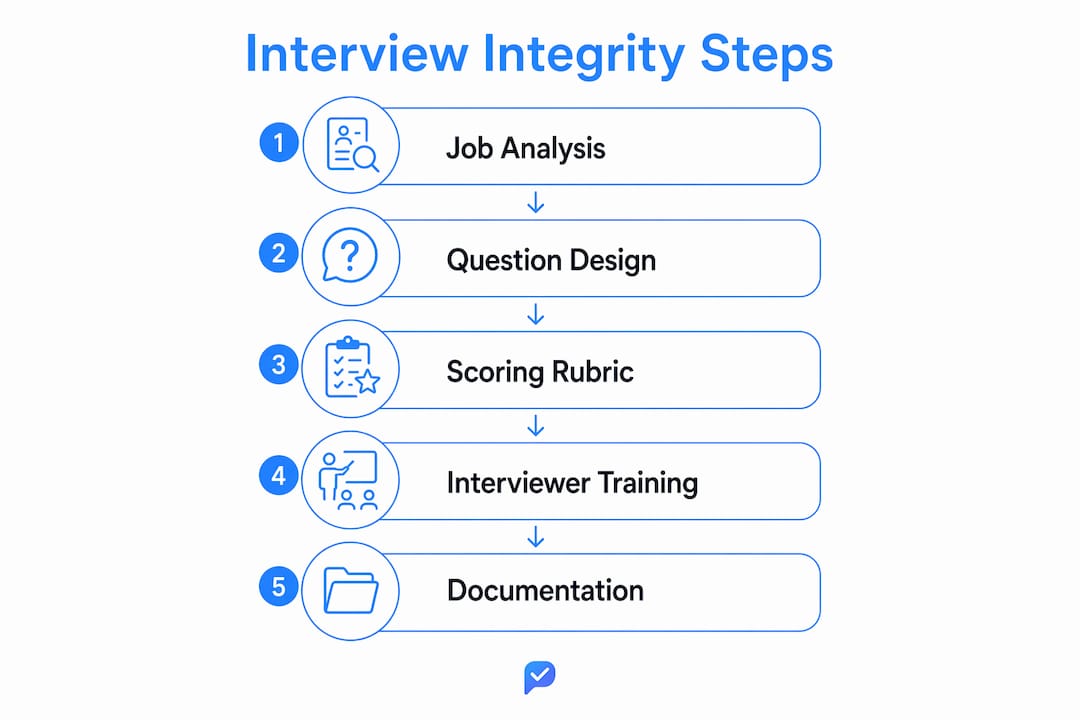
Effective interview integrity guidelines rest on five interconnected elements. Each one addresses a specific failure point in the typical hiring process, from inconsistent questioning to undocumented decisions that cannot withstand legal scrutiny.
Structured question design rooted in job analysis. Every interview question should trace back to a documented job analysis that identifies the competencies, behaviors, and ethical standards the role requires. Questions derived from job analysis are defensible under EEOC regulations and produce answers that are directly comparable across candidates.
Standardized scoring rubrics, including behaviorally anchored rating scales (BARS). A BARS assigns specific behavioral descriptions to each point on a rating scale, so a score of 3 means the same thing to every interviewer on your panel. Clear scorecards anchored to measurable role outcomes reduce reliance on gut feeling and improve hiring confidence.

Consistent application across all candidates. Every candidate for the same role must receive the same questions in the same order. Deviating from this standard, even with good intentions, creates disparate treatment risk and makes post-interview comparisons unreliable.
Interviewer training on bias, legal limits, and ethical conduct. Training is not optional. Interviewers must understand which questions are legally prohibited, how unconscious bias distorts evaluation, and what the organization's documentation expectations are. Standardized scoring combined with trained interviewers reduces unlawful bias and strengthens your legal position.
Documentation and record retention policies. Your guidelines must specify what interviewers record, how they record it, and how long those records are kept. Under 29 C.F.R. Part 1602, organizations must retain personnel records to defend against discrimination claims. Standardized evaluation forms, not personal notes, are the correct tool here.
Pro Tip: Build your scoring rubric before you write your interview questions. Knowing exactly what a strong answer looks like forces you to write questions that actually elicit the behaviors you need to evaluate.
How to develop interview integrity standards step by step
Building interview integrity standards is a process, not a one-time document. The following sequence moves from analysis to implementation to ongoing audit.
- Conduct a job analysis. Identify the core competencies, ethical behaviors, and performance outcomes the role demands. Interview current high performers, review the job description, and consult the hiring manager. This analysis becomes the foundation for every question and scoring criterion you create.
- Draft structured interview questions. Write questions that target the competencies identified in your job analysis. Behavioral questions ("Tell me about a time you faced an ethical conflict at work") and situational questions ("What would you do if you discovered a colleague falsifying records?") are the most reliable formats for assessing integrity. Experts recommend 5 to 7 integrity questions per interview, using layered follow-ups to verify consistency.
- Build a 1-to-5 scoring rubric. Define what each score means for each question. A score of 1 should describe a response that raises serious concerns. A score of 5 should describe a response that demonstrates clear ethical reasoning and accountability. Avoid vague descriptors like "good" or "poor." Use specific behavioral language instead.
- Train your interviewers. Cover the structured question set, the scoring rubric, prohibited questions under EEOC guidelines, and documentation requirements. Role-play scoring exercises where interviewers score the same sample answer independently, then compare results. Significant scoring gaps reveal calibration problems that need to be resolved before live interviews begin.
- Communicate expectations to candidates. Providing candidates with the position description and panelist names at least 24 hours before the interview reduces candidate stress and shifts the assessment toward actual job-relevant skills rather than on-the-spot performance. This practice also signals that your organization values fairness.
- Implement documentation protocols and audit cycles. After each interview cycle, review completed evaluation forms for scoring consistency. Check whether any protected demographic group is experiencing selection rates below 80% of the highest-passing group, which triggers adverse impact analysis under EEOC guidelines. Schedule a formal audit of your guidelines at least annually.
| Step | Purpose | Output |
|---|---|---|
| Job analysis | Identify competencies and ethical requirements | Competency framework |
| Question design | Create structured, bias-resistant questions | Standardized question bank |
| Rubric development | Define measurable scoring criteria | BARS scoring guide |
| Interviewer training | Calibrate evaluation and legal compliance | Trained interview panel |
| Candidate communication | Reduce anxiety, improve assessment validity | Pre-interview materials |
| Audit cycle | Monitor fairness and update guidelines | Compliance review report |
Pro Tip: Run a pilot interview with an internal candidate or a role-play volunteer before your first live use of new guidelines. You will catch ambiguous rubric language and poorly worded questions before they affect real candidates.
How do you test and verify integrity during interviews?
Testing for integrity during an interview requires deliberate technique, not just good questions. The way you ask, listen, and observe matters as much as the question itself.
Behavioral and situational questions are the foundation. Behavioral questions ask candidates to describe past actions, which are the strongest predictor of future behavior. Situational questions present hypothetical ethical dilemmas and assess reasoning. Both formats require candidates to demonstrate their values rather than simply state them.
Silence is one of the most underused tools in integrity assessment. After a candidate finishes answering an integrity question, staying silent for a few seconds often prompts them to continue. That continuation frequently reveals more authentic detail, or exposes inconsistencies that a polished initial answer concealed. The technique works because most candidates interpret silence as a signal that more is expected.
Chronological consistency is another reliable signal. Ask candidates to walk through a specific ethical situation in sequence. Dishonest accounts tend to lack detail at key decision points or shift in timeline when probed with follow-up questions. Honest accounts hold together under scrutiny because they are grounded in actual memory.
Body language and attention patterns provide supplementary data, particularly in remote interviews. Unusual eye movement, frequent off-screen glances, or attention patterns inconsistent with genuine thinking can indicate that a candidate is consulting external sources. These signals are not conclusive on their own, but they warrant follow-up questions.
Formal integrity or work ethics assessments can complement the interview when used consistently across all candidates for the same role. These tools add a structured data point that is independent of interviewer judgment. When combined with behavioral interview scores, they improve predictive accuracy and provide additional documentation for your hiring decision.
"Designing scorecards aligned with measurable role outcomes clarifies evaluation and reduces reliance on intuition or gut feeling." — Hunt Scanlon Media
Common challenges in maintaining interview integrity
Even well-designed guidelines face real-world obstacles. Recognizing these challenges in advance allows you to build solutions into your process rather than react to problems after they occur.
Interviewer bias is the most persistent challenge. Affinity bias, halo effect, and confirmation bias all distort scoring even when interviewers are well-intentioned. The solution is structural. Panel interviews with multiple trained evaluators who score independently before any consensus discussion produce more valid and legally defensible decisions than single-interviewer formats. Independent scoring prevents one strong opinion from anchoring the group.
Inconsistent practices across hiring managers are common in organizations where interview guidelines exist on paper but are not enforced. Centralized question banks, mandatory rubric use, and periodic calibration sessions address this directly. The choice of interview platform also matters. Platforms that enforce structured question delivery and standardized scoring remove the option for interviewers to go off-script.
Remote interview integrity presents a distinct set of risks. AI-assisted cheating in remote interviews is increasingly difficult to detect through video observation alone. Candidates can use AI tools to generate answers in real time without any visible indication to a standard video interviewer. Zero-knowledge monitoring tools and platforms with real-time behavioral analysis provide detection capabilities that traditional video cannot. This is not a hypothetical risk. It is an active challenge that your guidelines need to address explicitly for remote formats.
Candidate anxiety can suppress authentic responses and skew your assessment. Providing advance materials, explaining the interview format at the start, and creating a structured but conversational tone all reduce anxiety without compromising rigor. The goal is to assess the candidate's actual capabilities, not their ability to perform under unnecessary stress.
| Challenge | Impact | Solution |
|---|---|---|
| Interviewer bias | Distorted scores, legal exposure | Panel interviews with independent scoring |
| Inconsistent practices | Unreliable comparisons | Centralized question banks, platform enforcement |
| Remote AI cheating | Invalid assessments | Behavioral monitoring, anti-cheat technology |
| Candidate anxiety | Suppressed authentic responses | Advance materials, structured opening |
Pro Tip: Schedule a 15-minute debrief immediately after each interview while impressions are fresh. Require each panelist to submit their scores before the debrief begins. This single practice eliminates most anchoring bias in group hiring decisions.
Key takeaways
Interview integrity guidelines work when they combine structured question design, calibrated scoring rubrics, trained interviewers, and consistent documentation enforced across every candidate and every format.
| Point | Details |
|---|---|
| Structure predicts performance | Structured interviews are up to twice as effective at predicting job performance as unstructured formats. |
| Rubrics reduce subjectivity | BARS-based scoring rubrics define what each score means, making evaluation consistent across interviewers. |
| Documentation is a legal requirement | Standardized evaluation forms and record retention protect your organization under EEOC regulations. |
| Remote integrity needs technology | AI-assisted cheating requires behavioral monitoring tools that go beyond standard video observation. |
| Candidate communication improves validity | Sharing position details and panelist names 24 hours in advance shifts assessment toward genuine job-relevant skills. |
Why interview integrity frameworks are worth the investment
I have seen organizations treat interview guidelines as a compliance checkbox, something to produce for an audit and then file away. That approach consistently produces the same outcome: expensive mis-hires, legal exposure, and a candidate experience that damages the employer brand. The organizations that treat interview integrity as an operational standard, not a document, hire better people and defend those decisions more confidently.
What changed my thinking on this was watching a mid-sized technology company cut its time-to-confidence on hiring decisions by nearly a third after implementing BARS-based scoring across all technical roles. The interviewers did not suddenly become better judges of character. They became better at translating what they observed into consistent, comparable data. That is the real value of a structured framework. It does not replace human judgment. It gives human judgment a reliable structure to work within.
The harder conversation is about remote interviews and AI-assisted dishonesty. Many HR teams I speak with are aware of the risk but uncertain about how to address it in their guidelines. The answer is to treat remote interview integrity as a distinct category with its own protocols, not as a footnote to the in-person process. That means specifying which monitoring tools are used, how behavioral signals are documented, and how discrepancies are escalated. Ignoring this in your guidelines does not make the risk disappear. It just means you have no documented response when it surfaces.
Balancing rigor with candidate experience is the final tension worth naming. Overly rigid processes can feel dehumanizing to candidates and signal a culture of distrust. The best guidelines build in structure without removing warmth. Explaining why you use a structured format, what candidates can expect, and how their responses will be evaluated actually increases candidate confidence rather than reducing it. Transparency about process is itself a signal of organizational integrity.
— Hudson
How Evy supports your interview integrity process
Evy is built for HR teams that take interview integrity seriously. As the only AI interview platform with real-time eye tracking, Evy detects when candidates are consulting AI tools or external sources during remote interviews, a risk that standard video observation cannot address. Beyond anti-cheat detection, Evy's structured interview features support consistent question delivery, standardized scoring, and 24/7 candidate screening at scale. If your organization is working to establish interview integrity guidelines that hold up in remote environments, Evy provides the technical infrastructure to enforce those standards reliably. Explore how Evy's platform aligns with your compliance and fairness goals.
FAQ
What are interview integrity guidelines?
Interview integrity guidelines are documented protocols that define how interviews are conducted consistently, ethically, and in compliance with employment law. They cover question design, scoring criteria, interviewer training, and documentation requirements.
How many integrity questions should an interview include?
Experts recommend 5 to 7 integrity-focused behavioral questions per interview, supplemented by layered follow-up questions to verify consistency and identify red flags.
Are structured interviews legally required?
Structured interviews are not universally mandated by law, but they provide the documentation required under regulations like 29 C.F.R. Part 1602 to defend against discrimination claims. Legal compliance makes structured formats a practical necessity for most organizations.
How do you detect AI cheating in remote interviews?
Standard video observation cannot reliably detect AI-assisted cheating. Platforms with real-time behavioral monitoring, eye tracking, and attention pattern analysis provide detection capabilities that go beyond what a human interviewer can observe on a video call.
How often should interview integrity guidelines be updated?
Guidelines should be reviewed at least annually and after any significant change in hiring volume, role requirements, or applicable employment regulations. Adverse impact analysis results should also trigger a review when selection disparities are identified.