
 By Adrian Pascual•Hiring insight•Published
How to Avoid Over-Interviewing Qualified Candidates
Most qualified candidates will tolerate a few interview rounds before they start reconsidering their options. Some candidates have rejected job offers specifically because the interview process was too long or complex. That number should concern any hiring team running five or six rounds as standard practice.
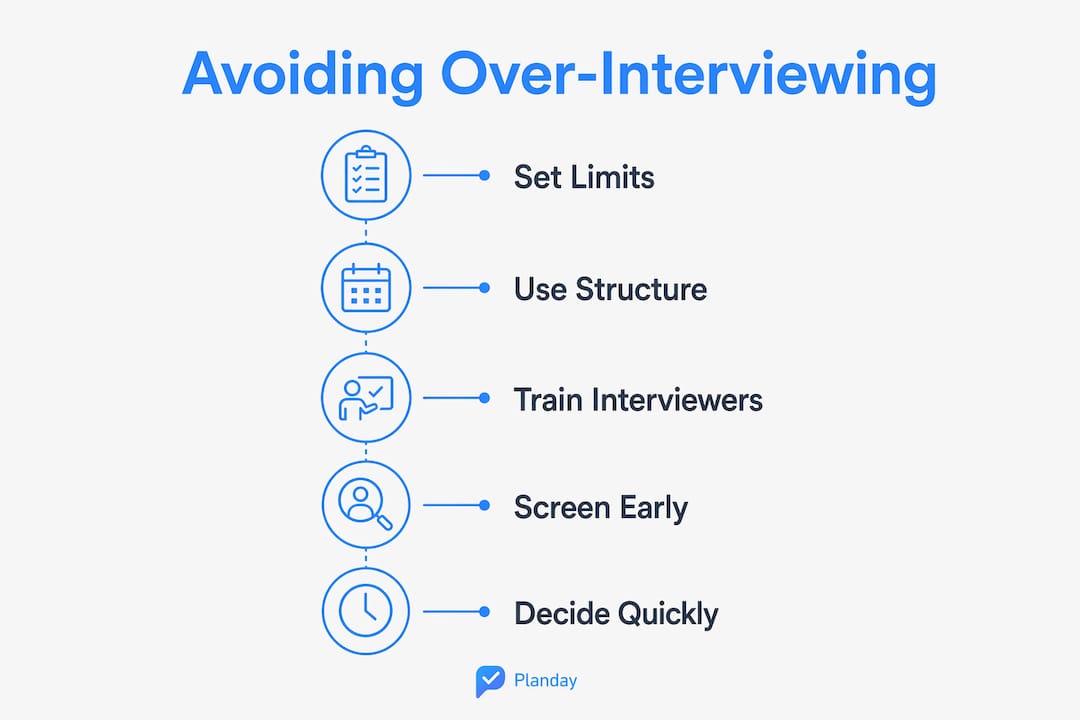
The fix is not simply cutting rounds. It is making each round count. The core steps to avoid over-interviewing qualified candidates are:
- Set a firm round cap of two to four interviews, defined at the intake meeting before the search opens
- Assign competencies to specific rounds and interviewers so no two conversations cover the same ground
- Use structured scoring rubrics that allow clear hire/no-hire calls per competency
- Deploy pre-screening tools to filter candidates before the first live interview
- Enforce decision gates after each round so the process advances or stops on evidence, not habit
Many job seekers lose interest when a hiring process runs too long. Protecting that interest means building a process that respects a candidate's time from the first touchpoint.
Table of Contents
- Why over-interviewing happens and what it costs you
- How structured interviews let you do more with fewer rounds
- Sharper rubrics and interviewer training reduce the urge for extra rounds
- How Evy helps you surface honest talent before the first live interview
- Fewer rounds, better hires: what Evy makes possible
- Key Takeaways
Why over-interviewing happens and what it costs you
Over-interviewing rarely starts as a deliberate choice. It accumulates. Industry research consistently points to three root causes: unclear evaluation criteria at the outset, organizational indecision that gets resolved by scheduling another panel, and what some practitioners call the "hiring ritual," where rounds are added because that is simply how the team has always done it.
The costs are concrete:
- Candidate drop-off: Strong candidates, especially passive ones, accept competing offers while waiting for round five
- Signal dilution: A candidate in their fourth 45-minute interview of a two-week process gives shorter, less specific answers than they did in round two
- Wasted interviewer time: Redundant panels consume engineering and management hours that could go toward actual work
- Weaker final hires: When the best candidates exit early, the pool that remains skews toward those who simply had more time, not more talent
Scheduling delays compound all of this. When recruiter screens lack structured data, downstream interviewers repeat the same questions to fill gaps, which extends the loop without adding new information. The result is a process that feels thorough but produces diminishing returns after round three.
Pro Tip: Set a maximum round count at the intake meeting, before the search opens. Once a number is agreed upon and documented, adding a round requires a written justification. That friction alone prevents most unnecessary additions.

How structured interviews let you do more with fewer rounds
The most reliable way to reduce interview rounds without losing decision confidence is to increase the quality of signal inside each round. Google and Metaview both confirm that structured interviews with defined competencies and calibrated rubrics yield more reliable hiring data in fewer conversations.
BrightHire's analysis found that teams using structured interviews need fewer interviews per hire, with an average of just over two rounds. That is not a coincidence. When every interviewer has a defined lane, redundancy disappears.
A well-structured interview loop requires four things in place before round one:
- Defined competencies specific to the role, not a generic list recycled from the last job posting
- Assigned coverage so each interviewer owns one or two competencies and goes deep, rather than five interviewers each taking a shallow pass at the same traits
- A shared scoring rubric agreed upon before anyone interviews, so a strong answer means the same thing to a junior interviewer and a senior one
- Immediate feedback capture after each conversation, while the details are still accurate
Google's structured interviewing guide notes that using pre-made questions, rubrics, and guides saves an average of 40 minutes per interview. Interviewers also report feeling more prepared, which tends to produce better questions and more useful scorecards. For a practical look at structured interview formats that work across different role types, the variety of approaches available is wider than most teams realize.
Sharper rubrics and interviewer training reduce the urge for extra rounds
When interviewers cannot make a clear hire/no-hire call after a round, the instinct is to schedule another conversation. Usually, that instinct is wrong. RippleHire's research on redundant interview panels shows that an inability to decide typically signals a rubric problem or a calibration gap, not a lack of information about the candidate.
Inter-rater reliability, measured by the intraclass correlation coefficient (ICC), tells you how consistently your interviewers are scoring the same competencies. An ICC below 0.50 indicates urgent rubric or training revision is needed; above 0.70 is the target for consistent, decision-ready data. Most teams never measure this, which is why they keep adding rounds instead of fixing the underlying process.
Best practices for rubric design and interviewer calibration:
- Write behavioral anchors for each score level before the search opens, describing what a weak, solid, and strong answer actually looks like
- Run calibration sessions where interviewers score the same sample answer independently, then compare and discuss discrepancies
- Track signal clarity per round: after each interview, ask whether the panelist can make a clear recommendation on their assigned competency
- Use an interview preparation checklist to confirm every interviewer enters the room with their competency scope, questions, and rubric in hand
- Review scorecards for scope creep, where two interviewers both submitted feedback on the same dimension when only one was assigned to it
Pro Tip: After each round, enforce an advance-or-stop decision gate. If the team cannot articulate a specific gap that the next round would address, the process should move to offer or rejection, not another panel.
Reducing interviewer subjectivity through calibrated rubrics is one of the highest-leverage changes a hiring team can make, and it costs nothing beyond time invested upfront.
How Evy helps you surface honest talent before the first live interview
Pre-screening quality determines how much work the live interview loop has to do. When early screens collect shallow or unverified data, every subsequent interviewer compensates by asking catch-up questions, which is exactly how interview loops inflate. Evy addresses this at the source.
Evy is the only AI interview platform with real-time eye tracking to catch candidates using AI assistance during screening. That matters for signal quality: when a candidate's responses are genuinely their own, the data you carry into live interviews is reliable. You are not spending round two verifying whether round one was honest.
Key advantages Evy brings to the process:
- 24/7 asynchronous screening so candidates complete assessments on their schedule, removing scheduling as a bottleneck
- Real-time integrity monitoring using eye tracking and attention pattern analysis to flag AI-assisted responses
- Consistent, structured data from every candidate, so downstream interviewers receive comparable information rather than gaps to fill
- Scale without added headcount, allowing teams to screen large candidate pools before committing live interviewer time
The result is a shorter, more confident live interview loop. When the pre-screen has already verified competency signals and candidate honesty, two or three live rounds are genuinely sufficient. Teams that improve candidate experience during screening also report higher candidate satisfaction scores, even when the overall process is shorter.
Fewer rounds, better hires: what Evy makes possible
Qualified candidates are also managing their job search data across multiple opportunities simultaneously. A five-round process does not signal thoroughness to them. It signals disorganization. Evy gives hiring teams the pre-interview intelligence to enter live rounds with confidence, cap the process at three or four conversations, and make faster, better-supported decisions.
If your team is running more rounds than it needs to, the answer is rarely more structure inside round five. It is better data before round one. Evy's AI interview features are built specifically for that: honest screening at scale, 24/7, so the candidates who reach your hiring manager have already been verified. See how Evy works and start screening with confidence.
Key Takeaways
Avoiding over-interviewing qualified candidates requires capping rounds at two to four, structuring each conversation around defined competencies, and using reliable pre-screening to reduce the work the live loop has to do.
| Point | Details |
|---|---|
| Cap rounds at two to four | The 2024 Greenhouse data shows 20% of candidates reject offers due to overly long processes; most candidates tolerate a maximum of two to four interview rounds. |
| Structure before you schedule | Assign each interviewer one or two competencies with a shared rubric; BrightHire found structured teams need 27% fewer interviews per hire. |
| Fix rubrics, not round counts | An ICC below 0.50 signals a calibration problem; adding rounds when interviewers cannot decide rarely solves the underlying issue. |
| Pre-screen to reduce live rounds | Structured early screens eliminate catch-up interviewing downstream and shorten the total loop without losing signal. |
| Evy reduces redundant interviews | Evy's real-time eye tracking and 24/7 AI screening surface honest, verified candidates before the first live interview, supporting a leaner process. |