
 By Adrian Pascual•Hiring insight•Published
How to Create Candidate Experience During Screening
Candidate experience in screening is defined as the sum of every interaction a candidate has with your organization from the moment they apply through the final screening decision. Every touchpoint matters, from the application confirmation email to the post-interview follow-up. Candidates who feel fairly evaluated and consistently informed are 38% more likely to accept a job offer. That single statistic should reframe how you think about screening. It is not just a filter. It is a relationship.
The standard industry term for this practice is candidate experience management, and it covers process design, communication cadence, and evaluation fairness. The phrase "create candidate experience during screening" captures what HR professionals and hiring managers actually need to do: build it deliberately, not hope it happens.
How to create candidate experience during screening that actually works
Candidate experience during screening is shaped by three forces: speed, transparency, and follow-through. When any one of these breaks down, candidates notice. Two-thirds of candidates report inconsistent communication during hiring, and 47% say they would withdraw from a process because of poor communication alone. That is not a technology problem. It is a process and discipline problem.
Candidate engagement refers to the specific actions your team takes, such as sending updates, scheduling interviews, and responding to questions. Candidate experience is what candidates feel as a result of those actions. You can have a sophisticated applicant tracking system and still deliver a poor experience if your communication cadence is inconsistent or your instructions are unclear.
The most common failures in screening engagement are silence after application submission, vague timelines, and inconsistent messaging between recruiters. Each of these creates anxiety and signals disorganization. Candidates interpret silence as rejection or indifference, and both lead to withdrawal.
Pro Tip: Personalize communication at three specific moments: interview scheduling, post-interview follow-up, and offer delivery. Personalization at these points improves candidate perception more than any other single tactic.
What does a transparent screening process look like?
Transparency in screening means candidates always know what step they are on, what comes next, and when to expect a response. This is not complicated to design. It requires discipline and a clear workflow.
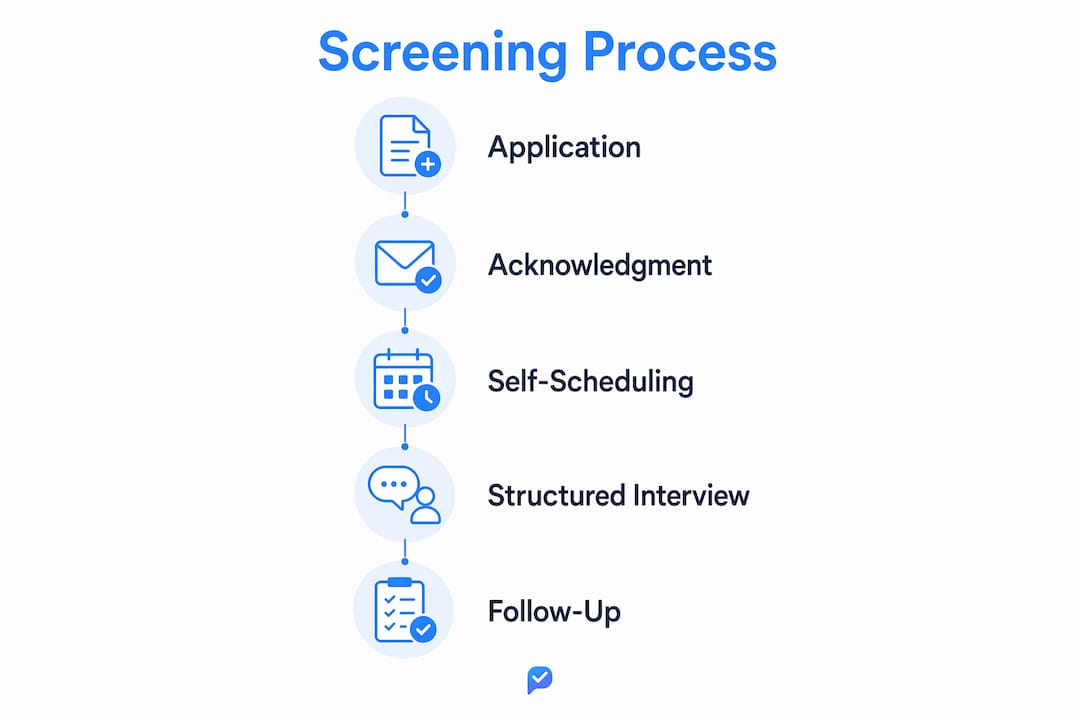
Start by mapping every stage of your screening process and writing a one-sentence candidate-facing description of each. Then assign a communication trigger to each stage transition. When a candidate moves from application review to phone screen, they get a message. When they complete an assessment, they get an acknowledgment. Nothing falls through the cracks.

Automated acknowledgments sent within 24 hours of application submission improve candidate perception significantly, even when a personal follow-up comes later. The acknowledgment signals that the organization is organized and respectful of the candidate's time. It costs almost nothing to implement and pays off in reduced dropout rates.
Self-scheduling tools and status updates give candidates a sense of control. When candidates can choose their own interview slot rather than wait for a recruiter to propose one, they feel respected. This small design choice reduces no-shows and improves candidate satisfaction scores.
Structured interviews with defined behavioral questions and scoring rubrics also contribute to transparency. When every candidate answers the same questions and is evaluated against the same criteria, the process feels fair. Candidates who perceive fairness are more likely to recommend your organization to others, even if they do not receive an offer.
Pro Tip: Build a one-page candidate guide that explains your screening stages, typical timelines, and who to contact with questions. Share it in your initial outreach email. Candidates who understand the process drop out far less often.
How does technology improve candidate engagement without losing the human touch?
Technology is a tool for consistency, not a replacement for human judgment. The most effective AI screening tools handle repetitive tasks, such as answering common questions, scheduling interviews, and sending status updates, so recruiters can focus on high-value conversations.
Conversational AI tools handle candidate queries 24/7, which matters when candidates apply outside business hours or from different time zones. A candidate who submits an application at 10 p.m. and receives an immediate, accurate response feels acknowledged. That feeling carries into the rest of the process.
Asynchronous video screening is another technology that improves the candidate experience when used correctly. Candidates record responses on their own schedule rather than coordinating a live call. This flexibility reduces scheduling friction and gives candidates time to present their best thinking. The tradeoff is that asynchronous formats can feel impersonal if not framed carefully. A short video message from the hiring manager introducing the process makes a significant difference.
The risk of over-automation is real. When every touchpoint is handled by a bot, candidates feel processed rather than considered. The solution is to reserve human contact for the moments that matter most: the first substantive conversation, the post-interview debrief, and the offer call. Technology handles the logistics. People handle the relationship.
AI screening accelerates candidate review without sacrificing fairness when implemented thoughtfully. Evy's platform, for example, uses real-time eye tracking to detect AI-assisted cheating during video interviews, which protects the integrity of the process for honest candidates. That kind of fairness assurance is itself a component of candidate experience. Candidates want to know the process is level.
For teams evaluating their current tech stack, reviewing technical screening tools benefits can clarify where automation adds value and where it creates distance.
Common mistakes that damage candidate experience during screening
The most damaging mistake in screening is the "black hole": a candidate submits an application or completes an interview and hears nothing for weeks. The offer-to-start gap is the riskiest period for candidate ghosting, but silence at any stage accelerates withdrawal. Proactive communication is the only reliable fix.
Other common mistakes include:
- Sending generic rejection emails with no specific feedback or timeline context
- Using different messaging from different recruiters on the same role, which signals internal disorganization
- Asking candidates to repeat information they already submitted in their application
- Scheduling interviews with less than 48 hours' notice without explanation
- Failing to close the loop with candidates who completed final-stage interviews
Detecting bottlenecks requires measurement. Gather candidate feedback through short post-screening surveys, ideally two to three questions sent within 24 hours of each major stage. Track dropout rates by stage. If candidates consistently withdraw after the assessment step, the assessment is either too long, too unclear, or not well-explained. The data tells you where to fix the process.
"Candidate experience failures usually stem from process and communication design flaws, not software. The discipline to communicate consistently matters more than the tools you use."
Recovery is possible when experience falters. A direct message from a recruiter acknowledging a delay, with a clear new timeline, restores more goodwill than most hiring teams expect. Candidates understand that processes get complicated. They do not forgive being ignored. For teams working to reduce hiring bias at the screening stage, consistent communication is also a fairness mechanism, not just a courtesy.
Key Takeaways
Candidate experience during screening is built through consistent communication, transparent process design, and technology used at the right moments, not all moments.
| Point | Details |
|---|---|
| Communication drives acceptance | Candidates satisfied with screening are 38% more likely to accept offers. |
| Silence causes withdrawal | 47% of candidates would withdraw from a process due to poor communication alone. |
| Automate logistics, not relationships | Use AI for scheduling and updates; reserve human contact for key conversations. |
| Structured interviews build trust | Defined questions and scoring rubrics make the process feel fair to candidates. |
| Measure and fix by stage | Track dropout rates at each screening step to find and fix specific bottlenecks. |
What I have learned about building screening processes that candidates actually respect
The conventional wisdom in HR is that candidate experience is a technology problem. Buy a better ATS, add a chatbot, send automated emails. That framing is wrong, and I have seen it fail repeatedly.
The teams that consistently deliver strong candidate experiences are not the ones with the most sophisticated software. They are the ones with the most disciplined communication habits. They decide in advance how often they will update candidates, who is responsible for each message, and what happens when a stage runs long. That discipline is what candidates feel, even if they cannot name it.
The most underrated practice I have observed is treating the screening process as the first chapter of an employment relationship. Candidates who feel respected during screening carry that perception into onboarding and beyond. Candidates who feel processed or ignored carry that too, and they tell others.
My practical advice: pick one process improvement and do it consistently for 60 days before adding another. Most teams try to fix everything at once and sustain nothing. Start with the 24-hour acknowledgment email. Get that right. Then add self-scheduling. Then add a post-interview status update. Build the habit before you build the system.
Technology, including platforms like Evy, works best when it sits on top of a well-designed process. If the process is broken, automation just breaks it faster. Fix the communication rhythm first. Then let the tools carry the load.
— Hudson
Evy's approach to fair and engaging AI screening
Screening at scale without losing fairness or candidate trust is the central challenge for most HR teams in 2026.
Evy is built to address that challenge directly. Its AI interview platform runs anti-cheat video interviews with real-time eye tracking, so every candidate is evaluated on their own honest performance. That fairness is visible to candidates, which strengthens their confidence in your process. Evy screens 24/7, removing scheduling friction and giving candidates flexibility without sacrificing evaluation integrity. For HR professionals who want to improve their AI candidate screening approach while keeping the process candidate-friendly, Evy offers a platform designed with both goals in mind.
FAQ
What is candidate experience in screening?
Candidate experience in screening is the perception a candidate forms based on every interaction during the hiring evaluation phase. It covers communication, process clarity, fairness, and the speed of feedback.
What is candidate engagement during screening?
Candidate engagement refers to the specific actions a hiring team takes to keep candidates informed and involved, such as sending status updates, scheduling interviews promptly, and responding to questions. Engagement drives the overall experience.
How does poor communication affect screening outcomes?
47% of candidates would withdraw from a hiring process due to poor communication alone. Silence and inconsistency are the leading causes of candidate dropout during screening.
What is the fastest way to improve candidate experience?
Sending an automated acknowledgment within 24 hours of application submission is the highest-impact, lowest-effort improvement most teams can make immediately.
How does AI improve candidate experience without replacing human connection?
Conversational AI tools handle routine queries and scheduling around the clock, freeing recruiters to focus on substantive conversations at key moments like interviews and offer calls.