
 By Adrian Pascual•Hiring insight•Published
AI Interviewer for Recruiters: Evaluate, Pilot, and Implement
An AI interviewer is an automated, role-aware agent that conducts structured candidate interviews at scale — use it to screen high-volume applicant pools while keeping human judgment in every final hiring decision.
- Primary use cases: High-volume initial screening, consistency across large cohorts, and 24/7 candidate access for roles where scheduling bottlenecks slow time-to-fill.
- Top cautions: Adverse impact risk under EEOC selection-procedure guidelines, candidate transparency obligations, and cheating vectors that require active detection (not passive trust).
- Immediate next step: Run a 6–8 week pilot integrated with your ATS, monitor adverse impact metrics from day one, and require SOC 2 certification and audit logs before any vendor goes live.
Evy is built specifically for teams that need all three: scale, security, and a defensible audit trail.
Table of Contents
- What does an AI interviewer actually do?
- What are the real benefits and limitations?
- How do you detect cheating in AI interviews?
- How should you evaluate and implement an AI interviewer?
- What are the US legal and compliance requirements?
- How do you protect candidate experience in AI interviewing?
- Key Takeaways
- AI interviewing augments recruiters — it does not replace them
- Evy screens at scale with integrity built in
- Useful sources for HR teams
What does an AI interviewer actually do?
An AI interviewer is a software agent that conducts structured, role-specific conversations with candidates at any hour, scores their responses against a defined rubric, and delivers a summary to the recruiter — without requiring a human to be present during the session.

In the hiring funnel, it sits between sourcing and the human interview stage: sourcing generates applicants, the AI interviewer screens them at scale, and recruiters engage only the candidates who clear the scoring threshold. That placement is what makes it valuable for high-volume roles. A recruiter who previously spent hours on phone screens can redirect that time to offer negotiation and relationship-building with finalists.
The core technical components of a modern platform include:
- Role model and question engine: Generates structured, job-relevant prompts calibrated to the role's competency framework.
- Scoring model: Evaluates semantic intent — what the candidate actually said — rather than voice tone, facial expression, or accent.
- Transcript and analytics layer: Produces a written record and structured summary for recruiter review.
- Identity and anti-cheat modules: Monitors behavioral signals during the session and flags anomalies for human review.
- ATS integration: Pushes scores and summaries directly into the recruiter's system of record, eliminating manual data entry.
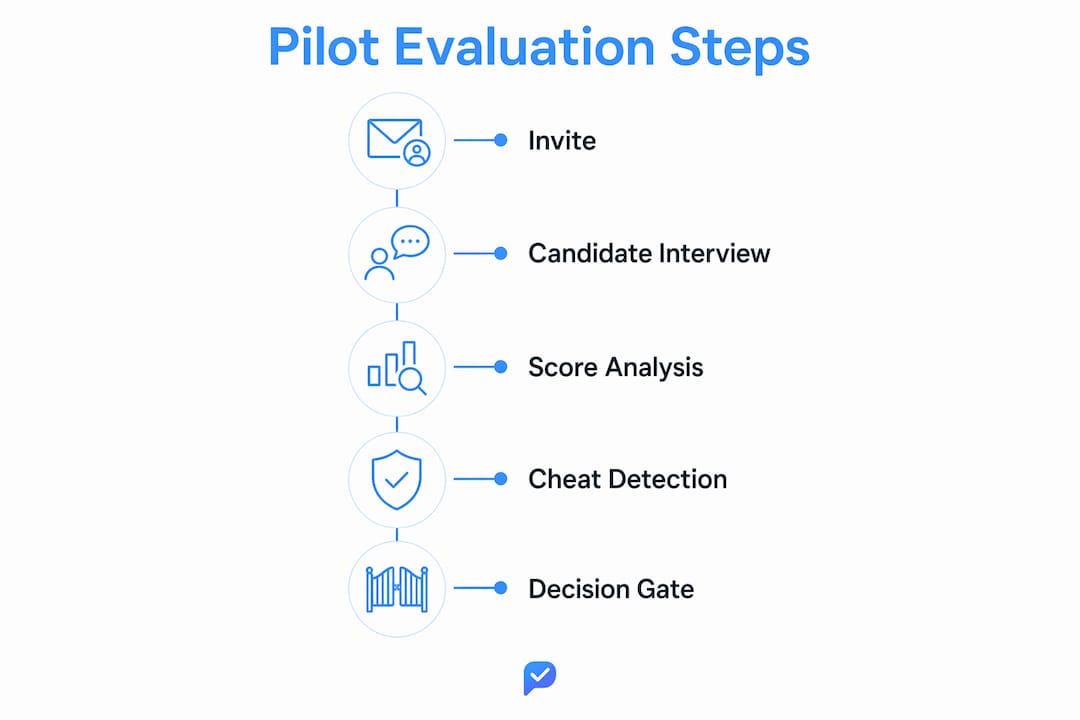
A typical session runs like this: the recruiter sends an invite link (or the ATS triggers it automatically), the candidate self-schedules, completes a conversational interview with adaptive behavioral and skills prompts, and the recruiter receives a scored summary within hours. The candidate never waits for a scheduling window.
The distinction between an agentic AI interview agent and a basic chatbot matters here. A chatbot follows a fixed script. An agentic interviewer reads the candidate's response, decides whether to probe deeper, and adjusts the next question accordingly — all while staying within a structured scoring rubric. That role-aware adaptation is what separates modern platforms from earlier, scripted tools.
What are the real benefits and limitations?
When used responsibly, AI interviewing delivers clear net value for high-volume roles — but the risks are specific enough that they require deliberate design choices, not just good intentions.
Concrete benefits:
- Scale without added headcount: A single recruiter can review AI-scored summaries for hundreds of candidates in the time a phone screen covers ten.
- Consistency across cohorts: Every candidate receives the same questions in the same structure, which reduces the variability that comes from different recruiters having different interview styles.
- Speed: Candidates can complete interviews within hours of applying, compressing the early funnel significantly. Teams that pair AI interviewing with strong ATS integration and process redesign have reported meaningful reductions in time-to-fill.
- 24/7 access and language coverage: Candidates in different time zones or who prefer languages other than English can complete interviews on their own schedule, widening the accessible talent pool.
- Bias reduction through semantic scoring: High-quality systems evaluate the substance of answers, not voice, tone, or appearance. This design reduces the bias exposure that comes with webcam-based sentiment or face-analysis models, and it's a meaningful difference when you're defending selection decisions to legal or HR leadership.
Limitations and failure modes:
- Adverse impact risk: Structured questions reduce but do not eliminate the possibility that a scoring model disadvantages a protected group. Monitoring is required, not optional.
- Candidate drop-off: Some candidates disengage when they realize no human is present. Completion rates vary by role type, candidate demographic, and how well the invitation is written.
- Evaluation gaps: AI interviewers assess what candidates say. They cannot observe physical demonstrations, assess interpersonal presence in the way a final-round interviewer would, or handle highly technical live-coding evaluations without purpose-built modules.
- Cheating vectors: Candidates can use AI tools to generate answers in real time, have a third party speak for them, or look up answers off-screen. Without active detection, these behaviors are invisible to the scoring model.
- Integration friction: A platform that does not connect cleanly to your ATS creates manual work and slows recruiter adoption.
Pro Tip: Design your pilot questions around job-relevant competencies only, and use a semantic-intent scoring rubric rather than keyword matching. This single design choice reduces both bias exposure and the risk of a legally indefensible scoring model.
How do you detect cheating in AI interviews?

Robust anti-cheat measures are not optional for async AI interviews in high-volume or high-stakes hiring. Without them, a scoring model that looks accurate on paper is measuring who has the best AI assistant, not who is the best candidate.
Common cheating signals and the detection methods that catch them:
- Tab switching and browser activity: Candidates who navigate away from the interview window to look up answers leave a detectable browser-telemetry trace.
- Duplicate or synthetic voice: A second person speaking off-camera, or a text-to-speech tool generating answers, produces audio patterns that differ from natural speech.
- Eye movement anomalies: Candidates reading from a screen or looking away repeatedly show attention patterns that differ from someone thinking through a response naturally. Real-time eye tracking catches this during the session, not after.
- Identity mismatch: The person completing the interview may not be the original applicant. Identity verification through trusted partners confirms the match before the session begins.
Multi-signal detection achieves higher accuracy than any single check. Evy's real-time anti-cheat features combine eye tracking, browser telemetry, duplicate-voice detection, and tab-switch monitoring into a layered system that flags suspicious behavior for human review rather than making automated disqualification decisions.
Consider a scenario where a candidate's eye movements show a consistent rightward pattern throughout every response — not the natural variation of someone thinking, but the fixed gaze of someone reading from a second screen. A multi-signal system flags this alongside a tab-switch event and routes the session to a recruiter for review. That human reviewer makes the call. The system surfaces the signal; the person decides.
Implementation checklist for secure screening:
- Require identity verification before the session begins, using a recognized partner (ID.me, CLEAR, or equivalent).
- Enable browser-telemetry monitoring and set a tab-switch threshold that triggers a flag, not an automatic disqualification.
- Activate real-time eye-tracking if your platform supports it, and document the behavioral thresholds used.
- Set a human-review queue for any session that crosses two or more fraud signals simultaneously.
- Notify candidates in the invitation that integrity monitoring is active — this is both an ethical requirement and a deterrent.
- Review a statistically meaningful sample of flagged sessions before adjusting thresholds or enabling automated advancement rules.
Evy's interview security guide covers threshold-setting, human-review workflows, and candidate notification language in practical detail.
How should you evaluate and implement an AI interviewer?
The single most important evaluation criterion is how well the platform integrates with your ATS and whether you can audit every score and data point it produces. A tool that delivers great interviews but requires manual export to your system of record will stall recruiter adoption within weeks.
Vendor questions checklist
Before any demo, ask these directly:
- Can you export scores, transcripts, and audit logs to our ATS automatically? Which systems do you support natively?
- Where is candidate data stored, and what are your data residency options for US-based employers?
- What certifications do you hold? (SOC 2 Type II and ISO 27001 are the floor; ISO 42001 for AI governance is a meaningful differentiator.)
- How are interview guides customized to specific roles and competency frameworks?
- What languages does the platform support for candidate interviews?
- What anti-cheat capabilities are active by default, and which require add-on configuration?
- How does the platform support ADA accommodations — extended time, alternative formats, human interview substitution?
- Can we access the scoring rubric and understand how a specific score was generated?
ATS integration is consistently cited by practitioners as the factor that determines whether AI interviewing actually speeds up hiring or just adds another tool to manage. For enterprise hiring teams, embedding interview outcomes directly into the ATS is what drives recruiter adoption and ROI.
Pilot timeline
| Phase | Weeks | Milestones |
|---|---|---|
| Setup and configuration | 1–2 | Role selection, question guide build, ATS connection tested, candidate notification template approved |
| Soft launch | 3–4 | First cohort invited, completion rate monitored, human-review sample established (minimum sample established) |
| Measurement window | 5–6 | Adverse impact metrics calculated, candidate NPS collected, recruiter feedback gathered |
| Review and scale decision | 7–8 | KPI review against baseline, scoring rubric adjustment if needed, go/no-go for broader rollout |
KPIs to track
- Time-to-interview: Days from application to completed AI screen (baseline vs. pilot).
- Completion rate: Percentage of invited candidates who finish the session.
- Candidate NPS: Collected immediately after the session via a short survey.
- Adverse impact metrics: Pass rates by protected group, reviewed at the end of each measurement window.
- Hire quality proxies: 90-day retention and manager performance ratings for pilot hires vs. the prior cohort.
Pricing considerations:
- Per-interview pricing works well for variable-volume teams; seat-based plans offer savings at consistent high volume.
- Identity verification fees are often billed separately — confirm whether they are included or add-on.
- ATS integration costs vary; some platforms charge for custom connectors.
Red flags to walk away from:
- No audit logs or opaque scoring that cannot be explained to a candidate or legal team.
- No native ATS integration with your current system.
- Certifications listed on the website but not available as current documentation on request.
- Anti-cheat described as "built-in" with no specifics on what signals are monitored or how flags are reviewed.
Understanding how AI scores interview responses before you sign a contract is one of the most practical steps a hiring team can take to avoid a compliance problem later.
What are the US legal and compliance requirements?
Compliance for AI interviewing in the United States requires three things: auditability, consistent selection procedures, and a clear accommodation path. None of these are optional, and none can be retrofitted after a hiring decision is challenged.
EEOC and adverse impact:
The EEOC's Uniform Guidelines on Employee Selection Procedures apply to AI-based screening tools the same way they apply to written tests or structured interviews. If a tool has an adverse impact on a protected group, the employer must be able to demonstrate its job-relatedness and validity. Incorporating adverse-impact monitoring into your pilot from the first cohort is the only way to catch a problem before it becomes a legal exposure. Maintain audit logs and transparent scoring records — these are what make a selection procedure defensible.
Data privacy checklist:
- Obtain explicit candidate consent for AI-based interviewing and data processing before the session begins.
- Define and document data retention limits; most legal teams recommend 12–24 months for screening records.
- Confirm your vendor holds SOC 2 Type II certification and that data is stored in US-based infrastructure (or that cross-border transfer agreements are in place if not).
- If identity verification involves a third-party partner, confirm that partner's data handling practices and whether their processing falls under your existing data processing agreement.
Accommodation checklist:
- Offer a human interview alternative for any candidate who requests one, and make that option easy to find in the invitation.
- Include an accommodation contact (email or phone) in every AI interview invitation.
- Document accommodation requests and responses as part of the hiring record.
- Use plain language in candidate-facing materials: "If you need a different format or additional time, contact [name] at [contact] before starting your interview."
Guidance on AI's role in reducing interview bias covers semantic-intent scoring design and how to structure a rubric that supports both fairness and legal defensibility.
This article provides general information about US hiring law and AI interviewing practices. It is not legal advice. Confirm current EEOC requirements and applicable state laws with qualified legal counsel before deploying any AI selection tool.
How do you protect candidate experience in AI interviewing?
Prioritize transparency and reasonable alternatives. Those two moves protect both fairness and completion rates — and they are the easiest to implement before a single interview goes live.
Candidate communication template (key elements):
- Front-loaded disclosure: "This interview is conducted by an AI system. No human recruiter will be present during the session."
- What to expect: "The interview takes a moderate amount of time and includes multiple questions about your experience and skills."
- Accommodation contact: "If you need a different format or additional time, contact [name] at [email] before starting."
- Data-use summary: "Your responses will be recorded, transcribed, and reviewed by our hiring team. Data is retained for [X months] per our privacy policy."
- Practice option: "A short practice question is available before the interview begins."
Practical steps to improve completion rates:
- Confirm the platform is mobile-optimized — a significant share of candidates will attempt the interview on a phone.
- Keep sessions under 30 minutes for initial screening; longer sessions correlate with higher drop-off.
- Offer language options where your candidate pool is multilingual.
- Send a reminder 24 hours before the invitation expires, not just at the point of invite.
- Review your invitation copy for tone — a cold, bureaucratic email reduces completion rates even when the platform itself is well-designed. The interview preparation checklist for hiring managers includes candidate-facing language templates worth adapting.
Pro Tip: A/B test your invitation copy and session length against a control cohort completing a human phone screen. Measure completion rate and candidate NPS side by side. The data from that comparison will tell you more about your specific candidate population than any vendor benchmark.
Avoiding common interviewing mistakes in the design phase — unclear instructions, overly long sessions, no accommodation path — is far less costly than fixing drop-off after a pilot has already run.
Key Takeaways
AI interviewing delivers measurable value for high-volume screening when it is built on auditability, active anti-cheat detection, and a clear accommodation path — and Evy is designed to meet all three.
| Point | Details |
|---|---|
| ATS integration is the priority | Choose a platform that pushes scores and summaries directly into your ATS; manual export kills recruiter adoption. |
| Audit logs are non-negotiable | Require exportable audit logs and an explainable scoring rubric before signing any vendor contract. |
| Anti-cheat must be active, not passive | Eye tracking, browser telemetry, and duplicate-voice detection together catch what single-signal systems miss. |
| Adverse impact monitoring starts at pilot | Calculate pass rates by protected group from the first cohort — retrofitting this after a challenge is too late. |
| Evy for secure, scalable screening | Evy combines real-time eye tracking, structured role-based interviews, ATS integration, and audit logs in one platform. |
AI interviewing augments recruiters — it does not replace them
The most persistent misreading of AI interviewing is that it is a cost-cutting move designed to reduce headcount in talent acquisition. That framing misses what actually happens when the tool is implemented well.
When structured screening is automated, recruiters stop spending the majority of their time on scheduling and initial phone screens. That time moves to the work that actually requires human judgment: building relationships with finalists, negotiating offers, advising hiring managers on candidate fit, and designing better hiring processes. Those are the activities that determine whether a company builds a strong team or a mediocre one — and they are the activities that get squeezed out when recruiters are buried in administrative screening.
The augmentation argument is not theoretical. A recruiter who previously ran 20 phone screens a week to advance 4 candidates can, with AI screening in place, review 80 scored summaries in the same time and advance the strongest 8. The recruiter's judgment is still in the loop — it is applied at a higher level of the funnel, with better information, and without the fatigue that comes from repetitive early-stage calls.
Human oversight at decision gates is still essential. AI surfaces the signal. People make the call. That division of labor is not a limitation of current technology — it is the right design for a fair and legally defensible hiring process. The goal is not to remove humans from hiring. It is to give them the time and information to do the parts of hiring that only humans can do well.
Evy screens at scale with integrity built in
Most AI interview platforms screen fast. Evy screens fast and catches candidates who are cheating with AI — a distinction that matters when your screening results need to hold up to scrutiny.
Evy's platform combines real-time eye tracking, browser telemetry, duplicate-voice detection, and structured role-based interviews into a single workflow. Scores and transcripts push directly to your ATS. Audit logs are exportable. Every session is built around job-relevant competencies, not paralinguistic signals, which keeps the scoring model defensible under EEOC selection-procedure standards.
For hiring teams running high-volume screening, Evy offers pay-per-interview pricing with optional seat plans for consistent volume — no long-term commitment required to run a pilot. Setup is designed to be fast: ATS connection, role configuration, and candidate notification templates can be live within days.
If your team is ready to run a pilot that includes anti-cheat monitoring, ATS integration, and a full audit trail from day one, start with Evy and see what honest, scored screening looks like at scale.
Useful sources for HR teams
- Evy features: anti-cheat and eye tracking — Product documentation on real-time eye tracking, multi-signal fraud detection, and integrity monitoring; useful for security and vendor evaluation conversations.
- Evy interview security guide — Practical guidance on setting detection thresholds, human-review workflows, and candidate notification; the most direct reference for building a secure screening program.
- How AI scores interview responses — Technical explainer on scoring models and audit logs; use this to brief legal and compliance stakeholders before a pilot.
- AI's role in reducing interview bias — Covers semantic-intent scoring design and how structured rubrics reduce adverse impact exposure.
- Interview platform integration benefits — Practical examples of ATS workflow integration and the adoption impact of embedded scoring.
- LH AI-Powered Recruitment — Industry overview of AI recruitment workflows, ATS alignment, and selection-procedure compliance considerations; useful for briefing internal stakeholders on the broader market.
- What is an applicant tracking system? 2026 Guide — Clear explainer on ATS fundamentals and why ATS alignment is the foundation of any AI interviewing deployment.
- EEOC Uniform Guidelines on Employee Selection Procedures — The primary regulatory reference for adverse impact monitoring, validation requirements, and selection-procedure defensibility in US hiring.