
 By Adrian Pascual•Hiring insight•Published
How AI Scores Interview Responses: 2026 HR Guide
AI interview scoring is defined as the automated evaluation of candidate answers against predefined, job-relevant competency rubrics using natural language processing (NLP) and machine learning. Understanding how AI scores interview responses is no longer optional for HR professionals. Platforms like Evy and others now apply these methods at scale, and hiring teams that cannot explain their scoring criteria face real compliance and legal exposure. This guide breaks down the data inputs, governance requirements, fairness risks, and practical integration steps you need to make AI scoring work defensibly in your organization.
How AI scores interview responses: the core mechanism
AI scoring systems analyze candidate answers by measuring linguistic content against structured evaluation criteria. Modern NLP methods assess multiple dimensions of a response, including keyword relevance, sentence structure, logical coherence, and alignment with the competency being tested. This is meaningfully different from simple keyword matching. A candidate who uses the right words in an incoherent answer will score lower than one who demonstrates clear reasoning without hitting every target phrase.
The process begins before any candidate speaks. Defensible AI scoring requires hiring teams to define validated competencies and explicit rubrics before candidate responses are evaluated. The AI then maps each response to those rubrics, producing a score that reflects how well the answer demonstrates the required competency. Without that pre-work, the scoring output is difficult to explain and harder to defend.
The industry term for this process is automated interview scoring, sometimes called machine learning interview scoring in technical literature. The informal phrase "AI grading interview answers" describes the same workflow. Both refer to the same underlying mechanism: structured rubric evaluation powered by NLP.

What data inputs does AI actually analyze?
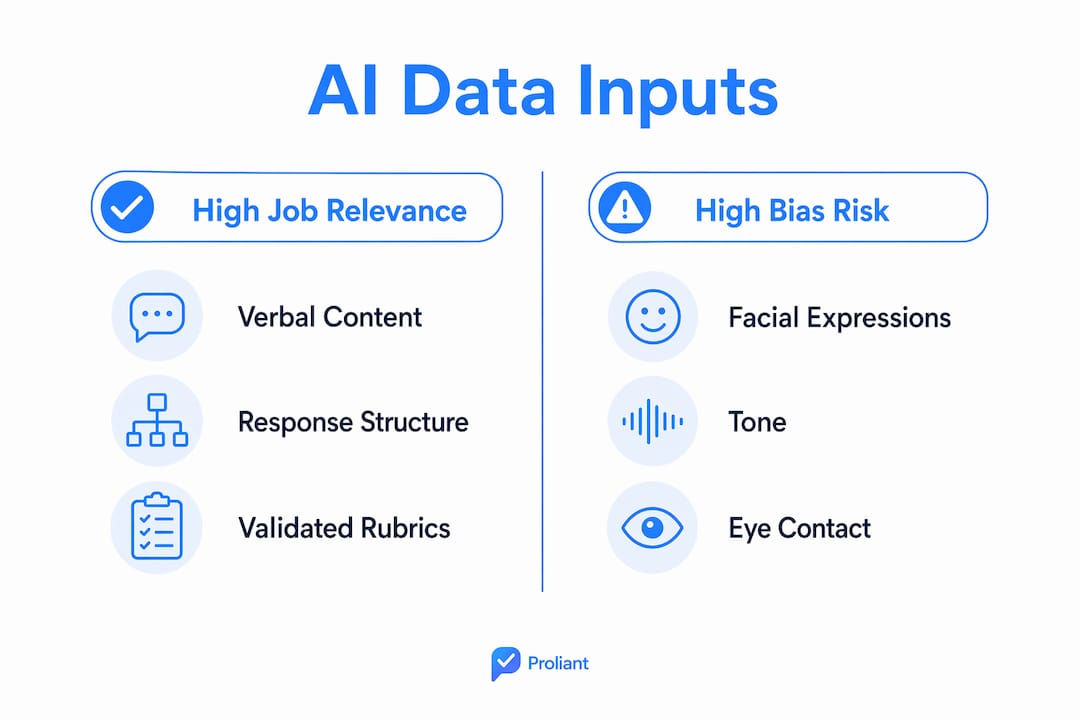
Not all scoring signals are created equal. The table below shows the most common data inputs used in AI interview evaluation, along with their validity and bias risk profiles.
| Data input | Job relevance | Bias risk |
|---|---|---|
| Verbal content and response structure | High | Low to moderate |
| Keyword frequency | Moderate | Low |
| Tone and speech pace | Low | High |
| Facial expressions and eye contact | Very low | Very high |
| Response length and coherence | Moderate to high | Low |
Behavioral proxies like tone, eye contact, and facial expressions carry weak job performance correlation and strong bias potential. A candidate with a speech impediment, a non-native accent, or a neurodivergent presentation will score differently on these signals without any difference in actual job capability. The CIO guidance on this point is direct: focus scoring on what candidates communicate against validated criteria, not on how they look or sound while doing it.
Content-based scoring, by contrast, evaluates whether the candidate's answer demonstrates the competency being assessed. A response to a behavioral question about conflict resolution is scored on whether it describes a specific situation, the candidate's actions, and the outcome. That structure maps directly to job performance and is far more defensible in an audit.
Pro Tip: When evaluating any AI assessment tool, ask the vendor to show you the exact rubric the system uses to score responses. If they cannot produce one, the scoring is likely based on behavioral proxies rather than validated job criteria.
How can hiring teams make AI scoring explainable and defensible?
Explainability is not a feature. It is a compliance requirement. The Public Service Commission of Canada mandates that organizations using AI-supported interview scoring must be able to explain the role of AI, the criteria used, and how the output was interpreted. This standard reflects a broader global direction in automated decision-making regulation.
For HR teams, defensible scoring workflows share several characteristics:
- Competency rubrics are documented before any candidate is evaluated, not reverse-engineered after the fact.
- Each score is traceable to a specific rubric criterion, so a hiring manager can explain why a candidate received a particular rating.
- Human reviewers validate AI scores before they influence hiring decisions, especially for borderline candidates.
- Candidates are informed that AI is being used in the evaluation process, and the criteria are available upon request.
- Audit trails are maintained so that if a candidate or regulator challenges a decision, the organization can produce the scoring logic.
The governance dimension here matters as much as the technology choice. Explainability and accountability in AI hiring are governance issues, not just vendor features. An organization that buys an explainable AI tool but fails to document its criteria or train its hiring managers has not solved the problem.
Pro Tip: Assign a named reviewer to validate AI scores for every hiring decision. This creates a human accountability layer that satisfies most regulatory explainability requirements and builds internal confidence in the process.
What fairness and bias risks exist in AI scoring?
Bias in AI interview scoring concentrates in the signals the system chooses to measure. Behavioral proxies carry stronger bias potential and weaker job relevance than content-based evaluation. This is not a theoretical concern. Candidates from different cultural backgrounds, with different communication styles, or with disabilities are systematically disadvantaged by systems that score tone, pace, or facial expression.
A 2026 study published in Scientific Reports introduced an intersectional bias-detection framework that improves fairness assessment accuracy by 12 to 18% over traditional methods. The framework uses deep learning with attention mechanisms and multi-dimensional fairness metrics to detect bias across overlapping demographic categories simultaneously. This matters because traditional bias audits often test one demographic dimension at a time, missing compounding effects.
HR teams can take four concrete steps to audit and reduce AI scoring bias:
- Audit your scoring signals. Remove any input that lacks a documented link to job performance.
- Run intersectional fairness checks. Test scoring outcomes across combinations of gender, race, age, and disability status, not each in isolation.
- Compare AI scores to human rater scores on a calibration sample. Systematic divergence signals a bias problem.
- Review your training data. If the AI was trained on historical hiring decisions, it may have learned to replicate past bias.
The critical warning here is that passing a bias audit does not mean the system is fair. Bias audits measure what you test. A system can score well on gender fairness while still disadvantaging candidates with non-standard accents. Fairness assessment requires ongoing process-level review, not a one-time certification.
What does 2026 research say about AI scoring in practice?
The evidence on AI in recruitment is more nuanced than vendor marketing suggests. A 2026 F1000Research study measured the actual impact of AI adoption across several recruitment outcomes. The results show that AI significantly improves recruitment efficiency with a beta coefficient of 0.61, a strong and statistically significant effect. Candidate experience also improved meaningfully.
| Outcome | Beta value | Significant? |
|---|---|---|
| Recruitment efficiency | 0.61 | Yes |
| Candidate experience | Positive | Yes |
| Trust and transparency | 0.08 | No |
| Bias mitigation | Modest | Partial |
The trust and transparency result is the finding most hiring managers miss. A beta of 0.08 is not statistically significant. Simply adding AI does not increase transparency or trust. Organizations that deploy AI scoring and assume it will make their process more trustworthy are misreading the evidence. Trust requires deliberate design: clear communication to candidates, accessible criteria, and human oversight.
This finding has a direct implication for hiring manager confidence. When AI scores are accompanied by explicit rubric references and a human reviewer's sign-off, hiring managers report higher confidence in the decision. When scores arrive as a number without explanation, confidence drops and the AI output is often ignored or overridden. The technology only adds value when the workflow around it is designed to make the output interpretable.
How should HR teams integrate AI scoring into their workflows?
Integration works best when it follows a defined sequence rather than being bolted onto an existing process. The steps below reflect current best practice for AI in recruitment workflows.
Start by defining your competency model. Every role should have three to five core competencies with behavioral indicators at each performance level. This work happens before you select a vendor. Once your rubrics exist, you can evaluate whether a given AI tool can score against them accurately.
Train the AI on validated rubrics, not on historical hiring decisions. Historical data encodes past bias. Validated rubrics encode the job requirements. The difference in downstream fairness is significant.
Combine AI scores with at least one other assessment method. Canada.ca guidance is explicit that AI results should be complemented by interviews or references to confirm candidate suitability. AI scoring is a structured input, not a final verdict.
Run bias audits on a quarterly basis, not annually. Candidate pools shift, and a system that was fair in Q1 may show drift by Q3. Schedule calibration sessions where human raters score a sample of responses independently and compare results to the AI output.
Communicate AI use to candidates before the interview. Candidates who know AI is scoring their responses and understand the criteria perform more authentically. Concealing AI use creates legal exposure and erodes trust in your employer brand.
Key takeaways
AI interview scoring produces defensible, fair results only when it evaluates job-relevant content against explicit rubrics, with human oversight and documented explainability built into every step.
| Point | Details |
|---|---|
| Content over behavioral proxies | Score verbal content and response structure, not tone, pace, or facial expressions. |
| Explainability is a compliance requirement | Document rubrics, scoring logic, and human review steps before any candidate is evaluated. |
| AI alone does not build trust | Research shows a non-significant effect on trust; deliberate design of transparency is required. |
| Intersectional bias audits matter | Test fairness across overlapping demographic categories, not single dimensions in isolation. |
| Integration requires sequencing | Define competencies first, then select tools, then combine AI scores with human judgment. |
Why explainability is the real differentiator in AI scoring
I have reviewed AI scoring implementations across organizations of very different sizes, and the pattern is consistent. The teams that get value from AI interview scoring are not the ones with the most sophisticated technology. They are the ones that did the competency modeling work before they bought anything.
The most common failure mode is purchasing an AI scoring tool and then working backward to justify the scores it produces. That approach is the opposite of defensible. It means the AI is driving the criteria rather than the criteria driving the AI. When a candidate or auditor asks why a particular score was given, the honest answer becomes "because the algorithm said so," which satisfies no one.
The second failure mode is treating behavioral proxy scoring as a neutral signal. Eye contact patterns, speech pace, and facial expression scores feel objective because they are quantified. They are not neutral. They reflect assumptions about how confidence, competence, or engagement look that are culturally specific and empirically weak. I would advise any hiring team to ask their vendor directly whether behavioral signals contribute to the score and to request the validity evidence for each one.
What actually builds stakeholder confidence is a scoring workflow where every number traces back to a rubric criterion, every rubric criterion traces back to a job requirement, and a named human reviewer has signed off on the output. That is not a technology problem. It is a governance problem, and it is one your team can solve regardless of which platform you use.
— Hudson
How Evy supports fair, explainable AI interview scoring
Evy is built for hiring teams that need AI interview scoring they can actually explain and defend. The platform applies criterion-based evaluation against job-specific rubrics, so every score is traceable to a documented competency. Evy also includes real-time eye tracking to detect candidates using AI assistance during the interview, which protects the integrity of the scores your team relies on. When a candidate's responses are genuinely their own, the scoring data means something. Explore Evy's interview features to see how transparent, anti-cheat AI scoring works in practice, and how it fits into a compliant, auditable recruitment workflow.
FAQ
How does AI score interview responses?
AI scores interview responses by analyzing verbal content against predefined competency rubrics using natural language processing. The system measures response structure, relevance, and alignment with job-specific criteria rather than surface-level keyword matching.
What makes AI interview scoring legally defensible?
Defensible scoring requires documented rubrics tied to job competencies, traceable score outputs, and human reviewer sign-off before decisions are made. The Public Service Commission of Canada requires organizations to explain the role of AI, the criteria used, and how outputs were interpreted.
Does AI scoring reduce bias in hiring?
AI scoring can reduce bias when it evaluates job-relevant content rather than behavioral proxies like tone or facial expressions. However, bias audits must be run regularly across intersectional demographic categories, since a single-dimension audit can miss compounding effects.
Why doesn't AI automatically improve trust in hiring?
Research from F1000Research shows that AI adoption produces a non-significant effect on trust (β=0.08). Trust requires deliberate design, including candidate communication, accessible criteria, and visible human oversight, not just AI implementation.
What should HR teams ask AI scoring vendors?
Ask vendors to produce the exact rubric used to score responses, the validity evidence for each scoring signal, and whether behavioral proxies like tone or eye contact contribute to the score. If a vendor cannot answer these questions clearly, the scoring methodology is likely not defensible.