
 By Adrian Pascual•Hiring insight•Published
AI for Interview: HR Leader's Guide to Screening at Scale
Use AI for interview screening when you need consistent, evidence-based evaluation at scale and can commit to pilot KPIs, candidate transparency, and ongoing fairness monitoring. Platforms with tamper-evident audit logs, adverse-impact testing, accessibility accommodations, and real-time anti-cheating controls meet the minimum bar for responsible deployment. Evy meets all of these criteria. EEOC guidance on selection procedures applies the moment an AI tool influences a hiring decision, so auditability is not optional.
Immediate next steps for HR leaders:
- Run a multi-week pilot on one role family; measure time-to-hire and pass-rate changes before expanding.
- Publish a candidate notice explaining that AI is used in screening, what data is collected, and how long it is retained.
- Require your vendor to demonstrate tamper-evident recordings, audit log access, and a documented adverse-impact testing process before signing.
Pro Tip: Set your pilot KPIs in writing before the first interview runs. Teams that define "success" after the fact almost always rationalize the result rather than learn from it.
Table of Contents
- When does AI for interview add measurable value for your hiring team?
- How do you protect screening integrity against AI-assisted cheating?
- What U.S. compliance and fairness obligations apply to AI screening?
- What questions should you ask when evaluating an AI interview platform?
- How do you design and run a responsible AI screening pilot?
- What do good interview tasks and scoring rubrics look like?
- Key Takeaways
- The gap between what AI screening promises and what actually matters
- Evy screens at scale with the controls your team actually needs
- Useful sources for compliance and technical reference
When does AI for interview add measurable value for your hiring team?
AI-powered screening delivers the clearest return in three situations: high-volume roles where recruiter bandwidth is the bottleneck, geographically distributed candidate pools that require 24/7 availability, and standardized job families where a consistent rubric is both feasible and defensible.

The business benefits are concrete. AI candidate screening reduces time-to-hire by removing scheduling friction and compressing the early screening stage. Interview-to-offer consistency improves because every candidate answers the same structured prompts under the same conditions. Recruiters spend less time on early-stage screens and more time on high-signal conversations with shortlisted candidates.
Roles that benefit most include technical positions (software engineering, data, QA), high-volume customer-facing roles (support, sales, retail), and any position with a standardizable skills component. Roles that remain better served by human-first interviews include senior leadership, highly ambiguous strategic positions, and roles where cultural nuance or relationship judgment is the primary selection criterion.
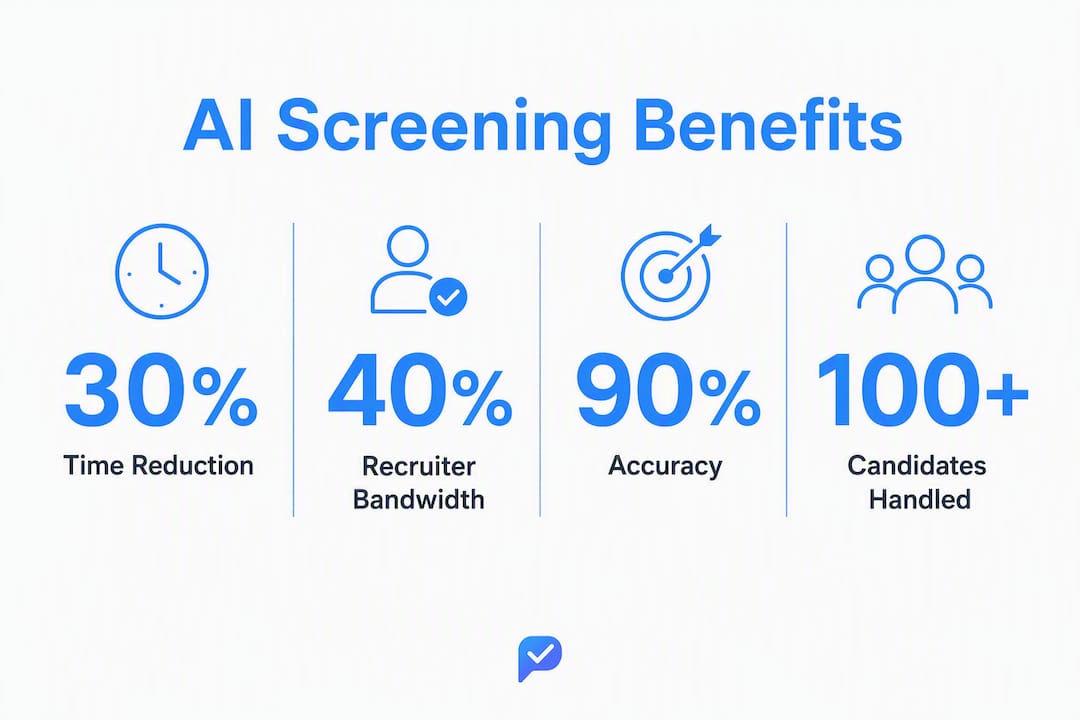
On the operational side, AI scoring integrates directly into ATS workflows. Scores, transcripts, and resume data flow into recruiter dashboards, enabling structured handoffs rather than subjective summaries. Employers are also responding to a real shift: candidates now use AI tools to craft resumes and prepare answers at scale, which means AI-scored screens that require demonstrated proof, not polished scripts, are increasingly necessary to surface genuine skill.
How do you protect screening integrity against AI-assisted cheating?
Candidate-side AI tools have created a new fraud surface. Products marketed as "invisible overlays" claim to feed live answers during video interviews without appearing on screen share. Synthetic voice tools can mask identity. Remote assistance can make a candidate appear far more capable than they are under independent conditions.
The primary risk vectors are:
- AI-generated answers delivered via real-time overlays during one-way or live video screens
- Deepfake video or synthetic audio used to impersonate a candidate
- Screen-sharing of external AI tools during coding or written assessments
- Remote human assistance coordinated off-camera
Detection requires layered controls. Real-time eye tracking is among the most reliable signals: attention patterns during genuine cognitive work look different from patterns associated with reading off-screen text. Evy's eye-tracking capability is built specifically for this. Tamper-evident recordings preserve the evidentiary chain for post-hire disputes. Keystroke telemetry and interaction anomaly scoring add a second layer for written and coding tasks.
Operational anti-cheating is most effective as a combination of technical detection and process controls. Eye tracking and biometrics catch behavioral anomalies; randomized prompts, timed one-way questions, and human review thresholds close the gaps that technology alone cannot cover.
Identity verification at session start, randomized question sets, and strict time limits on individual prompts reduce the window for coordinated assistance. Human review escalation rules should trigger automatically when anomaly scores exceed a defined threshold.
Procurement checklist for anti-cheating:
- Request a live demo of eye-tracking and anomaly detection, not just a slide deck.
- Ask for a sample audit log showing timestamps, recording integrity hashes, and score provenance.
- Confirm the retention and tamper-evidence policy in writing before signing.
Pro Tip: Excessive anti-cheating friction raises dropout rates and can disproportionately affect candidates with accessibility needs. Calibrate detection thresholds to flag anomalies for human review rather than auto-reject.
What U.S. compliance and fairness obligations apply to AI screening?
EEOC guidance on selection procedures applies to any AI tool that influences a hiring decision. If a protected class passes at a rate below 80% of the highest-passing group (the four-fifths rule), that is a prima facie adverse-impact finding requiring investigation. OFCCP requirements add a layer for federal contractors. State laws, including California Consumer Privacy Act obligations, govern how candidate data is collected, stored, and disclosed.
Required vendor capabilities for U.S. compliance:
- Documented adverse-impact testing, ideally run on your own historical data before full rollout
- Explainable or feature-level scoring so you can reconstruct why a candidate passed or failed
- Tamper-evident audit logs with timestamps and score provenance
- A written retention and consent policy that candidates receive before the screen begins
Accessibility under the ADA means vendors must offer alternative assessment paths for candidates who cannot complete the standard format. Require documentation of how accommodation requests are handled, what the alternative path looks like, and how scores from alternative paths are normalized.
Internally, schedule periodic fairness audits, at minimum quarterly during the first year. Build a dispute-resolution workflow so candidates can contest a result, and require human-in-the-loop review for any borderline decision within a defined score band.
Recommended process steps:
- Before launch, run a simulated adverse-impact analysis on de-identified historical hire data.
- At 30 days post-launch, pull pass rates by gender, race, and age band and compare against the four-fifths threshold.
- At 90 days, conduct a full fairness audit and document findings for legal review.
Pro Tip: Require vendors to deliver both raw evidence (transcripts, timestamps, individual question scores) and summary scores. Store both with tamper-evident retention. Summary scores alone are insufficient for a legal audit.
What questions should you ask when evaluating an AI interview platform?
Evaluation should cover six dimensions: scoring transparency, anti-cheating capabilities, adverse-impact testing, ATS integration, rubric customization, and pricing structure. Vendors who cannot answer the questions below clearly during a demo are telling you something important.
Sample questions to ask during demos and RFPs:
- How is the overall score calculated, and can we see feature-level score breakdowns?
- Can you run an adverse-impact simulation on our historical candidate data before we sign?
- What does your data retention policy look like, and how is tamper evidence maintained?
- How are ADA accommodation requests handled, and what does the alternative path produce?
- Can you show us a real audit log, including timestamps and recording integrity verification?
On pricing, clarify whether the model is per-interview or seat-based, what overage costs look like at 2x your projected volume, and whether ATS integration carries a separate fee. Ask for a sample ROI scenario: time-to-hire savings versus cost per interview at your expected monthly volume.
Procurement checklist:
- Security certifications or SOC 2 status (request the current report, not a summary)
- Sandbox or pilot access with de-identified data before full contract commitment
- Contract clauses covering data portability, audit rights, and termination data return
Pro Tip: Request a 30–60 day sandbox using de-identified past candidates. Running an adverse-impact simulation on real historical data before you commit is the single most defensible procurement step you can take.
How do you design and run a responsible AI screening pilot?
A well-structured pilot runs 6–8 weeks across four phases: setup (weeks 1–2), live screening (weeks 3–5), analysis (week 6), and iteration planning (weeks 7–8).
Phase responsibilities:
- Setup: Recruiting defines role-specific rubrics and question sets; vendor configures ATS integration and audit logging; legal reviews candidate notice language.
- Live screening: Recruiters monitor anomaly flags and escalate borderline cases; hiring managers review shortlists with score explanations attached.
- Analysis: Pull KPIs, run adverse-impact check, collect candidate NPS, and document false positive/negative cases.
- Iteration: Adjust score thresholds, rubric weights, or question sets based on findings before scaling.
| KPI | Baseline target | Pilot target |
|---|---|---|
| Time-to-hire (days) | Current average | 15–20% reduction |
| Interview-to-offer rate | Current rate | Maintained or improved |
| Adverse-impact ratio | Establish baseline | At or above four-fifths threshold |
| Candidate NPS | Not measured | Positive net score |
| False positive rate | Not measured | Establish and track |
Log timestamps, raw recordings, raw scores, and decision reasons for every session. Retain these with tamper-evident controls for the duration required by your data retention policy.
Rollout checklist:
- Recruiter training on score interpretation and escalation rules
- Candidate notice published before the first screen runs
- Accommodation process documented and tested
- Escalation path defined for contested results
Pro Tip: Assign a single named owner for pilot KPI reporting. Shared ownership means no one pulls the data on time.
What do good interview tasks and scoring rubrics look like?
Task design determines whether AI scoring produces signal or noise. The goal is a task specific enough to reveal genuine skill and structured enough for consistent scoring.
Technical role tasks
For software and AI engineering roles, end-to-end pipeline prompts outperform isolated algorithm questions. Ask candidates to describe a system from input through retrieval, generation, verification, and feedback, and explicitly require them to identify failure modes and trade-offs. Practitioner guidance consistently shows that product-minded answers anchored to business metrics like latency, cost, and retention separate strong candidates from pure implementers.
Nontechnical role tasks
For customer-facing and operational roles, structured behavioral prompts using the STAR method (Situation, Task, Action, Result) remain reliable. Role-play scenarios and written synthesis tasks add a second signal layer.
| Rubric dimension | Scoring range | What to look for |
|---|---|---|
| Correctness / accuracy | 1–4 | Does the answer solve the stated problem? |
| Clarity of explanation | 1–4 | Can a non-specialist follow the reasoning? |
| Trade-off discussion | 1–4 | Are alternatives and limitations acknowledged? |
| Business metric orientation | 1–4 | Are outcomes framed in terms of impact? |
| Follow-up adaptability | 1–4 | Does the candidate adjust when probed? |
A total score of 16–20 typically maps to a shortlist; 10–15 warrants human review; below 10 is a pass. Calibrate these thresholds against your historical hire data during the pilot.
Combine automated evidence (time to answer, code test pass rate) with human rubric fields. Avoid over-weighting raw fluency scores generated by language models, since AI-assisted answer preparation can produce polished language that does not reflect independent capability.
Key Takeaways
AI screening delivers consistent, auditable hiring decisions at scale when deployed with the right controls, pilot KPIs, and candidate transparency from day one.
| Point | Details |
|---|---|
| Deploy with clear conditions | Use AI screening for high-volume, standardizable roles; keep human-first interviews for senior and ambiguous leadership positions. |
| Anti-cheating requires layers | Combine real-time eye tracking, tamper-evident recordings, randomized prompts, and human review escalation for reliable fraud detection. |
| U.S. compliance is non-negotiable | EEOC adverse-impact testing, ADA accommodations, and a written retention and consent policy must be in place before the first screen runs. |
| Pilot before scaling | Run a 6–8 week pilot measuring time-to-hire, adverse-impact ratio, and candidate NPS; define KPI targets in writing before launch. |
| Evy for screening at scale | Evy provides real-time eye tracking, tamper-evident audit logs, adverse-impact reporting, and per-interview or seat pricing for U.S. hiring teams. |
The gap between what AI screening promises and what actually matters
The conversation around AI in hiring tends to split into two camps: enthusiasts who treat automation as a cost-reduction play, and skeptics who treat it as a fairness liability. Both miss the more useful frame.
The real question is not whether AI screening is good or bad. It is whether your organization has the operational discipline to run it responsibly. The teams that struggle are rarely the ones that chose the wrong platform. They are the ones that launched without clear decision ownership, published a vague candidate notice as an afterthought, and never scheduled a fairness audit after go-live.
Eye tracking and audit logs matter, but they are only as useful as the review process behind them. A tamper-evident recording that no one pulls during a dispute is not a control. A fairness report that no one reads quarterly is not compliance. The technology creates the capability; the process creates the accountability.
What Evy's approach gets right is that anti-cheating and auditability are built into the platform architecture, not bolted on as optional add-ons. That matters because retrofitting these controls after a legal challenge or a failed audit is far more expensive than requiring them at procurement. HR leaders who treat security and fairness as procurement criteria, not post-launch concerns, are the ones who scale AI screening without incident.
Evy screens at scale with the controls your team actually needs
Screening hundreds of candidates consistently, fairly, and securely is exactly what Evy is built for. Real-time eye tracking catches AI-assisted cheating as it happens, not after the fact. Tamper-evident audit logs give your legal and compliance teams the evidence chain they need for any dispute or regulatory review. Adverse-impact reporting runs on your data so you can monitor fairness continuously, not just at annual review.
Evy integrates with your existing ATS, supports per-interview pricing for pilots and seat plans for volume, and provides sandbox access so your team can validate rubrics and run an adverse-impact simulation before committing. Candidate notices, accommodation workflows, and escalation rules are configurable from day one.
If you are ready to run a structured pilot, request a sandbox and see how Evy handles your specific role family before you scale.
Useful sources for compliance and technical reference
The sources below are the most authoritative references for the topics covered in this article. Consult them in the order that matches your immediate need.
For U.S. legal and compliance guidance:
- EEOC Uniform Guidelines on Employee Selection Procedures (29 CFR Part 1607) — the primary authority on adverse-impact testing and the four-fifths rule.
- OFCCP Federal Contract Compliance Manual — required reading for federal contractors using AI in selection.
- California Consumer Privacy Act (CCPA) official text — governs candidate data collection and disclosure for California-based hiring.
For technical and practitioner reference:
- How to Prepare for AI Interviews in 2026 — CoPrep AI's guide covers AI interview workflow types, candidate-side behaviors, and what employers now expect from screening.
- AI Engineer Interview Questions and Prep — IGotAnOffer's practitioner guide on technical task design, pipeline thinking, and business-metric framing for technical roles.
- Why Candidates Use AI During Interviews — Evy's analysis of candidate-side AI behaviors and the implications for screening integrity.
- Risks, Fairness, and Fitting AI Screening Into Your Process — Evy's operational guide to risk mitigation, fairness monitoring, and workflow integration.
A note on documentation: Keep your vendor's audit logs, tamper-evident recordings, and adverse-impact reports as primary evidence during any internal compliance review. Published guidance and third-party articles are useful context; your own documented records are what matter in a legal or regulatory proceeding.