
 By Adrian Pascual•Hiring insight•Published
What Is AI Interview Screening? HR Guide 2026
AI interview screening is an automated candidate evaluation process that uses artificial intelligence to score responses, apply structured rubrics, and filter applicants before any human interviewer gets involved. The industry term for this practice is automated interview screening, and it sits between the application stage and live human interviews in the modern AI hiring process. Platforms like TestGorilla and BrightHire have made this approach standard at scale, and hiring cycle times have dropped significantly as a result. For HR professionals managing high-volume pipelines, understanding how this technology works and where its limits lie is no longer optional.
How does AI interview screening work in the hiring process?
AI interview screening activates after an application is received and before any recruiter picks up the phone. The process typically follows a defined sequence that replaces the traditional phone screen with a faster, more consistent alternative.
Here is how a standard automated interview screening workflow runs:
- Application triggers an invite. The applicant receives a link to complete a structured interview, often asynchronously, on their own schedule.
- The candidate records responses. Questions are competency-based and pre-set. The candidate answers on video or in text, with no live interviewer present.
- AI parses and scores the responses. Natural language processing (NLP) analyzes the content of each answer against a validated rubric. Scores are generated per competency.
- A scorecard is delivered to the recruiter. The recruiter reviews ranked candidates, reads transcript excerpts, and decides who advances.
- Shortlisted candidates move to human interviews. The AI output informs the agenda for those conversations.
AI pre-screens typically run 10–20 minutes, compared to 30 minutes for a traditional phone screen. That time savings compounds quickly across hundreds of applicants. The real efficiency gain is not just speed. It is the elimination of scheduling friction and the ability to screen candidates 24/7 without recruiter availability as a constraint.
Pro Tip: Set a clear deadline for AI screen completion in your invite email. Candidates who do not complete within 72 hours are statistically less likely to engage well in later stages.

What technologies power AI interview scoring?
The scoring engine behind most AI interview platforms relies on NLP to evaluate what candidates actually say, not how they look or sound while saying it. This distinction matters for both fairness and legal defensibility.
The core components of a well-built AI scoring system include:
- Transcript analysis against competency frameworks. The AI reads the candidate's response and maps it to a framework like STAR (Situation, Task, Action, Result). Responses that demonstrate clear structure and relevant evidence score higher.
- Rubric-based output with documented justification. Platforms like TestGorilla score responses on a 0–5 scale against validated rubrics, focusing exclusively on response content. Recruiters can see the specific transcript excerpt that drove each score.
- Inter-rater reliability benchmarks. Validated AI models achieve reliability correlations of 0.6–0.8 compared to human raters. That range is comparable to a single trained human reviewer, which is the relevant benchmark for first-pass screening.
One area where the industry has made a deliberate retreat is paralinguistic and visual scoring. HireVue dropped facial expression scoring in 2021 after sustained criticism about bias and validity. Reputable platforms in 2026 do not score candidates on tone of voice, facial expressions, or perceived enthusiasm. These signals introduce demographic bias and have no validated link to job performance.
Pro Tip: When evaluating any AI interview platform, ask the vendor directly: "Does your scoring model use any visual or paralinguistic features?" If the answer is vague, treat that as a red flag.
What are the benefits and limitations of AI screening?
AI interview screening delivers measurable gains in efficiency, consistency, and fairness. Understanding where it excels and where it falls short helps you deploy it correctly.
| Feature | AI Interview Screening | Traditional Human Screening |
|---|---|---|
| Speed | 10–20 minutes per candidate, asynchronous | 30+ minutes, requires scheduling |
| Consistency | Identical rubric applied to every candidate | Varies by interviewer and mood |
| Bias risk | Eliminates accent and appearance factors | Susceptible to affinity and halo bias |
| Depth of judgment | Strong for structured competencies | Better for nuanced, senior-level assessment |
| Legal defensibility | High when scoring is explainable | Variable, depends on interviewer documentation |
| Scalability | Screens hundreds simultaneously | Limited by recruiter bandwidth |
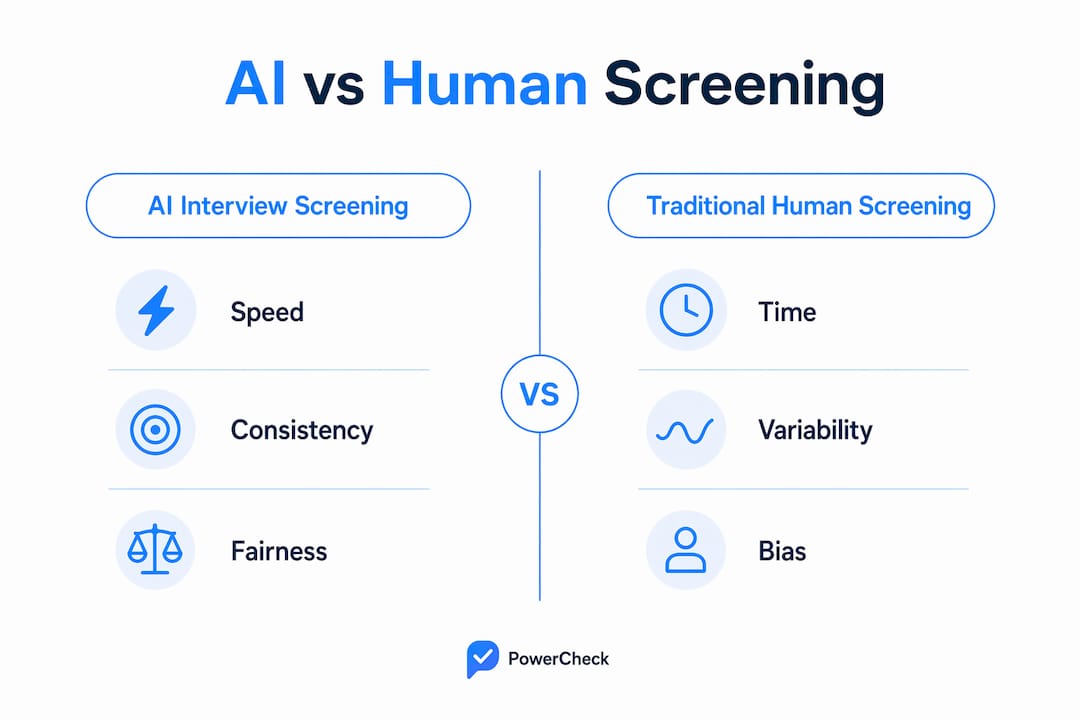
The consistency advantage is significant. Unstructured human phone screens produce highly variable results because different recruiters ask different questions and weight answers differently. AI applies the same rubric to every candidate, which reduces recruiter workload and accelerates shortlisting without introducing the inconsistency that plagues manual processes.
The limitation is equally clear. AI scoring accuracy is comparable to a single trained human rater but falls short of a trained human panel. For senior, strategic, or highly nuanced roles, AI screening is a starting filter, not a final verdict. Over-relying on AI scores for complex hires creates real risk. The technology is a productivity layer, not a replacement for human judgment at the decision stage.
There is also a compliance dimension. Black-box AI systems that lack transcript-backed justifications expose organizations to legal risk under regulations like the EU AI Act and New York City's Local Law 144. Any platform you use must be able to explain, in plain language, why a candidate received a specific score.
How should HR teams integrate AI screening responsibly?
Deploying AI interview screening well requires more than switching on a platform. The process must be structured to preserve human decision ownership and maintain candidate trust.
Practical guidance for responsible integration:
- Retain recruiter authority at every stage. Final hiring decisions must not be made automatically by AI. The AI produces a scorecard. A human reviews it and decides who advances.
- Tell candidates AI is involved. Transparency is not just ethical. The Public Service Commission of Canada's 2026 guidance mandates disclosure of AI's role in the hiring process, including the criteria being assessed.
- Use AI transcripts as supplementary evidence. Treat the AI scorecard the way you would treat a structured reference check. It informs your thinking. It does not replace it.
- Let AI scores direct your human interview agenda. AI score signals which competencies to probe more deeply in follow-up conversations. A low score on problem-solving becomes a targeted question set for the panel stage.
- Audit your AI tool's outputs periodically. Compare AI scores against eventual hire performance data. If the correlation is weak, recalibrate the rubric or the question set.
One risk that HR leaders underestimate is the integrity of the AI screen itself. Candidates increasingly use generative AI tools to craft responses in real time during asynchronous video interviews. A score that looks strong may reflect AI-assisted output rather than genuine candidate competency. This is where platforms with integrity monitoring, such as Evy's real-time eye tracking, add a layer of signal that transcript analysis alone cannot provide.
Panel interviews vs. AI screening: how do they compare?
The question of what is panel interview versus AI screening comes down to purpose and stage. These two methods are not competitors. They serve different functions in the same funnel.
AI screening is built for the top of the funnel. It handles volume, applies consistent criteria, and surfaces candidates worth a deeper look. A panel interview is built for depth. It brings multiple stakeholders into the room to assess judgment, cultural alignment, and how a candidate handles pressure and ambiguity. Neither method does the other's job well.
| Dimension | AI Interview Screening | Panel Interview |
|---|---|---|
| Best use case | High-volume first-pass filtering | Senior or complex role final assessment |
| Evaluators | AI scoring engine | Two or more human interviewers |
| Candidate experience | Flexible, asynchronous | Formal, synchronous |
| Assessment depth | Structured competencies | Judgment, culture fit, stakeholder dynamics |
| Time investment | Low (recruiter reviews scorecards) | High (multiple schedules to coordinate) |
AI screening as a first-pass evaluation means panels remain the standard for complex hires. The practical workflow is straightforward: use AI to reduce a pool of 200 applicants to 20 qualified candidates, then deploy a panel to assess the final 5. This structure protects recruiter time while preserving the depth that senior hiring requires.
Pro Tip: Share the AI scorecard with panel members before the interview. It tells them exactly which competency gaps to probe, making the panel conversation more targeted and productive.
Key takeaways
AI interview screening is a structured, NLP-driven evaluation layer that improves hiring consistency and speed while requiring human oversight to remain legally defensible and effective.
| Point | Details |
|---|---|
| AI screening sits between application and live interview | It filters candidates using structured rubrics before any recruiter time is spent. |
| NLP scores content, not appearance | Reputable platforms ignore accent, tone, and facial expression to reduce demographic bias. |
| AI accuracy matches one trained human rater | It is reliable for first-pass filtering but not a substitute for a trained panel on complex roles. |
| Transparency is a legal requirement | Candidates must be told AI is involved, and scores must be explainable with transcript evidence. |
| Use AI scores to guide human interviews | Low scores on specific competencies become targeted questions for the panel stage. |
What HR leaders often miss about AI screening
The conversation around AI interview screening tends to split into two camps. One side treats it as a silver bullet that removes bias and speeds up hiring overnight. The other dismisses it as a compliance liability waiting to happen. Both views miss the point.
What I have seen consistently is that the organizations getting real value from AI screening are the ones that treat it as a signal generator, not a decision maker. They use the scorecard to walk into a panel interview with sharper questions. They do not use it to eliminate candidates without a human ever reading the output.
The compliance risk is real, but it is manageable. The organizations that get into trouble are the ones using black-box systems they cannot explain to a candidate or a regulator. If your AI vendor cannot show you the transcript excerpt that produced a specific score, that is a problem worth solving before you scale the tool.
There is also an integrity question that the industry has been slow to address directly. Asynchronous AI interviews are increasingly vulnerable to candidates using generative AI to answer in real time. A polished transcript score may not reflect genuine competency at all. Platforms that monitor attention patterns and eye movement during the interview add a layer of verification that pure NLP scoring cannot provide. That distinction will matter more, not less, as AI-assisted cheating becomes more common.
Treat AI screening as a productivity layer with a verification requirement. The technology is genuinely useful. The risks are manageable if you choose the right platform and keep humans in the decision seat.
— Hudson
Screen smarter with evy's AI interview platform
Evy is built for HR teams that need to screen at scale without sacrificing the integrity of their results. Unlike standard AI interview tools, Evy combines structured rubric-based scoring with real-time eye tracking to detect when candidates are using AI assistance during the interview itself. That means the scores you review actually reflect candidate capability, not a well-prompted language model.
Evy runs 24/7, gives recruiters full control over scoring criteria, and produces explainable transcripts that satisfy compliance requirements under regulations like Local Law 144 and the EU AI Act. Every score links back to a specific candidate response. Explore Evy's anti-cheat AI interview features to see how transparent, verifiable screening works in practice.
FAQ
What is AI interview screening, exactly?
AI interview screening is an automated process that evaluates candidate responses to structured questions using NLP and competency rubrics, producing scored transcripts for recruiter review. It sits between the application stage and live human interviews in the hiring funnel.
How is AI interview result interpretation done?
Recruiters review AI-generated scorecards that link each competency score to a specific transcript excerpt, allowing them to see exactly what the candidate said and why the AI scored it that way. The recruiter then decides whether to advance the candidate based on that evidence.
Can a candidate opt out of AI screening?
Opt-out policies vary by organization and jurisdiction, but candidates should always be informed that AI is being used in the process. Public sector guidance in Canada requires disclosure of AI's role and the criteria being assessed before the screening begins.
How does AI screening differ from a panel interview?
AI screening filters large candidate pools using structured rubrics at the top of the funnel, while panel interviews assess judgment, culture fit, and stakeholder dynamics for shortlisted candidates. The two methods are complementary, not interchangeable.
Is AI interview screening legally compliant?
AI screening is compliant when the platform provides explainable, transcript-backed scores and candidates are informed of AI involvement. Systems that cannot justify scores with evidence risk violating regulations like the EU AI Act and New York City's Local Law 144.