
 By Adrian Pascual•Hiring insight•Published
Why Diversity Hiring Needs Fair Screening to Work
Fair screening in diversity hiring is the practice of evaluating candidates based solely on skills and qualifications while systematically removing demographic influences from the process. Without it, bias enters at every stage, from the first resume review to the final offer. HR professionals who rely on unstructured, subjective methods consistently produce less diverse candidate pools, even when diversity is an explicit organizational goal. The gap between intention and outcome is where fair screening becomes non-negotiable. Understanding why diversity hiring needs fair screening means recognizing that good intentions do not override the structural patterns that shape who gets seen, who gets called, and who gets hired.
Why diversity hiring needs fair screening at every stage
Bias in hiring is not always deliberate. Research consistently shows that white-sounding names receive 50% more callbacks than identical resumes with Black-sounding names. That single finding exposes how much demographic information shapes decisions before a hiring manager reads a single line of work experience. Fair screening methods exist to interrupt that pattern before it compounds.
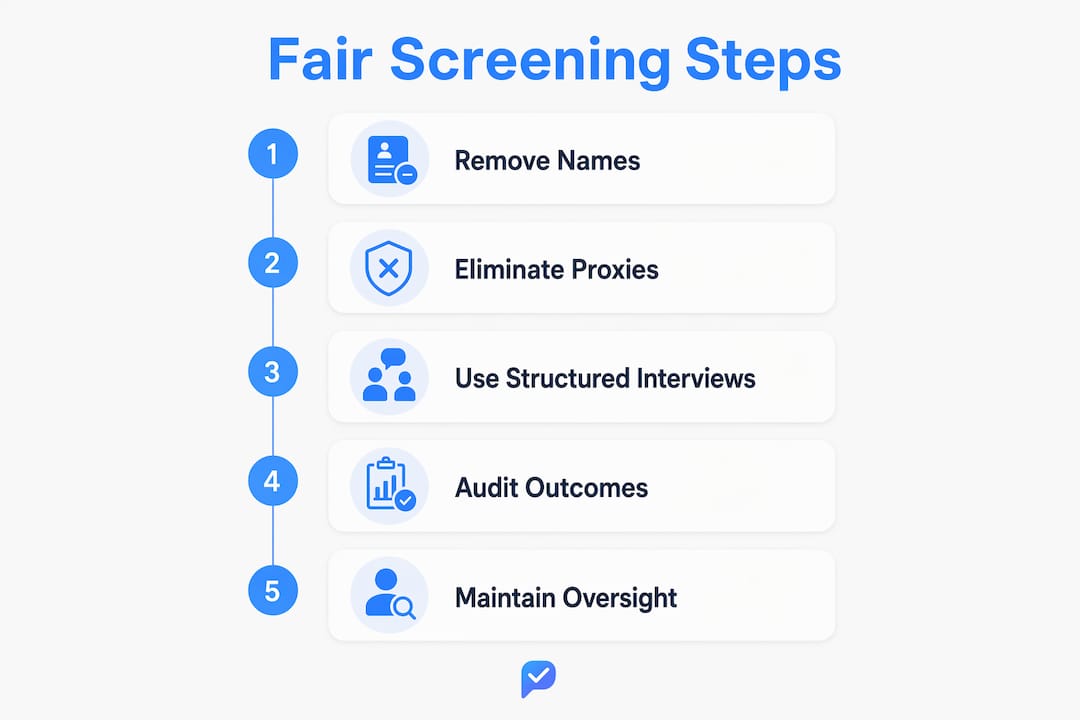
The core principle of equitable hiring processes is simple: remove information that triggers bias before it influences a decision. In practice, this means standardizing what reviewers see, when they see it, and how they score it. Structured criteria replace gut instinct. Consistent scoring rubrics replace subjective impressions. The result is a process where qualifications drive outcomes, not familiarity or unconscious association.

This matters because bias does not stay contained to one decision. It accumulates. A candidate filtered out at the resume stage never reaches the interview. A candidate scored lower in an unstructured interview never reaches the offer. Each stage where bias operates unchecked narrows the pool further. Fair screening addresses this by building consistency into the process from the start, not as an afterthought.
How does blind screening improve diversity in candidate pools?
Blind screening removes identifying information from resumes before reviewers assess them. Names, photos, graduation years, and addresses are stripped out. What remains is a record of skills, experience, and accomplishments. This approach directly targets the source of demographic bias in early-stage review.
The results are measurable. Blind screening increases diversity in interview pools by up to 46% compared to traditional resume review. That is not a marginal improvement. It reflects how much demographic information was shaping decisions before it was removed.
Common blind screening practices include:
- Removing candidate names and photos from resume files before distribution
- Stripping graduation years to reduce age-related assumptions
- Omitting addresses and ZIP codes that can signal neighborhood demographics
- Anonymizing university names where institutional prestige creates proxy bias
Pro Tip: Removing a name is not enough. University names and ZIP codes can function as demographic proxies. Audit your screening template to confirm that no field indirectly reveals protected characteristics before reviewers score candidates.
The importance of fair hiring at this stage cannot be overstated. Blind screening does not lower the bar. It raises the floor by ensuring that every candidate is evaluated on the same criteria, without the interference of information that has no bearing on job performance.
What role do structured interviews play in reducing bias?
Structured interviews are a defined format where every candidate answers the same questions in the same order, scored against the same rubric. This consistency is what separates them from conversational, unstructured interviews where interviewers improvise questions and rely on personal rapport to assess fit.
The evidence for structured interviews is strong. Structured interview processes reduce bias by 40–60% compared to unstructured formats. That reduction translates directly into fairer outcomes for candidates from underrepresented groups who are most vulnerable to subjective evaluation.
The business case is equally clear. Organizations using structured, merit-based hiring report:
- 28% higher revenue compared to peers using less consistent hiring methods
- 40% lower turnover rates, reflecting better alignment between role requirements and candidate qualifications
- 15% higher retention among employees with disabilities, a group frequently disadvantaged by informal interview formats
These numbers reflect a broader truth about the benefits of diverse teams: when hiring processes surface the most qualified candidates regardless of background, the organization performs better. Structured interviews are not just a fairness tool. They are a performance tool.
Scoring rubrics are the mechanism that makes structured interviews work. Each question maps to a competency. Each answer receives a score based on defined criteria. Interviewers compare scores, not impressions. This format reduces the influence of personal chemistry, shared background, and other factors unrelated to job performance.
How do fairness-aware frameworks address bias across the full hiring pipeline?
Single-stage interventions are not enough. Bias compounds through multiple hiring stages, meaning that a candidate who survives blind resume screening can still face biased evaluation at the interview, assessment, or offer stage. A fairness-aware framework monitors demographic pass-through at every step, not just at the top of the funnel.
Recruitment-aware fairness models track three specific metrics across the pipeline. Fairness-aware pipelines improve demographic parity by 32.4%, equal opportunity by 28.7%, and equalized odds by 25.9%. Each metric captures a different dimension of equity. Demographic parity measures whether candidates from different groups advance at similar rates. Equal opportunity measures whether qualified candidates from all groups are identified correctly. Equalized odds measures whether error rates are consistent across groups.
Ongoing audits are what keep these frameworks functional. AI tools require continuous monitoring and human oversight to prevent bias from re-entering through the back door. A system trained on historical hiring data will reflect the biases embedded in that data unless it is regularly tested against current outcomes.
Pro Tip: Audit outcomes, not just inputs. A process can appear neutral on paper while producing disparate results in practice. Run quarterly demographic pass-through reports for each stage of your pipeline and investigate any stage where one group advances at a significantly lower rate.
Human oversight is not optional. AI tools can flag patterns and surface data, but a human reviewer must interpret findings, investigate anomalies, and make governance decisions. The risks of AI screening increase when organizations treat automated tools as self-managing systems rather than tools that require active stewardship.
What are the legal risks of deploying fair screening tools?
Proxy discrimination is the most underestimated risk in fair screening. Removing a candidate's name and address does not guarantee a bias-free process if the algorithm uses ZIP codes, university affiliations, or other variables that correlate with protected characteristics. Proxy variables like ZIP codes can reveal demographic information even when direct identifiers are absent. Auditing inputs is not sufficient. Organizations must audit outcomes.
Legal accountability follows the employer, not the vendor. Organizations remain legally responsible for the outcomes of algorithmic hiring tools regardless of what vendor contracts say. The EEOC and OFCCP hold employers accountable during compliance audits, and vendor claims of bias-free performance do not transfer liability.
Practical compliance requirements include:
- Maintaining paper trails that document how screening criteria were selected and applied
- Generating bias impact reports at each stage of the hiring pipeline
- Conducting pre-deployment risk assessments for any AI or automated screening tool
- Reviewing vendor methodology and requesting independent audit results before adoption
Transparency is both a legal and ethical requirement. Candidates and regulators expect organizations to explain how hiring decisions are made. A process that cannot be documented cannot be defended. HR professionals who treat compliance as a documentation exercise rather than a governance practice create significant organizational risk.
Key Takeaways
Fair screening is the foundation of effective diversity hiring because it removes the demographic signals that distort candidate evaluation at every stage of the process.
| Point | Details |
|---|---|
| Blind screening expands pools | Removing names and proxies increases interview pool diversity by up to 46%. |
| Structured interviews cut bias | Consistent questions and scoring rubrics reduce hiring bias by 40–60%. |
| Multi-stage audits are required | Bias compounds across pipeline stages; fairness frameworks must track every step. |
| Employers hold legal liability | Vendor contracts do not transfer accountability for biased algorithmic outcomes. |
| Outcome audits outperform input checks | Auditing demographic pass-through rates reveals bias that input reviews miss. |
Fair screening requires governance, not just good tools
I have watched organizations invest in blind screening software and structured interview templates, then declare the problem solved. That is the most common and costly mistake in this space. Tools create the conditions for fair hiring. Governance is what sustains it.
The organizations that see lasting improvements in hiring diversity are the ones that treat fairness as an ongoing operational responsibility. They run quarterly audits. They assign ownership to specific roles. They update their screening criteria when job requirements change. They do not assume that a process that worked fairly last year is still working fairly today.
The tension between AI efficiency and human oversight is real. AI can process thousands of applications in the time it takes a human reviewer to read ten. That speed is genuinely useful. But speed without accountability produces fast, biased decisions at scale. The answer is not to slow down AI. The answer is to build governance structures that catch what AI misses and correct course before patterns become entrenched.
Cultivating accountability also means being honest about what your current process does not do well. Most organizations have at least one stage in their pipeline where demographic pass-through rates are inconsistent. Identifying that stage and fixing it is more valuable than any single tool purchase. Fair hiring is a practice, not a product.
— Hudson
How Evy supports fair, accountable screening at scale
Evy is built for HR teams that take screening integrity seriously. Its AI interview platform includes real-time eye tracking to detect when candidates use unauthorized assistance during interviews, which protects the validity of every response you collect.
When your screening process produces honest, unassisted answers, your evaluation data is worth trusting. Evy screens candidates 24/7 at scale, so your team spends time on qualified, verified talent rather than sorting through responses of uncertain origin. Explore Evy's full platform features to see how structured, monitored interviews fit into a fair and defensible hiring process. For HR teams building or auditing their screening approach, Evy's 2026 practical guide covers governance frameworks worth reviewing.
FAQ
What is fair screening in diversity hiring?
Fair screening is the practice of evaluating candidates using standardized criteria while removing demographic identifiers that trigger bias. It includes blind resume review, structured interviews, and outcome-based audits across every hiring stage.
How much does blind screening improve diversity?
Blind screening can increase diversity in interview pools by up to 46% compared to traditional resume review. The improvement reflects how much demographic information was shaping decisions before it was removed.
Do structured interviews actually reduce bias?
Structured interviews reduce hiring bias by 40–60% compared to unstructured formats. They work by requiring every candidate to answer the same questions and be scored against the same rubric, removing the influence of personal rapport and subjective impression.
Who is legally responsible when an AI hiring tool produces biased outcomes?
The employer is legally responsible, not the vendor. Organizations must maintain documentation, bias impact reports, and audit trails to demonstrate compliance with EEOC and OFCCP requirements, regardless of vendor claims.
What is proxy discrimination in hiring?
Proxy discrimination occurs when a screening tool uses variables like ZIP codes or university names that correlate with protected characteristics, even after direct demographic identifiers have been removed. Auditing outcomes rather than inputs is the most reliable way to detect it.