
 By Adrian Pascual•Hiring insight•Published
What Is Technical Interview Integrity for HR Teams
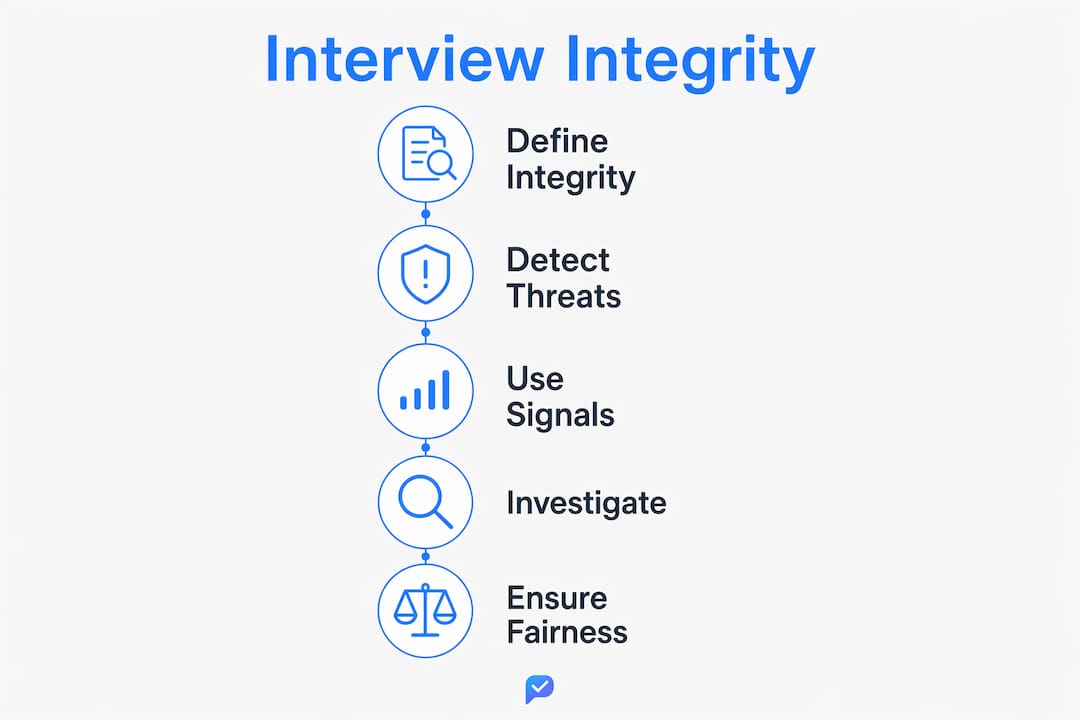
Technical interview integrity is defined as the practice of maintaining honesty, fairness, and ethical conduct throughout technical hiring assessments to produce valid, unbiased evaluations of candidate skill. The industry term most closely aligned with this practice is assessment validity, though "interview integrity" has become the working standard across HR and talent acquisition teams. For hiring managers overseeing remote or AI-assisted screening, this concept is no longer abstract. It directly determines whether the person you hire can actually do the job, or whether they simply got good at gaming your process.
What is technical interview integrity and why does it matter?
Technical interview integrity is the foundation of any reliable hiring process. Without it, your assessments measure a candidate's ability to cheat, not their ability to perform. The consequences reach further than a single bad hire. When integrity breaks down, high-performing honest candidates lose opportunities to less qualified candidates who used unauthorized aids, which distorts your talent pipeline over time.

The importance of interview integrity extends to legal and reputational risk as well. Hiring decisions based on compromised assessments expose organizations to claims of unfair process, particularly when candidates from underrepresented groups are disproportionately affected by inconsistent standards. Maintaining technical interview standards is not only an ethical obligation. It is a structural requirement for building teams that perform as expected after onboarding.
Integrity in interviews also signals organizational values to candidates. A process that is transparent, consistent, and secure tells applicants that your company takes fairness seriously. That perception shapes employer brand in ways that affect future talent attraction.
What are common threats to integrity in technical interviews?
Common misconduct in technical interviews includes switching browser tabs to access external resources, copying and pasting code from outside the assessment environment, resizing windows to obscure monitoring tools, and using multiple monitors to display unauthorized reference material. These behaviors are widespread in remote settings, where physical oversight is absent and candidates operate from their own devices.
The threat landscape has grown more complex with the rise of AI coding assistants. A candidate can now receive near-complete solutions from tools like ChatGPT or GitHub Copilot in seconds, without any visible tab switch. Eye movement that drifts repeatedly to a second screen, or attention patterns that suggest reading rather than thinking, can indicate AI-assisted responses. These signals are subtle and easy to miss without purpose-built detection.
Beyond individual cheating, structural threats also compromise integrity. Inconsistent question sets across candidates, interviewers who unconsciously favor certain backgrounds, and poorly calibrated scoring rubrics all introduce bias that undermines fair evaluation. Technical interview ethics requires addressing both deliberate misconduct and systemic process failures.
Pro Tip: Record a baseline of what natural problem-solving looks like on your platform before flagging anomalies. Candidates who pause, backtrack, and revise code are typically working independently. Suspiciously linear, error-free submissions warrant closer review.
How do Interview Integrity Signals and technology detect misconduct?
Technology has moved from passive logging to active, real-time detection. HackerRank's Interview Integrity Signals represent one structured approach: rather than generating a separate alert for every suspicious action, the system groups multiple behaviors, such as copy-paste events, window resizing, and tab switching, into consolidated notifications. This clustering approach reduces noise and allows interviewers to assess a pattern of behavior rather than reacting to isolated events.
The logic behind clustering is sound. A single tab switch during a 90-minute assessment may mean nothing. Five tab switches combined with copy-paste activity and window manipulation tells a different story. Grouping these signals into meaningful alerts keeps interviewers focused on evaluation rather than distracted by a constant stream of minor flags.
The table below summarizes the key signal types and what each suggests:
| Signal type | What it may indicate |
|---|---|
| Tab switching | Accessing external resources or AI tools |
| Copy-paste activity | Importing code from outside the environment |
| Window resizing | Attempting to hide monitoring overlays |
| Multiple monitor use | Displaying unauthorized reference material |
| Irregular eye movement | Reading from an off-screen AI assistant |
Evy takes this further with real-time eye tracking, which detects attention patterns that suggest a candidate is reading from an external source rather than thinking through a problem independently. Eye movement during genuine problem-solving looks different from eye movement during reading. That distinction is measurable, and it catches AI-assisted cheating that tab-switch detection alone cannot surface.
When suspicion arises, the recommended verification step is screen sharing. Asking a candidate to share their screen mid-assessment confirms or dismisses concerns without requiring an accusation. This approach protects both the candidate's dignity and the organization's legal standing.
Pro Tip: Do not rely on a single signal to disqualify a candidate. Use clustering data as a prompt to investigate further, not as a verdict. Combine technology flags with a follow-up technical conversation to verify genuine understanding.
What are best practices HR can implement to ensure technical interview ethics?
Maintaining integrity during interviews requires both policy and process. Technology alone does not solve the problem if the surrounding structure is inconsistent or unclear. The following practices give hiring teams a practical framework for upholding technical interview standards.
- Set explicit expectations before the assessment begins. Send candidates a written statement of what is and is not permitted. Specify whether documentation, IDE tools, or internet access are allowed. Ambiguity creates gray areas that candidates exploit and that HR cannot fairly penalize.
- Use behavioral and ethical scenario questions alongside technical tasks. Integrity interview questions evaluate honesty, accountability, and moral decision-making through past behavior and hypothetical scenarios. Asking a candidate to describe a time they caught an error in their own work, or how they would handle discovering a colleague's misconduct, reveals character that a coding challenge cannot.
- Train interviewers on both bias and misconduct recognition. Interviewers who understand how confirmation bias and affinity bias affect scoring are better equipped to evaluate candidates fairly. Employers who prioritize accountability and ethical conduct as hiring criteria produce more consistent, defensible decisions.
- Deploy anti-cheat technology appropriate to the assessment format. For asynchronous technical screens, platforms with eye tracking, tab monitoring, and alert clustering provide the strongest coverage. For live coding interviews, screen sharing and verbal explanation requirements add a layer of verification that automated tools cannot replicate.
- Standardize scoring rubrics across all candidates for the same role. Inconsistent evaluation criteria are as damaging to integrity as candidate cheating. Every candidate should be assessed against the same defined competencies, with scores documented before the debrief conversation.
- Review flagged assessments with a second evaluator. A single interviewer reviewing suspicious activity introduces subjectivity. A second reviewer who examines the same signals independently reduces the risk of false positives and protects the organization from bias claims.
How does interview integrity improve hiring outcomes and candidate experience?
Maintaining interview integrity reduces both false positives and false negatives in candidate evaluation. A false positive occurs when a dishonest candidate passes and is hired into a role they cannot perform. A false negative occurs when an honest, qualified candidate is rejected because the process was inconsistent or biased. Both outcomes are costly, and both are preventable with the right standards in place.
The benefits of a high-integrity process extend beyond accuracy:
- Stronger hiring decisions. Candidates who pass a rigorous, fair assessment are more likely to perform as evaluated. The interview platform you choose directly affects whether your process can detect and prevent misconduct at scale.
- Improved employer brand. Candidates who experience a transparent, well-structured process report higher trust in the organization, regardless of outcome. That trust translates into positive referrals and a stronger talent pipeline.
- Reduced post-hire attrition. When technical assessments accurately reflect job requirements and are conducted fairly, the candidates who advance are genuinely prepared for the role. Mismatched hires driven by compromised assessments are a leading cause of early attrition.
- Legal defensibility. Documented, consistent processes with clear integrity standards provide a paper trail that protects organizations in the event of a hiring dispute.
The candidate experience dimension is often underweighted in integrity discussions. Candidates who feel they were assessed fairly, even when they do not receive an offer, are more likely to reapply, refer others, and speak positively about the company. That outcome is worth protecting.
Key takeaways
Technical interview integrity requires consistent standards, purpose-built detection technology, and structured human judgment working together to produce valid, fair hiring decisions.
| Point | Details |
|---|---|
| Define integrity clearly | Technical interview integrity means fair, honest, and consistent evaluation of candidate skill without unauthorized aids. |
| Cluster signals, not single events | Alert clustering, as used in HackerRank's Integrity Signals, reduces noise and surfaces meaningful patterns of misconduct. |
| Behavioral questions add depth | Integrity interview questions assess honesty and accountability in ways that technical tasks alone cannot measure. |
| Technology and process must align | Anti-cheat tools only work when supported by clear candidate expectations, trained interviewers, and standardized rubrics. |
| Integrity benefits everyone | Fair processes reduce false positives, improve employer brand, and produce hires who perform as assessed. |
Why the integrity conversation needs to go deeper than cheat detection
I have spent years watching hiring teams treat interview integrity as a purely technical problem. Deploy the right monitoring tool, flag the right behaviors, and the problem is solved. That framing is too narrow, and it creates a false sense of security.
The harder truth is that traditional technical interviews provide limited signal even when no cheating occurs. A 45-minute coding challenge under artificial pressure does not replicate the conditions of actual work. The best engineers I know perform poorly in high-stakes, time-boxed formats. The candidates who excel at them are often optimizing for the format rather than demonstrating genuine capability.
Steve Yegge's argument that longer, real-work evaluations generate stronger hiring signals than short interview loops is one I find compelling. When candidates complete a meaningful task over days rather than minutes, the output is harder to fake and more predictive of actual job performance. The integrity problem partially solves itself when the format is harder to game.
That said, most organizations cannot run extended work trials for every candidate at scale. So the practical answer is a layered one: use technology to detect misconduct in screening rounds, use behavioral questions to assess character, and reserve your highest-signal evaluation for the final stages. The goal is not a perfect process. It is a process that is fair, defensible, and accurate enough to make good decisions consistently.
— Hudson
How Evy helps you protect the integrity of every interview
Evy is built for hiring teams that cannot afford to guess whether a candidate's performance was genuine. As the only AI interview platform with real-time eye tracking, Evy detects the attention patterns that indicate AI-assisted cheating, including the subtle gaze shifts that tab-switch monitoring misses entirely.
Evy screens at scale, 24/7, so your team reviews only the candidates worth your time. Suspicious activity is clustered into clear, reviewable alerts rather than a flood of individual flags, keeping your interviewers focused on evaluation rather than investigation. If you are serious about combating cheating in technical interviews, explore the full range of Evy's anti-cheat features and see how real-time monitoring changes what fair hiring looks like in practice.
FAQ
What is technical interview integrity?
Technical interview integrity is the practice of conducting candidate assessments in a way that is honest, fair, and free from unauthorized assistance, so that results accurately reflect a candidate's actual skill level.
What behaviors threaten integrity in technical interviews?
Common threats include tab switching to access external resources, copy-pasting code from outside the assessment environment, using AI tools like ChatGPT, and manipulating window views to obscure monitoring software.
How do Interview Integrity Signals work?
Interview Integrity Signals group multiple suspicious behaviors into consolidated alerts, reducing interviewer distraction and allowing a clearer view of whether a pattern of misconduct occurred.
What questions assess integrity in a technical interview?
Behavioral integrity questions ask candidates about past ethical decisions, accountability in past roles, and how they would handle hypothetical misconduct scenarios. These questions reveal honesty and character that coding tasks cannot measure.
How does interview integrity affect hiring quality?
A fair, consistent process reduces false positives and false negatives, meaning fewer unqualified hires and fewer missed opportunities with strong candidates. It also strengthens employer brand and reduces early attrition from mismatched hires.