
 By Adrian Pascual•Hiring insight•Published
How to Spot Dishonest Interview Responses in 2026
Hiring the wrong person costs far more than a missed opportunity. When you cannot spot dishonest interview responses, you risk onboarding candidates who misrepresented their skills, experience, or reasoning ability. And the problem is growing. AI-assisted cheating nearly doubled, rising from around 28% to 55–60% based on analysis of 20,000 interview records. This guide gives HR professionals a structured, evidence-based approach to identifying misleading responses, whether they come from a rehearsed candidate or one reading from an AI tool in real time.
Table of Contents
- Key Takeaways
- Spotting dishonest interview responses before they slip through
- Execution: techniques for detecting false answers live
- Post-interview verification methods
- Designing interviews that reduce dishonesty from the start
- My take: why single cues keep failing us
- How Evy helps your team screen with confidence
- FAQ
Key Takeaways
| Point | Details |
|---|---|
| Structured frameworks matter | Design interviews around behavioral and scenario-based questions before you can reliably evaluate honesty. |
| Forensic questioning works | Use layered "why" and "how" follow-ups to expose AI-generated or scripted answers that lack genuine depth. |
| Verification is non-negotiable | Employment and reference checks confirm what the interview cannot, especially for timeline and role inconsistencies. |
| Multi-signal detection is more accurate | Clustering behavioral, linguistic, and timing cues produces far better results than relying on a single red flag. |
| Process design reduces dishonesty | Multi-stage, cross-functional interviews make it significantly harder for candidates to maintain a fabricated narrative. |
Spotting dishonest interview responses before they slip through
Before you can reliably detect deception in real time, you need a structured foundation. Unstructured interviews create too much noise. When every interviewer asks different questions in different sequences, comparing candidate responses becomes unreliable and inconsistent gaps in an answer go unnoticed.
The first step is adopting an evidence-based interview framework. This means using predetermined behavioral questions tied to the specific competencies the role requires. Structured formats give you a consistent baseline to compare across candidates, making deviations in response quality, depth, or tone much more visible.
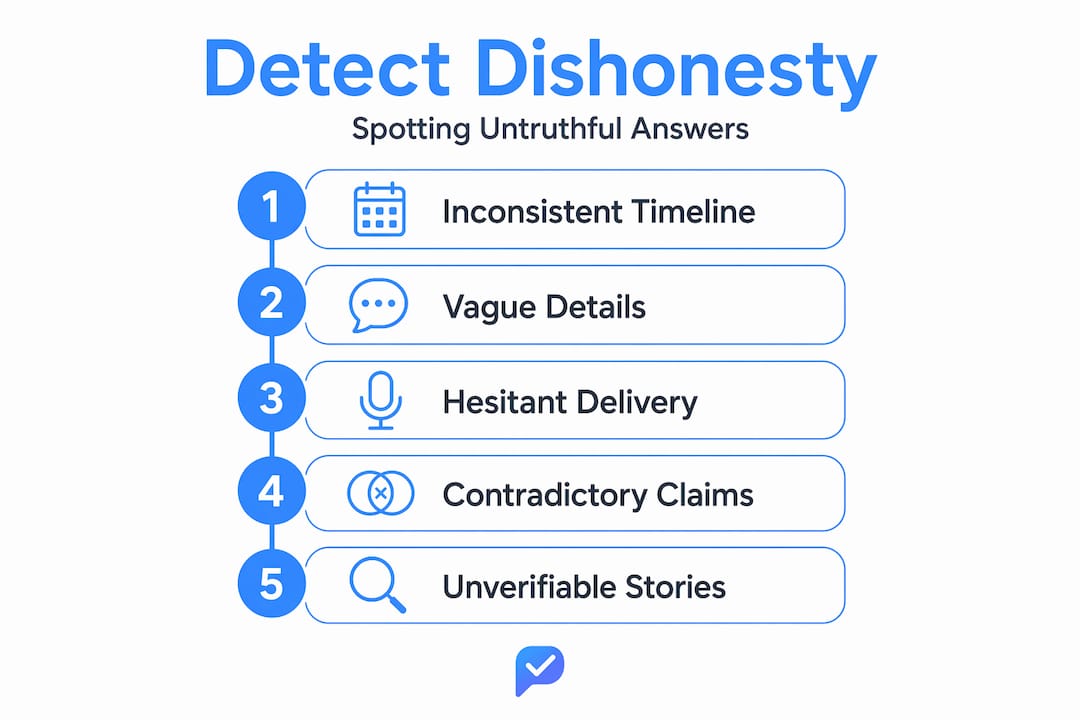
Beyond structure, your team needs foundational knowledge of how dishonesty typically presents itself. Inconsistencies across interviews, timeline irregularities, and vague or overly generalized detail are among the most reliable early indicators. These are not signs you notice casually. They require intentional attention during the interview and careful review of notes afterward.
You should also plan your verification workstream in advance. Reference checks, employment verification, and AI monitoring tools should be selected and ready before the interview stage begins, not scrambled for after a suspicious session. The table below outlines common indicators and the preparation each one requires.
| Indicator | What it signals | Preparation needed |
|---|---|---|
| Timeline inconsistencies | Fabricated or inflated tenure | Employment verification on file |
| Overly polished, list-like answers | AI-generated or scripted responses | Forensic follow-up question bank |
| Long pause before flawless delivery | AI tool consultation in real time | Behavioral monitoring or eye tracking |
| Vague claims about responsibilities | Role inflation or exaggeration | Structured reference checks |
| Inability to name alternatives | Lack of genuine subject knowledge | Specificity probes prepared in advance |
Pro Tip: Build a short "probe question" library before each interview round. Tailor two or three follow-up questions for each major competency area so your interviewers have something ready the moment an answer sounds too clean.
Execution: techniques for detecting false answers live
This is where preparation pays off. Once the interview begins, your primary tool is forensic questioning: a method that uses layered "why" and "how" follow-ups to force candidates to explain the reasoning behind their answers, not just restate them.
Here is why this matters. A candidate coached by an AI tool will often produce a polished, structured summary. It sounds credible on the surface. But when you ask them to walk through the specific trade-offs they considered, or to name alternatives they rejected and why, the answer frequently falls apart. Candidates relying on AI tools often struggle to name alternatives or explain trade-offs when probed directly, which exposes the absence of real understanding.
The sequencing of forensic questions matters. Start with an open-ended behavioral question. Then probe the reasoning. Then ask for a counterexample. Then request specifics about the outcome. Each layer requires genuine recall and reflection, which AI-assisted or rehearsed responses simply cannot sustain.
"The gap between a polished summary and a credible underlying rationale is where dishonesty lives. Interviewers who probe that gap consistently surface far more about a candidate than those who accept the first answer at face value."
Scenario-based and case-led discussions add another layer of exposure. Multi-stage evaluations with cross-functional interviewers help detect AI-polished answers lacking depth. When a candidate must respond to an evolving scenario in real time, any scripted preparation breaks down quickly.
For virtual interviews specifically, pay close attention to the following behavioral and verbal cues.
- Unnatural pauses before unusually structured answers, which may indicate the candidate is reading from an AI tool rather than thinking through a response.
- Eyes drifting consistently off-screen or to a fixed lower point, which can suggest the candidate is referencing an external screen or document.
- Answers that arrive in clean numbered lists without any false starts, self-correction, or conversational variation, a pattern rare in genuine human recall.
- An inability to recall the emotional or interpersonal context of a situation they claim to have experienced firsthand.
- Flat or mismatched vocal tone, where the words describe a high-pressure moment but the delivery feels rehearsed and affectively neutral.
Pro Tip: After a suspiciously polished answer, ask the candidate: "What would you have done differently if you had more time or fewer resources?" This question has no clean AI-generated default. It forces genuine reflection and consistently separates real experience from fabricated narrative.
Post-interview verification methods
Strong interview technique catches many forms of dishonesty. But it does not catch all of them, and it certainly does not confirm factual claims. That is why post-interview verification is a separate, required workstream, not an optional add-on.
Employment verification identifies resume fabrications such as inflated tenures and altered job responsibilities, typically within two to five days for domestic checks and five to ten days for international ones. These timelines are short enough to integrate into most hiring cycles without causing delays, provided you initiate them immediately after the first interview stage.
Structured reference checks serve a different purpose. They surface behavioral patterns that interviews rarely expose: how someone handles accountability, how they respond to peer feedback, or how their actual performance compared to their self-description. Reference check software streamlines this process through automated surveys, improving response rates and generating consistent, shareable reports for your hiring team.
The table below compares the most commonly used verification methods, along with their practical trade-offs.
| Method | Primary use | Strengths | Limitations |
|---|---|---|---|
| Employment verification | Confirm titles, dates, responsibilities | Fast, factual, objective | Does not capture behavioral patterns |
| Structured reference checks | Assess conduct and performance | Captures nuanced behavioral data | Dependent on referee honesty and availability |
| Background check services | Verify legal and credential claims | Covers criminal and education records | Variable turnaround; may miss soft fabrications |
| AI monitoring (interview-stage) | Flag real-time suspicious behavior | Immediate, observable signal | Requires proper platform integration |
When reviewing results, pay specific attention to timeline mismatches. A candidate who claims to have managed a team from 2021 to 2023, but whose employment record shows a different title for that period, is raising a flag that strong interview performance cannot override. Verifying employment timelines is a distinct workstream, and inconsistencies there are treated as disqualifying rather than contextual. For additional verification vendor options, reviewing ranked background check services gives your team a current picture of available tools.
Designing interviews that reduce dishonesty from the start
The most sustainable approach to identifying misleading responses is not detection alone. It is designing a process that makes sustained dishonesty structurally difficult. This requires rethinking the interview format itself.

Multi-stage, cross-functional evaluations are among the most effective structural deterrents. When a candidate speaks to four different interviewers across two rounds, maintaining a fabricated narrative across all four conversations becomes genuinely hard. Inconsistencies surface on their own.
Incorporating collaborative or real-time exercises adds a further layer. A live case discussion, a shared problem-solving session, or a brief technical exercise completed during the interview cannot be prepared for with an AI tool in the same way a behavioral question can. These formats evaluate how candidates actually think, not how well they have prepared.
Open-ended, contextual questions also change the dynamic. Rather than asking "Tell me about a time you led a project," try "Walk me through the moment you realized the project was in trouble, and what you did in the next 24 hours." The specificity of time and emotional context makes scripted responses feel hollow immediately.
Secure interview environments matter as well, particularly for remote hiring. Platforms that monitor suspicious behavior during virtual sessions give HR teams real-time signals rather than requiring post-hoc analysis. Features like eye tracking and attention pattern monitoring flag behavioral clusters that warrant follow-up, without penalizing candidates unfairly for a single ambiguous moment.
Pro Tip: Rotate the interview panel, not just the questions. When candidates know different people will be asking about the same themes from different angles, they are less likely to rehearse narrow answers and more likely to show you how they actually think.
My take: why single cues keep failing us
By Hudson
I've spent years working with HR teams who are frustrated by one persistent problem: they know something felt off in an interview, but they can't articulate why, and they can't act on a feeling. So the candidate moves forward. Sometimes that works out. Often it doesn't.
The reason it keeps happening is that most interviewers are still trying to catch dishonesty through a single observable cue. An odd pause. Averted eye contact. A suspiciously complete answer. The research is clear that single cues like eye contact are insufficient, and that clustering multiple indicators yields meaningfully better detection accuracy. But the training and the tooling most teams use haven't caught up to that finding.
What I've found actually works is a shift in framing. Stop trying to catch candidates lying and start designing for genuine reasoning to surface. When your process requires candidates to explain trade-offs, handle evolving scenarios, and respond to the same theme from multiple angles, you don't need to be a human lie detector. The process does the work. The dishonest answers simply can't keep up.
The teams I've seen do this well treat verification not as a background task but as a parallel signal. They compare what they heard in the room against what the references and employment record confirm. When those streams align, confidence goes up. When they diverge, that divergence is data. It's a more grounded, fair, and accurate way to hire.
— Hudson
How Evy helps your team screen with confidence
Detecting signs of dishonesty in interviews is significantly more reliable when your platform is built to support it. Evy is the only AI interview platform with real-time eye tracking, specifically designed to catch candidates consulting AI tools during virtual interviews. Rather than flagging individual cues in isolation, Evy monitors attention patterns and behavioral signals together, raising alerts only when multiple indicators cluster.
HR teams using Evy can screen candidates at scale, 24/7, without sacrificing the quality of evaluation. The platform integrates forensic-style questioning capabilities alongside behavioral monitoring, giving interviewers structured prompts and real-time intelligence in a single environment. If your team is ready to build a more secure, integrity-first hiring process, explore Evy's anti-cheat features to see how they fit your workflow.
FAQ
What are the most reliable signs of dishonesty in interviews?
The most reliable approach clusters multiple signals rather than relying on one. Watch for long pauses before unnaturally structured answers, inability to explain trade-offs, vague emotional recall, and inconsistencies between responses across different interviewers.
How does forensic questioning help uncover fake interview replies?
Forensic questioning uses layered follow-ups — asking for reasoning, alternatives, and specific outcomes — to expose the gap between a polished surface answer and genuine understanding. AI-generated responses typically collapse when pressed for specificity.
Can employment verification catch dishonest interview answers?
Employment verification confirms factual claims like job titles, tenure, and responsibilities, and domestic checks finish in 2–5 days. It cannot assess behavioral patterns, so it works best combined with structured reference checks.
How can HR teams reduce AI-assisted cheating in virtual interviews?
Use platforms with real-time behavioral monitoring, incorporate scenario-based exercises that require live reasoning, and design multi-stage evaluations with cross-functional interviewers. Structural complexity makes AI assistance far less effective.
Why is a multi-signal approach better than watching for single cues?
Multimodal deception detection research shows that individual behavioral cues like eye contact or pauses are unreliable on their own. Accuracy improves substantially when acoustic, visual, and lexical signals are evaluated together.