
 By Adrian Pascual•Hiring insight•Published
Why AI Answers Hurt Hiring Decisions in 2026
AI-generated interview answers are defined as candidate responses produced or heavily assisted by generative AI tools, and they are actively corrupting hiring decisions across the industry. Understanding why AI answers hurt hiring decisions starts with a hard fact: over 90% of organizations have deployed AI in talent acquisition, yet fewer than 5% report transformational outcomes. That gap exists because AI outputs frequently automate subjective human intuition rather than replace it with genuine objectivity. The result is false certainty, encoded bias, and a growing inability to identify who can actually do the job.
Why AI answers hurt hiring decisions at the assessment level
AI tools struggle most where hiring matters most: soft skills and cultural fit. 72% of recruiters report that AI cannot reliably assess cultural fit, and 55% say it performs poorly when evaluating interpersonal skills. Those are not minor gaps. Cultural fit and communication ability are among the top predictors of long-term employee success, and AI screening consistently misses them.

Generative AI compounds the problem by enabling candidates to produce polished, generic answers at scale. A candidate who uses a large language model to craft interview responses can sound articulate, structured, and confident without demonstrating any genuine understanding of the role. The answer passes automated scoring. The person behind it may not be capable of the work. You can read more about why candidates use AI during interviews to understand the scale of this behavior in 2026.
The candidate experience also suffers. 40% of candidates have abandoned or seriously considered abandoning job applications because of AI screening processes. That figure represents real talent walking away. When your screening process feels impersonal or unfair, the candidates most likely to leave are often the ones with options, meaning the strongest ones.
- AI scoring models reward format and vocabulary, not substance or original thinking.
- Candidates with non-traditional communication styles are penalized even when their skills are strong.
- Generic AI-generated answers are nearly indistinguishable from authentic ones without behavioral signals.
- High-volume screening creates the illusion of thoroughness while missing individual nuance.
Pro Tip: Ask one follow-up question that requires a candidate to reference a specific past experience by name, date, or outcome. AI-generated answers rarely survive that level of specificity.
Is AI just automating bias rather than removing it?
The most dangerous misconception in AI-assisted hiring is that algorithmic outputs are neutral. They are not. As Siddhant Patil describes, AI automates impressions rather than providing objective measurement, creating what researchers call "laundered intuition." The term is precise: AI takes the subjective judgments embedded in historical hiring data and repackages them as scores that look objective and are much harder to challenge.
When an AI model is trained on years of past hiring decisions, it learns which candidates were hired and which were not. If those historical decisions reflected bias, the model encodes that bias. It does not correct for it. The output looks like a number. The number feels authoritative. But it is, at its core, a faster version of the same flawed human judgment that created the training data.
Shraddha Sunil and Mudit Saraf note that AI outputs are often unaccountable, confident without grounds, and lacking the human nuance that good hiring requires. That confidence is the real risk. A hiring manager who sees a high AI score is less likely to probe further. The score creates closure where there should be inquiry.
The distinction between "hiring inputs" and "hiring answers" is critical here:
- A hiring input is a data point that informs judgment. It requires interpretation, context, and human review.
- A hiring answer is a final decision. It carries accountability and must be defensible.
- Treating AI output as a final answer rather than an input is a documented source of bad hires, legal exposure, and litigation.
- No AI system currently on the market can carry the accountability that a hiring decision requires.
"AI is confident without grounds and unaccountable, lacking necessary human nuance." — Shraddha Sunil and Mudit Saraf, Harvard Business Review, 2026
The legal dimension is growing. Emerging regulations in several U.S. states now require employers to document and audit AI hiring tools for bias. Treating an AI score as a final answer without that documentation creates real liability.
How AI-generated answers damage candidate experience and hire quality
The impact of AI on hiring quality shows up in two places: the candidates you lose and the ones you mistakenly advance. Both outcomes damage your organization.
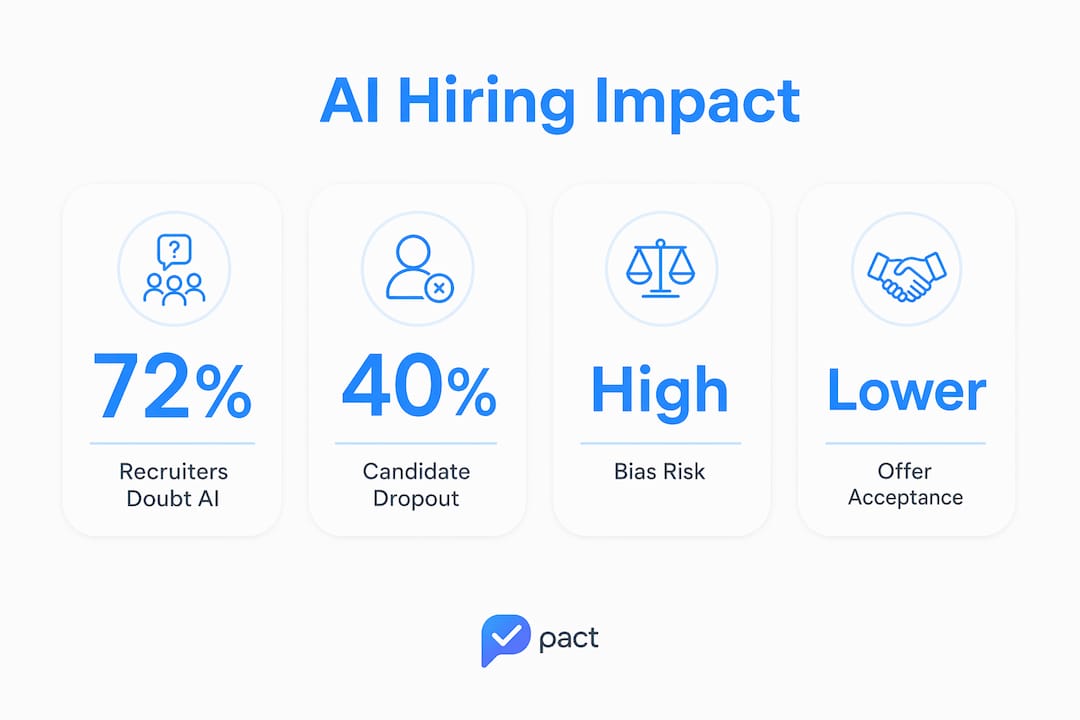
Candidates with high potential but non-traditional backgrounds are the most vulnerable. NLP models fail to capture subtle communication nuances, which means candidates with disabilities, non-native English speakers, or people from underrepresented groups are often scored negatively despite genuine capability. Human oversight is needed to catch what the model misses. Without it, you are not screening for talent. You are screening for conformity to a pattern the model already knows.
On the other side, candidates who use generative AI to craft their answers can game automated screening with ease. A well-prompted large language model produces structured, keyword-rich responses that score well. The candidate advances. The hiring manager meets someone whose live performance does not match their screened profile. That mismatch is a direct cost: wasted interview time, delayed hiring cycles, and a higher risk of a bad hire. The risks of AI candidate screening extend well beyond the screening stage itself.
Employer brand takes a hit too. Candidates talk. A process that feels automated, cold, or unfair spreads quickly on review platforms. Outsourcing entire screening to AI risks losing top talent and reduces overall hire quality, according to Lee Biggins. The efficiency gains from full automation are real, but they come at a measurable cost to the quality and diversity of your final candidate pool.
Pro Tip: Track your offer acceptance rate and first-year retention separately for candidates screened by AI versus those who went through a human-reviewed process. The difference usually tells you more than any vendor benchmark.
Best practices for using AI as a tool, not a decision-maker
The solution is not to abandon AI in hiring. AI handles volume, consistency, and speed in ways that human teams cannot match alone. The solution is to treat AI outputs as inputs, not answers, and to build human oversight into every stage where a decision is made.
- Use AI to flag candidates for human review, not to approve or reject them automatically.
- Require structured human evaluation of every candidate who reaches the interview stage, regardless of AI score.
- Audit your AI tools at least annually for demographic parity and equal opportunity metrics. Human-in-the-loop oversight combined with sociotechnical frameworks can improve demographic parity by 32.4% and equal opportunity metrics by 28.7%.
- Document every AI-assisted decision with a clear record of which human reviewed the output and what judgment they applied.
- Train hiring managers to treat AI scores as one signal among many, not as a conclusion.
Transparency with candidates also matters. Telling applicants that AI is used in screening, and explaining how, builds trust and reduces the perception of unfairness. It also positions your organization well as AI-specific hiring regulations continue to expand.
The disciplined use of AI tools in any high-stakes process requires explicit guardrails against automating historical bias. Hiring is no different. The organizations seeing real results from AI in talent acquisition are the ones using it to support human judgment, not replace it.
Key takeaways
AI-generated answers hurt hiring decisions because they create false certainty, encode historical bias, and prevent accurate assessment of the soft skills and genuine capability that predict job success.
| Point | Details |
|---|---|
| AI outputs are inputs, not answers | Treat every AI score as a starting point for human review, never as a final hiring decision. |
| Soft skills remain a blind spot | 55% of recruiters find AI ineffective at assessing interpersonal skills, the traits most tied to long-term performance. |
| Laundered intuition is real | AI trained on biased historical data repackages that bias as objective-looking scores that are harder to challenge. |
| Candidate quality and experience both suffer | AI screening drives away strong candidates and advances those who game the system with AI-generated answers. |
| Human oversight improves fairness measurably | Structured human-in-the-loop review can improve demographic parity by over 30% compared to fully automated screening. |
The uncomfortable truth about trusting AI scores in hiring
I have watched hiring managers receive an AI assessment score and visibly relax. The number arrives, it looks authoritative, and the conversation shifts from "what do we actually know about this person?" to "what do we do next?" That shift is the problem.
The score did not come from nowhere. It came from a model trained on past decisions made by humans who had their own blind spots, preferences, and biases. The AI did not audit those decisions. It learned from them. When you trust the score without questioning what produced it, you are not being objective. You are outsourcing your bias to a system that cannot be held accountable for it.
The hiring managers I respect most use AI the way a good analyst uses a spreadsheet. It organizes information and surfaces patterns. It does not make the call. They still read the transcript. They still notice when a candidate's written answers feel too polished compared to how they speak live. They still ask the follow-up question that no AI prepared the candidate for.
Ethical responsibility in AI hiring is not a compliance checkbox. It is a professional obligation. The people you screen are real. The decisions you make affect their careers. A tool that gives you false certainty about those decisions is not making you a better hiring manager. It is making you a less careful one.
— Hudson
How Evy addresses the risks of AI-generated interview answers
Hiring teams need a way to screen at scale without losing the signal that matters: whether the person answering is actually thinking for themselves.
Evy is the only AI interview platform with real-time eye tracking built specifically to detect when candidates are reading AI-generated answers during a live interview. While other platforms score what candidates say, Evy monitors attention patterns and eye movement to surface behavioral signals that reveal whether the response is authentic. That means your anti-cheat interview features do not just flag suspicious answers. They give you the behavioral context to make a more informed human judgment. Evy screens at scale, runs 24/7, and helps your team surface honest, qualified talent without sacrificing fairness or speed.
FAQ
Why do AI-generated answers make hiring decisions less reliable?
AI-generated answers mimic the structure and vocabulary of strong responses without reflecting genuine candidate capability. Automated scoring rewards format over substance, which means the most polished answer wins regardless of whether the person behind it can do the job.
What is "laundered intuition" in AI hiring?
Laundered intuition describes how AI models trained on historical hiring data encode the same biases as past human decisions, then present those biases as objective scores. The output looks neutral but reflects the same flawed judgments that produced the training data.
How does AI screening affect candidate experience?
40% of candidates have abandoned or considered abandoning applications because of AI screening processes. The candidates most likely to leave are often the strongest ones, since they have other options and are less willing to tolerate impersonal processes.
Can human oversight actually reduce AI bias in hiring?
Research shows that human-in-the-loop oversight combined with structured sociotechnical frameworks can improve demographic parity by 32.4% and equal opportunity metrics by 28.7% compared to fully automated AI screening.
What is the difference between a hiring input and a hiring answer?
A hiring input is a data point that informs human judgment and requires interpretation. A hiring answer is a final, accountable decision. Treating AI output as a hiring answer rather than an input is a documented cause of bad hires and legal risk.