
 By Adrian Pascual•Hiring insight•Published
What Is Interview Script Consistency in Hiring?
Interview script consistency means asking every candidate the same job-relevant questions and evaluating their answers against an identical scoring rubric, so that candidate performance is the only variable being measured. It is the structured practice that separates defensible hiring from gut-feel decisions. When applied correctly, it controls for interviewer mood, communication style, and unconscious bias, leaving a clear, comparable record for every candidate who walks through your process.
The core components work together:
- A predetermined set of job-related questions asked in the same sequence to every candidate
- A standardized scoring rubric with defined criteria for weak, solid, and strong answers
- Consistent opening and closing procedures so every candidate receives the same information
- Documented evidence captured during the interview to support each score
Interview script consistency is not about reading lines robotically. Think of the script as scaffolding: it holds the structure in place while skilled interviewers listen deeply, ask targeted follow-ups, and gather real evidence about each candidate's capabilities.
Why does interview script consistency matter for fair hiring?
Fairness in hiring is not just an ethical goal. It is a legal and operational requirement. When every candidate answers the same questions and gets scored on the same criteria, you remove the interviewer as a confounding variable. The signal you read is the candidate's ability, not whether the interviewer had a good morning or felt an instant rapport.

Structured interviews create documented evidence that supports hiring decisions and makes them defensible to stakeholders, reducing reliance on subjective impressions. That defensibility matters when a rejected candidate asks why they were not selected, or when a hiring decision is challenged internally. You can point to evidence rather than a feeling.

Consistency also builds candidate trust. When applicants know the process is standardized, they experience the evaluation as fair, regardless of outcome. That perception affects your employer brand, particularly in competitive talent markets where candidates compare experiences openly.
Key reasons script consistency protects your organization:
- Removes subjective interviewer influences that skew comparisons between candidates
- Enables objective evaluation by controlling the questions and scoring criteria
- Supports legal and ethical hiring standards requiring equal treatment of all applicants
- Provides a documented record to justify hiring decisions to leadership or legal review
- Reduces the likelihood of discrimination claims rooted in inconsistent treatment
What goes wrong without script consistency?
The most common failure is not deliberate. Interviewers drift. A second interviewer skips questions because the conversation flowed differently. A third improvises because the candidate seemed impressive. By the debrief, five people have assessed five different things and scored on five private scales. Inconsistent interviewing, including skipping questions or varying scoring criteria, leads to unreliable hiring decisions and increases the risk of discrimination claims.
Uncalibrated rubrics compound the problem. If two interviewers define "strong leadership" differently, their scores are not comparable, even when they use the same numerical scale. The scorecard looks structured, but the underlying judgments are not.
Other pitfalls that surface without script discipline:
- Interviewers deviating from the approved question set, creating unequal candidate experiences
- Scoring filled in from memory hours or days after the interview, losing accuracy
- Incomplete data because critical competency areas were never assessed
- Debrief discussions dominated by the most confident voice rather than the strongest evidence
- Legal exposure when candidates from different demographic groups receive meaningfully different interview experiences
Best practices for building and maintaining a consistent interview script
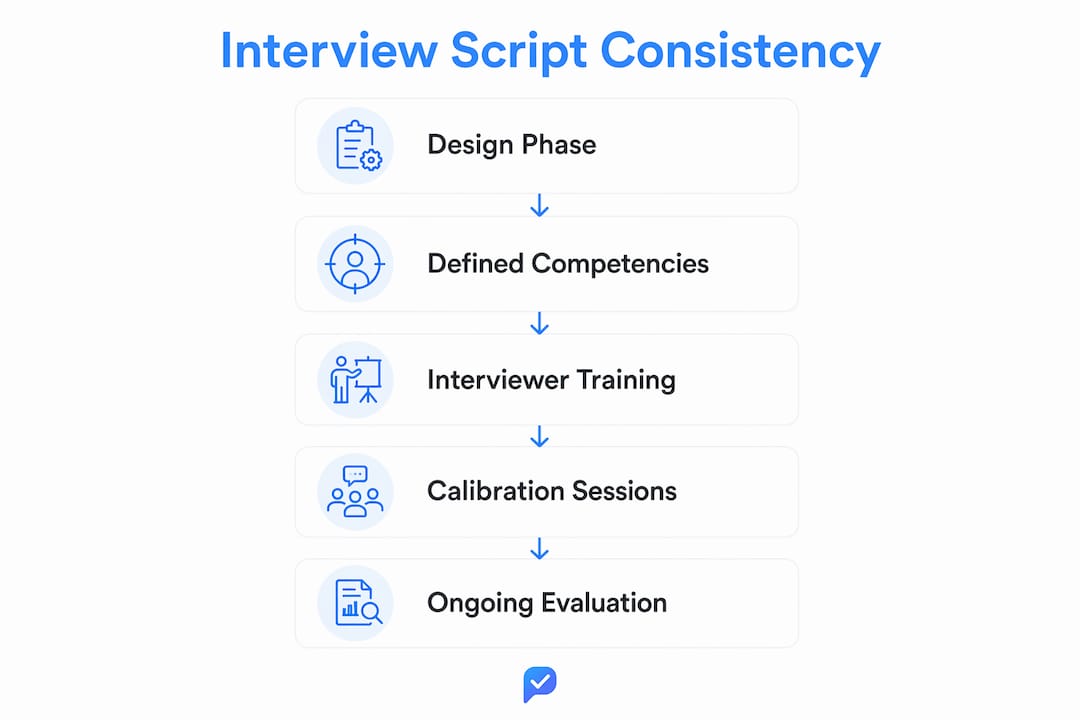
The design phase determines whether consistency is achievable at all. Start by defining the four or five competencies that most predict success in the role, then write two or three behavioral questions for each. Behavioral questions ask for real past examples, which are harder to rehearse and more diagnostic than hypothetical scenarios.
Pro Tip: Before anyone interviews, agree in writing on what a weak, solid, and strong answer looks like for each competency. Teams that skip this step end up with scores that reflect individual standards rather than a shared bar.
Practical steps for building a script that holds up in practice:
- Define job competencies first, then write questions that directly assess each one
- Pre-agree on scoring rubrics with concrete examples of answer quality at each level
- Assign each panel member one or two competencies to own, so coverage is focused rather than redundant
- Train interviewers on script adherence and rubric calibration before the first interview runs
- Capture interview data in real time so the record reflects what was actually asked, not what the interviewer remembers asking
- Review scripts periodically against hiring outcomes and interviewer feedback to catch drift early
One underappreciated benefit: scripts reduce mental load on interviewers, freeing them to listen more carefully and ask sharper follow-ups. The structure handles the logistics; the interviewer handles the judgment. For teams building out their question bank, reviewing types of interview questions for specific roles can sharpen the initial design.
How to evaluate candidates consistently using scripts and rubrics
A rubric is only useful if every interviewer applies it the same way. True scoring consistency is achieved when different interviewers give the same score to an identical candidate response, removing personal subjectivity from the equation. That standard requires calibration, not just a shared document.
Techniques for reliable, comparable evaluation:
- Score against the rubric immediately during or right after the interview, before the debrief
- Focus on the candidate's specific actions and reasoning, not the team's results or a polished narrative
- Document the exact evidence supporting each score, not just the number
- Run calibration sessions where interviewers score the same sample answer independently, then compare and discuss
- Structure debriefs around evidence ("the candidate described X, which maps to level 3 on the rubric") rather than impressions ("she seemed really sharp")
Calibration sessions are particularly valuable for new interviewers. When a junior interviewer and a senior interviewer independently reach the same score on a sample answer, you have inter-rater reliability. Without it, a "strong yes" from one person and a "strong yes" from another are two different opinions dressed as the same signal. Teams looking to go deeper on this can explore approaches to reduce interviewer subjectivity as a complement to script design.
How AI tools strengthen interview script consistency
The hardest part of structured interviewing is not designing the script. It is proving the script ran. A planning document shows intent; it cannot show execution. That gap is where AI-powered tools provide real operational value.
AI platforms can capture the full interview conversation as it happens, creating a verbatim record of every question asked and every answer given. That record supports auditing: you can verify which competencies were assessed, whether interviewers followed the approved question set, and where coverage fell short. Evy's AI interview platform adds real-time eye tracking to this layer, detecting attention patterns that may indicate a candidate is reading from an external source rather than responding authentically. That combination of script adherence monitoring and integrity detection addresses two distinct risks in a single process.
AI capabilities that directly support script consistency:
- Real-time transcription capturing the exact questions asked in each interview
- Automated alerts when interviewers deviate from the approved script
- Analytics on scoring patterns across interviewers, surfacing calibration gaps
- Recorded interview data that enables coaching and training grounded in real examples
- A detailed, unbiased interview record that strengthens defensibility in hiring decisions
For HR teams managing agentic workflows across large candidate pipelines, AI tools shift consistency from a matter of trust to something measurable and auditable. The script is no longer a planning artifact. It becomes a live standard with a verifiable record of adherence.
Evy's platform is built for exactly this challenge: screening at scale, 24/7, while surfacing candidates whose responses reflect genuine ability rather than coached performance or AI-assisted answers. Explore Evy's anti-cheat features to see how real-time eye tracking and transcript analysis work together to protect the integrity of your interview process.
Key Takeaways
Interview script consistency is the single most reliable way to make candidate evaluations comparable, defensible, and fair across every interviewer and every hiring round.
| Point | Details |
|---|---|
| Core definition | Asking every candidate the same job-relevant questions and scoring responses against an identical rubric. |
| Fairness and legal defense | Consistent scripts create documented evidence that supports hiring decisions and reduces discrimination risk. |
| Calibration is critical | True consistency requires interviewers to score identical answers identically, achieved through regular calibration sessions. |
| Scripts reduce interviewer load | Standardized scripts free interviewers to listen deeply and ask sharper follow-ups rather than managing logistics. |
| AI closes the execution gap | AI tools capture verbatim interview records, monitor script adherence, and surface scoring patterns that manual review misses. |